


Hybrid drivetrains – in luxury vehicles – are less about fuel efficiency than they are about more power and better performance. The new Lexus LX700h – the hybridized version of the LX ultra-luxury SUV – is a case in point.
The optional hybrid drivetrain doesn’t appreciably increase the MPGs – but it very much increases the HP (horsepower) and torque.
What It is
The LX is – basically – an ultra-luxury iteration of the Toyota Sequoia. Both are full-size/three-row SUVs built on the same underlying platform and share similar mechanicals, including their standard 3.4 liter twin-turbo V6 engines. One of the big differences is that the Sequoia comes standard with basically the same hybrid drivetrain that’s optional with LX.
This is surprising, given that the Sequoia is much less expensive – $62,425 to start – than the non-hybrid LX600 Premium, which stickers for $107,450 to start.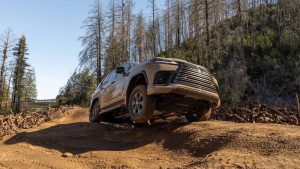
The $114,500 to start LX700h Overtrail comes equipped with the hybrid-augmented version of the 3.4 liter V6 that’s standard in the Sequoia.
That’s nearly twice as much as the base-trim (but hybrid-equipped) Sequoia costs. Being a Lexus rather than a Toyota, the LX700h’s hybrid drivetrain does tout more power (457 vs. 437 horsepower) and it does come standard with some other things, including a 25 speaker Mark Levinson ultra-premium audio system, massaging front seats, ventilated second-row seats, 22 inch wheels, ultra-premium leather seat covers and trim as well as a 2,400 watt inverter you can use to power high-draw accessories.
Every LX also comes standard with a beverage cooler built into the center console, an adaptive suspension and an electrically locking center differential. Also, all LXs come standard with 4WD; it’s optional with the base-trim Sequoia, which comes standard with rear-wheel-drive.
The Overtrail also has 33-inch all-terrain tires on 18 inch wheels, front and rear locking differentials, skid plates, all-weather rubber floor mats and unique-to-this-trim exterior and interior styling differences.
If you prefer crisper on-road handling, there’s the $117,000 700h F Sport, which has 22 inch wheel with low-aspect-ratio (short sidewall) tires for sharper steering feel, sport suspension tuning, sport buckets up front, along with aluminum-trimmed pedals and an “aero” body kit unique to this trim.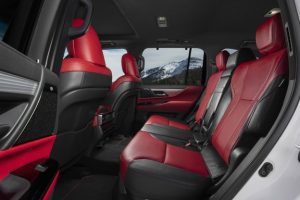
A top-of-the-line LX700h Ultra Luxury – $140,500 – nixes the third row in favor of a much more expansive and luxurious two-seater passenger area, with a pair of luxury captain’s chairs for the backseat occupants that can be reclined and that come standard with massagers, along with a twin 11.4 inch display entertainment system and rear center table.
What’s New For 2025
Both the optional hybrid-augmented drivetrain and the Overtrail trim are new for 2025.
What’s Good
Superlatively luxurious – even the “base” LX600.
Available with luxuries that aren’t offered with the Sequoia.
Hybrid augmentation bumps up the power without cratering the MPGs.
What’s Not So Good
Hybrid augmented drivetrain that’s an expensive extra in the Lexus comes standard in the Toyota.
Standard (non-hybrid) drivetrain in the Lexus isn’t as powerful as the hybrid-augmented drivetrain that’s standard in the much-less-expensive Toyota.
Toyota (and so, Lexus) have had some early teething troubles with the 3.4 V6 engine.
Under The Hood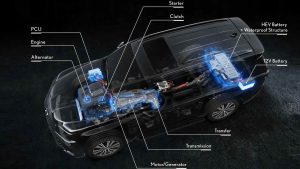
The 600 versions of the LX come standard with a twin-turbo 3.4 liter V6 that touts 409 horsepower and 479 ft.-lbs. of torque. This relatively small (relative to the size and weight of this full-size SUV) makes more power than the much larger 5.7 liter V8 that was standard in the LX through the 2021 model year. The old V8 touted 383 horsepower and 403 ft.-lbs, of torque – as well as 12 MPG in city driving and 16 on the highway. The current 3.4 V6 engine brings that up to 17 city, 22 highway. It’s not a huge uptick and probably not especially relevant to the majority of the people considering a vehicle such as this, for whom gas mileage usually comes way distant to power/capability and performance.
But it does matter greatly to Toyota (and so, Lexus) because every vehicle manufacturer must address the compliance issue – i.e., how to satisfy federal requirements pertaining to fuel efficiency and “emissions” (of carbon dioxide, which are a function of the burning of gas) and the way they’ve figured out how to do that is by replacing bigger engines with smaller ones; the turbos are added to make up for the downsizing of what’s under the hood.
Adding hybrid augmentation is a way to increase power even more – without incurring compliance costs.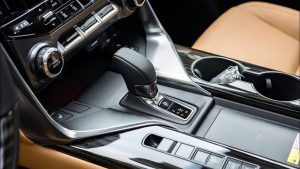
In this case, adding a hybrid element – high-voltage battery pack and electric motor power supplementation – bumps the total drivetrain output to 457 horsepower and 583 ft.-lbs. of torque, without an appreciable decrease in fuel economy. In fact, the much-stronger hybrid-augmented drivetrain in the “h” versions of the LX rates slightly better mileage: 19 city, 22 highway. Of course, no one’s going to pay the roughly $7k it costs to upgrade from the base LX600 to the least expensive version of the “h” to gain two-miles-per-gallon. The sell is the 48 horsepower (and 104 ft.-lbs. of torque) upgrade you get.
You also get 8,000 lbs. of towing capacity – a 1,000 lb. increase from the last V8-powered version of the LX.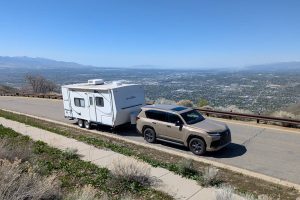
A ten speed transmission is standard with both the hybrid-augmented V6 and the V6 by itself. Full-time 4WD (with a two-speed transfer case and 4WD Low gearing) are also standard with either set-up.
Hybrid-augmented models have a watertight battery case, a sensible precaution for a vehicle with off-road equipment that might be used to ford creeks and such. Overtrail models come with an underbody camera system that’s useful for seeing rocks and such that might dent the floorboards or hang up the LX when you’re driving offroad.
On The Road
The LX – hybrid-augmented or just the V6, without the hybrid augmentation – rides like your favorite sofa and that’s a compliment. Lexus seems to get that luxury is more important to some than sport. Some people just want a super plush, ultra-quiet and supremely comfortable vehicle and don’t mind that it can’t autocross with Corvettes.
Lexus builds vehicles like this LX for people like that.
This does not mean, however, that the LX wallows like a ’75 Chrysler Cordoba; nothing new or even recent does that. What most new vehicles – especially luxury-brand vehicles – do is try to be both luxurious and sporty and that means compromising one or the other to some degree, for the same reason you can’t be a powerlifter and a long-distance runner at the same time, either.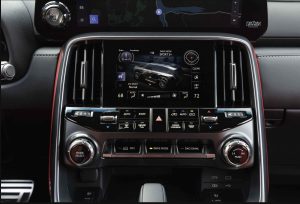
Everything about the LX is calming, including the silent-but-potent twin-turbo drivetrain. Especially when hybrid-augmented, because it is often literally silent yet extremely potent. Having nearly 600 ft.-lbs. of torque at your command is like having the most potent muscle car V8’s power at your command – it’ll get you to 60 in about 5.4 seconds if you need it to – but without the drama. In keeping with this potent-but-silent theme, this Lexus doesn’t have “sound augmentation” (the Toyota Tundra pickup, which is related to both the LX and the Sequoia does) to muscle up the sound of the V6 by piping V8 sounds through the audio system into the cabin.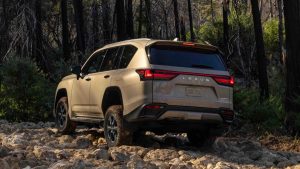
The quiet is very much like an electric car’s – but without the worry, since you don’t have to be anxious about the range or the wait, since it only takes a few minutes to fill up the LX700h’s tank. However, it does run dry faster – than the LX600’s tank – because it’s got a smaller tank (18 vs. 21 gallons). The three gallons less works out to about 50 miles less range, which means more frequent stopping for a top-off. The hybrid-augmented RX700h’s tank is smaller because space had to be carved out for the hybrid equipment (the electric battery and high voltage battery).
Another electric-like thing about the LX700h is that it has EV-like throttle-braking, which means you can slow the big Lexus down just by easing off the accelerator pedal. Driving this way saves brake pad life and also saves some gas, by using the vehicle’s momentum to recapture energy (electricity) during deceleration.
Perhaps the most appealing thing about the LX is that – big as it is – it doesn’t feel bigger than it is. Perhaps because it’s not as wide as some of the other full-size SUVs currently on the market. A Cadillac Escalade is 81.2 inches wide. The LX is a comparatively svelte 78.3 inches and if you don’t think a couple or so inches makes much difference, try driving an Escalade or similar wider-through-the-hips SUVs on a narrow country road with little or no shoulder and then try the LX.
At The Curb
The LX – 600 or 700 – doesn’t look like it costs as much as it does and that’s good if you aren’t interested in projecting to the world what you can afford to drive. It’s handsome rather than ostentatious. Interestingly, it is also not as long as the Sequoia it shares its platform with. The Lexus is 200.5 inches long vs. 208.1 inches long for the Toyota. A Cadillac Escalade is 211.9 inches long; a Benz GLS is 205 inches long. The Lexus is thus one of the smaller full-size luxury SUV.
This has its pros – and cons.
The pro is that the Lexus is easier to park – especially curbside – and it takes up less space in the garage. The con is that the Lexus has less-than-average cargo-room vs. most of the others in the class. It has only 11 cubic feet of space behind its third row and maxes out at 64 cubic feet with its second and third rows folded. Its several-inches-longer Toyota cousin has twice the cargo space (22.3 cubic feet) behind its third row and maxes out at 86.9 cubic feet. The Escalade eclipses them both, with 25.2 cubic feet behind its second row and a max of 121 cubic feet, the most in the class by far.
The third row is also tight given the size of the LX. Not just because the LX is not quite as long other full-size luxury SUV like the Cadillac Escalade and Benz GLS. It has a sold rear axle (i.e., it does not have an independent rear suspension) and that pushes the floorpans up in the area where the third row is, with the result that passengers back there sit with their legs kind of bunched up.
On the other hand, the Lexus is available in a unique-in-the-class four-seater configuration. The Ultra Luxury ditches the third row and the second row’s middle seat. The space that’s opened up allows for the reclining rear seats, which can be used as beds on long trips. These also come with a five-option massage function, which your passengers can enjoy while they watch a movie on the rearseat entertainment system that’s also bundled with the Ultra Luxury standards.
Every LX comes with a digital display dashboard and a dual-touchscreen infotainment system that’s easy to use because you don’t have to use it. Lexus – like Toyota – continues to use traditional knob/button controls for key functions such as turning the stereo’s volume up and down (via a knob) and adjusting cabin temperature via toggles. This combines form and function, which has become uncommon in the luxury segment, where there is often too much emphasis on “tech” uber alles.
The Rest
There are only two things about the LX that are a little iffy.
The first is that this top-of-the-line Lexus doesn’t come standard with the augmented hybrid drivetrain that’s standard in the Toyota Sequoia. Given that the base price of the LX600 is about $40k higher than its less-prestigious but otherwise similar Toyota-badged cousin, that’s an omission that ought to be rectified.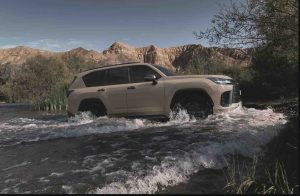
The other thing is something possibly iffy about every new Toyota/Lexus equipped with the 3.4 V6 engine. You may have heard about the recall that encompassed more than 102,000 Tundra pick-ups as well as the LX600 (hybrid-augmented models have not as yet been identified as having a problem). Toyota says it’s a manufacturing defect rather than a defect with the engine, itself. Hopefully, that’s true. If it’s not, it’s going to be a big problem for Toyota – and Lexus – because one of the main reasons people buy them is because they believe in them.
Cadillac shit the bed with the problems – sudden/catastrophic engine failure – it’s been having with the 6.2 V8 that’s standard in the Escalade.
Here’s hoping Toyota – and Lexus – vehicles equipped with the twin-turbo 3.4 V6 do not have similar problems.
The Bottom Line
That old saying about there being no replacement for displacement turns out to no longer be true.
On the other hand, speed is still a question of money. How fast do you want to go?
. . .
If you like what you’ve found here please consider supporting EPautos.
We depend on you to keep the wheels turning!
Our donate button is here.
If you prefer not to use PayPal, our mailing address is:
EPautos
721 Hummingbird Lane SE
Copper Hill, VA 24079
PS: Get an EPautos magnet or sticker or coaster in return for a $25 or more one-time donation or a $10 or more monthly recurring donation. (Please be sure to tell us you want a magnet or sticker or coaster – and also, provide an address, so we know where to mail the thing!)
If you’d like a Baaaaa hat or other EPautos gear, see here!









Does it look like one of the Cylons from the old “Battlestar Galactica”?
I question the idea of a 2 speed transfer case in a lux suv that costs over $100,000.
Is anyone going to take this thing to a mud pit?
Could have saved some weight and money with a less robust set up.
I always thought this platform was covered with ugly skin. Personal preference, but why not something more classy and well styled that appeals to more potential buyers willing to shell out 100+k?
Morning, Dan!
Well, having 4WD Low in heavy snow definitely helps.
The 4 low will be good for when there 15-20 years old and cheap enough people can get one and do a off road build.
It’s a beautiful vehicle it’s not based on the Sequoia it’s a 300 series land cruiser with a high end interior the Toyota stripped down model is not available in the USA the build quality really is unmatched it’s still built in Japan and it’s a Land cruiser.
Hi Angelo,
The LX shares a common platform with the Sequoia and the drivetrains are also closely related. I agree it’s a nice vehicle but the price… lawsee! Especially relative to the very similar Sequoia.
‘The LX700h has EV-like throttle braking.’ — eric
That’s a nice touch if you’re stuck with a 10-speed automatic. It’s the equivalent of downshifting a manual transmission for engine braking. Nice to have on mountain roads, when everyone else is riding the brakes.
Three total turn-offs:
1. It weighs three (3) tons.
2. It costs six (6) figures.
3. Its plug-ugly ‘cowcatcher’ face makes me want to punch it in with a heavy fence pole.
Verdict: Hell frickin’ no!
I ain’t no sucker, I ain’t no fool
Talking about them 10-speed automatic blues, yeah
— The Cult, Automatic Blues
Very interesting observation. I’ve driven hybrid sedans since 2013, two Lincoln mkz-h and now a Lexus es 300h. I like them for the economy and luxury. I considered SUV or crossover hybrids but I am not impressed with the negligible increase in economy. I like to drive a car, I have a V8 pickup and a 1973 Jeep so a car fits me for driving most of the time. The increase in HP with the hybrid is something I had not considered, I manage to get pulled over driving hybrid sedans so more speed is not what I need. The added comforts in the 700 sound quite nice, most of which are not in the 300, which puzzles me. Thanks for your keen reviews.
Thanks, John!
I’ve got an article coming that will get into this inmore depth; should be live by tomorrow.
The newest 5.7 Sequoia is 5 years old. This 3.4 has a good chance of not making to 5 years old.