


GM is apparently developing a new – more “efficient” – V8 engine. The word is bracketed within air fingers quote marks to mock the etymological cowardice. What GM is apparently developing is a more compliant V8 engine.
These distinctions matter. 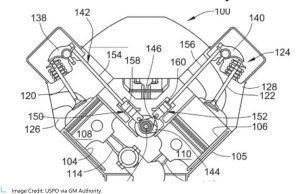
GM has filed a patent application for a new iteration of cylinder deactivation “technology” – that word is reflexively upchucked whenever something unwanted is about to be foisted on people – that is in fact a new iteration of already existent compliance “technology.”
Cylinder deactivation “technology” goes back some 40 years, to the time when GM brought out the V8-6-4 in Cadillacs. As the term suggests, this was a V8 that had “technology” that let it run on six or even just four cylinders, by shutting off spark/fuel to the shut-down cylinders. It was then – as now – a compliance “technology” ginned up to increase (slightly) gas mileage and to decrease emissions of exhaust gasses, via the burning of less gas. It didn’t work very well but that didn’t keep GM from trying to make it work. Over the ensuing decades, the “technology”got more elaborate – and caused more problems for the people who bought vehicles so equipped. 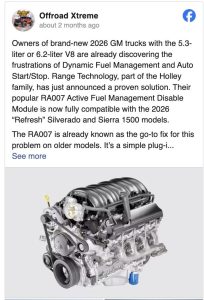
This ought to have been foreseen. Cylinder deactivating a healthy V8 is not unlike forcing an athlete who can run to wear leg braces while he tries to run. There is no market demand for this sort of thing but government demands result in the propagation of such things – because government demands take precedence over market demand.
This, too, is a distinction that matters. Or at least, it ought to matter.
Like Patty Hearst – the kidnapped heiress who came to love her abusers – the American people have gotten so used to being told what they’re allowed to do and allowed to buy – and have to buy (if they want to buy a thing) that they have become as passively accepting of – and even receptive to – what’s been done to them as she was. The healthy resentment of an abused animal that at least snarls at his abuser has been entirely bled out of them via decades of abuse, such that the abuse feels normal to them now. 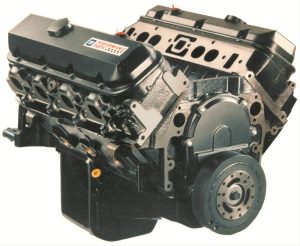
Let’s look at some specifics with regard to the current “benefits” of a V8 with cylinder deactivation “technology,” which is also sometimes styled Active Fuel Management and Variable Displacement, among other things.
A 2026 Chevy Tahoe with the 5.3 V8 that has this “technology” rates 15 MPG in city driving and 20 on the highway, according to the government that micromanages fuel efficiency and issues requirements regarding the latter that must be complied with.
A circa early-mid-1980s Chevy truck with a 454 big block V8 (7.4 liters in the current gay way of describing engine displacement) averaged 12-14 MPG. Yes, it’s a difference. But is it one that matters? To the person who owns the vehicle, I mean. 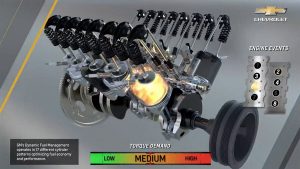
The big-block V8 was a simple, cast-iron workhorse that could be serviced by almost anyone with a little mechanical knowledge and basic hand tools. You spent more on gas, certainly. But not much more. And you spent a lot less on service – because it required less and because it could be serviced by you.
The current Chevy (GM) V8s are aluminum and make tremendous power but they are only just barely more “efficient” – even though they are hag-ridden by “technology.” Without this “technology,” they use a little more gas. But they wouldn’t be hag-ridden by compliance “technology” – which would make them more appealing to buyers because they’d cost less to buy and to maintain.
The only thing as regards this “technology” that’s of any real benefit to the people who buy vehicles so equipped is that they can still buy vehicles equipped with engines – especially V8 engines – that would otherwise be too non-compliant to offer for sale.
I suppose we ought to be grateful for what we get – and are obliged to pay for.
Thank you, sir! May I have another?
. . .
If you like what you’ve found here please consider supporting EPautos.
We depend on you to keep the wheels turning!
Our donate button is here.
If you prefer not to use PayPal, our mailing address is:
EPautos
721 Hummingbird Lane SE
Copper Hill, VA 24079
PS: Get an EPautos magnet or sticker or coaster in return for a $25 or more one-time donation or a $10 or more monthly recurring donation. (Please be sure to tell us you want a magnet or sticker or coaster – and also, provide an address, so we know where to mail the thing!)
If you’d like a Baaaaa hat or other EPautos gear, see here!










Ive had three Rams with 5.7L Hemis and MDS, never had one problem with any of them. Ive heard some stories though. All got 22-23 mpg straight highway and 15MPG-ish around town. Even towing a 16’x7′ trailer loaded to max id do 13MPG. Cant complain thats 400hp and about 415 f5 lbs torque. So, until the regs change it has been a decent alternative IMO. Keep an extended warranty I do says Yoda.
Jasper sells the 5.3 with the afm delete kit
I had an 06 Grans Prix GXP with the 5.3 and cylinder deactivation. Lots of GP guys do what I did, which was to tune the DOD (Displacement On Demand) out from the ECM. Simple to do and much better than having it constantly going between 4, 6 and 8 cylinder modes. I never saw anything more than close to 1mpg improvement at best, going by the dash display at least. It’s a stupid technology, effectively neutering the 300 plus horsepower engine and making it burn extra oil.
Wow. I fast scrolled thru the article and the comments, every bit I saw just emblazoned that G.M. products are …Crap.
I used to see G.M.C. or Silverado as being a useful long lasting,… – durable – tool.
No more. Poof!
And, yah, “Say goodbye to 2nd and 3rd-hand used vehicles.”
I think, that’s, ‘The Plan’.
…Bastards.
More expensive, less durable, non-repairable in the field, planned obsolesce. So very, anti-American. ‘er, it used to be thought that way. Not any more.
Engines are so complex now. Some companies, like Volvo and Daimler have jumped onto tiny, highly boosted engines. Mercedes gets 470HP out of a 2.0 liter, 4-cyl with stunning amounts of boost. Volvo has twin-charged (supercharged and turbocharged) 2.0 engines. Search online for pictures of these. No sane mechanic would ever want to work on one.
RE: “No sane mechanic would ever want to work on one.”
Monkeys! We’re ruled by, and the corporations are staffed by, idiot drunkin’ Satanic-Leprechaun Monkeys.
‘Candace x Bassem Youssef | Candace Ep 298’
https://www.youtube.com/watch?v=xjzb_t5Tk9o
One thing gm will make sure of? No way will you be able to use a 3rd party device to deactivate the de activator! Stay away Stay very far away!
Range Technology has been very good about keeping products available for GM models to turn off active fuel mananagement.
Nah, if a person can design and build it then another person can reverse engineer and hack it.
That is an air tight assumption.
Computer engineers know that the rule of thumb that you get anywhere from 5 to 50 bugs per 1000 lines of code. There are practical exceptions. Or used to be. The Space Shuttle had systems with zero defects in code with many hundreds of thousands of lines. But that once reliable system of careful writing, review and testing seems to be broken, aerospace systems now seem to have plenty of errors. Boeing aircraft anyone?
Each bug is a potential exploit. They still find bugs in code that is decades old. They get found during refactoring and a whole slew of new ones found.
I’m here in the inner sanctum! The lower case car company is quietly making gigantic investments into software and software security. It’s part of their strategy to move earnings from consumer sales. I doubt I’m wrong
Image of a donkey cart.
Image of the space shuttle Challenger.
“It’s part of their strategy to move earnings from consumer sales.”
Nutz.
Control. Control. Control.
It’s obsessive. Possessive, even.
Hat tip for the inside tip, Rob!
I’m not surprised. This is apparently the plan, industry-wide. “Data” and “transportation” rather than vehicles. I wish I could transport back to the Mad Men era and get to attend a long lead for the brand new 1967 Camaro…
Here is the two YouTube video of Vice Grip Garage trying to get one of those 8-6-4 Caddy’s going again.
https://www.youtube.com/watch?v=5QbP5YwGsT4
https://www.youtube.com/watch?v=lKfNbecAQYU
The electronics made it way harder.
All this current horrendous compliance started innocently enough as just trying to make our engines cleaner and more efficient. And I would say it accomplished those goals by the 80’s, 90’s. But then our Gov/Big Biz figured out they could use laws and regs to keep out the competition. There’s no better example than Tier 4 diesel regs that came out in the late 2000’s that destroyed the great diesel engine reliability. Why? Because Asian diesel Manuf. caught up to our Tier 2 and 3 regs and were selling these engines for 1/3 to 1/2 of our domestic Manuf. It’s all sold as better for the environment to the public, and the karen’s scream for it. And a large percentage of trucking costs that have gone through the roof, even beyond the inflation issue.
And that’s why we’re here. And that’s also why these regs will not change. They may not be ‘enforcing’ them in the aftermarket anymore, but the regs will stay, or there will not be any domestic manuf. anymore.
To borrow a phrase that EP refers to often: “There’s no end to doin’ good.”
Sure wish you’d stop being so good to me, Cap’m
The Ford 1.5 “Dragon” triple is said to have cylinder deactivation, meaning it runs on TWO cylinders at highway speeds.
For fuck’s sake.
I’m no automotive engineer, but it seems to me that cylinder deactivation would only be effective if you could keep the valves open on the compression stroke. The greatest resistance on the deactivated cylinder is going to be on the compression stroke, so you would need to keep the valves open to overcome that, but you’d still be using crankshaft inertia to push the dead weight of the piston and rod. It would seem to me that the energy needed to overcome the compression and the dead weight of the piston and the rod would negate some of the purported fuel savings.
Maybe they DO have a way to keep the valves open. I don’t know, I’ve never worked on one. But it seems like an awful lot of complicated bullshit when greater fuel savings could be realized by aerodynamics, tires, etc.
‘In cylinder deactivation, the intake and exhaust valves in the deactivated cylinders remain closed throughout all cycles. By closing the valves, the engine traps exhaust gases inside the cylinder, creating an “air spring” effect that reduces pumping losses and minimizes engine vibration. Fuel injection is also deactivated.’ — AI overview
Without combustion, the air spring effect results in a net loss of energy due to friction and turbulence, but it’s not too large.
Out of my element here, but I’m guessing that smoothest operation demands keeping evenly spaced compression strokes, even without combustion in some cylinders. Otherwise you would get a ‘lumpy’ torsional variation with uneven compression impulses — the Harley ‘po-ta-to’ effect! 🙂
Good point.
The technology sounds like a problem in search of a solution, though.
What a waste. Too bad they can’t just go with “stuff that works”. Four valve heads, better intake/exhaust design, and after 35 years of use in my ‘91 Silverado, throttle body fuel injection is just dandy. Want a good running powerful motor? Get the flow and fuel management right & enjoy the ride!
The one move Harley got right was the four valve heads in the M8 motor design. They’ve had fuel injection for years but a bone stock EVO then injected Twin Cam series motor was doggy stock. The M8 stock out of the box is shockingly a great performer, no more laggy throttle response down low and excellent acceleration. Thanks four valve heads!
There are carb kits for M8s to get rid of all the computer and emissions garbage. You basically have a blockhead with a factory custom 4 valve head at that point like I used to see in the custom magazines in the 90s
Our 2011 Honda Pilot V6 has cylinder deactivation. It’s at about 212,000 miles now with nary a problem, besides a dead alternator a year ago.
Technology isn’t a problem until you can no longer opt out.
As long as there are kit cars and crate engines, and cheap old rollers that are exempt from the rules, I’m good. I’ve never in my life bought a brand new car and it seems I never will, which is A-OK with me.
It is a shame the car companies are not able o design cars for the free market. Can you imagine what would be possible today?
They promised me a flying car by 1985. Forty years have passed. And I am not bloody amused.
https://en.wikipedia.org/wiki/Convair_Model_118#/media/File:ConvairCar_Model_118.jpg
‘A low fuel forced landing destroyed the car body and damaged the wing. The pilot reportedly took off with little or no aviation fuel aboard. Although the fuel gauge indicated that the tank was full, it was the automobile’s fuel gauge, not the aircraft’s gauge.’ — Wikipedia
UX [User Interface] strikes again! Like the Adobe Acrobat reader — it’s all obscure little icons now, meaningless to me, and moved around so I can’t find the one I want. Pfffttt!!! Goin’ back to school now, for a degree in Icons as a Second Language.
These garbage “technologies” will save the Feds from having to do another “Cash for Clunkers” scheme.
All these direct injection, AFM, turbocharged, variable crankshaft, CVT equipped pieces of exquisite junk will soon mechanically total themselves.
Say goodbye to 2nd and 3rd-hand used vehicles.
The poors better get used to riding on a flammable EV public bus.
Dad bought a Cadillac V-8-6-4, he was only able to tolerate it for less than a year, traded it in for a Lincoln Town Car.
‘The [V8-6-4] problems were legion. The rocker control system wasn’t quick enough to respond, whether accelerating or decelerating, which led to delays in power production that made the engine impossible to drive smoothly.
‘The deactivation and fuel injection systems didn’t really know what state the motor [sic] was in, which meant that the throttle-body was often either sending too much or not enough fuel into the motor for the number of cylinders that were actually in use.
‘Certain cruising speeds would even throw the processor into a tizzy where it would hunt between cylinder counts, going back and forth like an automatic transmission that couldn’t quite select the proper gear for the situation at hand.
‘After attempting 13 software updates with positive improvement in terms of drivability, the 8-6-4 design was quickly retired after a single model year. The L62 was replaced with a smaller 4.1L V8, while those customers who decided to keep their ’81s had the cylinder management system permanently disabled, keeping the engine running on eight cylinders for the remainder of its natural life.’
https://www.drivingline.com/articles/cadillacs-8-6-4-variable-displacement-engine-was-ahead-of-its-time-and-its-tech/
The new patent describes solenoids, hydraulic valves and lost-motion lock springs. Even if controlled by a more powerful chip, all these parts have a small but finite failure rate. Are you feeling lucky,
punksbuyers?From the linked MSN article:
‘This patent shows GM is still betting on internal combustion, especially in segments where battery-only power isn’t yet a perfect fit for everyone.’
As Gavin Newsom’s EeeVee-pushing arm Veloz claims, ‘THE FUTURE OF TRANSPORTATION IS ELECTRIC FOR ALL.’
You have been warned.
I bought a used 2017 GMC Sierra with a 5.3L engine. Out of my own ignorance at the time, I didn’t realize it had cylinder deactivation. After a bit of research, I found Range Technology and their OBD plug-in that deactivates the deactivation. Hopefully that will make the engine last a lot longer.
As Louis Alexander from AGCO Automotive used to point out: “These fuel saving technologies never saves enough on gas to pay for there own repair”, (from memory) now just imagine an entire car full of this technology and yet the manufacturers don’t have the balls to push back when their customers lose interest in new cars.
Exactly Landru,
The few bucks you save on gas are more than overwhelmed by the hundreds if not thousands of dollars in repair costs.
I worked for a guy that bought one of the 8-6-4 Caddys in the early 80s. That thing spent more time in the shop than on the road.
Complicated machines will break in complicated ways.
I learned this with the HEMI and will never buy any fuel management engine again.
Amen, Dan!
A carburetor is my kind of “active fuel management.” It actively manages the fuel – via jets and orifices and throttle valves, all mechanical things that can be easily checked for proper operation and easily fixed if not operating properly!