

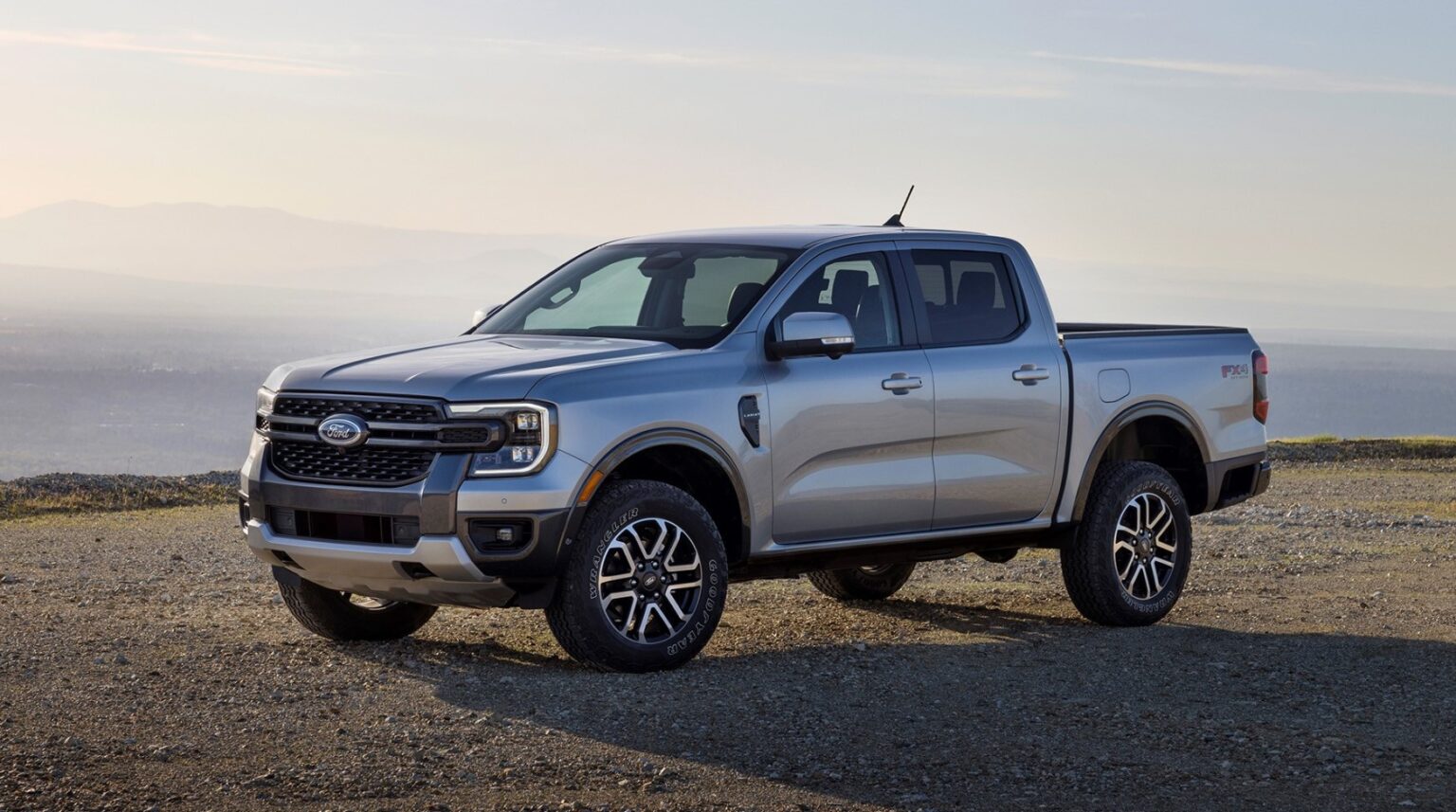

A strange thing has happened to what used to be compact-sized – and affordable – trucks like the Ford Ranger and its rivals. They have grown in size to the extent that they are now nearly as big as full-size trucks used to be – and they have become twice as expensive as compact trucks used to be as recently as about ten years ago, when all the small ones got replaced by much bigger ones bearing the same names.
On the upside, these no-longer-compact trucks have almost-as-much towing capability as full-size trucks once touted – and much more power (even through they have small engines).
The Ranger is an example – and a case in point.
What It Is
The Ranger, like its rivals, is a mid-sized truck that was previously a compact-sized truck. Also like its rivals, it currently comes as a crew cab (with a short bed) only. But Ford does offer three different engines, depending on the trim.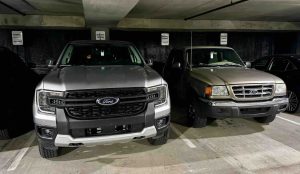
Prices start at $33,350 for the XL trim with 2WD; adding the optional 4WD system bumps the sticker price up to $36,850. This version of the Ranger comes standard with a turbocharged 2.3 liter four cylinder engine, a ten speed automatic, a six speaker stereo, a digital main instrument panel and a 10 inch LCD touchscreen.
The XLT ($35,875 for the 2WD version, $39,365 for one with 4WD) comes standard with the same drivetrain but you can opt for a more powerful 2.7 liter V6 – if you first buy the 4WD version. This adds an additional $2,295 to the sticker. XLTs also come standard with a 120V household power point, LED bed lighting and a wireless charge pad.
The Lariat ($43,755 for one with 2WD; $47,255 with 4WD) is also eligible (4WD models) for the more powerful 2.7 liter engine and comes standard with a powered sliding rear window, 10 speaker premium B&O audio system, a larger (12 inch) secondary touchscreen and synthetic leather seat covers, among other upgrades.
At the apex is the Raptor – which is a high-performance/off-road variant of the Ranger that comes – uniquely – with a 3.0 liter twin-turbo V6 and 405 horsepower, standard 4WD and slew of off-road upgrades that includes locking front and rear differentials, 17 inch wheels with 33 inch all-terrain knobby tires, tow hooks, fender flares and a modified suspension that features a wider track, along with Fox off-road shocks.
This one stickers for $57,020.
What’s New For 2026
The FX4 off-road package – which used to be limited to higher trims – is now available with the base trim. It bundles skid plates, an electrically locking rear axle, off-road shocks and other upgrades.
What’s Good
Standard 2.3 liter four is almost as powerful as the V8s in full-size trucks were 25 years ago.
Even with the little four, this truck is rated to pull up to 7,500 lbs.
Crew cab is much roomier than the much smaller regular/extended cabs that compact-sized trucks had.
What’s Not so Good
Pushing $40k for the least-expensive 4WD-equipped version of the base XL trim. Rival trucks such as the Toyota Tacoma, Nissan Frontier and Chevy Colorado are similarly pricey – but all of them used to be much less so.
Regular cab/extended cab not available.
Short (five foot) bed is the only available bed size
Under The Hood
The Ranger’s standard turbocharged 2.3 liter engine makes 270 horsepower and 310 ft.-lbs. of torque. To get a sense of how impressive these numbers are – for an engine this small – consider that back in 2005, the full-size F-150’s optional 4.6 liter V8 touted just 231 horsepower and 293 ft.-lbs of torque. This full-size, V8-powered truck could only toe 6,300 lbs., too.
On the downside – relative to now – is that back in ’05, you could have bought a brand-new F-150 with the 4.6 liter V8 for $25,560. Yes, inflation. But the problem is that most people’s incomes have not inflated in tandem. Back in ’05, more people could afford a new F-150 than can afford a new Ranger, today. And – a further point of comparison – back in ’05, the Ranger’s base price was just $14,610. If you doubled what it cost to buy one back then, it’d still cost less than it costs to buy one today.
XLT trims are eligible for the optionally available 2.7 liter twin-turbo V6, which makes 315 horsepower and 400 ft.-lbs. of torque. This same engine is available in the much larger current F-150, so it transforms the smaller/lighter Ranger into a pick-up with real pickup. It can get to 60 in 5.6 seconds, which – for some sense of just how quick that is – is quicker than a 2005 Mustang GT with a 4.6 liter V8.
Gas mileage (21 city, 26 highway for the 2.3 liter four; 19 city, 23 highway for the 2.7 V6) is better than the gas mileage you’d have gotten back in ’05 with the V8 – in the full-size F-150.
On the downside – as regards the 2.7 liter V6 – it’s a big step up in price to get it because you must first buy at least the XLT trim and then you must buy the optional 4WD to be able to opt for the V6. This will push the price of the Ranger to about $42k. That kind of money used to buy a decently equipped full-size truck – with 4WD – and not as long ago as 2005.
The Ranger Raptor comes with a larger, 3.0 liter V6 that touts an astounding 405 horsepower and 430 ft.-lbs. of torque. A point of comparison? Back in ’95, your Libertarian Car Guy got loaned a Cobra R Mustang to drive for a week. This version of the Mustang was a literal race car that was just barely street legal. Ford only sold them to people who were going to race them (you had to have an SCCA road racing license). It had the very last 351 (5.8 liter) V8 Ford ever put in a Mustang. It made 300 horsepower – and this ultra-light/, made-to-race version of the Mustang was only just barely quicker getting to 60.
On the downside, the Raptor is similar to the Cobra R in that its price renders it exotic. $60k (almost) being enough to price most people who’d like to have one out of the market for one.
All of the Ranger’s engines are paired with a ten speed automatic. When the Ranger was still a compact-sized truck, it was available with a manual – as was true of the others in the class, when they were compact-sized (and still cost much less than a full-sized truck).
On The Road
The new Ranger feels like the nearly full-sized truck it is – at least by the dimensional standards that defined a full-size truck through the early 2000s, before full-size trucks got super-sized.
This has its pros and its cons
On the pro side, you feel as if you’re driving a larger, more substantial – and much stronger – truck than the compact-sized Ranger that Ford cancelled back in 2011. The no-longer-available compact-sized trucks had many virtues, but one of them wasn’t that they were strong. Equipped with their standard, non-turbocharged four cylinder engines that typically made around 150 horsepower – they were not going to get you to 60 in the mid five second range. Ten was more like it. And because they didn’t come standard with a lot of power, they typically were rated to pull 3,500 lbs. Maybe as much as 5,000 lbs. – if you bought one with its optional V6 (which was also not turbocharged and made less power than the current Ranger’s standard four).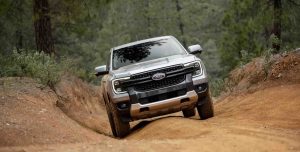
On the con side, this is a big truck – and feels like it is. it is just shy of 211 inches long, which is nearly as long as an early 2000s full-size truck. The main difference is that it’s not as wide – and that is a saving grace on narrow country backroads. Today’s super-sized full-size trucks are so wide that when two pass one another going opposite directions on a narrow country road, they sometimes smack mirrors.
That’s not an issue with the Ranger.
Tight-space maneuvering on the other hand, is. Or at least, it is more of an issue than it was back when the Ranger was still compact-sized and was only 189.4 inches long. The 2026 Ranger is nearly two feet longer – and for that reason isn’t as easy to park in tight spots as the old Ranger and the other compact-sized pick-ups were. The latter were also not as wide as the current model and while that did make for a cozier cabin (less shoulder room) it also left more room in your garage. Those compact-sized trucks only took up about as much floor space as a new Corolla or Civic – and had the additional virtue of coming standard with a six foot bed.
More about that – and related matters – now.
At The Curb
There are at least two interesting things about the Ranger. The first is that it is about as long – 210.9 inches – as a full-sized/regular cab half-ton truck with a six foot bed from the early 2000s. A 2001 Ford F-150 XL regular cab – with the six foot bed – was 206.9 inches long. The 2001 F-150 was a smaller truck, in other words, than the current “mid-sized” Ranger is – except in terms of width. The ’01 F-150 was wider – three could sit across (up front) in the regular cab and even though the bed was short (for a half-ton truck) it was still wide enough that you could lay a 4×8 sheet flat in the bed.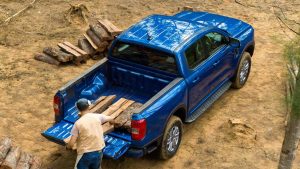
This brings up another interesting thing. More like a curious thing. The Ranger is only available in one configuration: Crew cab with four full-size doors and a short (five foot) bed. The fact that it is a crew cab is why the bed is so short.
The old Ranger – last available in 2011 – was a much smaller truck but it came standard with a longer six foot bed, because it came standard with two rather than four doors. It was feasible to add a six foot bed to a regular or extended cab body – but adding a six foot bed to a crew cab would push the length to too-long and that’s why the current Ranger comes only with a five foot short bed. Others in the class – such as the Chevy Colorado – are similarly crew cab/short bed only. All of these trucks used to offer different configurations – as well as different engines. It’s weird that they’ve become one-size-fits all. Because sometimes, one size doesn’t fit all.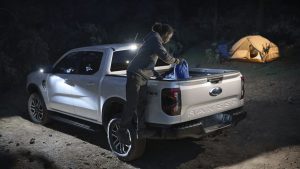
Then again, the reality – apparently – is that most people who buy these trucks buy them mainly to carry people, not 4×8 sheets. The bed is big enough – in a pinch – and it’s perfect size for the dog and a few bags of mulch every now and then. Meanwhile, the cab is big enough to comfortably carry five people, making it practical as a family vehicle that also happens to have the additional utility and capability – such as being capable of pulling nearly 8,000 lbs. – that most family vehicles lack.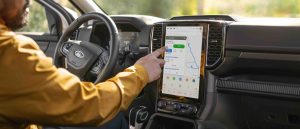
Even the base XL is pretty loaded – certainly relative to the way base trim trucks used to come. In addition to the powerful turbocharged engine, there are 17 inch wheels, LED headlights a digital dashboard and a six speaker stereo. Back in the early 2000s, that would have qualified as loaded – even luxurious. Of course, that’s why the Ranger is as expensive as it is – even in “base” trim.
The Rest
It’d be interesting to see what would happen if Ford were to offer a new Ranger more like the old (compact-sized) Ranger. Not necessarily that size – but that basic, at least to start. Instead of the powerful turbocharged four, a powerful-enough four without a turbo – paired with a standard manual transmission. Nix the digital dash and the big touchscreen. Maybe even make manual roll-up windows standard – and AC optional. Get the base price down to around $25k rather than $33k.
Ford might sell a bunch of them.
The Bottom Line
The Ranger is without doubt the most powerful, most capable – and nicest Ranger Ford has ever made. The problem is it’s become as expensive as a decently equipped full-size truck used to be, not all that long ago.
. . .
If you like what you’ve found here please consider supporting EPautos.
We depend on you to keep the wheels turning!
Our donate button is here.
If you prefer not to use PayPal, our mailing address is:
EPautos
721 Hummingbird Lane SE
Copper Hill, VA 24079
PS: Get an EPautos magnet or sticker or coaster in return for a $25 or more one-time donation or a $10 or more monthly recurring donation. (Please be sure to tell us you want a magnet or sticker or coaster – and also, provide an address, so we know where to mail the thing!)
If you’d like a Baaaaa hat or other EPautos gear, see here!









Diesel was $8.36 in Salinas CA. today. I long for $1.36 Gl.
[…] https://www.ericpetersautos.com/2026/02/07/2026-ford-ranger/ […]
My 2002 Tacoma was hit and totaled. Not to argue that point or the validity of insurance, but there was no question the truck was wrecked beyond practical repair. The frame was tweaked and had some worrisome corrosion that rusted through.
I went looking for a replacement and at the time, this being 2 years ago, was not overwhelmed by the Tacoma that was current at that point. I looked for a previous generation and was striking out. The market for them is ridiculously over priced, there’s a serious premium. Toyota stopped offering stick shifts as a base and you could only get a manual in the TRD trims, which was fine except it seriously limited the number of potential used trucks I could find.
So I broadened my scope to also include Rangers. Ended up with a 2020 XLT, I think the last year of the previous T6 body style to the one Eric reviewed.
I really like this truck. I think it’s a better truck than the 3rd gen Tacoma and maybe better than any Tacoma except maybe the current one. I think in some ways it’s a better truck than my 1st generation. A big reason is my Tacoma wasn’t fully boxed frame while the Ranger is, which makes it much more rigid.
The engine is good. Feels more powerful despite being a 4 vs V6. The 2.3L Ecoboost turbo is not offensive. It’s a Mazda engine so I’m not too worried about quality. I don’t really miss the 3.4L V6 from my old truck in terms of performance, but I do worry about the turbos. I guess I’ll see.
My old truck was a 5 speed manual, this one is 10-speed auto. I thought I was going to hate it but I actually don’t. Maybe it’s just me getting old but I got used to the auto very quickly.
The biggest change was going from an extended cab 6′ bed to a 4 door with 5′. The only reason I clung to the 6′ bed was because I camped in it. I’m over 60 now so climbing in the back to sleep on the platform was getting old. I ended up finding a used Go Fast Camper and wonder why I didn’t do this year ago. Game changer.
Having 4 doors is really nice, but then again many of the extended cabs made after my Tacoma had gone to swing out half doors, which solves my main complaint about access to the back of the cab.
Honestly, all-in-all I could not be happier.
Oh, other reasons I settled on the Ranger over the Tacoma was the Ford is less plastic feeling. The bed on 2005 and newer Tacoma is plastic inside, the front bumpers are plastic on the Tacoma. The Ranger uses a steel inner bed and the front and rear bumpers are more simple steel. The inside of the Ranger felt more like my 2002 than the newer Tacomas, which are busy and complex in comparison. My Ranger has a 8″ screen in the middle and small 4″ in the middle of the speedo and tach, real controls for the climate and radio, the dash is real needles. The dash overall is fairly low key by modern standards. My overall impression was the Ranger felt more truck-like than the Tacoma is now. The way I’d say it was the 2020 Ranger felt like an evolution of the my Tacoma, which makes sense since the current Ranger was designed by the Ford Australia rather than in Detroit and those blokes are tough on truck in the Outback.
The Ranger offers engine and trim options … but no alternatives to the crew cab / 5-ft bed, and the ten-speed transmission.
My compact pickup is for hauling stuff, not people. So it has two doors, a six-foot bed, a five-speed manual transmission, and four-wheel drive.
Not a single 2026 model pickup is of the slightest interest to me at any price, including free. I’m a ‘don’t-wanter.’ Don’t want their crap. Don’t want their telemetry and douchescreens. Don’t want their useless ten speeeeeds.
I was surprised to find that no 3/4 ton or 1 ton pickups are available with a manual. The only pickup in 2026 that is available with a manual is the Tacoma. And that comes with a 4 cylinder toyota engine which is turbocharged.
Double plus unreliable.
When right out of the box, two of the four attributes of a vehicle are the number of speakers, and the size of the touchscreen, we have truly “jumped the shark.”
I would be embarrassed to drive a giant truck with a tiny bed and engine. The single two things which matter the most to me in a truck are neutered. It would be cheaper and achieve the same effect were I to wear a big furry codpiece everywhere I go and walk by thrusting my hips.
I think is has more to do with there are no big ‘cars’ anymore. You can’t fault a man for not wanting a compact or mid-sized crossover/suv.
It happened to me in the 90’s, when there were no more RWD v8 cars, so I traded in my well worn out car and beater farm truck on a new 4-door pickup w/v8 to be my everything car. Did that for 25+ years.
Yes, they are silly big now, and mine were actually even bigger cause some Manuf. let you get a 6.5′ bed, which I always used hauling dirtbikes. Long as the old 60-70’s boats, and I like it.
I don’t fault them if they can afford it and want new for the relative lack of worries. I just stick with the old like my ’82 Chevy 2 door with the 305 v8 and 8 ft bed. Cost was $3,000. Needed all new fluids, new battery, new tires, new crankcase breather, new coolant reservoir. Blew the water pump belt at one point, so new belts, and the transmission started pouring out fluid at another point (new threaded plug), but it’s like starting a relationship with any new person – there’s bound to be some growing pains. In twenty words or less I’m saying I’m aware that people gladly spend the equivalent of 10-20x what I did for “new”, but I don’t think I will ever understand it..
“…back in ’05, you could have bought a brand-new F-150 with the 4.6 liter V8 for $25,560”
In ’08 I bought an F-150 XL V-6, stick with zero options on it. MSRP was $18,000.
Paid $13,500 OTD. Still have it. they can bury me in that truck because i am never getting rid of it and will never see a deal like that again.
I hope the truck manufacturers saved the old truck designs so they can be manufactured again. Lots of us are going to be buried in the old ones unless they can turn this ship around.
That was during the GFC of 2008. Nice timing.
It was when gas prices spiked to $4.25. They were practically giving trucks away. People were trading in pickups for Priuses.
Six months later gas was $1.85… yeah, it was one of the few times in my life I got lucky.
I think the ranger is a good buy seeing the with 4wd new local for 33k not bad considering price of the other trucks not around around 40k good towing capacity good gas mpg I’m not big on the turbo 4 or any of the Ford auto transmission I would buy one if looking for cheaper 4wd truck but Nissan frontier probably best being it’s a v6 still.
A beautifully written and informative article about the new Ranger and the changes in it over the last 30 years, its comparison to the F150, and even how it compares to the hottest rodded mustang over last three decades.
It’s not the truck that’s the problem, its that our fiat dollar is so devalued that it takes 33,000 to 57,000 fedbux to buy one!!!
Thankfully and hopefully, the truck will last at least 20 to 30 years, cuz that’s how long the poor owner will take to break even on owning one!!!
Thanks for the kind words, Saxon!
I wish I could review all the old models we love so much… I sometimes try to imagine what it must have been like to have my job 50 or 60 years ago. I envision myself sliding behind the wheel of a brand-new GTO Judge or 440 ‘Cuda. Even a new Beetle, for creep’s sake!
As much as those 60’s cars were awesome (had a Judge), they in no way compare to a modern 300 v8 for example. Maybe it’s an age thing.
If they built a new Judge and 300, in my youth I’d go Judge, but after 40-50? give me the 300, or now charger, which I will be considering when the 4-door comes out.
I think we just need to somehow get rid of all the nanny/safety crap somehow, and we’d be happy car guys again.
You know it’s sad when the Ranger is the same length as a 1976 Monte Carlo and that was a big car. I agree that if they offered a base stripper model that it would probably sell but I’m guessing that they make more money selling it loaded and perhaps since everyone finances or leases nowadays that’s true.
Either way when a full size truck can cost a $100K that you wonder who can actually afford them.
The real Rangers had an optional 7 foot bed. And the 2.5 four easily lasts 300,000 miles.
2.5s were indestructible. They were non-interference motors, so when the timing belt went, you could fix it for the cost of a new belt.
Had one that I sold at 213,000 because of body rot. Engine still ran like new, though.
You beat me to making the same comment. The 7–foot bed was available only with the regular cab, thought, not with the extended SuperCab.
In the last years before production of the old Rangers ended in December 2011, Ford evidently tried to restrict availability of the longer bed to commercial buyers.
Meanwhile over in Europe this thing comes standard with a 2.0L turbodiesel and a six speed manual as well as a wide variety of trim packages.