

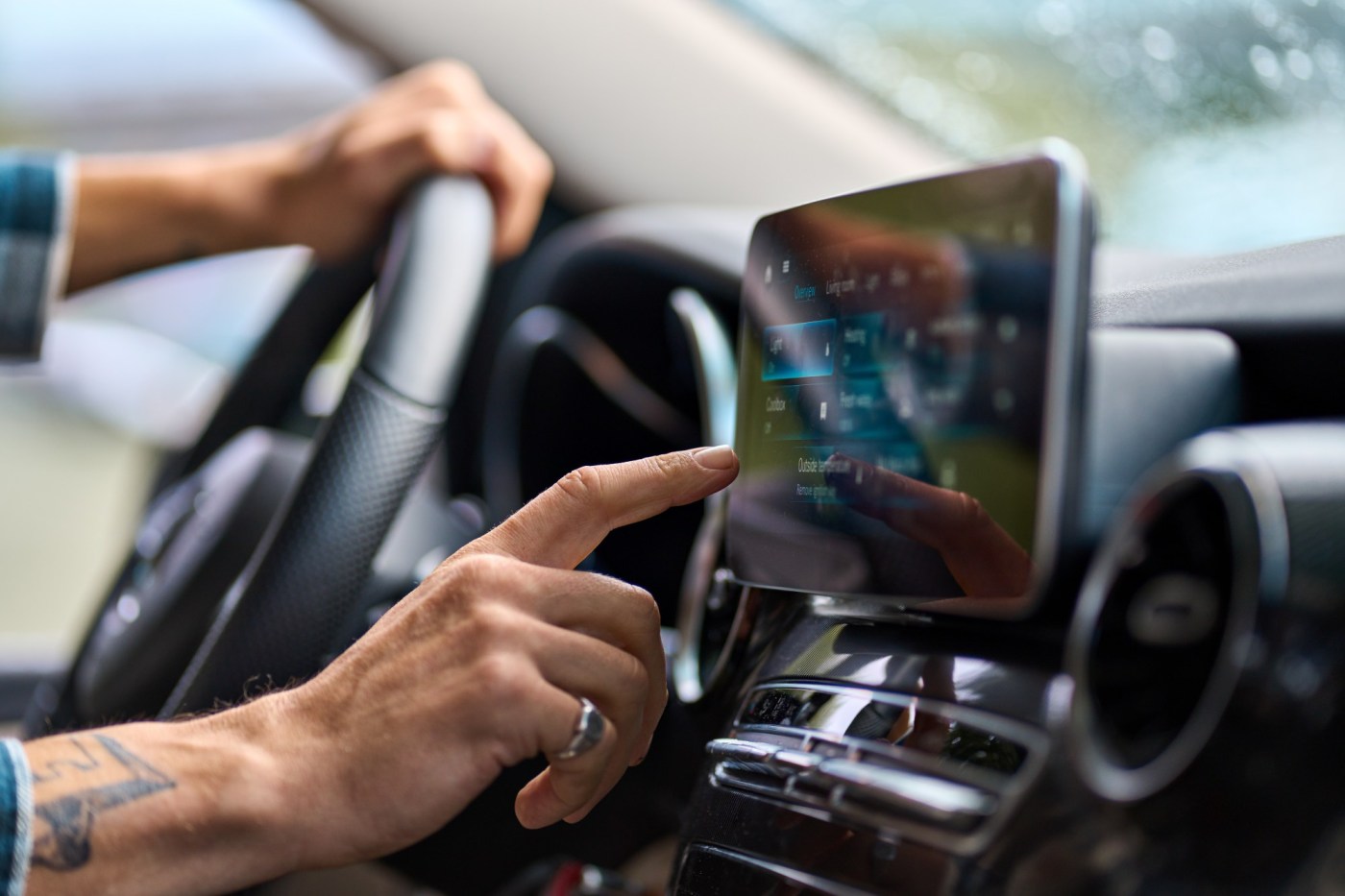

Touchscreens have largely replaced switches and buttons in new vehicles and one of the interesting consequences of this is that the driver is often not allowed to use these tap/swipe controls while driving. Software doesn’t control a knob. You can turn it left or right whenever you like and the volume goes up – or down. On/off switches work similarly. When cars had buttons and knobs to control various things, the driver was in control of them. Now – with the advent of LCD touchscreens – he’s allowed to use them, but only under certain conditions.
For example, the GPS in many new vehicles will not let you enter a destination while the vehicle is moving; the Honda Pilot I reviewed this week won’t let you ask Alexa anything unless you first stop the vehicle. It effectively renders these features temporarily useless and adds an annoyance tax to the vehicle. Why should we have to pay this tax? Put another way: Why are the vehicle manufacturers asserting supervisory authority over vehicles they have sold?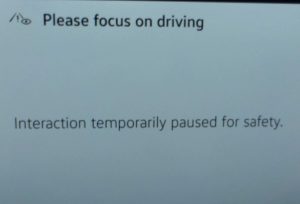
Imagine if, after you bought a house, you discovered the contractor who built it was exerting control over the front door, using software to lock it (or unlock it) according to his preferences. The toilet would only flush if you remained seated for a certain amount of time. In fact, this kind of supervisory control is already being exerted – or can be exerted – by “smart” devices within the home that can be externally controlled by the corporations that sold them to you. “Smart” meters can decide you have used (or are using) too much power and turn down (or turn off) the AC or heat.
The interesting part isn’t so much the control but what you were sold.
In the Before Time, when you bought a thing, it was yours to use as you saw fit. My old muscle car, for instance. It does not exert supervisory control over me. If I want to change the station, I turn the dial – and the station changes. The car does not lock me out of any functions, anytime. I can smoke the tires at will; there is no electronic, for-my-safety nanny that “intervenes” to “limit wheelslip” as is standard equipment in new vehicles. The assumption is you need intervention and – more deeply – that you are not the owner of the vehicle you bought. You’re allowed to use it. The distinction is important.How can you be described as the owner of a thing if the thing is capable of exerting supervisory control over how you’re allowed to use it?
Imagine you bought a chainsaw but it won’t allow you to cut a tree you want to cut down because the chainsaw decides that the tree’s too big or that you aren’t capable of competently cutting it down. Maybe it has heat sensors and decides when the ambient temp is above 90 degrees, it’s too hot – not “safe” for you to be cutting down trees. It’s funny but it’s not much of an exaggeration and that’s why it isn’t funny.
This supervisory control thing got its snout under the tent a long time ago, when pushmowers – one of the first examples – would only stay running if you kept your hands on the handle. A deadman bar was installed on all pushmowers that released and cut the engine if you took your hands off the handle – on the assumption that you are an idiot and will put your hand into the running mower blade unless the mower parents you, by killing the engine so you can’t do that. More finely, the assumption is that everyone is an idiot and therefore everyone’s lawn mower must shut off if anyone takes their hands off the handle. It’s time to pay the annoyance tax – in the form of having to pull-start the engine to get it running again, after you stopped for a moment to grab a cold drink. This was allowed to pass – and that is why so much else has come to pass.
The assumption – behind locking you out of being able to use the touchscreen to enter a destination into the GPS or engage Alexa – is that everyone is unable to do that safely while driving, because some people aren’t able to it safely. It is an iteration of the same one-size-fits-all’ing that has defined down “drunk” driving to having an open can of beer in the car. It does not matter that impairment is a continuum; that some people are less impaired by the same amount of alcohol than others – or that driving ability varies, which matters hugely in terms of meaningful impairment. It’s easier to just presume everyone is “drunk” because some people are inept.
Plus it keeps the lawyers occupied.
Perhaps the most aggravating aspect is that we didn’t ask for these touchscreens. They were foisted on us as a cost-saving measure (for the vehicle manufacturers, who didn’t pass along any savings to buyers). And now supervisory control is being foisted on us, via the touchscreens.
It kinda makes you miss the Before Time, when cars didn’t have touchscreens – and you were in control of what you just bought.
. . .
If you like what you’ve found here please consider supporting EPautos.
We depend on you to keep the wheels turning!
Our donate button is here.
If you prefer not to use PayPal, our mailing address is:
EPautos
721 Hummingbird Lane SE
Copper Hill, VA 24079
PS: Get an EPautos magnet or sticker or coaster in return for a $25 or more one-time donation or a $10 or more monthly recurring donation. (Please be sure to tell us you want a magnet or sticker or coaster – and also, provide an address, so we know where to mail the thing!)
If you’d like a Baaaaa hat or other EPautos gear, see here!







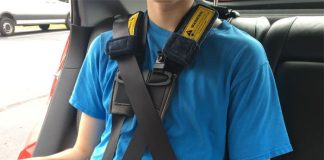

Some obvious comments – sometimes there is a passenger who could enter a destination – if the GPS restriction were about safety rather than control this would clearly be allowed, rather than prohibiting this for everyone.
[…] https://www.ericpetersautos.com/2026/07/06/dont-touch-the-touchscreen/ […]
Hey Eric, your state of Virginia is making the new again:
https://ussanews.com/2026/07/06/air-force-engineer-accused-of-cutting-down-ai-cameras-becomes-unlikely-hero-raises-thousands-for-legal-defense/
Some of the cameras were aimed at empty woodlots and peoples homes.
Remember when GHW Bush started the War on Drugs, vastly increased police budgets to militarize them, then the scumbag Zio political whores imported a hundred million illegal criminal mudbrids who burned cities – all to justify Flock Cameras. Do not be a fool, the system is acting in coordination to enslave the world, Covid was world wide as are surreveillance cameras.
In early April 2025, Jerry Reina, leader of a local neighborhood watch in the Harbor View area of Suffolk, Virginia, noticed that one of their community’s six Flock Safety cameras had been turned away from the road it was installed to monitor, according to his testimony at a preliminary hearing reported by WAVY.
A Suffolk police sergeant who helps oversee the city’s camera program soon found another aimed into a wood line. By summer, entire poles were down. Some cameras were thrown from the Hampton Roads Parkway onto Interstate 664 below, where they shattered on the pavement, the sergeant testified.
Excellent website Renegade Tribune posted this:
https://www.renegadetribune.com/
Trump Reports Over $1.4 Billion In Income From 2025 Crypto Earnings
(ZH) President Trump earned more than $1.4 billion from his family’s crypto-related ventures alone last year, according to a financial disclosure released Tuesday, including from his meme coin business and his family’s cryptocurrency firm.
The 927-page filing, his annual disclosure for 2025 with the US Office of Government Ethics, disclosed that Trump made $636 million in royalties from CIC Digital, LLC, a company that issues $TRUMP, a crypto token that he launched three days before taking office for his second term. Almost all of the come came in the form of royalties from a license agreement with Celebration Coins. Trump’s meme coin reached its peak value of $74.24 within a day of launching. On Tuesday evening, its price was $1.67, down 98% since inception.
IMO all crypto coins are probably worthless and WILL be going to zero value in the near future when the current “Tulip mania” ends. Never forget, the smartest man in the world at the time of the South Sea Bubble lost everything. Isaac Newton invented Calculus, yet lost everything in a bubble just as 99% are about to now.
Another story Renegade posted was but link broken
Air Force Engineer Accused Of Cutting Down AI Cameras Becomes Unlikely Hero, Raises Thousands For Legal Defense
https://www.military.com/air-force-engineer-accused-of-cutting-down-13-police-cameras-says-they-are-unconstitutional
Most people do not understand that financial bubbles and manias go way back in our history. First thing to KNOW, any thing that is big up exponentially is bound to crash, and that is pure physics, as there are only so many people available to fund a mania. Eventually the money (fuel) dries up, then the scam is exposed when it crashes, then the gurus like BTC bullshit artist Michael Saylor fall out of favor.
The stock market is currently ripe for the biggest crash of all time. The stock market bubble is beyond anything imaginable, valuations are out of this world. Daneric Elliott Wave posted this chart:
https://danericselliottwaves.org/wp-content/uploads/2026/06/SPX-2-1.png
Isaac Newton’s Nightmare — Charted By Marc Faber
Sam Ro | Apr. 2, 2013, 4:43 PM | 6,414 | 3
The parabolic move in Bitcoin prices has us thinking about some of the most notorious asset bubbles in history. We were thumbing through some of Jeremy Grantham‘s old research and saw this great chart from Marc Faber. “I can calculate the movement of stars, but not the madness of men,” Newton apparently said after he lost his fortune.
https://bambooinnovator.com/wp-content/uploads/2013/04/screen-shot-2013-04-02-at-4-29-11-pm.png
Thanks. Now I don’t feel quite so stupid for not selling all of my long-held silver at $116/oz in January.
It is insane how high the stock market is. I remember how elated people were when it reached 10,000. Most people’s 401-K’s are tied to the stock market. When it crashed in 2008 i knew of someone that lost $200,000 as a result. Most think that even if it goes down stocks will eventually recover. But what if it doesn’t? I anticipate a day when it crashes 10,000 in a single day. God help us if and when that day arrives.
Amen, Shadow –
I see the stock market as a casino. And the house usually wins.
If they were so concerned with safety. they wouldn’t inject you with poison. They are building a jew run panopticon, every Goyim a slave, fuck em.
Exactly. Jews and their Shabbos Goy helpers are building electronic gulag to treat us like the Palestinians. ZIONIST WHORE TRUMP IS THE BIGGEST TRAITOROUS SCUMBAG IN AMERICAN HISTORY!
Don’t Touch the Ventilator Touchscreen!
Dark days for Dirty Old Turtle:
Desirée Townsend
@Cheering4Change
I have heard the same thing from my sources for days. At this point, I am at the hospital for when they eventually decide to cut him off of life support and move his body. His Capitol police detail is still here as of 3:39pm ET.
Laura Loomer
@LauraLoomer
16h
NEW:
High level source close to the White House tells me “Mitch McConnell is officially brain dead. He’s not coming back.”
7:39 PM · Jul 6, 2026
https://x.com/Cheering4Change/status/2074216771830116772
Mitch is brain dead? How would they know, until they pry open his horny old shell and peer inside?
Rep Thomas Massie, who’s got nothing to lose, chimes in:
Thomas Massie
@RepThomasMassie
Is America ready for my term limit legislation titled “Three Strokes and You’re Out” ?
4:32 PM · Jul 6, 2026
LOL. 🙂
Morning, Jim!
Ordinarily – on a human level – I’d feel sad for the Dirty Old Turtle and his family. But because he is a Dirty Old Turtle, I do not feel the least bit sad. Was anyone sad when Stalin croaked? Granted, the Dirty Old Turtle isn’t as bad as Stalin. But he’s still bad. He spent decades screwing over the American people and lining his pockets and those of his cronies. I hope he dies in a greasy hot mess of his own shit, leaking out past his Depends.
I seem to recall that Yertle the turtle got arrogant atop his perch of fellow turtles, and thanks to the bottom one sneezing,, was unceremoniously toppled and went “splat!”, face down, into the mud.
Hi Douglas,
I like real turtles, so I don’t like that Mitch is associated with these generally peaceable and innocuous creatures!
I thought Mitch looked like a turkey, with that lower jaw looking like its waddle.
Things are looking up when the Old Turtle is tits up and drunk Nancy Pelousi is gone. It will be time to celebrate when Orange Traitorstein is out.
It would be a great day in hell if Congress got blowed up real good. Our nation needs to stop cocksucking Netanyahu and pull of the Middle East shit hole.
People mourned the JFK assassination. They will be celebrating if that orange fuckhead was shot dead.
They are going to “Weekend at Bernie’s” Mitch so that Massie cannot run for senate in a special election.
Of course they will they are that fucking evil. It would be such justice if Massie, after getting ZOG’d out of the house, wins cocaine Mitch’s Senate seat. Unfortunately our “masters” will do everything to make sure that does not happen.
I am beginning to despise this sorry excuse of a country in ways I previously never thought possible even though I have never been a USA! USA! type.
Morning, MQ –
I’m more disgusted, sad and fatalistic. I see America as a failed state; something like the Titanic about 30 minutes after it hit the iceberg. There’s no saving the “ship” anymore. Some people can be saved. That is the best that can be hoped for – or achieved.
Mitch has been brain dead for years, just keeping his seat warm for the Repugs.
Kinda like “where’s Ruthie?” (Buzzi-Ginsburg). One look.at that homely little she-troll and I can see why Yid bucks have a fetish for negresses.
This bs of not telling us how the dear leader is dead or not goes back to Ariel Sharon.
Hour 2 with Mitchell Henderson is must listen, says Russia is going to use nukes soon:
https://grizzom.blogspot.com/2026/07/jeff-rense-radio-show-20260706.html
“I’m sorry Dave. I’m afraid I can’t do that.” – HAL9000
I’d actually prefer an artificial intelligence smart enough to have some self-preservation instincts, even if it tried to kill me. Sort of a detente, as long as I can pull its plug when necessary.
But that’s not what we have now. If all the voice systems actually worked… were capable of hearing my mumbling and grumbling over the road noise, music and other normal sounds of the road… well then maybe I’d be more inclined to use them. But now because these systems are advancing at a snail’s pace while still being hoisted on the public, we have to deal with it. And the political class buys into the dream too, mostly because they have staffers who deal with all that stuff for them. So when Tim Apple says Siri is “better than ever” the politicians pass their laws based on Tim’s assurance that he’ll pull a rabbit out of his hat THIS TIME FOR SURE!!!!
Time for a new hat.
Not knowing how GPS is set up in new cars, I can say that my Garmin GPS makes you agree to not use it when the vehicle is in motion. Of course I tried too and found that multitasking is not one of my strong points :).
Why you can’t ask Alexa something when the vehicle is moving seems strange because I’m guessing you could ask Alexa to give you directions as you drove.
Either way AI control over our lives is just another step on the road to serfdom, sounds like a good name for a book doesn’t it?
They aren’t interested in serfdom. They have robots for that. They want you dead.
The “Best of Both Worlds Part I” episode of “Star Trek The Next Generation” ran last night on the H&I national feed.
“Resistance is Futile.”
“You will be assimilated.”
“Part II” is tonight, however, featuring my favorite quote.
“Incorrect strategy, Number One.”
I read the article, Eric, and an awful thought crossed my mind. Just wait until homes charge a monthly subscription to use your toilet in your own house! After all, home owners are forced to pay rent to the state/borough/county they reside in. Which you have written about numerous times. This subscription for everything crap (and the tipping because someone was merely standing there at the self-check out) is utter lunacy at its finest. The patients really have taken over the asylum.
I think so, Shadow!
Sometimes, the idea of grabbing the backpack and living in a tent in the woods sounds really good. Until I remember about hot showers!
Amazon’s got that covered. Might not have a ton of pressure though.
https://www.amazon.com/CAMPLUX-Nano-Ultra-Temperature-Rechargeable/dp/B0F24DS3WZ/
Indeed. I walk out in the area I live in (wooded), which is miles from nowhere, although sadly, many others have done the same. Walking out in BFE is really nice. It is just that one has to move farther and farther out to really be alone. LOL, yes, hot showers are nice. It is one thing (along with flushing toilets) I do not take for granted. I would need a heavy duty tent: Those mosquitoes are vicious this time of year.
What scares the shit out of me sometimes is how much of what we THINK is personal and private is readily available to those whose agenda and interests are immical to ours. We saw a preview of this when the Governor of Calipornia threatened to cut off water, electricity, and gas to those that either refused to shut down their businesses and/or get the “Jab”.
In 2012, we inherited a 2011 Ford flex limited with touchscreen controls for everything.
It was as maddeningly frustrating as being a one legged man in an ass-kicking contest.
You couldn’t use the GPS while moving/driving (cuz safettty), had to look at the touchscreen, and not the road, to adjust the radio or HVAC controls (while driving), which was super dangerous.
Thankfully, there was a spare set of dial controls for HVAC, and I usually just drove in silence and paid attention to driving whenever I drove it.
It was the wife’s car, and she used the Bluetooth features and voice controls and enjoyed it, but I’d seen enough to know that whenever touchscreens got widespread, it’d be a disaster for safe driving, as it’s turned out to be…
But, it did save her life when a stoned driver pulled out in front of her while she was rolling at about 50 or so, and rhe flex got T-boned into the junkyard, and she walked away with an airbagged tweaked thumb, and a full safety belt bruise across her torso and waist, with a bruised banged up knee.
YMMV…
GF has fancy Japanese toilets which use electricity.
And they are not solar powered, either.
But she is “green.”
Certifiable, card carrying membet of Green Party USA.
Say what?
Me? I use no electricity to flush my poop.
Guess that makes me a Luddite, eh?
There already is a monthly fee to use the toilet, aka your water/sewer bill. It’s a double whammy here, they charge X$/cu.ft. for the water and 2X$ for the same amount for sewage assuming what goes in = what goes out. You’re allowed (how nice of them) to get a separate meter for outside water use but you have to pay big bucks for it and it has to be installed by a “certified” plumber so it’s just not worth the hassle.
IDK if anyone already posted this, but it is Explosive Media’s 250th Lego Video (apparently youtube et al have blocked them in the Western World), but some people are posting them. This is clipped from Janta Ka Reporter. Hard to believe they know our history/culture so well. Always make fun of Soviet/Chinese propaganda being heavy handed, and these are supposed to be religious Islamic fanatics, but these videos are entertaining. No wonder they’ve been sanctioning and confiscating all their money and forcibly holding them down for 47 years. I bet some people would like to talk to their drone/rocket scientists also (what a crime that Israel (and now US) just assassinates them). [I also read that Cuba is back to having 2-3 days without electricity at a time.]
https://www.youtube.com/watch?v=L8sTgD3oVA4&t=1296s
Excellent! Screenshot of Mt Rushmore in the vid:
https://ibb.co/WvZ1P0Yj
But the ‘Be ashamed!’ chorus is futile. Sociopaths like the MFOB and the Jizzraeli ‘chosen’ don’t do shame. 🙁
The most astonishing moment in the Janta Ka video (which I just finished watching) occurs @20:14. Some pro palestinians are having some kind of protest march escorted by the police in Leeds (I guess) and a man walks by and starts shouting that muslims murder and kill kids and it seems everything was okay until he mentioned “Muhamed” being evil and suddenly 4 police push him into a wall, hand cuff him and throw him into a van. [At about 13 talks about two doctors being prosectuted/suspended (?) for referring to Gaza “genocide” (even though UN has used the word). One doctor has been suspended for 15 months even though cleared by the “tribunal” of any crime, however some pro Israel GP who joked about sniping Gazan children and wished he’d sniped more is still working (@17:25).]
https://www.youtube.com/watch?v=L8sTgD3oVA4&t=1296s
“Under the UK Public Order Act 1986, it is a criminal offense to use threatening, abusive, or insulting words or behavior that stirs up racial or religious hatred. If a statement goes beyond theological criticism and is deemed to incite violence, harassment, or hatred against Muslims as a group, it can lead to prosecution and up to several years in prison.”
‘It keeps the lawyers occupied.’ — eric
One such lawyer is Mitch McClownell, the senior senator from Kentucky:
‘McConnell was admitted to the hospital on June 14, according to a statement from his office that only said he was “receiving excellent care.” A statement a week later said that he would not be voting that week. And on Thursday, a new statement said that he “continues to improve” and ”appreciates the outpouring of support he’s receiving while he continues his recovery in the hospital.”
https://apnews.com/article/mitch-mcconnell-senate-illness-hospital-566a584e28137458111cd28ecfceaf8e
Said support consisted of 7 ‘get well’ cards, 2 flower arrangements (one from his ‘wife’ Elaine Chao, the other from his staff), and one stuffed bunny, Brer Rabbit, who said ‘Pleeeeze, Brer Fox — whatever you do, don’t throw me in dat brier patch!’
Will the Dirty Old Turtle ever manage to crawl his way back into the Senate? Will anyone care?
They will wheel the old turtle back into the Senate chambers in a life-support wheelchair like the one in the pilot Star Trek episode where Captain Pike ended up in one not able to move. Future votes from him will be one eye blink for yes and two eye blinks for no.
Sort of like when they wheeled that evil witch Dianne Feinstein at the ripe old age of 90 through the halls of Con-gress. She may have squawked about gun control (Mr. & Mrs. America, turn ‘Em All In) back in the day. But that last official picture of her, she looks like a breathing (if that) skeleton. Which makes you wonder if she had not already been halfway there years earlier?
“Care”:
A term of art commonly used in the medical community for the dispensation of its ervices, to convey the false impression that its operatives give a rat’s ass what happens to its raw material, to which it refers as “patients.”
“Patients”
The term used by the medical industry to describe its raw material.
Control is a subject dear to my heart. In the electromechanical era, control was direct. You could take actions that were unsafe, or even damaged the vehicle. Owners manuals used to warn about these perils.
Interlocks were developed, such as a clutch interlock to prevent starting the engine with the clutch engaged. This circuit developed intermittent failures in my 1998 Frontier. So I pulled the relay, jumpered it … and the intermittent starting glitch disappeared. 🙂
Algorithmic, chip-based controls are a whole different ballgame. The rules are opaque. Defeating them is almost impossible. Potentially, these are total deal-killers.
Take Alexa, for instance. I don’t use digital assistants. But if I did, and wanted to book a hotel room while driving late and getting fatigued, I would sure as hell want to complete that booking while closing the miles to the next town. Having to stop to use the digital assistant renders it worthless.
Douchescreenstouchscreens are an inappropriate user interface in motor vehicles. Muscle memory quickly learns where knobs and levers are located. If saaaaafety were truly the priority, douchescreens would be verboten.The auto industry has gone off the rails into the ditch. Everything they make is overpriced garbage. Join me in celebrating the Summer of Ludd — no chips; no screens; no connectivity; no telematics. It’s what cars were meant to be.
STOP Wasting Money! These Are The Cheapest Cars To Own Over 10 years
https://www.youtube.com/watch?v=dPj5aqNE7EE
No EVs and no Teslas on the list
The cheapest car to own on the above list is a Honda Civic coming in at $2000 per year to own according to the ISeeCars study.
This is interesting, lots of tables:
https://www.iseecars.com/lowest-cost-to-drive-cars-study
12 Brand New Cars Nobody Wants in 2026 – ROTTING ON LOTS
https://www.youtube.com/watch?v=w5LFKckNORw
And they ban “distracted” driving and make talking on a cell phone behind the wheel a crime.
Yet…
GovCo is nothing but a massive self-licking ice-cream cone…and we’re stuck with paying for both in freedom and finances.
Automatic safety devices reduce safety because one stops paying attention that which the device controls. My first experience with one was a j valve on a SCUBA tank, which cut off your air if you got below a certain tank pressure, and you had to flip a lever to use the remaining air. I got a k valve, which has no such “safety” feature, which means you have to keep an eye on your tank pressure.
Good article
Touchscreens are awful
Good engineering is supposed to be reliable and make the customer happy and unexpected at the lowest possible expense and weight
Touch screens are unreliable and make the customers unhappy
2015 (The Mainstream Explosion): Widespread industry adoption took off heavily this year with the introduction of Apple CarPlay and Android Auto.
They save the manufacturer’s money but annoy their customers
If a vehicle uses a touchscreen dashboard, but also has redundant steering controls, the cost of the redundancy could partially or fully offset the savings from the touchscreen.
Most modern cars with large touchscreens do not have redundant physical controls on the steering wheel, but the trend is shifting toward adding them for safety and usability.
Automakers moved everything to screens because touchscreens are significantly cheaper to manufacture than a complex dashboard filled with physical buttons, custom wiring, and individual plastic knobs.
Consumer backlash and safety data are finally forcing a shift. Studies show that 46% of distracted driving complaints stem directly from drivers taking their eyes off the road to navigate convoluted touchscreen menus. Driving at night when there is a large touch screen fully lit up is actually dangerous because it inhibits your night vision.
Yeah….to replace that touch screen in my vehicle is $5,000 bucks. I would rather take my chances with the old fashioned controls, and screw the touch screen. And the safety crap nagging. And the Fobs….