

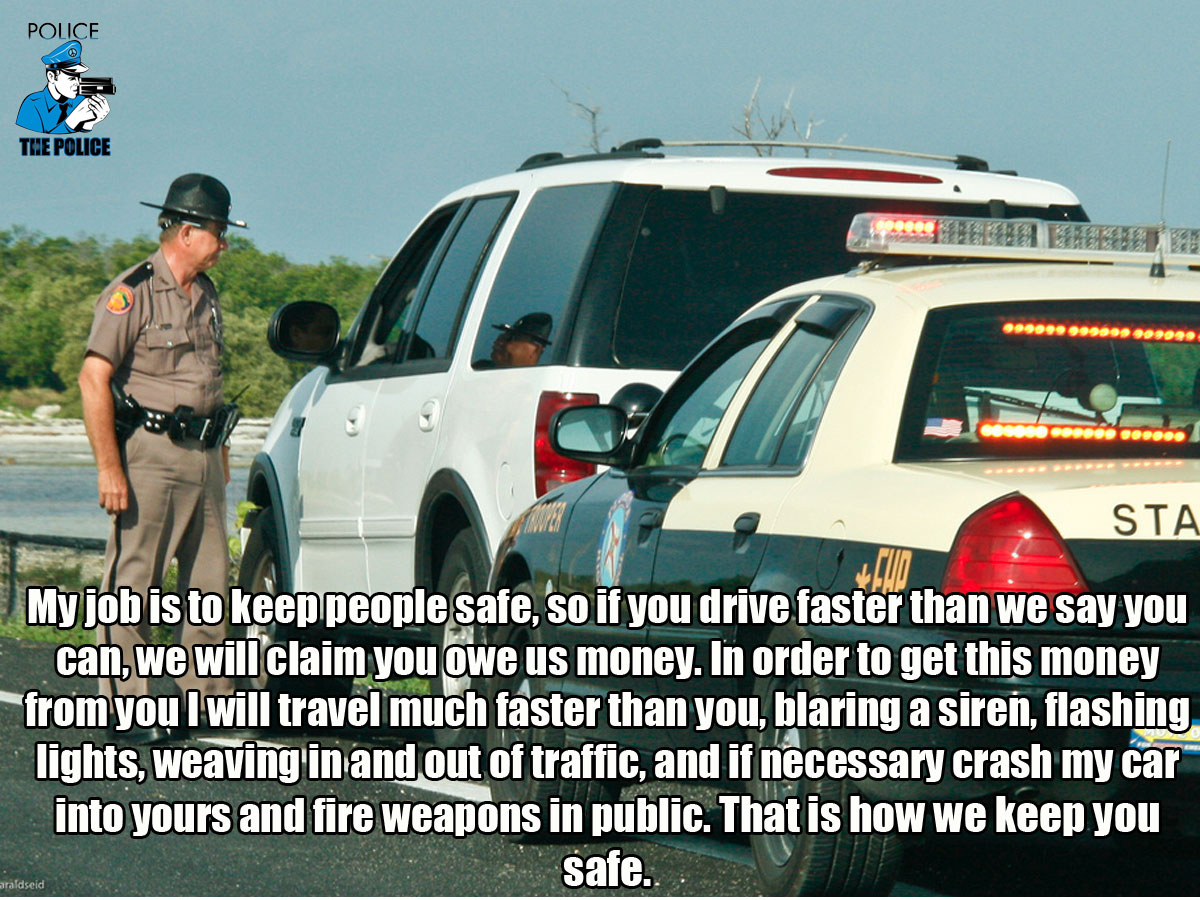

Here’s an interesting little clip of a “speeder” attempting to catch a “speeder.” A speed limit enforcer sits by the side of the road. A “speeder” passes by. The speed limit enforcer “speeds” in order to catch up with the “speeder,” who then “speeds” away, very quickly. The speed limit enforcer than “speeds” – at very high speed – for more than five minutes, chasing nothing because the “speeder” is long gone. During those five minutes, the speed limit enforcer drives at speeds well in excess of 100 MPH – which was faster than the “speeder” was driving when he drove past the speed limit enforcer. The enforcer keeps on “speeding” – at very high speeds – long after it’s obvious the “speeder” has “gotten away with” his “speeding.
So has the “speed limit enforcer.”
Few people seem interested in asking the obvious questions.
The first is why is it that these speed limit enforcers are empowered to drive at speeds that would land anyone else in jail? Does “speed” not “kill” when it is a speed limit enforcer who “speeds”? Some will say it is necessary – and so justified – to empower speed limit enforcers to “speed” because how else are they going to catch up to “speeders”? This brings up the question of speed limits themselves. Why should it be a matter for law enforcement? Speed advisories can serve a valuable informational purpose. There’s a curve up ahead and you might want to slow down, assuming you are unfamiliar with the road. 
Speed limits are arbitrary Thou Shalt Nots. There is nothing inherently wrong (morally) with driving faster than a sign says you’re allowed to. If that were not true, then “speeding” would not be something almost everyone consciously does almost every day. We do it because we know there’s no harm in it. It is why we do not feel moral guilt or shame when we get handed a “ticket” because a speed limit enforcer caught us driving 47 in a zone with a posted 35 MPH limit that almost no one obeys – unless there is a speed limit enforcer around.
During the era pf Prohibition, when it was illegal to buy or sell or drink alcohol, people weren’t ashamed about ignoring the law that said Thou Shalt Not Drink – because they knew that having a drink was not immoral because having a drink didn’t cause any harm to others. It’s the same with “speeding.” As was true during Prohibition, only a small handful of Puritan hysteric types disagree. As was true back then, even the enforcers agree – though they pretend to disagree.
Sometimes, they stop pretending. As in the case of this “speeding” speed limit enforcer. If he truly did believe the lectures he almost certainly dishes out to the “speeders” he catches he’d have stopped “speeding” (at triple digit speeds) as soon as it became obvious he was not going to catch the “speeder.”
Instead, he “speeds” for about five minutes.
It can’t be said for sure because there’s no way to know for sure, but probably the speed limit enforcer took advantage of his opportunity to do some serious “speeding.” The kind of “speeding” he’d arrest and haul off to jail anyone else for doing.
That’s what makes it despicable. Rules for us but not for them. Insult added by the insipid lectures and how it’s all about keeping us “safe.” . . .
If you like what you’ve found here please consider supporting EPautos.
We depend on you to keep the wheels turning!
Our donate button is here.
If you prefer not to use PayPal, our mailing address is:
EPautos
721 Hummingbird Lane SE
Copper Hill, VA 24079
PS: Get an EPautos magnet or sticker or coaster in return for a $25 or more one-time donation or a $10 or more monthly recurring donation. (Please be sure to tell us you want a magnet or sticker or coaster – and also, provide an address, so we know where to mail the thing!)
If you’d like a Baaaaa hat or other EPautos gear, see here!







The Austro-Libertarian economist and historian Murray Rothbard famously argued that America was conceived in liberty.[1]
This new frontier emerged largely unburdened by government taxes and monopolistic regulations, setting the stage for a vigorous intellectual contest between proponents of small and big government.
This ideological struggle has been vividly embodied by two opposite Founding Fathers: Alexander Hamilton and Thomas Jefferson.
This intellectual divide has also manifested among historians, with advocates of expansive government championing Hamilton, while defenders of limited government extol Jefferson.
Both camps agree that Hamilton was the architect of the U.S. government **and financial system, yet they evaluate his legacy in diametrically opposed ways.
Historian Ron Chernow outlines Alexander Hamilton’s accomplishments, though with an apparent pro-Hamiltonian bias that colors his analysis.
“He had prevailed in almost every major program he had sponsored—whether the [central] bank, [debt] assumption, funding the public debt, the tax system, the Customs Service, or the Coast Guard—despite years of complaints and bitter smears. …
helped to transform the role of the president from passive administrator to active policy maker,
creating the institutional scaffolding for America’s future emergence as a great power.
He had demonstrated the creative uses of government and helped to weld the states irreversibly into one nation. …
If Washington was the father of the country and Madison the father of the Constitution, then Alexander Hamilton was surely the father of the American *government*.
… Hamilton left the government determined to repair his finances and refurbish his legal practice. Moreover, by then he was so controversial, so divisive, that the mere mention of his name could trigger debates.” (Ron Chernow. Alexander Hamilton. (2004) pp. 481, 509.)
Especially from a libertarian perspective, the decisive clash between Hamilton and Jefferson stands as the turning point in world history.
A victorious Jeffersonian vision of mniimum or no government, the famous “Empire of Liberty”, would have unleashed freedom and Industrial Revolution across the globe while largely sparing humanity its darkest downsides
—crony monopolies, taxes and regulations, central bank led cartel economy, imperialist wars, and the centralized police-warfare state
that Hamilton’s system ultimately birthed.
Jeffersonian freedom could have delivered steady 5–10% annual growth instead of the 0.5–1.5% average plagued by violent business cycles and destructive wars, thereby rapidly lifting the whole world out of poverty into peace and prosperity.’
My impression is that this is not a job that attracts a particularly sharp or thoughtful kind of person. It’s not something I would be interested in doing.
Speed limits
On many of the roads I drive along in London, the limit is 20 mph. My Grandma does more than that in her invalid carriage. Coupled with this oppressively low limit, there are speed bumps, chicanes and some stretches of road have had four feet stolen from their width to create ‘cycle lanes’, which are fence-posted off, constricting the carriageway so that you cannot overtake another vehicle without lurching into the opposite lane. Very safe!
It’s all part of the ‘environmental architecture’ war on private car ownership.
We have big bright yellow boxes here which house speed cameras, but ANPR cameras are black, and high up and sneaky. Some enterprising vigilantes are using angle grinders to cut down speed cameras. Since I am a law abiding creep, I couldn’t possibly comment.
Air Force dude charged with vandalizing Flock cameras, says they’re unconstitutional:
https://www.wavy.com/news/local-news/suffolk/detective-suffolk-man-accused-of-damaging-flock-cameras-said-theyre-unconstitutional/
Kinda ironic considering that he works for the ZOG military-industrial complex… but I’d vote to acquit
Q. Who would most like having no speed limits and banning all high speed police chases?
A. Criminals
People who want no speed limits and no high speed police chases are either criminals or support criminal activity. President grump would call him the worst of the worst
9% to 10% of high-speed police pursuits result in a collision specifically involving the police vehicle
Between 30% and 45% of all high-speed pursuits end in a crash of some kind, most frequently involving the suspect vehicle or innocent bystanders.
Because of these high accident rates, many law enforcement agencies nationwide have shifted toward more restrictive pursuit policies, limiting high-speed chases to suspects of violent crimes rather than traffic infractions or property theft
If there were no speed limits, the U.S. would likely see more crashes, more severe crashes, and more fatalities.
In the United States, police officers are generally not allowed to drive faster than the posted speed limit unless they are responding to a genuine emergency or actively pursuing a suspect.
The general rule is that police officers should call off or disengage from a pursuit when the risks to human life and property outweigh the benefits of immediate apprehension.
Prolonged chases are generally limited to serious violent felonies or situations where the suspect poses an immediate threat to public safety
High-speed pursuits are the highest-risk activity for at-fault accidents. The Police Executive Research Forum notes that 30% to 45% of all police pursuits end in a crash & 50% of officers killed in cruiser accidents were found to not be wearing their seatbelts
Richard writes:
“People who want no speed limits . . .are either criminals or support criminal activity.”
Why, exactly?
I do not support criminal activity and I am not a criminal, either. I do “speed” – but how does that make me a criminal? Because “speeding” is illegal? Well, if it became illegal to step on a crack – because it might break your momma’s back – would it be a crime to step on the crack anyhow?
Your comment is the perfect example of the difficulty many people have understanding what a “crime” is. People like you think it is a violation of law. Just because that’s the law. People like me think that for there to be a crime – morally speaking – there must be a victim. An actual human being who has in some tangible way been harmed by the actions of the criminal. If I shoot someone or use a gun to force someone to hand over money then I am a criminal. How am I “criminal” for driving faster than a number on a sign says I am allowed to?
I’ll go further. I consider it a crime to punish people in the absence of any harm caused, on the sole basis that a “law” was not obeyed.
I know – people like you say that driving faster than whatever the sign says constitutes a threat of harm and that makes it actionable. But can you not see how subjective – how arbitrary – that is? It is the same logic that was used to impose “mask” wearing on people.
Maybe it is dangerous for you to drive faster than the speed limit. But maybe it isn’t for me. Why must I be punished for not causing harm to anyone because you worry I might?
Speed limits – in practice – have little if any relation to reasonable/safe travel speed. Most people naturally drive at a reasonable/safe speed (for them) because most people are not criminals and do not purposely risk their own lives or the lives of others. I do drive fast, but I am an excellent driver and drive within my limits. The fact that mine are probably higher than yours is not a justification for demanding I be punished for exceeding your limits.
“Speed limits – in practice – have little if any relation to reasonable/safe travel speed.”
That’s not typically true unless the local John Law and his city council enablers set up a stretch as a speed trap.
The large majority of the time is it not arbitrary in the way you imply, as a number picked from thin air. There is a baseline standard used that sets the posted speed limit is usually set at 85% of the design speed, which is done so that if traffic is at the speed limit cars can execute a pass, which requires going faster, without exceeding the car/road physics.
Design speed then has several variables.
Some are obvious in the pavement condition, turn banking, sight lines but a road isn’t a closed race track so design speed also takes into account entry and exits, shoulder width (in consideration of break-down clearance) and chance of pedestrians or wildlife strike, guard rails.
There are issues in the design standard because a common vehicle is assumed so of course a motorcycle or sports cars has a higher capability than a family sedan, which itself handles better than a box truck or semi. So the posted limit can’t be true for every individual vehicle and driver.
But we all share the road so there’s always going to be conflicting interests among users. Even without governments and standards a private road owner would have to do something to maintain order. A high speed limit would mean limiting the types of users, for example the road would be essentially start trending towards a track if it caters to high speed capable cars. A road suited and used by heavy truck will always be far too low speed in a Corvette.
Or training requirements, for example the Autobahn, where licensing requires driver to demonstrate an understanding of how to safely overtake or be overtaken when there is a very large difference in vehicle size and speed. You might think you’re a good driver and you might very well be but when you’re traveling at 30 MPH faster than prevailing traffic and someone doesn’t expect it and pulls out in front of you there’s a problem.
It’s not speed that kills, it’s large differences in speed that kills mainly because even the best daily driver simply does not have the subconscious peripheral perception and reaction skills of a professional race driver in fast changing situations.
Beyond this, most road authorities have a process in place to adjust speeds up or down. A speed limit may tick up if traffic flow is smooth and there are no accidents over time. That’s actually what’s happened as the power and handling of cars has improved. Interstates that were in many cases designed for 55 MPH speed limits can actually be safely used now at 65 and 75 MPH. What often held back speed limits is a troublesome spot, maybe a curve or lack of sight, and that large trucks are still large and slow. So it’s usually preferred to keep a speed limit predictable and consistent because most drivers kind of are dullards and will either ignore (EVERYONE thinks they could have been an F1 driver, it’s always the other person who’s a bad driver) or just not see a warning sign of an impeding need to slow down.
Yes, but …
The core issue here, in my view, is this business of punishing people who’ve caused no harm on the assumption that they might. This is, obviously, both hypothetical and hugely subjective. Which is why it’s dangerous – in the sense that it empowers busybodies and tyrants. It also corrupts what – in a free society – would be the peace-keeping function into “law enforcement.” That is, legalism – Talmudism – this idea that the law must be obeyed (and enforced) simply because it is the law. Not because a wrong has been committed.
Put another way: It does not matter – under legalism – that no one has been harmed; that there is no victim. This is morally outrageous.
Why is it that almost no one ever feels ashamed or guilty for “speeding”? Obviously, it’s because they know they didn’t do anything wrong. So why are we punishing people for not doing anything wrong?
Going 100 mph in a quiet residential street is obvious criminal negligence, let alone extreme foolhardiness.
Hauling ass at about the same pace, between Ely, NV, and Delta, UT, on a bright, sun-shining December afternoon, ambient temperature 19 degrees Fahrenheit, dry payment, is simply, with dry pavement, little if any traffic on US 6/50, and no winds to speak of, getting across 153 of boring desert as quickly as possible. Especially with a then brand-new 2020.Ford Fusion which on straight stretches was hitting 115 mph and still.was turning only 4800 rpm. Did it in but 97 minutes. Do the math. BTW, made it to I-15 in Nephi before the black ice began to form!
Also, Richard –
I assume you have been ticketed for “speeding” at some point, since virtually every driver has been ticketed for “speeding” at some point. Did you feel ashamed? Did you feel guilty; i.e., that you had done something morally wrong and deserved to be punished? I doubt it. I doubt many (if any) people handed a ticket for “speeding” feel ashamed or guilty. What most of us feel is pissed.
Now, this is interesting – if you think about it a moment. Are most people sociopaths? They must be, if the do not feel shame/guilt when caught doing something “the law” says is wrong. If they routinely do things that (supposedly) cause harm to others. Such as (in your view) “speeding.”
On the other hand, what if most people are not sociopaths and normally do feel guilty and ashamed when they do something actually wrong? Especially so when what they did actually caused real harm to someone else.
Ponder my words, as Allowat Sakima says.
no speed limits and no police high speed chases
= bad news for crime victims
whether the posted speed limits are too low, or whether policeman give out too many speeding tickets, are two different subjects.
i want my local cops to chase criminal felons trying to get away from their crimes.
In most jurisdictions, including regional departments like the Detroit Police Department and the Michigan State Police, officers are authorized—and expected—to actively pursue suspects who are fleeing from violent or life-threatening felonies.
The probability of getting a speeding ticket in Michigan when you are doing less than 5 miles an hour over the speed limit is very low
Stolen cars have historically been a major catalyst for high-speed chases in Michigan.
Because of the high frequency and dangers of these incidents, the Michigan State Police (MSP) enacted a strict policy change restricting pursuits.
Under this directive, state troopers are barred from chasing suspects for property crimes—explicitly including stolen vehicles—unless the suspect has committed or is about to commit a life-threatening, violent felony
Oakland county Michigan, where i live
2019–2023: +140% increase in auto thefts
effective March 14, 2024:
Under the new rules, troopers may only initiate a vehicle pursuit if there is probable cause to believe the driver or occupant has committed a life‑threatening or violent felony (e.g., murder, attempted murder, kidnapping, arson, armed robbery)
This means for most traffic‑related offenses — such as failing to stop for a traffic ticket — police will no longer engage in high‑speed chases.
Richard,
You’ve spewed a bunch of non sequiturs; in other words, you evade dealing with the questions I asked. This tells me you have no good answers.
You asked four or five questions
am i being interrogated by the armchair anarchist?
Richard,
Let me address one of your non sequiturs. You write: “i want my local cops to chase criminal felons trying to get away from their crimes.”
Well, so do I. I have no problem with cops pursuing criminals. I do have a problem with cops pursuing “speeders,” because it is not criminal to “speed.” The idea that it is is just silly – and I think (I hope) you know it is.
If you think it is “criminal,” then you must think almost literally every driver is a “criminal,” since almost literally every driver “speeds.”
The question arises: Why is it that almost literally every driver “speeds”? Do you believe these “speeders” – which is basically all of us – are sociopaths? Or is the better explanation that speed limits are just arbitrary constructs and that is why most of us do not feel morally chagrined when we “speed”?
I am truly fascinated by your mentality. By your reverence for arbitrary/subjective laws and for punishing people who transgress them. Also by the implicit liking for dumbed-down, one-size-fits-all standards. You believe that because some people cannot safely drive above a certain speed, everyone must be punished if they drive faster than that speed.
Yours is the same mindset that wants carrying guns to be made a crime because criminals use guns to commit crimes.
“for most traffic‑related offenses — such as failing to stop for a traffic ticket — police will no longer engage in high‑speed chases”
that comment from my last post refers to michigan rules for police since 2024, and it makes sense
for catching speeders police should only be able to speed to catch the license plate of a car and that’s it
“Why is it that almost literally every driver “speeds”? Do you believe these “speeders” – which is basically all of us – are sociopaths?” EP
80% to 90% of drivers admit to driving over the posted speed limit at least some of the time, making even minor speeding an overwhelmingly common behavior.
Because standard traffic engineering deliberately sets speed limits based on the 85th percentile rule—the speed at or below which 85% of people naturally drive—nearly 15% of drivers are exceeding the limit on a given road at any random moment under free-flowing conditions.
The percentage of people who exceed the speed limit would generally decrease if the speed limit were raised by 5 or 10 mph.
Whether speed limits are too low is a subject worth debating
Eliminating all American speed limits would lead to a substantial increase in both the number and the severity of traffic accidents.
Decades of traffic safety data, physics principles, and highway studies show a direct correlation between higher travel speeds and an increase in crashes.
Only an armchair anarchist would lobby for no government, no taxes & no laws, including no speed limits.
Hi Richard,
Why do you assume that, absent speed limits, most people would drive recklessly? I drive fast – faster than the sped limit – but since I am no a sociopath or suicidal, I drive within what I consider to be reasonable limits for me, the vehicle and conditions. I think most people do the same. The speed I drive may be faster the speed you are comfortable driving. So? Does that make it dangerous? Only hypothetically – in the sense that if there is a crash, the resultant impact forces will be greater. It does not mean there will be a crash or even that a crash is more likely.
You admit that most speed limits are bullshit. But then go on to defend speed limits!
You assert that “Eliminating all American speed limits would lead to a substantial increase in both the number and the severity of traffic accidents.” Well, it was asserted that Drive 55 “saves lives.” Bullshit. All it did was generate millions in “revenue” extracted from drovers who were driving at reasonable speeds.
GovCo operates on the premise that everyone is a psychopathic suicidal killer and legislates accordingly.
I think it’s psychological projection.
Richard writes:
“Only an armchair anarchist would lobby for no government, no taxes & no laws, including no speed limits.” I have no idea what an armchair anarchist is. I am a professional writer who writes (professionally) about libertarian-anarchist subjects; so I do not see where the “armchair” part comes in. You, on the other hand, are an armchair rider – in that you don’t ride motorcycles but presume to give advice about riding to those who do.
As far as no taxes: Of course. I do not believe any form of robbery or theft is morally justifiable. You can try to argue that “taxes” are not robbery or theft. I do not see how you can argue that position intelligently.
The only laws that are morally justifiable are those that protect everyone’s rights and provide remedies for people whose rights have been abused.
You are a believe in Talmudic law. That is, statutes that must be obeyed because they are “the law.” Whether they are morally right is not a consideration under Talmudic law. Only that “the law” be obeyed.
And how often is that? Hopefully not much, else it calls into question the lawlessness of Michigan’s.
But some hauling ass on a lonely stretch of Utah or Nevada highway is hardly a dangerous felon. Maybe should he “lose it”, he’s “Spam in the can”, but unless he involves others, imprudently, what HARM has he done?
OTOH, if the:coppers” didn’t chase Barry Newman as Kowalski, driving that ’70 Challenger with the 440 Six-Pack we don’t have “Vanishing Point”, do we?
I would submit that speedometers and speed limits encourage lawlessness.
When the 55NMSL went into effect everyone knew that driving faster than that was perfectly fine and thus most, if not all, ignored it to some extent. Where previous to this some people would (85th percentile rule) “speed” the numbers on the sign were, for the most part, prima facia. Now they became absolute.
People openly defied this new mandate. Radar enforcement created radar detectors. Respect for cops plummeted as they were now viewed as “law enFORCErs” instead of a constabulary.
Focus on the sign and the needle became the highest of holies.
However.
If you take away the signs and the needles people focus on DRIVING not some arbitrary bureaucratic edict from On High. People then focus on the terrain and other drivers. Situational awareness, that is key to avoiding collisions, skyrockets.
If you’ve never driven a vehicle that didn’t have a speedometer, it’s quite liberating. No longer do you think about “that other guy is speeding” because you’re more focused on what YOU are doing as opposed to others.
Slower traffic keep right on multi-lane highways and if you’re on a two-lane, have the courtesy to let faster traffic by.
Now, how will the GovCo Criminal Justice [sic] System and the insurance mafia deal with the loss of revenue? Tough shit. Suck it up buttercup.
Our sad reality is we live in a (((Police State))) and have for over 90 years, and the noose just keeps getting pulled tighter a little at a time.
Our “fearless leaders” have been instructed by (((TPTB))) to figure out ways to extract our wealth thru various schemes such as traffic violations, where no crime actually occurs, but an opportunity to steal your funds by operating outside of “their” rules.
Stalin said, “Show me the man, and I’ll show you the crime”…
And the Jew-USA said, “here, hold my beer… ”
Oy Vey!!!
YMMV….
I wonder how many times this revenue producing fucking piece of shit has written tickets for drivers for not keeping in the right lane except to pass? I bet close to none.
The only good one of these pricks is a dead one. Give me immunity and I’d gladly put a bullet in the back of any one of these cock suckers’s heads.
Amen, David –
He’s not by an outlier, either. I see cops “speeding” almost every time I go somewhere. Not as fast as this dude was “speeding,” but at “speeds” he no doubt “pulls over” people – not cops – for driving, routinely. They also don’t have to “buckle up” for “safety.”
The only way I’d ever become a cop would be if I could choose how to spend my shifts. I’d spend my entire time pulling people over for failures to maintain lane discipline and not signaling before turning or changing lanes. These are the primary contributors to traffic, which causes accidents, which kill people, so failure to allow traffic to flow as smoothly and predictably as possible is tantamount to murder, in my book.
Well shut my mouth. That’s one of the few Corvettes I’ve ever seen rolling that wasn’t going ~5 mph under the posted speed limit.
Kudos to the vette driver, I just hope the AGW’s aren’t able to track him down by his plate number, couldn’t see it well in the video.
Eric, I’m guessing you’re not quite up on the proper Puritan parlance. It’s ‘Thou shalt not…’ rather than ‘thou shall not.’ You’re welcome.
Roger, cobblestones – adjustments made – thanks!
This is a prime example of illegal vs legal. The only difference is who the government says who can and who cannot. Another example that affects all of us is counterfeiting vs “quantitative easement”. If an individual does it; illegal. If the government does it; legal. Never mind that both produce greenbacks out of thin air with nothing to back it.
Typical cop hypocrisy. “Rules for thee, but not for me.”
What pisses me off even more than the speeding is the cop exemption to the gun control laws. In every Blue state you have girlboss politicians with their panties in a bunch primly declaring “Assault weapons have no purpose but to commit mass murder” and “Weapons of war do not belong on our streets.”
And then issuing the very “assault weapons” they make it a felony for YOU peasants to possess, to the cops.
And to their protective details.
I guess that would mean the cops are “mass murderers” and “soldiers” engaged in war, am I right?
Crickets.
How about a little proposal here? ALL cops are required to abide by the gun control laws they enforce.
Better yet, ALL police officers in every agency, both state and federal, shall be limited to carrying .38 revolvers.
Just like Barney Fife.
How ’bout that, Ossifer Hero?
Or would being forced to abide by the same laws as the peasants shrink your already-small dicks?
It does confound me that the public has been so swayed that a sign on the side of the road = the legitimate and unquestionable rule of safe speed.
In our little town, there is a state road that runs through it. Under PA law, the state sets the minimum speed at 35 mph, yet the sign says 25.
There are rules to changing the speed that need to be followed, like obtaining a traffic study from the state and keeping that study and permission to modify as a public record. Yet when I checked with the state and the town, none of the documentation could be produced.
That doesn’t stop the cops from nailing people on the regular. The tickets they write are of course illegal, but who is going to take time off to fight a $150 ticket, even if they know the enforced limit is illegal?
Someone just DECIDED that 25 was what they wanted and made it so.
It’s Safe When Cops Do it
‘A skyscraper-scaling daredevil told police that he and his girlfriend climbed the Empire State Building’s antenna and unfurled a banner because he wanted to “do something special” for their engagement, prosecutors said Thursday at the couple’s arraignment on felony reckless endangerment, burglary and other charges.
‘Police waited about a half-hour for the antenna to be powered down before Emergency Services Unit officers started ascending and eventually intercepted the climbers on their way down, according to the complaint, which noted the danger to officers who climbed about 1,250 feet (381 meters) above the ground.
‘Ivan Beerkus and Angela Nikolau were released without bail, in accordance with New York laws that restrict when monetary bail can be set.’
https://apnews.com/article/skywalkers-love-empire-state-building-felonies-be1e1053639886aef8b2058ab06f7fbc
At least three untoward phenomena are apparent here:
1. Charge inflation. Climbing towers without permission is a classic minor misdemeanor.
2. Leftist flakery. Despite ‘felony burglary’ charges (because of a broken lock on a door), the couple were released without bail.
3. Cop daredevilry. Why climb up the antenna to meet them, ‘endangering officers,’ when the couple obviously had to re-enter the building through the same door with the broken lock?
*sigh*
Freedumb!
In the immortal words of Droopy the basset hound, “That make me mad.”
Instead of being charged with a life-ruining felony, the couple should be given the keys to the city, and a parade.
‘Where is 35.3° N / 94.4° W,’ I asked AI. Roughly 5 miles northeast of downtown Fort Smith, Ark., it answered. Thought uh recognized that mush-mouf accent!
And they luvvvvvvv to catch neighbors who ooze across the nearby state border in fast cars with temp tags. Frickin’ Okies!!
Peace Officer = Hero / LEO = Criminal
Eric’s fine writing aside.. this is about the best explanation I have heard on the subject.
https://www.youtube.com/watch?v=whgEX_QfISM&list=LL&index=8&t=428s
When a NCHP trooper told me, in a casual setting, that he drove 150+mph 3-4 times a week I had to hold my tongue. I wanted to ask him if he did that because he wasn’t “gettin’ any”.