

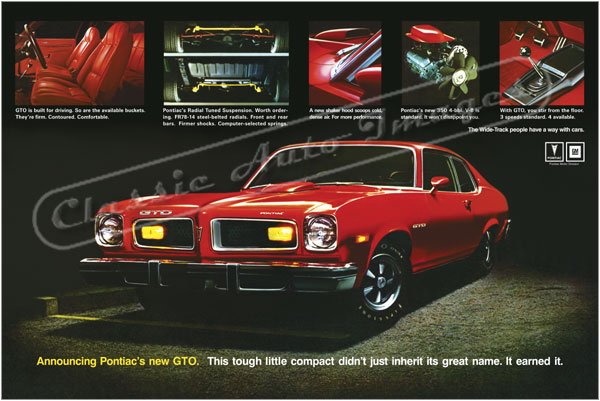

People laughed at the 1974 GTO – which was the last real GTO (if you define that as the last one that was powered by a Pontiac V8). They laughed because it seemed small and so did its engine, which was just a 350 (5.7 liters in modern-speak) whereas just a year before the GTO was a much larger car that came standard with a 400 (6.6 liters) and could have been optioned with a 455 (7.5 liters).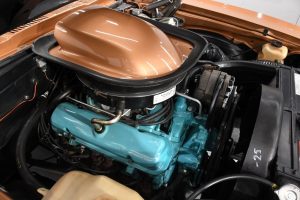
But – looking back – the ’74 GTO was more in line in some important ways with the original 1964 GTO that is credited with igniting what became the muscle car craze that lasted for (roughly) the next decade, until 1974. That year marked the end of the muscle car craze because it was the last year before the effective requirement that went into effect for the ’75 model year that all new vehicles be fitted with catalytic converters.
The federal government did not actually, formally, require cats; it was just that the emissions regs that were going into effect could not be complied with (for the most part) without plugging a cat into the exhaust. These early cats were huge and very restrictive; they were also expensive, which created an issue for V8-powered muscle cars that (up to then) had dual exhaust. Two converters would be necessary to make an emissions-compliant exhaust and that was too expensive.
So a single exhaust – with just one very restrictive cat – became a de facto requirement and that was the final nail in the muscle car (and pony car) coffin. Chevy cancelled the Z28 Camaro after 1974. Dodge dropped the Challenger. The Mustang became the Mustang II and – initially – didn’t even offer a V8. There would be no ’75 GTO, either – because single exhaust with a single cat would have gimped the engine’s output such that the car would have been mostly show and not much go (as happened to the Z28, which returned in ’77 with a badly gimped 350 breathing through a single-cat exhaust with fake dual exhaust tips). All of this was on top of low compression and “emissions”-tuned carburetors and ignitions. 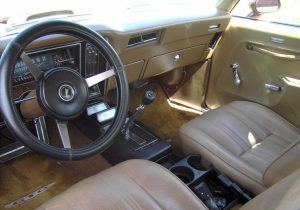
The ’74 GTO was thus the last of it kind. But it was also an attempt to recreate what the original GTO was. A comparison makes the point.
A 1964 GTO was 203 inches long and rode on a 115-inch wheelbase. It was based on the Tempest coupe, which was considered a mid-sized car in 1964. The 1974 GTO was 199.4 inches long and rode on a 111 inch wheelbase. It was based on the Pontiac Ventura coupe. Both the ’64 GTO and the ’74 GTO were much smaller cars than the 1973 GTO,which was based on the Pontiac LeMans coupe. The ’73 GTO was 207.4 inches long, which would qualify it as a full-sized car by modern standards. It was also a heavy car – just shy of two tons (3,910 lbs.) without the driver behind the wheel.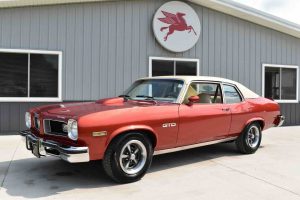
The ’74 GTO weighed just over 3,600 lbs. – almost exactly the same weight as the ’64 GTO (3,590 lbs.) – harkening back to the original GTO’s idea of going fast by putting a big engine in a smaller (lighter weight) car. The ’74 GTO got to 60 in about 7.7 seconds, not far off the time posted by the ’64 GTO equipped with its standard 389 (the higher-horsepower optional versions of the 389 reduced the 0-60 time substantially) even though the ’74 GTO’s 350 only touted 200 horsepower while the ’64 GTO’s 389 claimed 348.
The thing to keep in mind, though, is that 348 horsepower – in 1964 – wasn’t all that much more horsepower than 200 horsepower in 1974. It was on paper, of course. But that is not the same thing as what you’ve actually got. When the ’64 GTO was new, horsepower numbers reflected what an engine produced on a dyno – without any power-sapping accessories such as a water pump, alternator and so on attached and (often) with tube headers rather than production cast iron exhaust manifolds and mufflers downstream. The engines were also often tweaked and tuned to make the maximum power, so as to be able to tout that number when the time came to market and sell the engine (and the car it powered).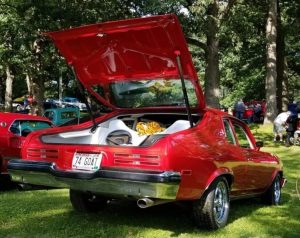
By 1974, engines were rated more honestly in that their actual “net” (rather than “gross”) output was advertised. The difference between the two is generally considered to be about 20 percent. So, by the “net” standards that applied in 1974, the ’64 GTO’s 389 made about 278 horsepower. The more important thing to consider, arguably, is that the ’74 GTO’s 350 could easily be cajoled into making as much real horsepower as the ’64 GTO’s 389 because it shipped detuned (low compression, a mild camshaft and “emissions” tuning of the carb and ignition). A hotter cam, more compression, some tuning and – voila!
Of course, you could also get more power out of the 389 – but not as easily, because the engine had been shipped in performance tune, with high compression heads and high-performance camshaft. It is easy to make a slow car go noticeably faster. It is harder to get an already fast car to go appreciably faster.
That ’74 GTO came standard with a lot of untapped potential. It also came standard with some other things no other GTO before or since even offered, such as a functional, Trans-Am-style shaker scoop.
By 1974, the Trans-Am’s scoop had been boarded shut. It could be un-boarded, of course – but as it came from the factory, all it did was shake, not scoop. The ’74 GTO’s did both. It shook, because (like the Trans-Am’s scoop) it was bolted to the engine – and it scooped, because a solenoid caused the scoop’s rear facing door to flop open when you floored the gas. The ’74 GTO was also available as a hardtop coupe and a hatchback, which arguably made it the most practical GTO. It also had Pontiac’s excellent Radial Tuned Suspension, very similar to what you got if you’d bought a ’74 Trans Am since both cars shared many common parts, including almost identical front subframes. While the earlier GTOs were great fun in a straight line, they were not nearly as fun in the curves – which they weren’t designed to take at high speed.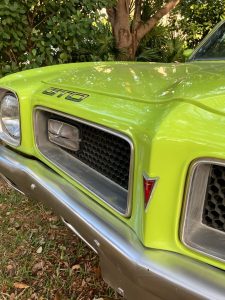
None of this is meant to argue that the earlier GTOs weren’t beautiful cars; the argument is that the ’74 GTO’s beauty wasn’t recognized at the time.
As more time passes, its beauty becomes more an more apparent.
. . .
If you like what you’ve found here please consider supporting EPautos.
We depend on you to keep the wheels turning!
Our donate button is here.
If you prefer not to use PayPal, our mailing address is: EPautos 721 Hummingbird Lane SE Copper Hill, VA 24079










https://www.streetsideclassics.com/vehicles/5855-tpa/1974-pontiac-gto-455
Pretty cool, and pretty pricey.
Hi Philo!
I’d say that car is egregiously overpriced. 455 and TH350… So, originally a 350/auto car, prolly. I’d rather have a factory/correct 350 four speed car and I’m betting you could buy a very nice one for under $30k.
You are right, that dealership’s prices are always insane.
The Holden version is a much better car. I see them sometimes on their Sunday drives. Ive NEVER seen any of those tacky collection of rotten vac hosed Nova clones outside the back row of a car show. I owned a 75 Laguna with those plastic bumper covers. I know of what I opine upon. These Nova were and likely ARE STILL what was said of them previously. Our 79 TA 400 4 spd was a far superior throwback last gasp to either late GTO. I also had a 77 Camaro 305 auto, nothing but trouble trouble trouble.
Hi Rain,
Nothing against the Holden “GTO.” It’s a fine performance car. But it’s a “Pontiac” in name only. It is powered by a Chevy V8. Again, I am not saying there is anything wrong with the Chevy V8; far from it. But it’s not a Pontiac V8 and a “GTO” cannot be a Pontiac in a meaningful sense unless it is powered by a Pontiac V8. The ’74 GTO may be smaller and smaller-engined, but it is unquestionably a Pontiac and a legitimate GTO.
I was 16. It was known as another POS Nova at the time by most of us.
Hi Rain,
This is unfair. The Nova was no more a “piece of shit” than the same-year Camaro or Firebird. These cars shared almost identical underthings as well as closely related drivetrains. A ’74 Nova had a 350 V8, the same basic engine found in Camaros. The Ventura/GTO offered a Pontiac 350, same basic engine as was available in the Firebird that year. I understand not liking the looks of the ’74 GTO in that it’s a subjective valuation and opinions differ. But to say it’s a “piece of shit” means the ’74 Firebird and Camaro were also “pieces of shit” and I think that’s a bit much.
agree, I like my ’71 307 Nova. Got me through my youth pretty well after I totaled my Judge.
Remember the chase scene in the movie the Seven Ups?
A lot of those later “muscle cars” like the Ventura-based 1974 GTO, Ford Cobra II/Mustang II (was there a Mach II?) G-body Olds 442s/Hurst Olds, Plymouth Volare Road Runner/Dodge Aspen R/T, Chevy Monza, AMC Hornet AMX, etc. are really looking good right now.
While they may not be “real” or “classic” muscle cars, they have the basic platform to add serious power and handling on the cheap and easy.
Also, weren’t Chrysler and Honda able to meet emissions targets without catalytic converters with their Lean Burn and CVCC systems? Speaking of which, the police spec Dodge Monaco and Plymouth Fury did have dual catalytic converters I think, at least in California.
Absolutely, Bryce!
I’d love to have a ’74 GTO – or a 340 four speed Duster!
In the lede graphic, flat-footed ad men labeled the 1974 GTO a ‘tough little compact.’
Had they run focus groups with 1973 GTO buyers — or 1968 GTO buyers like myself — they would have heard none of these three vaguely patronizing diminutives expressed.
Half a century has passed … but idiot GM is till shooting itself in the foot. Die, GM, die! 🙂
Another thing that probably didn’t help sales were the GovCo mandated bumpers.
Interestingly enough that 5 mile an hour impacts would not damage the car as the bumpers were on hydraulic shocks. Newer car bumpers are mounted solidly so a 5 mile an hour impact will require several thousands of dollars for repairs.
Someone should write a book about how auto makers gradually wormed their way out of 5 mph bumpers … while gratefully chugging the emissions Kool-Aid.
It’s almost as if they had an agenda (*cough* ‘Ford Foundation’ *cough*) … :-0
Darling, let’s turn back the years
And go back to yesterday
Let’s pretend that time has stopped
And muscle cars didn’t go away
— Waylon Jennings, Let’s Turn Back the Years
Hi Jim,
Pontiac came up with a then-novel way to deal with the ugly 5 MPH bumpers. Pontiac hid them under body-colored bumper covers. This practice is now emulated by pretty much everyone.
I like the ’74 GTO. It has its own unique look, which I think looks pretty good. The little 350 just needs a set of earlier heads to bump the CR up to around 9.5:1 and a slightly hot cam. Easy – and streetable- 250/275 hp out of it and then you’d have something a lot like the Dodge Demon 340, which is a (to me) very desirable) car.
100% agree. I think of all the cars that I was snobby about when I was younger, I’d take nearly any of them now, including a 1974 gto