

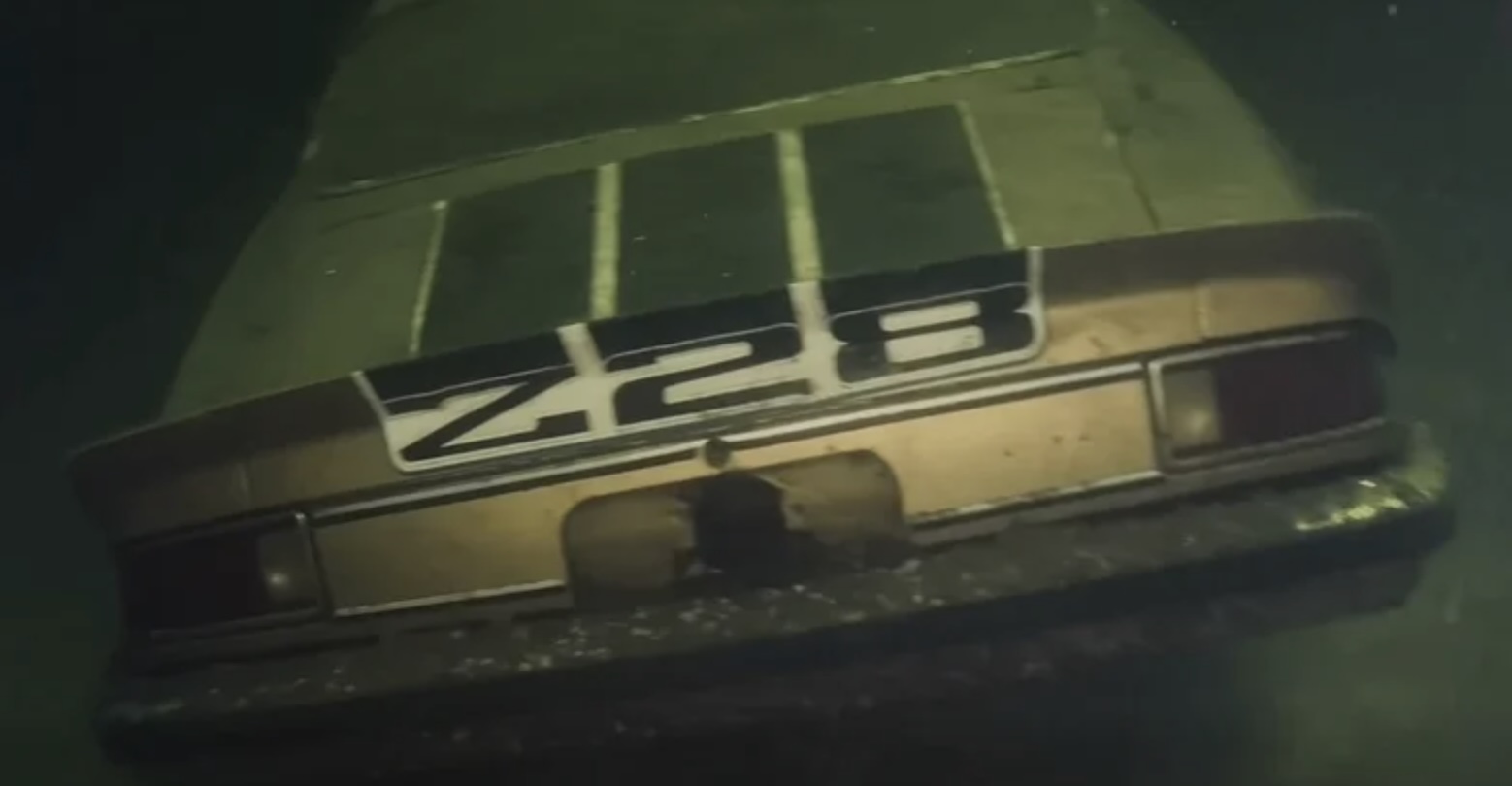

You may have caught the news story about the guy who found a 1974 Z28 Camaro submerged in Sebago Lake in Maine. No one knows how the Z28 got there, though it is likely someone drove it onto the ice one winter and discovered the ice wasn’t thick enough to support the car’s weight.
It’s a shame, because there weren’t that many ’74 Z28 Camaros to begin with and also because 1974 was arguably the last year for a genuinely high-performance Z28 – at least as far as the second generation (1970-1981) Camaros are concerned. It was unquestionably the last Z28 offered by Chevrolet until 1977, when the name was brought back – but it wasn’t really a Z28.
Where to start?
1974 was the first year all Camaros got a new front and rear end; specifically it was the first year for the battering ram exposed bumpers that had to be added per the federal government’s requirements. Chevy did what it could to integrate them into a design that was never designed to include battering ram external bumpers (the ’70-’73 cars featured a Ferrari-inspired look defined by an exposed central grill with offset bumperettes on either side) and while not ugly, the ’74’s appearance was heavy-and-awkward looking compared with what it had been previously. Especially in the rear, where the Corvette-like round tail lights were replaced with larger/semi-rectangular units above the full-width battering ram bumper.
These bumpers were also literally heavy. They added about 150 pounds of curb weight to the car.
But – even so – the ’74 Camaro Z28 still had something other Camaros could not get under their hoods. This thing being the L-82 high-performance 350 V8 that was shared with the Corvette. Though it was not as high-performance as the LT-1 350 that had been the Z28’s standard V8 in 1970, it still touted such upgrades as high-flow cylinder heads with larger valves, a forget steel crank, heavy-duty block and a relatively high (for 1974) compression ratio of 9.0:1. The engine also had a performance camshaft and dual exhaust. It was rated at 245 horsepower – which was a lot of power by 1974 and would be a high-water mark not seen again until the mid-late 1980s (and long after the end of the second generation Camaro’s production run ended in 1981).
It was, in sum, a legitimately high-performance Z28 and – arguably – the last one for the remainder of the second generation Camaro’s production run.
Chevy cancelled the Z28 outright for 1975 – probably because that year was the first year for catalytic converters and single exhaust. Not because the latter was required by the government but because it was dictated by realities. GM’s early “pellet” converters were huge and fitting two under the Camaro’s floorpans would have been difficult and expensive; so all Camaros got single exhaust – which would have choked the L-82, although this engine (progressively detuned) was still available in the Corvette for a number of years during the mid-late ’70s. But it was taken off the roster as far as the Camaro and without that special V8, unique to the Z28, the feeling within Chevrolet apparently was you no longer had a Z28. So Chevy decided to stop making the Z28 out of respect for what it had been.
Interestingly, Pontiac continued to sell the Trans-Am, which gave Pontiac a huge sales and marketing advantage over Chevrolet. The Trans-Am was, of course, the high-performance version of the Firebird and the Firebird shared its platform with the Camaro, with the main differences between the two GM “F” cars being exterior styling differences and – during the second generation years – engines. Pontiac still made its own engines in those days and so a Trans-Am had either a 400 cubic inch or a 455 cubic inch V8. These engines weren’t merely bigger; they were entirely different than (and shared no parts with) the Chevy V8s used in Camaros.
Anyhow, Pontiac kept the Trans-Am going after 1974 – even though beginning with the ’75 model year, the 400 and 455 V8s had to exhale through single exhaust and were badly gimped relative to the versions used in prior years. Even the 455 – one of the biggest V8s ever put by GM into a passenger car – had been downgraded to a low-compression, soft-cammed nothing special engine (identical to the engines used in big Pontiacs such as the Bonneville sedan and Safari station wagon). Nonetheless, they were both still big – and by 1975, just having a big engine was really something. As a counterpoint, the ’74 Mustang II didn’t even offer a V8 at first and when one became available, it was a little (in comparison) 302 that barely coughed up 140 horsepower. The ’75 Trans-Am’s standard 400 at least offered size – and 180 horsepower. Plus, you could still get a 200 hp 455 and that was something in ’75-76.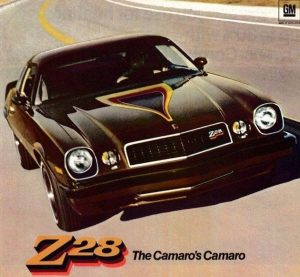
Probably in part because the Trans-Am did sell really well, Chevy decided to bring back the Z28 for 1977. However, this “Z28” wasn’t anything more than what was also available in other Camaros. Specifically, its 350 V8, which was a nothing-special V8 that was also offered in other Camaros. I owned one, once – a 1978 Type LT and it was basically the same as a ’77 Z28 except by ’78 the heavy external bumpers were covered with much-better-looking plastic that was painted body color (a look pioneered by the Trans Am). The Z28 did get a heavy-duty F41 suspension as standard, but other Camaros like my Type LT could be ordered with it. The only things unique to the Z28 were the badging and trim, which included gaudy “Z28” decals, with the exception of the functional “air induction” hood scoop that Z28s got for 1980 and 1981.
It would not be until later on on in the ’80s – and the third generation cars, which made their debut in 1982 – that the Z28 once again was mechanically special. And it would be another few years before you could get a 350 in a Z28 that had as much power as the ’74 Z28’s L-82 350 made.
That’s why the ’74 Z28 was special – and that’s why it’s sad to see one at the bottom of a lake.
. . .
If you like what you’ve found here please consider supporting EPautos.
We depend on you to keep the wheels turning!
Our donate button is here.
If you prefer not to use PayPal, our mailing address is:
EPautos
721 Hummingbird Lane SE
Copper Hill, VA 24079
PS: Get an EPautos magnet or sticker or coaster in return for a $25 or more one-time donation or a $10 or more monthly recurring donation. (Please be sure to tell us you want a magnet or sticker or coaster – and also, provide an address, so we know where to mail the thing!)
If you’d like a Baaaaa hat or other EPautos gear, see here!







Good history on the Camaro Eric. I see a few of the older models in Australia, some in right hand drive and some as it was made.
Thanks, to5!
I’ve owned a number of them over the years; once I almost bought a ’74, with the L-82 and four speed manual. Looking back, I wish I had!
It’s not uncommon to find stolen cars at the bottom of lakes and rivers. After stealing them and either joyriding or stripping them, they’ll dump the car in deep water to cover up the crime. Camaros, Mustangs, and Challengers were some of the most stolen cars in the 1970s. My father’s ’73 Ford Mustang Mach1 was taken out of his work parking lot just a year after he bought it by joyriding kids from Hartford. They broke the ignition and trunk lock and abandoned the car in the city. Luckily the cops recovered it after a week before more damage was done.
FYI.
https://www.youtube.com/watch?v=12blbP1yCwE&list=PL6759844B310670D2&index=9
Hi Eric, this is unrelated to to the topic, but I finally had the pleasure of listening to the carb whine/whistle of a 1970 (I think) Dodge Charger. It has a 7.2 liter supercharged V8 producing 525 horses and 700NM (excuse the metric figures) of torque. I saw “Mopar” emblazoned on the cylinder head covers. That whine was the most beautiful wail I ever heard an engine make. I finally understood the fuss you’ve always made about the whine of a 4-barrel of those old and golden engines.
Excellent, Espico!
I’m about to load a video that will (hopefully) deliver some more of those kinds of sounds!
Here it is: https://rumble.com/v79cgw0-455-four-speed-therapy.html
I or’d and received a 1972 El Camino which I adored. 350 w/quadrajet and dual exhaust. That car never knew what road dirt was. Seven months later I got drafted. That was the last car I owned that was fun. Now I’m 76 and drive the wife’s Explorer.
God stuff, Don!
You were lucky to be able to buy a new car like that ’72 El Camino. My generation and up were denied that wonderful experience.
If you have the front wheel drive Explorer derived from the 500/Taurus, have your mechanic check the weep hole for the water pump to make sure that you don’t have signs of the leak which eventually afflict that design.
I’ve noticed that the number of Explorer owners encountering the water pump issue and posting online has increased lately.
Years ago, Gas Engine Magazine published an article about a hit-n-miss engine that went into the water somewhere up north. I can’t remember the details, but the end result was the engine was recovered, restored, and runs like a champ. Pity the Camaro wasn’t salvageable.
It is a sad end for that Z28 but depending on how long it’s been underwater and how bad of shape it was before it drowned it could be repairable. Although I do concede the interior, electrical, the entire drivetrain, etc will need rebuilding or replacement. Unlike a 1969 ZL1 Camaro a 1974 Z28 Camaro wouldn’t be worth enough to pay to be rebuilt but a hobbyist might do it if they already had some of the needed parts.
I did notice that it doesn’t appear to have plates on it.
Morning, Landru!
Apparently, it disintegrated when they pulled it out of the water. Very sad, indeed.
Yeah, it’s only a source of maybe its glass at that point.