


Thirty years go – in the summer of 1996 – I had an opportunity to test drive the then-new EV1, GM’s first electric car. Since I am one of not many people who actually drove one of these things – along with Ford’s first less-well-known first EV, the Ecostar – I thought it might be of interest to take a sort-of retrospective test drive – to remember how it was – and still is.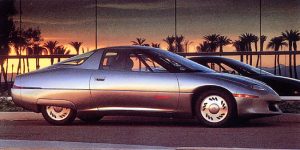
To begin with, the only reason I got to test drive the EV1 was because it wasn’t very far away.
Back in ’96, I was living just outside Washington, DC because at the time, I was working for The Washington Times, in DC. GM’s press pool garage was downtown in those days, not far from The Times’ building on New York Avenue. I lived about 15 miles from there, just across the Potomac river, in the Northern Virginia suburbs. If I lived then where I live now – some 230 miles away from DC – I’d probably not have had the opportunity to get seat time in the EV1 because it would never have made it here.
At least, not on its own.
The first-generation EV1 had a fully charged range of about 60 miles. Much has improved since the EV1’s time as far as range is concerned. Most mass-market EVs come standard with about 250-300 miles of driving range, enough to commute into DC and back (a round trip of say 30 miles, if I go by my old commute) with plenty of margin, which the EV1 didn’t have. On the other hand, it does take about 5-8 hours to recharge a current EV at home, using a Level II (240v AC outlet) electric stovetop or dryer outlet. As it turns out, that’s as long as it took to fully recharge the EV1 using the same 240V power source, 30 years ago.
It’s true that, today, you can plug into what they call “fast” chargers that use high voltage DC current rather than household AC current but you’re still going to have to wait for at least 15-20 minutes to recover any significant charge. A full charge will require waiting at least an hour – because the charging process slows to a trickle charge once the battery reaches 80 percent charged. This is a safety . . . safeguard built into the system to avoid damaging the battery or triggering a fire (due to the build-up of heat).
Either way, it’s the same problem today that it was 30 years ago. Most people haven’t got the time to commit to waiting even twice as long as it takes to fully fuel a gas-engine car, which is about five minutes. This includes the time it takes to pay for the gas. EV apologists never factor in the time it takes to deal with getting the EV “fast” charge kiosk to accept their payment method – no cash! – and deal with the adaptor they may need to get the kiosk to “pair” with their EV.
No “breakthrough” in battery technology will make this faster, either – because it’s not a battery issue. The difficulty is safely conducting the extremely high voltage electricity necessary to charge fully in about five minutes. There is also the matter of figuring out how to deliver that much electricity at scale – to replicate the existing network of gas stations. This would require a massive increase in grid power as well as the infrastructure necessary to distribute it to a vast, national network of charging kiosks.
As with modern EVs, actual driving range also varied according to the weather. Very cold weather could reduce the range by 30-40 percent. It’s not as severe as that today, but only if you keep the EV hooked up to charger when it’s sitting in the cold. If you don’t, the thermal management system – which keeps the battery warm in cold weather – will burn up a significant percentage of your battery pack’s charge overnight. So will using the heater for you – as well as other electrically powered accessories.
The EV1 was quick in its day – just as as EVs are today. Zero to 60 took about 8 seconds – which was very quick, back in ’96. A Mustang GT was only about two seconds quicker. Most transportation appliances were slower getting to 60 than GM’s little electric car. Like all electric cars, it was smooth and quiet. But – then as now – it was unsettling to have to keep track of the charge remaining.
It made you feel something like a scuba diver monitoring his oxygen tanks.
Another commonality is cost. GM never actually sold the EV1; it was leased to a relative handful of people for around $400-$500 per month. In today’s depreciated dollars, that would be equivalent to about $950 per month. For a lease, mind you. The cost to actually buy would have been much higher. This for a tiny commuter car with a best case range of about 60 miles, for the first generation models (this went up to 80-90 for the second generation iterations).
Today, you can buy an EV for less than $1,000 per month – but the “inexpensive” ones still cost about $30,000 to start and that’s usually with what they call the “standard range” battery that doesn’t give you enough range for road trips – at least not without a lot of stops and waits along the way.
In the end, GM did not “kill” the electric car – as asserted in the Michael Moore movie. It collected the EV1s it had leased and crushed most of them, because selling them wasn’t a viable business proposition. Back in ’96, gas cost about $1.50 per gallon and you could buy a small commuter car such as a Saturn SC1 for about $12k which meant your monthly payment would have been far less than GM charged to lease the EV1 – and you’d never have to wait for more than about five minutes to fill the tank, which would give you enough driving range to go a week before you needed to fill up again.
Selling people on less range, more wait and more cost was a hard sell back then – just as it is today.
. . .
If you like what you’ve found here please consider supporting EPautos.
We depend on you to keep the wheels turning!
Our donate button is here.
If you prefer not to use PayPal, our mailing address is: EPautos 721 Hummingbird Lane SE Copper Hill, VA 24079










” EV apologists never factor in the time it takes to deal with getting the EV “fast” charge kiosk to accept their payment method – no cash!”
Not an issue for a Tesla owner using a Supercharger.
Everything gets billed automatically, just plug it in.
The unfortunate reality is that with presidents who start foreign wars at the drop of a hat buying a used EV might become a necessary hedge.
My EV objections:
1) Battery cost is *way* too high;
2) Battery size and weight are excessive;
3) Battery energy and power densities are far too low;
4) Battery cycle lifespan is too short;
5) Battery charging times are too long;
6) The absence of standard automotive battery sizes/shapes;
7) Battery replacement is not cost effective (an end of life battery means the car is effectively totaled).
1,2,3,4, and 5 are fundamental flaws of the current technology, and can not be addressed without revolutionary technological advances. 2 and 3 are related.
6 and 7 are related, and these are both addressable.
For the current technology to be at all palatable, the batteries need standardization (size, shape, interface, voltage), and the vehicles need to be designed for easy battery replacement. Of course, getting the car manufacturers to even consider doing this is probably going to require awful blackmail of some sort or something.
Well-said, AC –
EVs are an answer to a question unnaturally asked. They are a fundamentally artificial construct. I do think, however, that the inexpensive (less than $10k) EVs available in China are decent little runabouts that would be appealing to young people and people on a tight budget and people who just want a basic little A-B appliance. It annoys me that the “market” is closed to them.
I drove one for about a week doing on road testing at the GM PG. It was an ok car and the sound was futuristic to me back then lol It was much lighter than comparable “cheap” EV’s of today and it had go kart handling. The cockpit was like a smaller version of the current C8 in regard to how it enveloped you. Overall it was fun to drive. From what I recall we just charged it unattended, inside the garage we were working out of. Verboten now a days! PS one thing that happened to me is I came down with a strange rash after a few days of being in it. No one never could say for sure if it was from the that huge lead acid battery but I always felt it was!
Stanley Meyer’s work extracting hydrogen from water, Bruce De Palma’s N Machine, Pons and Fleischmann’s work with LENR (cold fusion) in the late 80s, Hutchinson’s work with radio frequencies and static fields, John Christie’s free energy generator, the enigma of Coral Castle, Tesla’s work many years ago, and etc.
My understanding is that oil, gas, solar panels, windmills and lithium batteries are exceptionally poor substitutes for what’s out there, but they are all we are permitted to believe is possible.
Free energy to the people would bury our current system.
Brilliant men are permitted to tinker in their garages, but every time they’ve tried to go public it has gone badly for them.
The documentary “Heavy Watergate” is a good starting point. Mallove’s 1991 book “Fire from Ice” covers the same topic. Judy Wood’s book “Where did the Towers Go?” posits that LENR was used on 9/11.
Coincidentally, the same man who wrecked Pons and Fleishmann’s careers (Steven Jones) happened to later on be a leader of the “9/11 Truth movement” pushing thermite controlled demolition – the official conspiracy theory of that pivotal day.
“Coincidentally, the same man who wrecked Pons and Fleishmann’s careers (Steven Jones) happened to later on be a leader of the “9/11 Truth movement” pushing thermite controlled demolition – the official conspiracy theory of that pivotal day.”
In the Epstein files that have been released, Epstein takes credit for killing off Pons and Fleishmann’s work. Because: “Free energy to the people would bury our current system.”
Epstein was representing the forces that profit from scarcity.
Exactly – I posted a link to that story just the other day – https://sayerji.substack.com/p/i-killed-pons-years-ago-epstein-files?publication_id=2878303&post_id=189725678&isFreemail=true&r=qbltf&triedRedirect=true
For the religious, it should only increase their respect for the power and mercy of their lord, that scarcity is entirely manmade, while abundance without limits is their birthright. For the agnostic, nature really is something innit?
Zimbabwe nonsense will never die.
Theres no free lunch just endless hope and attendant bullshit.
“In the end, GM did not “kill” the electric car – as asserted in the Michael Moore movie. It collected the EV1s it had leased and crushed most of them, because selling them wasn’t a viable business proposition.” -EP
Firstly, I remember seeing that movie. Michael Moore had nothing to do with it, BTW. It written and directed by one Chris Paine.
Secondly, I don’t and possibly never will understand the claim that GM “crushed most of them, because selling them wasn’t a viable business proposition.”
If I remember correctly in that movie, some owners of the EV1 actually took to the streets in protest because GM wasn’t allowing them to buy/save their cars. Many of those EV1 owners were celebrities and could’ve shelled out $50k for a piece of history and maybe a car they liked. I’m guessing this is the assertion because it was some kind of tax write-off, but could you not have priced to cars accordingly? Seems like such a waste.
Also, maybe I’m deranged, but I don’t understand why destroying your own property could be considered a tax write-off. Perhaps I’m digging in the wrong field, however.
I suspect that GM feared that EV1s on the road might be an unacceptable liability due to the possibility of further recall(s). Online sources say that GM self-recalled (not gov-mandated) 450 EV1s in March 2000 to fix a faulty charging port that could overheat and cause a fire.
I don’t know how old a vehicle has to be before neither the manufacturer nor fedgov would want to recall it for a safety issue. But it’s apparently a pretty long time in some cases at least: Just this morning I scheduled a visit to the local Ford dealer to have the driver airbag on our 2007 Ford edge replaced in accordance with a NHTSA-ordered recall. Ford replaced the passenger airbag (at no charge to me) on an earlier NHTSA recall a few years ago. When they replace the driver airbag (again at no charge) in mid-November the vehicle will be ~20 years old!
No matter how hard they try, the PTB can’t change the laws of chemistry and physics. Even if aliens landed and gave us a battery that could be fully charged in 5 minutes there’s no way the power infrastructure can provide the necessary energy, not to mention the Big Brother data centers sucking all the available power to enable our digital prison.
Yes; in fact the faster the batteries charge, the higher the instantaneous demand, and the more strain on the grid. Simple calculations reveal that for an EV charger to match the miles added per unit of time that we get with a gas pump and IC vehicle, each charger would draw about 5 megawatts. But the EV fanboys will tell you that is not a problem at all.
Your point well taken but watch the units.
One gallon of gasoline is generally said to contain 120,214 BTU. This is equivalent to 35 kWh.
This would be 35 kW continuous over 60 minutes. Or 2100 kW moving in one minute.
Typically gas pumps run about 8 gallons per minute so 961,712 BTU are moved in one minute. This is around 282 kWh equivalent moved in one minute.
However since it’s done in one minute that takes 16,920 kW, which is roughly 16.92 MW be available for that minute.
To give the layperson a feel for this.
Your home uses on average about 900 kWh per month and this works out to be roughly 21 watts over any given minute.
This doesn’t represent your actual usage because most people turn off lights all day and most of the night, your TV or dryer are only on for a couple of hours, you run the microwave for maybe 3 minutes, etc.
You’re actually using a lot of peak power but it’s over short in duration. You’re probably over any given minute need something like 500 watts with short periods of perhaps 1 kW or so.
So if you assume a home uses 1 kW per minute fast charging an EV at the same rate as pumping gasoline will take the same demand as 10,000 homes at a reasonable peak usage and maybe another two or three times that number of homes at their quiet evening watching a movie with a few lights on.
Non-engineers just don’t really get a sense of what they’re asking the grid to do by driving EVs. It’s not that the generating capacity isn’t there. In fact there is quite a lot of unused capacity because the system is sized to meet the peak demand from 6AM to 9AM and then again at 5PM to 10PM.
So plugging in a car overnight or during the middle of day to slow charge doesn’t necessarily have to burden the grid. In fact the power companies all things being equal would love to be able to sell power from 10PM to 6AM because they normally have to throttle down power plants and the big coal, nuke and gas plants don’t throttle up and down quickly so they just assume some power is wasted. If they could mine coal and run the plants at 100% around the clock it would actually be the most efficient.
But asking cars to fast charge during peak demand hours is a major problem no one is being honest about. Capitalism should address this in pricing but the grid being quasi-socialist with state regulatory board doesn’t allow this, so we get shared financial pain and rolling brown-outs. They have to throttle the EV chargers.
When they say “fast charging isn’t working” it’s not because the charger is broken specifically but the peak demand can’t support it at that moment, the power on the grid simply does not exist. If you roll up at midnight the same station will probably have no problem fast charging.
A car isnt entire block after block with 2 point whatever vampires plugged into each panel.
EV cannot scale to anywhere near current expectations.
IOW bullshit. Get over it.
Instead of using gasoline’s combustion energy content, a more direct and accurate approach is to simply compare an ICE vehicle’s miles/gallon performance to that of an EV’s miles/kWh performance. This approach accounts for the ICE’s actual efficiency.
Let’s say a typical ICE vehicle gets 25 miles/gallon; at 8 gallons/minute that’s a re-fill (charge) rate of 200 miles/minute. And let’s say a typical EV gets 3.5 miles/kWh. In order for the EV to gain 200 miles per minute — and thus match the charge rate of the ICE vehicle — the EV would have to charge at 57 kWh/minute, which equals 3.4 MW.
Whatever one says about these cars it is sad to know GM crushed them all- wonder if any did survive – what an interesting car this was back on the day !
Hey Nasir,
This is part of what I posted above. But I do believe that 2 or 3 survived. Perhaps Jay Leno even has one.
I know Francis Ford Coppola has one. I remember seeing it on an episode of Jay’s show. Can’t remember how he came to own it though.
Interesting – apparently a number did survive because they were donated to Universities for students to look at as some high tech thing…. these just sat around collecting dust in parking lots.
https://youtube.com/shorts/wwUvCg0So2o?
The Questionable Garage is covering the restoration of EV1 chassis# 212 on his channel. Privately owned.
What seems to be lost on car makers, politicians, enviros is that cars are tools. One size does not fit all. EVs may fit the needs of some people but no car can satisfy everyone.
I wouldn’t buy a Koenigsegg to take kids to school nor an Excursion if all I ever did was commute 50 miles to work.
Junkyards are doing a good business with all the mechanical disfunction built into things these days. Seems things will further improve for them before all is said and done.
In my area they’re all going tits up. There’s more money in scrap than in used car parts. Unfortunately.
One thing that would make me consider an EV would be if batteries were standardized and easily swapped out—and if you could charge using a standard 110 volt outlet.
Trouble is, these don’t seem possible, let alone practical.
A 120-volt circuit with a fifteen-amp breaker can deliver 1.8 kilowatts, or 2.4 horsepower.
Since accessory loads alone are more than that, not even considering motive power, a 120-volt circuit never will be able to deliver power at a rate that will charge an EeeVee in a reasonable time.
It’s just physics, combined with standard house wiring. Even Elon can’t change this.
Bryce.
Like Bob Segars song, these EV devices are “Still the Same”….pipe dreams in the sky for true believers. A three or four fold range increase, over 30 years??? And the sky’s the limit for price??? And “range anxiety” consistently???
Eric’s dead-center shot analogy of a SCUBA diver checking air constantly is absolutely correct. As a decades long diver, the first, last and most overwhelmingly important gauge you’re constantly checking is how much air you’ve left to breathe. And you’re always worried about it and your rate of breathing. It’s ended wonderful dives early because dive buddies cant regulate their breathing due to panic and overwork. And while a dead battery won’t kill you like an empty air tank will, its a hugely expensive inconvenience.
Most EV’S will let you charge on 110V.
However, it’ll take literally days to fully charge at that rate.
You’ll never see standardized power outlets, unless the (((governments))) mandates it.
YMMV….
Hi Bryce,
Such an EV once existed – the Baker electric! It used deep cycle batteries that were about the same size as a typical modern car 12V battery; they could easily be swapped out as needed and could be charged using common household current. The downside was a range of less than 100 miles. But, so? There is a use case to be made for s short-range EV. Many people do not need to drive more than about 30 miles in a day. A basic, inexpensive EV that was powered by simple, lead acid batteries would be fine for them.
I’d love to have such a car—as a second vehicle for puttering around town to run errands and the like. For road trips of any consequence, not really.
Hey Bryce,
Our Chevy Bolt will charge from 120V at 12 amps. This adds about 5 miles of range per hour. Slower than hell? Yes. But it still works for most of our charging at the present time we don’t do a great deal of driving. To get the usual 200 miles of highway miles, that would be 40 hours of charging, but if you’re not going anywhere for a couple of days, as is often the case in our rural lives, that’s not much of a problem. It’s all about what you expect out of a vehicle.
I think someone could still manage swappable batteries, probably something like having to lift the body, funny car style, and the battery would roll in and out on casters.
The Chevy Volt seems to me to be a vehicle that actually makes sense and works, if I recall how it works. If memory serves, it’s an electric dominant hybrid in that the electric motor actually turns the wheels, and the gasoline engine is there to turn a generator to make electricity for the electric motor to turn the wheels, as well as charge a battery, which is good for 50-100 miles of electric only range, and that battery can also be charged with a cord. But whenever the electric battery runs lot, the engine kicks on to charge it, as well as provide power on longer drives.
These kinds of cars actually help you save gas and money. Trouble is, not many are made, and they cost more than standard IC vehicles.
Either way, I’m not buying EVs now.
I had a friend that got a Volt early on (2014? maybe) he was a GM Engineer, lived in Flint, worked in Auburn Hills. 30 miles each way. Charged at home and at work. For a commuter it was perfect. The gas went bad as he did not use it enough. He did have a GMC Suburban for other driving.
Doing the same thing, and expecting different results.
Auto makers make perfect sense, once one realizes they are barking mad.
‘In the end, GM did not “kill” the electric car.’ — eric
And that’s our cross to bear. Just a few years after the EeeVeeOne, Elon introduced the Tesla Roadster … and the willfully distorted ‘MPGe’ [sic] figure promulgated by the EPA. By omitting the nearly two-thirds loss of energy in generation and distribution, ‘MPGe’ produces absurd values north of a hundred, unrelated to energy consumption at the source. Divide ‘MPGe’ by three, and it’s about the same as traditional MPG.
Now on October first, Elon is relaunching the Roadster. Wild rumors are circulating that it may be able to fly, or at least hover, with gas thrusters from SpaceX. Me Buck Rogers, me fly boy!
Elon is barking orders to his dupes: gimme a $5,000 credit card payment today; send me a $45,000 wire transfer next week — or else! Neither the merchandise nor its total price (thought to exceed $250,000) is even defined.
Along with EeeVee Fever from the ‘Biden’ era and today’s raging Data Center Fever, the new Roadster and the Scout Motors EeeVee may rate a chapter in the next edition of Mackay’s Extraordinary Popular Delusions and the Madness of Crowds.
Some suckers are just born to lose. 🙁
Question for you, Eric, as I do not know a whole lot about the batteries in EV’s. Let’s say you charge said EV every night when you come home from work, for five days a week, roughly. How long do these batteries last? Don’t these batteries depreciate with every charge? Funn how the more things change, the more they stay the same.
Hi Shadow.
Just look at how the usable stored power in your phone, laptop or cordless tools depreciates over time and how a battery that seems to work fine one day is totally dead the next. It’s not a major problem if you can easily replace it yourself for around $50 but if it’s a $10K replacement that you have to hire someone else then it’s a real problem.
I just cannot stomach paying $10,000 dollars for a vehicle battery, especially in light of the the fact that EV range still sucks, and even more so in the long, frigid cold. For the moment, one is “allowed” to purchase a new vehicle battery for their gas powered vehicle, and save a lot of money in the long run. Why fix, then, something that is not broken? As you say, Landru, the key is whether EV owners will ever be “allowed” to replace the battery themselves, or pay out the nose to have someone else do the same. Also, though, I do not know the mechanic details of EV batteries, and whether they are as easily replaceable as the ones non-EV vehicles use.
Also, heat is really bad for batteries too—I had a battery conk out on a 95-degree day.
I did not think of the extreme heat (other end of the weather spectrum), Bryce, as our version of “extreme heat” would be laughable to others. But it makes sense. I imagine using the air conditioner to keep you from boiling in the hot Summer sucks up every bit of juice the way it would if one wanted to keep warm at frigid cold temperatures. If EV batteries were cheap, such that one could swap out the depleted one for the charged one-that you charged at home, and while using the other one-then maybe it could work? But not when the price of the battery is beyond reach for most.
Hi Shadow
The Questionable Garage channel on YouTube which is mostly ICE has done some EV videos on servicing and redoing a battery pack on a Hybrid Tahoe which covers testing and replacement of a supposedly rebuilt pack, why the purchaser got scammed and using low hour cells from a Toyota. Worth watching to understand those EV questions regarding the battery pack.
True dat: It’s like knowing for sure that you’ll have to get a new engine and/or transmission after 7 years/75,000 miles.
Hi Shadow,
Battery life depends a lot on how the EV is used – and charged. Heavy discharge-recharge cycling is harder on the battery. Paradoxically, this means if you use the EV’s max range often – and so (probably) “fast” charge frequently – you are probably shortening the life of the battery. So, to get the most life out of the battery, you ought to restrict how far you drive – and avoid “fast” charging, which means a lot of waiting!
In that case, scrap an EV in these parts-at least in the Winter-especially given the fact that most commute from out-of-town (within the borough) to work and shop (such as it is). So one most likely will use the EV max range often, and subsequently have to recharge often. Like it or not, there is no such thing as “short trip”, unless one lives right in town. And what about those who work 12 hour shifts? There would not be enough time to charge an EV before having to go back to work again. If one has to restrict one’s driving to save the life of a rapidly depleting extremely expensive battery, few will want to bother with it. And it may be a cold day in hell before people willingly decide to move closer to town (per the 15 minute city goal) for the sake of an EV battery that no one wanted or asked for. The real kick in the teeth, is that we have more oil sitting under our feet that we are not “allowed” to drill for, that could sustain us far beyond our own life times. Which makes the EV debate (good or bad) all-the-more absurd, frustrating, and senseless. But that is just my own opinion.
The EV 1 was ugly 30 years ago and it’s still ugly today.
In the useless trivia section the Questionable Garage YouTube channel is involved with the ongoing restoration of probably one of very few non GM owned EV 1s. Sort of interesting and apparently gm is kicking in free parts. Skimming the series there is also lots of interviews with the engineers that designed I and yep they’re still true believers.
As for today’s EVs I’m curious why manufactures can’t standardize on one connector? If it’s a voltage/ amperage issue I suspect that if a smart battery charger can deal with reversed cables I suspect that there is a way that it could be done. As for needing to link it to your credit card I’m surprised that the charging stations don’t sell prepaid charging gift cards just like everyone else does that wouldn’t need your phone to be connected to the card.
RE: standard connector. Fast-developing technology tends to exceed the standard.
Hi Ready.
But based on available power at a charging station I seriously doubt the power exists to fast charge a significant numbers of vehicles at multiple hundred of amps, meaning either just a few chargers with lineups or multiples with lower amperage ratings.
Lets also not forget that the cables will need to be a lot heavier for higher amperage’s. Probably not a problem with us but what about your 76 year old Aunt Rose that needs assistance as I’ve never heard of a full service charging station?
‘Trust your car to the man who wears the star.’ Image:
https://tinyurl.com/sy2f6b7a
Elon’s Optimus robots will ‘man’ full-service Tesla charging stations, helping doddering ‘seniors’ lug those hundred-pound cables.
Now fetch me a hot toddy, Starman.
‘I’m sorry, Jim. I’m afraid I can’t do that … for your saaaaaafety.’ 🙁
If the fast charger is in fact a battery bank, which can charge its own batteries during not-too-busy times, i could see the “fast charging” station being much more effective for multiple vehicles. But there is still the physics/chemistry of charging them ( vehicle batteries) fast and full without damage.
Hi Landru,
I’m glad you mentioned the fast charger cables. The existing ones are unwieldy, even for me. They’re heavy and have these supporting cable things to keep them from flopping around. I am certain many older people and women have difficulty dealing them – as they are.
True, but the potential for delivering a lot more energy than the five year old model is there, and that requires a new connector that can handle the current. Carmakers can roll out a new “standard” socket but retrofitting hundreds of pedestals and maintaining backward compatibility isn’t something most charging companies can justify. So the owners end up with a trunk full of adapters
We haven’t even standardized liquid fuels.
How many grades of gasoline? Usually three. But then you end up somewhere at higher altitude and you see gas as low as 85 octane.
But then there’s ethanol gas and non-ethanol. Ethanol content from 10% right on up to E85 for flex fuel vehicles. Don’t put E85 into a vehicle not intended for it or you’ll be in a world of hurt.
Don’t forget Diesel. High sulfur off-road, dyed, or undyed? Low sulfur for on-road.
And don’t forget the other ones outlier compressed gaseous based fuels like LNG fleets sometimes use and the now defunct Hydrogen proposals.
And you expected common EV charging ports?
But those fuel options are choices, and the production and distribution networks have become well developed over the last 130 years. Trying to centrally plan and interpose a EV system in a few short years over that existing system is the height of arrogance and hubris.
Now should someone be a modern Henry Ford and develop a truly mass market EVsuch a charging network would grow organically. Reality prevents this, battery chemistry needs a big leap to allow it and electrochemical cells just wont get there.