

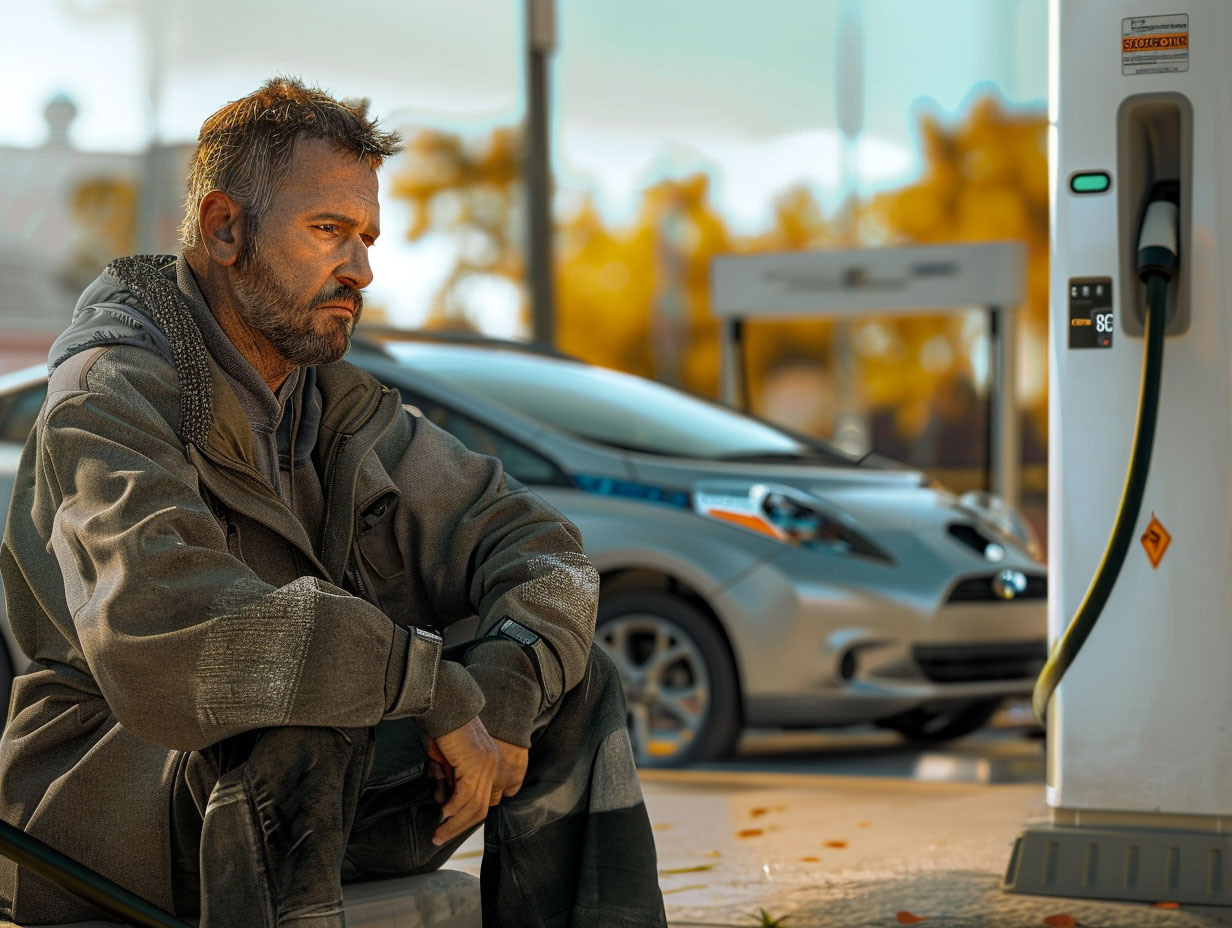

What does it matter how “fast” you can charge up an EV if the “fast” charger won’t let you charge? This just happened to me over the weekend – and it’s not the first time it’s happened.
I’ve been test driving a 2027 Toyota Bz (you can find my review here, if interested) for about a week. Yesterday, I planned – you have to plan these events with EVs – to wait for a charge at a “fast” charger kiosk downtown, after hitting the gym, I needed to charge it because the range was running low and while I had enough left to get back home, there would not be much left once I got home. I could plug in at home, of course – but I don’t have the 240V (Level II) hook-up, which would let me charge it fully in about eight hours. Actually, I do have a 240V outlet – but not the right receptacle, which you have to have for the specific make/model EV you have. Since the Bz is not my EV, I do not wish to spend the money to get the right receptacle for it that will not work with other make/model EVs.
All I have available for press car EVs are common 120V household-type outlets. If you plug an EV into one of these, you might get about 30 miles of range back after about 12 hours or so.
So, if I wanted to drive the Bz anymore before it gets picked up (and if I didn’t want to be a dick and leave it with next-to-no charge for the poor delivery driver to deal with) I figured I’d plug it in at the “fast” charger and – after about 30 minutes – have recovered enough charge to drive it a bit more and still have enough charge left for the delivery driver to make it back to the “fast” charger, where he could recharge it enough to give it enough range to make it to the next stop.
Not so fast, libertarian car guy!
After hooking up the “fast” charger cable – which takes some wrangling, because the “hose” is as thick as a horse cock and heavy, too – I attempted to get my credit card accepted by the kiosk. The kiosk badly wants me to download an “app” – so that the kiosk can track my charging habits as well as debit my bank account directly. The kiosk can – as Bender so eloquently put it in The Breakfast Club – eat my shorts. I am not connecting my bank account – or my sail fawn – to their Hive Mind collective. 
Eventually, I got the kiosk to accept my credit card. Now comes the hard part. The “pairing” part. The kiosk must have a little chat with the device – the EV – before the charging process commences. Not once but three times – at three different kiosks – I was unable to get the EV to successfully pair with the kiosk. I disconnected the horse cock and decided to head home on charge remaining and let the delivery driver deal with it. But there was still one more hassle to deal with. Like many EVs, the Bz EV has an adapter that goes in between its charge portal and the “fast” charger hookup. You plug the adapter in before you plug the EV in.
The problem – for me – was that the adapter would not un-adapt. It locked into place and I could not get it to unlock. There’s no obvious release button, so I just drove home with it plugged in and the charge door swung open. When I got home, I finally figured out how to get it to release its death grip coupling (if you have ever tried to separate a pair of hounds humping, you will have some idea). Turns out you have to push the “unlock” button on the key fob. The door unlock button didn’t work; I tried that at the “fast” charger kiosk. How is it possible to make something that works – a gas cap just unscrews – into something so aggravatingly intricate?
I have mentioned this not-being-able-to-charge thing has happened to me before – at different “fast” charging kiosks, with different make/model EVs (including a VW ID Buzz and a Mercedes EQS). These kiosks – at least the ones in my area – are functionally iffy. They sometimes allow you to charge – but sometimes, they do not. This does not surprise me, given the elaborate protocols involved in “fast” charging. It is nothing like pumping gas, which does not require the pump to “pair” with the tank. You just insert the nozzle and fill ‘er up. The hose is half the diameter, too – and much less difficult to handle than the horse cock “fast” charger heavy cable (necessary due to the very high voltage being conducted).
No “app” is needed, either.
Most anti-EV rants focus on the relatively short range you generally get with most mass-market EVs. This Toyota Bz, for example, has a maximum fully charged range of 281 miles. But that is not really the problem. Does anyone bitch about the Corvette’s range? In city driving, it has about the same driving range as the Bz, but the thing is, you can easily refuel the Corvette in just a few minutes, pretty much anywhere. You do not have to plan around the wait – and you do not have to worry that the pump may not “pair” with your tank.
If they can figure out how to make “fast” chargers reliable – and how to get an EV fully charged in about five minutes – it would not be a hassle to own and drive an EV.
Right now, it is.
. . .
If you like what you’ve found here please consider supporting EPautos.
We depend on you to keep the wheels turning!
Our donate button is here.
If you prefer not to use PayPal, our mailing address is: EPautos 721 Hummingbird Lane SE Copper Hill, VA 24079










‘There’s no obvious release button.’ — eric
A lifetime of experience with devices has taught us to look for obvious controls in obvious places. Need to release an adapter? Put a red-colored release button next to it — maybe even a mechanical one that requires no wiring.
But no-o-o-o-o … some genius decided to release it with a ‘key fob’ — another costly piece of gratuitous enshitification that is inferior to a plain old key.
Tesla eliminated door handles and hid the emergency mechanical release under the rear seat — instead of in the OBVIOUS place on the rear door panel where door handles have always been located. Because of this slick, la-di-da styling cue, people DIED because they could not find the freaking hidden release handle in a burning car.
Reject, reject, reject galloping enshitification.