



Why is there an Affordability Crisis – as regards new vehicles? There are many reasons why, including the decrease in value (buying power) of the fiat money we’re forced to use to buy things that has not been made up for by an increase in the quantity of fiat money we have to accept as payment for the work we do.
But there is another – subtler – reason. It is one a reader got me to thinking about that I think it’s worth all of us thinking about. It is how people renting vehicles – leasing them – is driving up the cost of buying vehicles.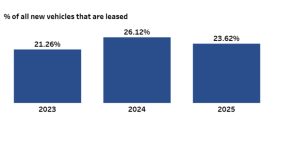
Leasing is a way to get into more vehicle than you could otherwise afford – or want to spend on one – by not buying it. Instead, you rent a portion of its sticker price, paid over a period of say three years rather than making payments for six (or more). A vehicle that might cost you $800 per month to buy only costs $500 a month to lease and of course during the lease period, you pay for very little else because the vehicle is under warranty and because new vehicles don’t require more than basic service, such as oil changes and tire rotations, for the first several years and leases sometimes cover these costs, too. 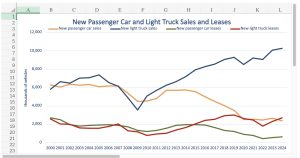
It’s a fine deal – for those who want a more expensive, fancier vehicle than they might otherwise be able to afford – if they can afford to sign up for a new lease when the old one ends. Many are obviously able to do that and – clearly – do not mind doing that.
How many? About one in four, according to the available data – or about 22-24 percent of all new vehicle transactions. Interestingly, the greatest uptick in leasing involves trucks and EVs – two of the most expensive categories of vehicles.
Consider what this means. More finely, consider what it has done. The least expensive iterations of current half-ton (1500) pick-ups all have starting prices close to $40,000. For example, the least expensive version of the 2025 Ford F-150 is the $37,450 XL with 2WD. Adding the optional 4WD – something most truck buyers want because a truck without 4WD is kind of like a cat without claws – bumps the price up to $42,465.
Here is some context for these numbers: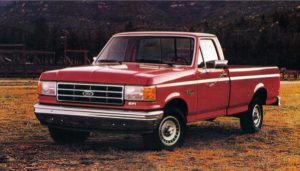
In 1990, the base price of an F-150 was about $12,000. If you plug that into the government’s Bureau of Labor Statistics inflation calculator, you get about $29,000 in today’s money; i.e., that sum is worth – has the same buying power – as $12,000 did back in 1990. But you cannot buy a 2025 F-150 today with the equivalent-in-buying-power dollars. You must come up with about another $10k – in today’s dollars – to swing a new F-150.
Obviously, you get more for that money today – things such as standard AC and power windows and a much more comfortable, “nicer” vehicle, generally. The ’90 F-150 was a truck. Metal floors, vinyl-covered bench seats and manual transmission, etc. Wing vent windows instead of AC. But what good are “nicer” things if you cannot swing the price?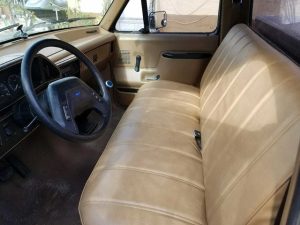
Enter the lease – and now you can! Plus more, actually. The lease lets you get into a nicer iteration of the F-150 because the lease payments are lower than the payments you’d make if you bought the base XL version. It lets you live beyond your means. It lets you appear to be more affluent than you actually are. This is the new American Dream.
It is very tempting, especially with a salesman tickling your ear all the while. Many people give in to this temptation. This, in turn, creates an incentive to have more expensive F-150s on the lot and also for Ford to build more of the expensive ones; after all, there’s more money in it for the manufacturer and the dealer. It moves inventory and it keeps those payments coming in, perpetually.
It also pushes the less expensive vehicles off the lot – and out of production. Ford no longer makes an F-150 that’s comparable to the 1990 F-150 “work truck.” Neither do any of the other manufacturers of trucks. The “base” trucks they’re selling today would have been considered very well-equipped, even top-of-the-line back in 1990. That is a good way to understand the effect leasing has had on truck prices (and generally).
Everything is very well-equipped, even “top of the line” now.
To make the point, take note of the fact that there is no such thing as an economy car on the market anymore. Economy cars – like work trucks – were just-the-basics vehicles, which made them affordable-to-buy vehicles. They have been supplanted by what are called entry level vehicles. These vehicles would have been classified as luxury vehicles by the standards of the ’90s, when AC was still optional in many cars and economy cars had 14 inch steel wheels, drum rear brakes and manual transmissions. But people without a lot of money could afford to buy them – and their availability as an alternative to more expensive cars helped keep the cost of most of those within reason, too.
Today, they are something else.
It is easy to find rows of brand-new F-150s on dealerships lots with MSRPs above $60,000; top-of-the-line versions sticker for close to $100,000. This is not to pick on Ford. You will find the same on other-make dealership lots as well. EVs “sell” chiefly because people lease them. If people had to buy them, it is doubtful many would – due to the cost of the things.
Leasing has driven this surge in costs – like a rip tide that carries everyone along for the ride – and we’re all paying for it, even if we aren’t interested in renting our next new vehicle.
And never owning one.
. . .
If you like what you’ve found here please consider supporting EPautos.
We depend on you to keep the wheels turning!
Our donate button is here.
If you prefer not to use PayPal, our mailing address is:
EPautos
721 Hummingbird Lane SE
Copper Hill, VA 24079
PS: Get an EPautos magnet or sticker or coaster in return for a $25 or more one-time donation or a $10 or more monthly recurring donation. (Please be sure to tell us you want a magnet or sticker or coaster – and also, provide an address, so we know where to mail the thing!)
If you’d like a Baaaaa hat or other EPautos gear, see here!








Leasing has resulted in vehicles that aren’t durable. In the last 10 years or longer sense. Why should the OEM’s make vehicles that last? Most leases are 3 years at the most? Don’t believe me? The lower case car company who I work for completely eliminated the durability and corrosion groups within engineering. Total waste of $$ as far as our “leadership” is concerned. My .02
Amen, Rob –
The second (and third) owner, post-lease is an irrelevance to the manufacturer. If anything, the fact that the off-lease car is a ticking time bomb that can’t be counted on to not bury you in costly repairs encourages more people to lease. Eventually, leasing – renting – will be all there’ll be. See today’s lead article!
Leasing makes sense when you think about it. It didn’t always back when a car was good for 200k miles without a lot of trouble. 40-50k+ base for many, if not most vehicles today. Three year warranty. Plastic crap, with planned obsolescence, scolding, and data mining all accelerating at an insane pace. Don’t know why anyone would buy, unless it’s an older, antique, or just plain something cool thats no longer made.
Leasing was the only thing that made sense for us. I get three years, 36 thousand miles which cost me just over 5 K a year, all in. It’s less than half of a purchase. Also nice to not be stuck with some piecer that will eventually brick itself. Plus, a lease was beneficial for our LLC. I’m honestly surprised anyone even considers buying new cars these days. Almost seems like a sign of economic illiteracy. Unless one just cant live without the current thing, and doesn’t mind wasting their money. The car companies (like almost every corporation today) hate our guts Why would you give your money to someone who hates your guts?
Hmmm, RE: “Don’t know why anyone would buy”
Maybe, ’cause, “You’ll own nothing, and like it”?
You prefer a service. You like to pay, and pay. On their terms.
Maybe, you even give them free access to dip into your bank account? [So creepy, letting them do so..]
Others, prefer ownership, as much as can be had.
RE: ” I get three years, 36 thousand miles which cost me just over 5 K a year,”
I spent under $5,000, plus some new tires and fluid changes on my ’98 Navigator and made it 20,000 miles or so before I needed a new tranny for 3 Grand. = six years.
I’m really really tired and I could be off some, but with your math, seems like I could buy mine – 3 times – (no wait!) FIVE TIMES! for what you pay, and still get to go to the same places as you do [IF, they let me in]. AND, I don’t get a flat when I hit a pot hole and no bastard is dipping into my bank account monthly as they please even IF I needed the money more than they do.
…YMMV. Hab a nice day.
I own plenty of cars outright, helot. Unfortunately we have a familial obligation in California that requires our monthly presence. I’m not interested in putting my owned property at risk in such a third world banana republic. If I wreck, get ticketed, pulled over, arrested for some firearms infraction, or whatever, I don’t want my vehicle becoming part of any potential incident.
I don’t know where you got the idea that anyone dips into my bank account. We have one account with 3-6 months worth of bills in it. None of them get ACH auto debited. It was a big fight between wifey and I. Fortunately it was one I refused to lose. So, she still has to go every month and send the payment from the account. Really not the same as it automatically paying.
Easy money, commercial paper markets, and regulations have contributed immensely to the affordability issue as well as durability. The crisis, lease residual values write-down for the automakers, which erases booked earnings , occurs if and when money gets tight. It’s what happened in 1993, 2000, and 2008. Regulations such as fuel economy and lead removal have driven manufacturers to use thinner oil, tighter tolerances, and aluminum bearings. These make the engine less durable during marginal situations. Manufacturers have also pushed 10k oil changes as a marketing gimmick(ease of ownership). This is a negative for durability.
Oh, I like your comment. Well, I don’t, “like it”.
…You know what I mean.
I hope you comment more.
“and aluminum bearings.”
Say what?!?!? Or are you only talking about low wear “bearings” like on the blend door? Not things like cranks and cams and axles?
Crankshaft and rod bearings
Leasing is a good idea on new cars being the quality is so bad on many repairs are stupid expensive only dealers can do work with the electric stuff needing programming save yourself the nightmare buy a old car you and half 40k still in your pocket
RE: “Leasing is a good idea on new cars”
This is a ‘push’. More of that, “You’ll own nothing, and be happy”?
“Question about English (US)
What does Good idea. mean?”
“The phrase “Good idea” is an expression in American English that means “that’s a good thought.” This phrase is used to show positive reactions to someone else’s suggestions or ideas.”
https://hinative.com/questions/24251739
The Only positive is, “You’ll own nothing, and be happy”
Or, will you? In the end, you’ll be in possession of,… nothing.
This is a natural consequence of a capitalist society, and there’s nothing wrong with it. Consumers make choices and, right or wrong, when they perceive more for less, they take it. The real commentary should be about how undisciplined and ignorant consumers are. If the article had related the increased cost of vehicles to the economic status of individuals, that would be far more significant. Today, Americans simply want what they want and are willing to go into debt to get it.
RE: “This is a natural consequence of a capitalist society, and there’s nothing wrong with it.”
Bullshit.
And, you write like a robot. Fluff and no substance.
Do, “Americans simply want what” or, are they only presented limited options imposed upon them by their overlords? Funny shit, Corporatism.
Nice rebuttal, you moron. You appear to have never had an econ course. Ask Cracker Barrel what happens when something is imposed on the American consumer, and don’t bother me again.
When car leasing became a thing in the 1970-80’s it was for businesses, not for personal cars. It probably should have stayed that way, as it makes sense for a business to rent things so they don’t need to tie up capital in things. Of course the tax breaks too.
My uncle had a leased car, paid for by his employer, a major newspaper chain (he was an ad sales guy). It was for his job of course, but since they were making great money, he could use it like it was his own personal car, a nice perk (he and my aunt only had to own one other car, a great savings). A new one every two years, usually an Oldsmobile.
That lasted into the 1990’s. The money started to dry up, and it went to three years and no more personal use. Then it was no more leased car, but a mileage payment for using a car he had to buy on his own.
My cousin, his daughter, when she got to car buying age, would lease. I think she started because that was what she saw growing up.
It got her in so much financial trouble. She wasn’t making anywhere near enough to be leasing new cars, so when the lease was up, it was a crisis every time trying to get into the next lease. It took like three or four of those to finally get her to finally buy a cheap used car and I think her new husband was the one that said no more we are broke. I know I wasn’t the only one telling her she couldn’t afford those cars, but she was determined to drive new.
So many parallels in other industries as well. Just look at college tuition. When the government started loaning money, guess what got way more expensive?
People are going to have to learn to live within their means, or find a way to make way more money.
Hellava an insightful comment there, richb.
“So many parallels”. Indeed.
We’ve leased trucks where I work for as long as I’ve been there. It’s F250 and F350, not light duty trucks though. I assumed a lot of businesses would do that for their fleets. The buyer gets as much of a basic truck as they can, which really are fairly basic trucks.
They’re not stripped down 1990 F150 base spartan but they do have cloth and vinyl 40/20/40 split bench seats, vinyl floors, A/C, cruise, manual knobs mostly even though they have a screen for the radio display and all the telematic junk. The seats are actually kind of clever, the middle section back folds forward and the back has a sort of console/armrest.
The ones they got most recently in March 2025 timeframe were just shy of $54k sticker (I’m not privy to the actual lease details) for regular cab, 7.3L V8 gas, 4×4, XL trim level. Rolling that back to 1990 numbers that’s $21.5k. I don’t know what a F250 back then cost but I suspect that would have been on the higher end. But as Eric points out, it probably is similarly equipped to an XLT Lariat back in the day so the price (if you believe CPI inflation) seems about fair for like-to-like.
>CPI inflation
CPI inflation is another government lie. Just got my 2026 SS COLA number. Govco advertises 2.8%, but actual net is 1.8%. The other 1% evidently gets taken back by Medicare, or whatever.
Reality is:
broccoli @ $2.79/lb. vs. $2.00/lb.
0.79/2.00 = 0.395
Not quite 2.8%, is it?
Almost everyone knows CPI is a useless number. But it’s the common lie we all have to agree to use as a starting point baseline. In this case it actually works against Eric’s argument. If we assume CPI is chronically under reported then in fact a $54K truck would be significantly lower in 1990 dollars. So instead of $21.5K it might actually be, who knows, 50%, 75% of that? IOW, if real inflation is double what CPI reports then a $10K truck would cost $54K now, which means in some ways you might argue you actually get more truck for your money.
RE: “then a $10K truck would cost $54K now”
Do you – ever – read any of Eric’s articles?
The cost, isn’t so much an inflation thing, it’s a regulatory/compliance thing.
I drive an F-350 XL at work. It’s a great truck. It’s actually true that compared to everything else out there, a base model Super Duty is a relatively good deal. Not cheap by any means but relative to everything else it’s pretty good, and you get an honest-to-God working/towing truck.
Leasing will become increasingly popular once more people discover how manufacturers are designing in components that only they can provide. When the manufacturer decides to quit building that component, the car becomes a paperweight when that component dies. It’s already happening, but it really hasn’t hit mainstream consciousness yet.
Late 90’s/2000’s cars really are the best, but I live in the rust belt and can only keep vehicles serviceable for so long. Eventually I will need to get something newer and by then leasing a new one and dumping the long term problems on someone else will look attractive.
Roger that, Big Guy!
Just got off the air with Bill Meyer (KMED FM) and a caller called in about his car’s touchscreen going dark, out of warranty. Via con dios….
RE: “and dumping the long term problems on someone else”
A.K.A. the greater fool theory.
…What happens, when you run out of fools, or, they run out of stupid money?
Duck Duck Goose.
Are you really worried about this country running out of fools???
Running out of stupid money? I can see THAT happening.
There is another way as well how financing has ruined car companies – the main client of the car companies moved from being the end user of the car to the buyer of the debt and other instruments issued off the back of car financing. Just saw a video a couple days ago (if I can find I will post) how Nissan in America went from one of the most reliable and respectable car companies to a joke – because they came to the realization about 20 years ago that they can make the most money by issuing high APR loans to high risk borrowers, which the banks would buy with a higher profit margin than the car !
Before this – saw how this method in the 90s/early 2000s ruined Peugeot in Europe – who focused on cheap crap cars which they can “sell” via financing to high risk borrowers – and then send the note to make more than they did on the cars ! Look at where that company is now!!
The Toyota V35 V6 debacle is another data point.
https://www.motorbiscuit.com/specialist-toyota-v6-failure-machining-debris/
https://www.thedrive.com/news/total-bs-engine-teardown-specialist-says-toyotas-explanation-for-v6-failures-doesnt-make-sense
They have been claiming it’s machining debris and they’ve found and corrected the problem. Yet engines are still failing. Apparently someone got ahold of a failed engine, which is beyond difficult because the cores are supposed to be returned when replaced. Anyway, they’re finding spun main bearings but the rod bearings are still immaculate. This is not consistent with debris and the supposition by the UTube guy is the engine is poorly designed.
It seems pretty evident that all manufacturers are designing and building them to last, if you’re lucky, to the end of the warranty and nothing more. I’d say it’s criminal but it’s that’s only true technically if they do NOT last to the end of the warranty.
It used to be a selling point that a car would last 100K and then 250K became possible and then you would occasionally hear of a manufacturer trumpeting their one million mile cars. Even Toyota did that with a first generation Tundra, which they bought back from the guy and gave him a new truck. Now just crickets.
Hi Anon,
Yup – RG (regular here) had a brand-new Escalade grenade its engine before they’d had it a month. I suspect in the case of the Toyota V6, it’s due to rush-to-production; this engine is a compliance engine. The old 3.5 V6 (no turbos) was one of the greats. This new one ain’t.
Oh, I don’t know if that’s all true. The basic design platform dates to 2017 with the A25 (2.5L) I4 in the Camry and V35 in the Lexus LS.
These are global engines, variations of all of their Dynamic Force designs are used in all their new models. Toyota for several years now has been moving to what they call TNGA (Toyota New Global Architecture), where all their vehicles share more than superficial things as was the case in the past. They have greatly reduced what they offer, down from several hundred engine types and variants that have been reduced down to 9 types with about 17 variants.
These engines have all the fancy things that were spread across tons of different engines before, VVT, D-4S (gasoline direct injection) and Atkinson cycle. Their use in the V35 is in most cases the 3rd generation of the feature.
in fact VVT-i and D-4S was used in the 5.7L 3UR V8 in the previous Tundra and Atkinson was used in the 3.5L 2GR-FKS V6 in the previous generations of the Tacoma and Sienna.
Even similar down to compression ratio, the V35 has 10.5:1 compression, the 3UR was 10.2:1. Slight smaller bore (86mm in the V35 vs 94mm in the 3UR) and nearly the same stroke, 100mm vs 102mm.
The significant change is they went to a 60 degree in the V35 vs 90 degree in the UR V8. However the GR V6 (4.0L 1GR was back to 2003 4Runners and 3.5L 2GR) has a 60 degree, so even that isn’t new to Toyota.
They even offered factory-approved and dealer installed superchargers on most of their V6 and V8 engines through the TRD parts channel. So it’s not even they did not understand the additional stress of forced induction.
No, IMO, it’s got nothing to do with compliance, it’s process and component quality issues.
RE: “it’s got nothing to do with compliance, it’s process and component quality issues.”
As a former metal fabricator in a factory setting, I wonder. Is the compliance further down the line, and you just don’t see it?
VS. hide the bad one in the middle.
Who knows? It’s a mixed up world except for Lola.
I remember not that long ago that the Nissan (Datsun) CEO was sacked for saying Nissan didn’t make quality vehicles anymore, hinting that it wasn’t profitable. More new vehicle sales that way.
Great article and a topic not often discussed.
Leasing is the most expensive way to drive.
Propaganda and marketing has convinced many that it is cheaper than buying as if the buyer was somehow transferring all the risks to the seller. Sure they are . . .
The other topic no one talks about is how companies such as ALG set lease rate residuals.
Turns out that by loading up vehicles with stuff like standard AC, ADAS features, heated seats, etc., it increases the residual value.
If the OEM’s can keep the residual high, it decreases the lease cost which enables them to better fleece the consumer with the Money Factor (aka interest charge) that most consumers aren’t even looking at. The effective APR on a lease is almost always higher than if buying. It’s how the finance companies make a killing on leases.
The high residual then works in the OEM favor when it’s time to take the car back and resell it.
Similar story for the low mileage leases we now see with 10,000 mile annual mileage limits.
This is all part of why used cars are now increasingly expensive due to high residual value and low mileage vs how the car market used to operate in the 70’s or 80’s.
Leasing has absolutely affected the dynamics of the used car market in ways that make it much harder to buy basic transportation.
Thanks, BID!
Glad I emitted one that found favor!
Everything is a racket these days. Screw the end user…
Biggest problem with leasing is that you’re always making payments and you have to carry full collision insurance, which isnt cheap. Might be nice to always have a new car but not a good idea financially.
“Leasing is the most expensive way to drive.”
One guy, gets it.
This was good, too: “Everything is a racket these days. Screw the end user…”
The, ‘Greater Fool theory’ in action.
Screw your neighbor, & his wife & kids. And, everybody else. I got mine!
The Vampire Economy!
Lastly, and bleed your wallet dry, “Biggest problem with leasing is that you’re always making payments and you have to carry full collision insurance”
A.K.A. Full Coverage!
Ok, I’ve depressed myself. ‘Land of the flea, home of the slave’.
Leases generally have a milage limit to help protect the owner from the depreciating asset that you’re renting. You can, of course purchase more miles if you like, but it does serve as a limit to your mobility.
I know most manufacturers used to sell cars that were driven by employees for a time “factory cars” and there are independent dealers that buy true rentals in bulk, but I don’t often see many cars coming off leases, at least not advertised as such. Do most people convert the lease into a sale? Are they just sent off to the actions after the lease is completed? Because it seems to me a way to get into a used car without quite as much concern about maintenance or other issues.
“Do most people convert the lease into a sale?”
No.
“Are they just sent off to the actions after the lease is completed?”
Yes.
>Do most people convert the lease into a sale? Are they just sent off to the actions after the lease is completed? Because it seems to me a way to get into a used car without quite as much concern about maintenance or other issues.
I can only speak to my own limited experience, which was with BMW in 2013.
The lease I signed included the option to purchase the vehicle at a stipulated residual price at lease termination (3 years). BMW will also finance the entire amount of the residual, at attractive terms.
So, if you would like to drive a new car, but don’t have much money for a DP, you can lease for three years with a much lower down payment, then buy for a pre-agreed residual price, which is based on the mileage driven.
Crevier in Santa Ana (then independent, now owned by Penske) does have lease returns on their used car lost. I have no idea what percentage of lessees buy the vehicle, as opposed to trading it.
Rent-To-Own.
Why do I always think of RTO as crap/junk being foisted upon the low time preference crowd?
“at attractive terms”
>In 1990, the base price of an F-150 was about $12,000.
I paid $7000 & change, in cash, for my 1989 F150.
Still driving it, 36 years later.
I have no desire to buy a new one.
I dislike the new designs, never mind the new prices.
I have a 2001 Jeep and a 2000 Chevy S-10. Both run great with low mileage. I have no idea what I’m going to do when I can no longer repair them. I hate the newer vehicles. The days of $500 beaters are long gone, as well as the shade-tree mechanics. The way the world is going I may not have this to worry about anyway…
Friend of mine drives a 200? Ford Expedition, for which he paid the exorbitant sum of $1600. Replaced the vinyl dash, and that’s it. Runs like brand new, looks great.
Dang. You guys. Why aren’t you out there leasing a new vehicle? MIGA.
Financial gurus like to tell you to not buy a new car — rather to buy one off lease and let someone else take the depreciation hit. But off-lease cars are not as cheap as it would seem, and, moreover, they are basically rentals.
And we all know what they say about rental cars — nobody washes them.
The lessee will drive it in the salt and probably go to maximum oil change intervals and otherwise ignore maintenance because it is under warranty and he is giving it back in 2-3 years anyway.
So I’m not big on leasing from either the perspective of the lessee or the next sucker in line.
I leased my 2013 BMW 328i.
Nicest car I have ever driven.
BMW includes all service in the lease payment, so there is no excuse for not doing an oil change. You already paid for it.
I’ve bought many ex-rental cars, knowing what they are, but I live in rust areas anyway.
They have always been good to me. But I also only buy from the dealer, with a ‘factory’ warranty. I know debatable, but it works out for me in the long run.
For my personal situation, I have to drive late model. I deal with the same good dealers (two) who like my business, and I like them for taking care of me w/no BS. Rental cars for service when they don’t offer them to anyone else, etc….. As I’ve said before, I trade early and pay cash. I say it costs $ to drive anything, and my costs for nice cars/trucks is well under $500/m. Good deal for me. Between my family and biz, I probably buy 1 a year over 30yrs, maybe more. I have no time or patience for BS and am usually out the door in under an hour.
There are actually three kinds of vehicles that make more sense to lease than buy:
1. Large European luxury vehicles; e.g., Mercedes S-Class, BMW 7 Series, Audi A8. These vehicles are utterly unreliable past 100,000 miles, and are often equipped with a lot of complex technology that is unaffordable to fix when it breaks, which is usually just after the warranty expires.
2. Commercial vehicles. Leasing a truck for your business provides certain tax benefits.
3. EVs. Battery degradation means that EVs have a useful life of 7-8 years, with battery health declining as soon as they’re purchased. With the exorbitant cost of battery replacement, as well as technological complexity, keeping one longer than most lease terms isn’t practical.
The EV buyers I talk to all seem to believe that that they will be able to game the system to get a new battery under warranty, extending the useful life of the vehicle to 14-15 years.
Reality will start to hit home soon as the Tesla Model 3 vehicles reach the eight year mark in large quantities.
RE: “2. Commercial vehicles. Leasing a truck for your business provides certain tax benefits.”
Pst. The world we live in.
Without the goobermint tax, “advantage”… it makes no sense.
über alles.
>In 1990, the base price of an F-150 was about $12,000.
I paid $7000 & change, in cash, for my 1989 F150.
Single cab, 8′ bed.
300 CID straight six w/ port fuel injection.
2WD, 4 speed stick (3 + granny, Borg-Warner T18)
XL trim. Dual fuel tanks.
AC, FM radio w/ cassette player.
Cloth bench seat w/ rubber floor mats.
Original engine lasted 25 years & 240,000 miles.
3 sets of spark plugs, including the originals.
Always smogged extremely clean.
Replaced Cat once. (>25 years).
Currently have ~70,000 mi on a remanufactured NAPA engine.
Tranny & differential still original.
Semi-major overhaul 2 weeks ago.
Fixed 4 engine oil leaks.
New clutch, flywheel, TO brg, & clutch slave cylinder.
New fuel pump and filter.
Aftermarket repaint better than factory original.
Factory supplied 1 coat baked enamel.
Deep shadow blue metallic.
Aftermarket is clear coat over pigmented.
I routinely get thumbs up and smiles on the paint job.
Talk to Jorge Rodriguez @ Kimmel if you live anywhere near 92882.
“Factory fancy” spoked wheels mounting 15 inch passenger car radials.
All original spec.
I like my 1989 F150 just fine, and have zero interest in buying a new one.
Special bonus: If you don’t want to ride in my pick-em-up, you are not my kind of woman.
Weeds out the undesirables.
FWIW, I have driven 4 BMW 3 series in the time I have owned “Old Blue.”
3 were owned, one was leased.
The 2013 (leased new from Crevier in Santa Ana) was the nicest car I have ever driven.
2 liter 4 cylinder with staged turbochargers. Smooth as silk, and plenty of power.
Goes where you point it, stops when you tell it to. Highly recommended.
Corona, California. Nice. My F.I.L. bought about that very same truck here in Iowa at about that same time. The rust monster ate it, long ago. I got to drive it & work on it. Nice machine. I miss it. I wish I could buy one today. But, this ain’t no free country.
Over the period of the lease you might have paid a good proportion of what it might have cost if you wished to buy it but you didn’t do that so the dealer can now detail it and sell it for a lot more money as a premium used car.
Car buying still makes sense if you are willing to do better than recommended maintenance and keep it at least 10 years.
Yeesh, ya gave me a mini-epiphany. “Car buying still makes sense if you are willing to do better than recommended maintenance and keep it at least 10 years.”
…All that paying the taxman. ‘They’ got us all scammed no matter if we lease, or buy, we all pay & pay & pay… also, the insurance mafia, those guys get a cut, too.
…Is there a donkey tax? …A dog sled tax?
Another point made by the reader who claimed that autos are designed for the lease market, is that the average lease is 36 months, during which a high-mileage driver might put 60,000 miles on a car that has a 100,000-mile drivetrain warranty.
So vehicle parts, including all the electronic flimflammery, are designed for a life of around 100,000 miles. What happens after that — whether it’s repairable; whether it retains any usefulness as a 10 to 30-year-old used vehicle — is not the manufacturer’s concern.
But it’s definitely my concern, since I refuse to own vehicles equipped with telematics, douchecreens, lane assist, and automatic transmissions. Who would have thought that 1995-2005 would be pinnacle of reliability combined with simple technology and maintainability?
When I was a kid, I wanted to a car designer when I grew up. Today, I just want to see the auto industry burnt to the ground. It is making absurdly costly products packed with features no one wants, while refusing to produce the vehicles that many DO want. Let it bleed. 🙂
It seems that in response to Trump declaring “tiny cars” OK to build in the U.S. (Which Eric has pointed out has always been the case. It’s the “selling” that’s banned) I’ve gotten numerous stories popping up on my various newsfeeds about how people really don’t want basic, inexpensive vehicles and won’t buy them.
Talk about a propaganda scam.
I’ve read several of these articles and they all just dismiss the idea of anything other than vehicles chock full of gingerbread being desired by ‘Muricans. As has been pointed out by others, UTVs are big sellers. I’ve seen quite a few rolling down the highways in NC and many of them tagged.
GovCo has so effed up the free market so badly that only God knows what people want versus what is being offered.
Hi Mark
They can push all the propaganda they want but what happens if people could buy a sub $10K car to use as a commuter and saving their F250 for family use when you need more room. A KEI car is a heck of a lot easier to park than an F250 and safer than the NYC or Charlotte subway as a bonus.
Amen, Landru –
How about a $15k compact pickup? Something like my ’02 Nissan Frontier? Do you think people would buy a 2002 Frontier like mine if they could buy it for less than $20,000? I’d bet the farm hundreds of thousands of people would stampede dealers to get one. Me among them.
Well, buyers snapped up all the $19,995 Mavericks… and now Ford has raised the price to nearly $30k.
Yup, they would for sure.
Since vehicles are priced at the level that companies believe yields the highest returns, speculation about how many would sell at a given dollar amount is irrelevant.
“When I was a kid, I wanted to a car designer when I grew up. Today, I just want to see the auto industry burnt to the ground.”
Auto engineer. Made that childhood dream a reality. Turned into a nightmare between industry increasingly catering to the government over the consumer and then the COVID vaccine mandate.
Thus the Avitar Name.
After I had already accepted a post-college job offer in a different industry, I got invited to interview with Ford’s test laboratory. Testing didn’t interest me, so I declined. But yes, how thankful I am not to have pursued a career in an industry that was in the process of being hijacked by government regulators, Woke thinking, EeeVee subsidies, etc. Burn it down.
RE, “and then the COVID vaccine mandate”.
I hope you didn’t cave.
RE: “Economy cars – like work trucks – were just-the-basics vehicles, which made them affordable-to-buy vehicles.”
Here in rural Iowa, those two seem to be UTV’s, nowadays. The things are all over the place.
Have you ever driven one? I haven’t. They look like fun. Except, they don’t go all that fast.
Also, aren’t these, “tiny cars”?
Those UTVs replaced the Jeep for beat around the farm work. They even have similar size and HP specs to a Willys CJ2 or CJ3 type Jeep, but with more plastic.
They have way more horsepower than a CJ2 or MB. And they ride a lot better, due to their 4 wheel independent suspensions and etc. But they’re not cheap, except as compared to a full sized pickup.
They even fill in for tractor work. Pull a Gravel Rascal Pro. Wish I had both.