


There are no small trucks anymore. They’ve all been replaced by “mid-size” trucks like the 2025 GMC Canyon and its competitors – which are longer and taller than the full-sized trucks of the early 2000s.
And most of them come standard with shorter (five foot) beds than the compact-sized trucks that used to be available.
They’re also a lot more expensive – and the GMC Canyon is no exception.
What It is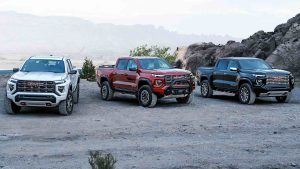
The Canyon is the GMC version of the Chevy Colorado pick-up. You can also say it the other way because it amounts to the same thing. They’re both mid-sized pickups made by General Motors that are basically the sane truck, with a few styling, trim and pricing differences.
The Canyon – being a GMC – comes with more standard features and a higher starting price: $38,4900 for the base Elevation trim (with 2WD) vs. $31,900 for the base Work Truck iteration of the Colorado.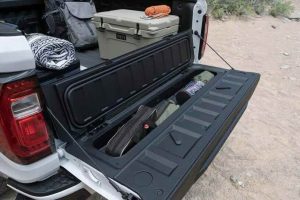
There are only two other Canyon trims – the first being the $45,700 AT4, which comes standard with 4WD and a locking rear differential. You can also opt for the AT4X off-road package ($8,600) that adds 17 inch beadlock-capable wheels with 35 inch mud-terrain tires, a locking front differential, full-size spare, steel front and rear bumpers with tow recovery hooks, upgraded skid plates and a 1 inch lift with upgraded “Multimatic DSSV” shocks.
The last – or third – depending on how you look at it – is the top-of-the-line (and luxury-themed) Denali, which stickers for $52,000. It comes standard with 4WD and 20 inch wheels with specific interior and exterior trim.
Regardless of trim, all Canyons are sold only in Crew Cab (four full-size doors) form with a five foot bed. The standard drivetrain in all trims is a turbocharged 2.7 liter four paired with an eight speed automatic.
What’s New For 2025
The Canyon carries over pretty much the same from last year; the previously available optional diesel engine is no longer available; ditto the previously available 3.6 liter V6 and the previously standard 2.5 liter four cylinder without a turbo.
What’s Good
Standard turbocharged four cylinder engine is is more powerful than the V8 engines available in full-size trucks back in the ’90s.
Pulls almost as much as a full-size truck.
Crew cab configuration has room for 5-6.
What’s Not So Good
More expensive than full-size trucks of the ’90s.
Bed (just five feet) is smaller than the six foot beds that came standard in the compact-sized trucks that used to be available .
No more optional engines.
Under The Hood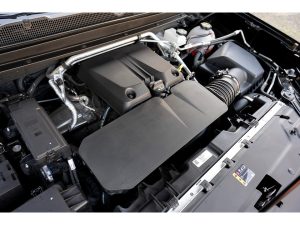
Every Canyon (like every Colorado) comes standard with a 2.7 liter, turbocharged four cylinder engine – it’s the same engine that’s standard in the Chevy Silverado 1500 – that touts 310 horsepower and 430 ft.-lbs. of torque, paired with an eight speed automatic transmission.
On the plus side, this engine is very strong. Strong enough to endow the Canyon with a standard 7,700 lb. maximum tow rating. To put that in some historical perspective, the compact-sized trucks you used to be able to buy – models like the last generation Nissan Frontier, the Ford Ranger and Toyota Tacoma – generally came standard with a 3,500 lb. tow rating and the most they could tow was 5,000 lbs.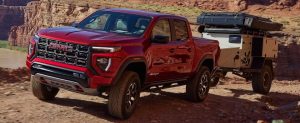
On the downside, this strong-armed capability doesn’t come free – or even at low cost. The Canyon’s strong-arm capability is of no use if you can’t afford to buy the thing. And part of the reason why many people can’t is because the Canyon now comes standard – and only – with that strong-armed 2.7 liter turbocharged engine.
The Canyon used to be available with a standard 2.5 liter four cylinder engine that only made 200 horsepower – which used to be considered a lot of horsepower. It didn’t have a turbocharger. It also did not come with base price just shy of $30,000. With the 2.5 liter four (and a six speed transmission) a 2022 Canyon – the last year the 2.5 liter engine was available – stickered for $28,700.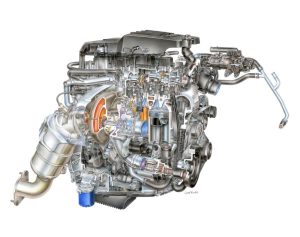
And it was still rated to pull 7,000 lbs.
So you’re not getting substantially more towing capability for the lots-more money. But you are getting more power – and quicker acceleration. Equipped with the 2.7 liter turbo engine, the 2WD Canyon can get to 60 in about 7.4 seconds. The 4WD versions – being heavier – get there closer to 8 seconds. Either way, that’s easily two seconds quicker to 60 than the Canyon was when it was available with the 2.5 liter, 200 hp engine.
It’s also not any thirstier.
Equipped with the 2.7 turbo engine, a 2WD Canyon rates 19 city, 23 highway; the Canyon with the 2.5 liter four (and no turbo) touted 19 city, 25 highway.
So at least you’re not paying more for gas.
On The Road
When it came out in 2004 – as the replacement for the S-10, which was a compact-sized truck – the Canyon/Colorado was still a mid-sized truck. Technically, it still is – because is is smaller than the current crop of super-sized full-size trucks.
But it is a big truck.
More finely, a long truck – 213.2 inches long (vs. 192.4 for the 2004Canyon/Colorado – which is nearly as long as an early 2000s full-size truck. But it is not yet as wide – and that makes it feel less huge when you’re driving it on a narrow country road with one lane in each direction. Having test driven all of the current full-size trucks on the market, I can personally attest to girth of the current crop of 1500s-series trucks. They are so wide that when you meet up with another of the type coming at you from the other direction it can feel as if there’s no room to spare in between the two. You grip the wheel tight, make fine adjustments and hope you don’t smack mirrors. Earlier this year, I was driving a new Ram 1500 on a singe-lane dirt road and encountered a late-model Ford F-150 coming the other way. Neither of us could continue because there wasn’t enough road for us to get by each other. The Ford driver reversed into a driveway so I could get by. Thankfully, there was one. If there hadn’t been, it would have been a kind of Mexican standoff. 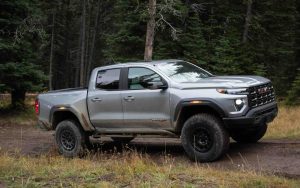
So – while the Canyon/Colorado and other “mid-sized” trucks are as long – or even longer – than the full-size trucks of the early 2000s and before (i.e., before full-size got super-sized) they are still narrow enough to not make you feel you’re running out of road to either side of you. That narrowness – or at least, narrower-ness – is also an obvious benefit off-road, because trails tend to be narrow and you sometimes have to work your way in between trees and so on.
Height is another matter.
All 2025 Canyons are lifted. Meaning, jacked-up. This stupid trend emulates the equally stupid super-sizing trend. The 2025 Canyon is just shy of 80 inches tall and to put that in some perspective, a 2004 Canyon was 65.2 inches tall. Yes, you read that right. Not a typo. The ’25 is that jacked up.
Yes, being jacked up means you have more clearance, which helps off-road and in deep (unplowed) snow. But it also makes the thing more top-heavy and unwieldy feeling on road, at highway speeds and in the curves. And it makes harder to get in and out of. Same goes for getting stuff in (and out of) the bed; more about that below.
Theres’s not a shortage of power, however. The turbo four’s torque output being greater than that of most V8s made through the early 2000s. But the manual transmission you used to be able to get is gone, of course – and that makes the driving experience less engaging – in addition to making the Canyon more expensive than full-size trucks used to be.
At The Curb
The Canyon is long – and short – in that it only comes with a short (five foot) bed). That’s because it only comes in crew cab (four full-size doors) configuration, which doesn’t leave much room for much bed. As it is, the Canyon is already 213.2 inches long. Adding another foot to that length (to allow for a six-foot bed) would increase the total to about 225 inches and that would result in a “mid-size” truck longer than an early 2000s full-size truck.
That begs the obvious question: Why not just get a full-size truck?
Well, because those trucks are super-sized now. The current (2025) GMC Sierra 1500 – which is the GMC badged version of the Chevy Silverado – is 211 inches long for the regular cab iteration with a six foot bed. The double cab iteration – with a six foot bed – is 231.9 inches long. A crew cab with a 6.6 foot bed is 241.5 inches long.
But at least you can get a regular cab Sierra – and with an eight foot bed, too. Astoundingly, it stickers for $100 less to start ($38,300) than the cost of a base price of the Canyon ($38,400).
If you need a work truck, then, you pretty much need a super-sized truck such as the Sierra or Silverado – because that’s the only way you can get a bed that’s at least six feet long. This brings up an interesting – and weird – point. Back when compact-sized trucks were available they came standard with six-foot beds. That made them more useful for carrying loads that have to fit inside an enclosed bed – such as mulch or gravel, for instance – than the current much-larger mid-sized trucks like this Canyon and its kin.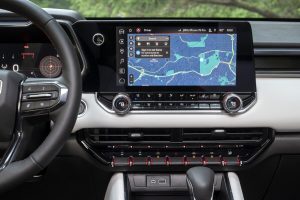
This truck has plenty of bed space for a wet dog.
That said, it’s a nice truck – and it ought to be, given it costs nearly $40,000 to start for the 2WD base trim version. Even adjusted for inflation, the Canyon’s base price is easily twice what it cost to buy a base trim compact-sized truck such as this writer’s 2002 Nissan Frontier when it was new. Of course, that ’02 Frontier did not come standard with a high-powered turbocharged engine and LED headlights, an 11.3 inch touchscreen, climate control and a lifted suspension. It came with a manual transmission and roll-up (manual) windows.
But that’s why it cost less than half what it costs to buy a new Canyon.
The Rest
The base Elevation trim is the only iteration of the Canyon that is available with 2WD. Put another way, it’s the only way to skip paying extra for 4WD. All trims come standard with a bundle of so-called “driver assistance” tech which surveys show very few people want, including Forward Collision Warning and Automatic Braking, that annoying feature that slams on the brakes when the vehicle thinks it’s time to slam on the brakes. Lane Keep Assist – that annoying feature that interferes with your steering – is also standard.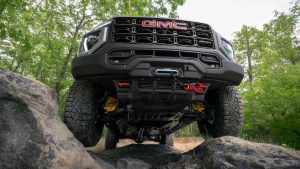
It’s interesting that every vehicle manufacture has made this “assistance technology” standard given most people wouldn’t choose to buy it if it were available optionally.
The Bottom Line
The Canyon is a nice truck for those who can afford it – and don’t really need a truck for the kind of work people used to buy trucks for. It’s more for play – not that there’s anything wrong with that.
If you can afford that.
. . .
If you like what you’ve found here please consider supporting EPautos.
We depend on you to keep the wheels turning!
Our donate button is here.
If you prefer not to use PayPal, our mailing address is:
EPautos
721 Hummingbird Lane SE
Copper Hill, VA 24079
PS: Get an EPautos magnet or sticker or coaster in return for a $20 or more one-time donation or a $10 or more monthly recurring donation. (Please be sure to tell us you want a magnet or sticker or coaster – and also, provide an address, so we know where to mail the thing!)
If you like items like the Baaaaaa! baseball cap pictured below, you can find that and more at the EPautos store!








Are you actually able to use these press loaner trucks as actual trucks? or is there a stipulation that you can only haul pillows in the bed? I ask because I hauled a load of scrap ( sharp scratchy scrap that dings the bed up scrap) in my 2004 Chevy Silverado RCLB 4×4 V6 5 speed, I have a feeling if you used the press loaner trucks like used my truck for scrap or gravel they would have a sh*tting hemorrhage.
Hi Eric,
I’m by no means a car guy (not an idiot though, I’ve been following your site after all!) I’ve been considering buying a newish Canyon or possibly a Tacoma (not 2025, I was thinking 2022ish with low mileage, when they still had a V6 and a little less electronic chaos.) I guess I’m asking for a little help or friendly input.
I want a relatively new(as in something that will last a while from now) vehicle that can do-work but also handle a little bit of off-road (canada during the winter…)
I’m semi young and the wife and I just bought our first house in a rural area and will be soon looking to have kids. I was hoping to upgrade from my 2014 Mercedes c300 4matic sport-um something more akin to rural living and self sufficiency & reliability(though I will always love the c class of 2014 wish i could afford a c63 of the same year 🙂 but it’s time I grab something bigger, more capable etc. Can you give me any pointers or thoughts? All would be appreciated.
Cheers,
Shaun.
Hi Shaun,
This one’s easy. Go with the recent-vintage Taco. They are excellent (durable, reliable) trucks. The V6 has enough power to tow about 5,000 lbs. abut the standard four is adequate for hauling a load of gravel in the bed and so on. Either engine is a good choice; it mostly comes down to how much power you need – or don’t. Another option – if you need something with an eight foot bed that can tow more – is an older (early 2000s) Tundra with the V8. These are full-size but not supersized behemoths; also very reliable and fixable, too,
I have gone for 45 yeas on American highways without a picktup truck. I hope to make it another 20. Without one. Large SUVs or the good old unavilable station wagon just makes more sense for me. Of course, I’m not hauling dirt around.
If I was… a trailer.
My brother had one of these with the V6 and liked it good enough. It then got totaled (seems they total cars pretty easily these days), and just ordered another one, but sight unseen.
Picked it up an whaaaat!!!!!! 4cyl-T. He tried to like it, but couldn’t stomach it and sold it. got a full size w/v8.
Yeah, I don’t get the point of a “truck” with a short bed. I parked next to a Ford Maverick the other day, and it looked like it had a 4 foot long bed. Why bother with the bed, why not enclose it like a SUV?
It’s a … baby bed!
So cute. Moms love this little truck.
Me either, SLH –
But then, this assumes you need a bed. People who buy these trucks obviously do not. Well, not for work. They use these baby beds to haul their dogs and so on – not that there’s anything wrong with that. But I need at least a six foot bed. And – to me – there is something absurd about a big truck with a bed that’s smaller than a small truck’s bed.
There are a lot of people that think mpg is the most important thing. They stress over it.
Have a bud who traded in his full size pickup for a honda ridgeline, so similar to the maverick, etc… and still put’s two dirtbikes in it.
I challenged his math about the loss on the trade, and no one ever cares.
My Bro and I used to run the GM 8.1L big blocks for a long time. When gas would rise to $4-5 people would dump these 10-14mpg trucks for a song. We’d get them for cheap and laugh all the way to the bank.
From my use perspective I agree but I’ve spent time overseas and you see four door pickups with short beds everywhere. Toyota and Nissan have sold them globally (back to the 1980s) long before they ever caught on here in the early 2000s. The reason is seems to be that they are good at carrying a few people and their cargo over bad roads. It’s getting to be a valid reason here, too, honestly. There are models of Land Cruisers that are four doors with a short ute bed that we’ve never gotten in the U.S. and only in Canada for mine use, never having seen a day of pavement or 2WD. They’ll probably never make sense to me but they seem to scratch an itch for a lot of people around the world.
I’m not sure how you can make a decent technical with a 4 foot bed. In many places that’s very important…
I saw a KEI truck IRL the other day!
Thing was like 4 feet wide. RHD, but driving it I would assume is easy given the thing is so narrow.
I said I wish it was legal to buy something like that around here (VA). He responded from the right side window, they are, as long as their 25 years old.
(I meant new, however the import law was 30 years if I’m not mistaken.) The bed was so low to the ground, it looked so practical. Very cool – kei trucks.
What people want vs. what the car companies are shoving up our asses. Big difference.
My ’01 GMC Sierra just keeps looking better and better. I love how this site keeps re-affirming that purchase decision.
Attention, EeeVee Mary:
https://tinyurl.com/55jdsmky
We don’t need no 8-speed slushbox.
The body designs on all these is no longer aero friendly, instead even in this “smaller” truck that giant slab of a front end is like pushing a barn door down the road.
My (at the time) full size 1991 Silverado 2 door 8 ft bed 2WD seems like a shrimp these days. Easy to get in and out of, and easy to reach over the tailgate for your stuff. Its bed is enclosed with a nice canopy so hauling things in the weather not a problem. That generation has the rounded shorter grill front end, curved and sloped windshield. Windy days it handles fine. Easy to reach inside the engine bay for maintenance checks.
It’s a giant hot-wheels truck for some dumb rich kid.
I’m only happy to hear that they still make a truck (Sierra) with a regular cab and 8-foot bed.
This one, however, with its 3-foot high side walls, 5-foot open trunk and uselessly enormous proportions is just a visual reminder of today’s idiocy. Unless, I suppose, you want a huge, 4WD family car.
Amen, BaDnOn –
I just drove my ’02 Frontier to the place I buy mulch. Because my truck’s six foot bed can take a “scoop” (and I don’t care if gets scratched). I left the shiny Tonka Toy at home.
That’s a good point, Eric. Your typical loader bucket is going to be longer than 5′ making such a procedure difficult or wasteful for these new monstrosities. Of course, we know most people that buy these things aren’t doing much mulching.
Out of curiosity, are you growing anything interesting this year? I’m trying my luck with silver maples, some more fruit trees, and will even try to germinate some eucalyptus, following some advice from one of your other readers. (Herr Heidler?)
Eucalyptus was used for steam ship fuel, hence the proliferation of the species back then. High oil content in the wood.
Box elder trees are a maple species and do produce maple sap in the early spring time. Boil it all down and you have maple syrup. Manitoba maple, California maple, all the same.
Box elder maple burns hot in a Buck Stove and the chimney temp goes to 925 degrees F.
You know it, Dumphish!
These trees are mostly being grown for fuel, but also privacy and some other useful products.
As I’m sure you’re aware, a solution of maple syrup can be fed to yeast, and a few days later, subject to distillation at ~70C to procure the delightful elixir known as rum.
The last new truck I bought was a 4WD 89 Dakota, bought precisely because it was low enough I could reach the bottom of the bed. Or step on top of a rear tire and climb up into the bed. Same was true of the last truck I owned. A 98 Tacoma, which my son now drives as needed, since I can no longer drive.
No more baby duramax? That’s unfortunate.
Guy at work had an older Colorado that finally rusted apart. He got a newer one and it’s not the same truck at all. They are slightly undersized 1500s, but without enough bed to be useful.
Say what you want about the size of trucks today, but (as long as you don’t have the mini beds that come in 1500s) they can fit 2 yards of mulch or dirt in them no problem.
There isn’t a legit reason to have gigantic trucks that can’t do a lot of truck stuff. It’s a styling feature for people who don’t actually use it like a truck.
I don’t see the point of $600 designer jeans either.
I had a 1967 Dodge half ton that would hold a full chord of wood, 4x4x8. I hated it. Didn’t think you would ever get a load of wood cut.
It’s like a disease, vehicle manufactures constantly increasing
the size of their products. If I want a compact whatever,
I don’t want larger.
They kowtow to any illegitimate government edict, but
don’t seem to pay much attention to consumer desires.
No sale…
‘The 2025 Canyon is just shy of 80 inches tall and to put that in some perspective, a 2004 Canyon was 65.2 inches tall.’ — eric
Indeed, the lede photo shows a beltline (bottom edge of windows and windshield) taller than some low-slung sedans.
Today, when all hatchbacks, crossovers and sedans are bob-tailed, sedans of the 1960s and 1970s look oddly proportioned to us, thanks to their l-o-o-o-o-n-g trunk extending three or four feet back from the rear wheels like a bustle skirt.
Likewise, pickups of that era weren’t a lot taller than cars — meaning that you could slide into the seat without needing a step, and reach over the bedwall to load it (as I still do with my 1998 Frontier when hauling yard waste).
In the lede photo, the Canyon truck with foot-high gaps between the top of the tires and the wheel wells makes it look like a top-heavy skyscraper rolling down the road. It brings back bad memories of a ride over Donner Pass in a friend’s mid-1990s Ford Explorer, knowing that those fool contraptions were prone to rollover accidents.
The Canyon’s ridiculous appearance, crew cab (which I don’t need), short bed, and 88-speed automatic (okay, that’s a typo, but let it stand) make me a ‘don’t wanter’ at any price, including free. I need a Canyon like I need a pair of full-cut purple silk pantaloons accessorized with wooden clogs and a Kevlar codpiece. Sheesh!
Pickups were originally passenger cars with a light sheet metal box stuck in the trunk to carry stuff. Light, cheap, and useful, until you needed a real truck for serious hauling.
In the 60s pickups reached a kind of zenith, I had a 66 Chevy C10 which was amazingly low and capable with an 8 ft bed 2 feet off the ground and a really nice driving height. My 2nd best was a bizarre looking 66 dodge which was tough as nails and had the same low riding/hauling virtues as the c10 but looked like dodge styling had been experimenting with LSD that week. Tail fins, hood louvers, and giant round headlights oh my!
Years ago I borrowed a first gen Colorado with the 5 cylinder and standard. It seemed like an OK little truck and had no problems carrying a large load of rough cut pine boards. Smaller than my old 80’s full size and one that I might have bought if I had the money at the time.
The new ones are just to big and high to use like a truck. More of a toy than a truck used for moving wood, garbage, furniture, etc. These new trucks are more in the line of body builders on display than a wiry field hand who works hard all day and makes it look easy to boot.
Nowadays I just borrow a truck from friends when I need one.
So, instead of getting a mid-size sedan (Torino/Chevelle/Etc.) with a v8 to pull your boat you are left with this.
These vehicles aren’t made for truck duty, they’re the Regulation Compliant sedans of our day that can haul a family of 5 or 6. A good, weather-tight, bed cover and you’ve got a great trunk but, don’t figure on hauling sheets of plywood.
Recalling the 90s, plenty of people drove compact trucks, but to see them now you also have to wonder how today’s enormous US Americans would fit inside one?
Waistline inflation is also a likely factor.
My friend’s dad bought the most stripped down S10 that Chevy offered in ’97 – a RCSB2wd 4cyl/5 speed with steelies.
Truck stickered around $11k, but dude had a GM MasterCard – which at the time had an amazingly generous rebate program – and he applied about $8k worth of cc rebate & scored that brand new truck for roughly $4k cash.
Good luck getting a deal anywhere near that today.