


The other day, I needed to get some things at Lowes that would not fit in the new car I was test-driving (the 2025 Audi Q3; my review is here) so I jumped in my old truck and headed off to Lowes. A glance at the gas gauge reminded me I’d forgotten to fill up since I last used the truck – it often sits for days or even weeks – and was running on empty.
Or nearly.
But, no worries – because there’s always gas up ahead and so actually running out is a remote worry. Even if you do run out, it’s easy to get gas and bring it back to where you ran out of it. Filling up from running on fumes also only takes minutes – about three minutes, for my truck; I have timed it. That’s how long it takes to pump 15 gallons into its tank – and even though my truck only averages about 22 miles-per-gallon, that’s enough gas to allow me to drive about 300 miles before I need to fill up again.
The situation wold have been entirely different if I had jumped into an EV I’d forgotten to recharge before heading into town.
First, it’s possible I might not have made it there – because unlike fuel gauges, EV range-estimators (the miles remaining the vehicle’s in-dash indicator says you can drive) are often wildly inaccurate, with disparities between indicated and actual ranging as high as 20 percent, depending on the make/model and also on conditions (e.g., how hot or cold it is outside) as well as how fast or slowly you drive.
This is enervating because not only might you run out of range before you get to a place to recharge (at which point you’ll need to have the EV towed someplace to get a charge) you might not be able to recharge when you get there. If you make it there. The EV “fast” charging network is both diffuse – there often isn’t one just up ahead or even anywhere you are close to right now as you watch the range-remaining indicator dwindle down to single digits – and unreliable, in that it’s not uncommon for the “fast” charging kiosks to be offline. The interface is sometimes also glitchy and – because everything is electronic – there is no option to walk inside the station and pay cash. There is no place to walk inside. There are just the kiosks – and if they won’t accept your credit card or the app that is often needed to get your credit card to be accepted isn’t working, no charge for you.
It gets worse – and there’s no getting around it.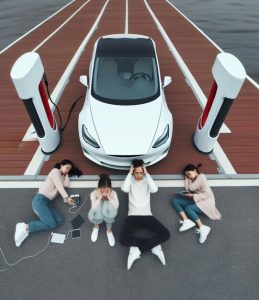
Let’s say you do make it to the “fast” charging place – and the kiosk accepts your card. You’re still going to have to wait for at least 20 minutes or so for your EV to download a partial charge. If you did not anticipate – and plan for – this having to stop and wait for at least 20 minutes to get a partial charge, it probably means you’re going to be late for something you had not planned on being late for. At the very least, it will be an unexpected interruption of your travel – and your day.
In my example, I could (and did) fully refuel my truck in just three minutes and so did not have to spend at least another 17 minutes waiting for a partial charge. During that time, I was at the gym, working out – while my hypothetical other self was sitting at the not-so-fast charger not working out. By the time my hypothetical EV-driving self had waited long enough to get a partial charge, I was already half-finished with my workout. By the time my hypothetical self made it to the gym and was halfway through his, I was headed home.
I’d be back home longe before my hypothetical self got there, too.
It gets worse.
When I made it back home – in my truck – the tank would still be almost full. Because I was able to fill it up (and in just three minutes). But my hypothetical self’s EV left the not-so-fast charger with only a partial charge – after a 20 minute wait, don’t forget. So by the time he made it home, the EV wouldn’t have much charge – or range – left. He’d. need to wait – again – for the thing to recover some charge, which takes hours at the least when you’re charging an EV at home. That’s the best-case scenario. It assumes your home is equipped with a 240V (Level II) place to plug into. If all you have is an ordinary wall plug (120V, styled Level 1) then you will have to wait at least 24-48 hours before the EV has recovered more than about 50 miles of range.
All of this is more than enough reason to throw the EV in the woods – so to speak. President Trump’s ending of the $7,500 federal tax rebate was merely the straw that broke the EV camel’s back. That – plus the rising cost of electricity. It now costs about the same in most parts of the country to charge up an EV as it does to fuel up an SUV.
So why bother with an EV?
Exactly. And that’s just what we’re seeing unfold. EV sales are cratering and vehicle manufacturers are cutting production of EVs, if not cancelling them outright.
The free market works. If it’s allowed to.
. . .
If you like what you’ve found here please consider supporting EPautos.
We depend on you to keep the wheels turning!
Our donate button is here.
If you prefer not to use PayPal, our mailing address is:
EPautos
721 Hummingbird Lane SE
Copper Hill, VA 24079
PS: Get an EPautos magnet or sticker or coaster in return for a $25 or more one-time donation or a $10 or more monthly recurring donation. (Please be sure to tell us you want a magnet or sticker or coaster – and also, provide an address, so we know where to mail the thing!)
If you’d like a Baaaaa hat or other EPautos gear, see here!









.)
Eric’s points about a gasoline fill up – vs an EV charge are inarguable.
On a side note however, has anyone else noticed how slow the gasoline pumps are today – vs – 20 or so years ago?
Of course the fanboys would say this scenario wouldn’t happen because you’d have plugged in to your home charging system right after you parked it last night. And sure, most of the time that’d be the case. But what if you didn’t quite get the plug in the whole way? Or you had something else on your mind, finishing up a phone call or a “code brown” event that took precedence and just plain forgot? Maybe there was a power failure.
As utilities continue to balance power supply and demand we’ll see more control placed on consumers. Right now it’s incentives to not use electricity. I signed up for a program with my coop called “Peak Time Payback” where they’ll refund me a little cash if I don’t use heavy loads like the stove during peak consumption time, usually in the early evening between 16:00 and 19:00. That time also coincides with waning solar production, so gas peaking plants are coming online. That’s the carrot. But when that’s no longer effective at affordably keeping the grid in balance, there will be sticks. Like telling your car not to charge if there’s too much demand. So if it takes 8 hours to recharge, but the utility only let your car charge for 4 hours, maybe you don’t have the range you expected. Oh, I’m sure they’ll send you texts and emails telling you they’ll be implementing conservation rules, but will you notice? And I’ll bet you can override the central controller… for a price.
It’s worse than that RK, in California (of course) the utility can suck power OUT of your EV if they need it to stabilize the grid at peak loads. Good luck getting anywhere the next day.
‘More than enough reason to throw the EV in the woods.’ — eric
An October 22 fire at GM’s Advanced Design Center in Pasadena CA (see Eric’s previous post) ought to be a wake-up call about the unacceptable dangers of EeeVees. But GM is blowing smoke (so to speak, heh heh) to shroud the role of EeeVee batteries in the incident:
‘In a statement to Car and Driver, a General Motors spokesperson said, “The isolated fire was contained to a single design concept vehicle and did not spread to any other vehicles, design concepts, or the building itself.”
‘The cause and source of the fire are still under investigation, and General Motors said that there is currently no evidence that the fire stemmed from lithium-ion batteries. According to Pasadena Now, the fire damaged part of the 149,000-square-foot campus, which fully opened in 2024 after a $71 million investment.’
https://www.caranddriver.com/news/a69137455/general-motors-design-studio-pasadena-fire/
WHUUUT — lithium-ion batteries weren’t the culprit? Why else would a concept car catch fire? A frustrated employee smokin’ crack to relieve the horror of working for wokesters?
Despite GM’s artful dodging and weaving, dozens of other building fires caused by EeeVees, as well as fires on container ships, testify to the fact that building codes need to PROHIBIT parking EeeVees inside or within 25 feet of structures.
In retrospect, Commiefornia’s building code requiring EeeVee charging facilities in residential garages is a ghastly error — along the same lines as the installation of lead water pipes and asbestos insulation in early to mid 20th century houses. That requirement needs to be deleted, pronto.
But the coup de grace for the misbegotten EeeVee experiment likely will be delivered by the insurance mafia. The Gecko doesn’t want to pay for the smoldering wreckage of torched ships, houses and parking garages. A simple policy rider that voids coverage for fires caused by EeeVees will put paid to Newsom’s Folly. Vehicles that can’t be parked indoors have no market — end of story.
EeeVees are our misfortune.
https://www.youtube.com/watch?v=1AP3Bt5ZZ3Q
A ding to a skid plate totaled this F150 Lightning.
The EV debacle is the natural result of Planned Economy thinking.
Our Overlords think all they have to do is pass a law, decree a fatwa or whatever and the world will bend to its wishes. It’s just like the phrase that was bandied about a few years ago, “failure is not an option”.
Bullshit. Failure is ALWAYS an option, so you better be ready with Plan B.
As Francis Bacon famously said, “Nature, to be commanded, must be obeyed.” I’ve got bad news for the EV pushers, you’re not God. You cannot will things into existence. Truth and reality always win. And, gravity is undefeated since the dawn of time.
When it comes to dealing with the natural world, never trust someone who’s never gotten a blister.
And there a lot of blisterless cunts mingling around these days
The only way I could ever see any type of EV making sense is if you have one massive bank of solar panels and could charge it yourself. Unlikely at best but perhaps someone has this type of setup. Otherwise lets leave rechargeable batteries for tools where they make sense but that Milwaukee impact wrench with a 50cc gas engine looks like a fun idea.
I generally avoid letting the tank go to E & running on fumes because I don’t want to cook the fuel pump. Putting the fuel pump in the tank is amongst the stupidest things the auto industry has done. Even my 25-year-old truck has it in the tank –which requires either dropping the tank or taking the bed off to spend the 5-minutes it takes to swap.
Hi MH. Some of the Japanese stuff have a removable panel to get at the pump. As for your truck it might make sense to cut out a section of the box to access the pump and get a larger piece of the box floor from a wrecking yard to pop rivet down in case the pump goes again.
That has crossed my mind. Angle grind an access port and fabricate a simple latch to reattach.
I’ll face the same in my 91 Silverado. I’m voting for a bed cut and replace patch – thanks YouTube!
When fuel drops below half tank I like to fill it back up.. keep the pump wet.
On my 2000 Nissan its 6 bed bolts, neck filler tube (1 bolt) and then just unplug some wiring so bed can be moved out of the way.
No WAY I’m cutting a hole in the bed of my beautiful classic Japanese truck!
https://i.postimg.cc/c4bYyGzq/A24b.jpg
“My beautiful, classic Japanese truck”…
Twenty years ago I would have laughed at you. Now I know exactly what you mean. The Japs made some really fine vehicles. Most of them were so cheap and practical they got used and abused and thrown away. I wish I still had my 84 Celica Supra, or a nice diesel Isuzu P’up.
“Twenty years ago I would have laughed at you”
Yeah I would have laughed too, but not anymore.
I LOVE this little Nissan truck.
Well AMC, if that was my truck I wouldn’t cut a hole either but if it was a beat up work truck or covered in rust I probably would cut that hole.
You’ve got a keeper in that thing.
Another reason not to let your tank get close to empty is because you don’t want the pump sucking up all the crap that settles at the bottom of your tank and running it through the system.