


Honda is bringing back the Prelude – after a 25 year absence. This is appropriate, in a way, because the 2026 Prelude will cost about twice as much as the last (2001) model.
Both the new and the old Prelude are small coupes made to appeal to people who want something smaller and sportier-looking than an Accord. But the last Prelude stickered for $23,600 back in 2001; the 2026 model will sticker for $43,195 – which is a lot to pay for a Honda, regardless.
Hondas – and Toyotas – were once the affordable (and generally, better) alternatives to Fords and Chevys. Whether they are better now is harder to say. But it’s not difficult to say that none of them are affordable anymore.
Some of the near-doubling of the ’26 Prelude’s price is of course what is called “inflation.” But this does not address affordability because most people’s incomes have not “inflated” in tandem with the cost of things. Put another way, things today – like cars and homes – cost more to buy because we have less money to spend on them. Are you making about twice what you were making back in 2001? If not, you are significantly poorer.
Almost everyone not a dolt or in denial (which excludes Trump) understands this. Why, for example, is it generally true that not as many people are able to afford two new vehicles today when they could afford them 25 years ago? The answer is because it takes about twice as much money to buy one today as it did to buy two 25 years ago.
Compliance costs have have not helped make things more affordable – and the new Prelude is a case in point. Part of the reason it costs so much is because it has a hybrid drivetrain. In addition to the engine, it has a pair of electric motors and a battery pack to store the electricity that feeds those motors.
The Prelude’s hybrid drivetrain is basically the same drivetrain that is already in service in the Honda Civic hybrid, which isn’t very affordable either. The latter’s base price is about $30k – which makes its high gas mileage pretty pricey. What good is a high-mileage car if you can’t afford to buy it? Remember: The “savings” are available only after you have paid for the car. You must (probably) make those payments every month in order to “save” while you’re driving – assuming you cannot afford to buy the thing outright before you start driving it.
Honda makes the Civic hybrid chiefly for compliance (rather than fuel efficiency) reasons. There is some confusion about this point because the Civic hybrid is fuel efficient. But it is fuel efficient chiefly on account of compliance pressure; i.e., Honda makes the Civic hybrid (as well as the Accord hybrid) because high-mileage hybrids help up Honda’s Corporate Average Fuel Economy (CAFE) score and also help lower the “emissions” of the dread gas that feeds plants (CO2) which also helps with compliance.
This compliance pressure accounts for the hybridization of increasingly all cars, including the Accord – which used to be available with a V6. Put another way, if it were about high-mileage as a selling point, Honda (and other car companies) would certainly make hybrid-equipped vehicles as specialty vehicles for people who esteemed gas mileage above other considerations. But making almost most (soon all) of their vehicles hybrids suggests compliance pressure is behind that – and we’re expected to pay more for that.
Back to the 2026 Prelude. You’ll pay about twice as much for it and get less (as well as more) for that. Less engine, for one. The old (2001) Prelude came standard with a 2.2 liter four that touted 200 horsepower; it came paired with a five speed manual transmission. The 2026 Prelude comes with a 2.0 liter four plus those electric motors and the battery pack and touts . . . 200 horsepower. It also comes only with a CVT automatic. But you do get simulated shifting via something called S+Shift, which mimics the gear changes of a manual except it is all electronically controlled.
You also get more weight. Because those motors and the battery pack aren’t light.
The 2001 Prelude weighed just under 3,000 lbs. The 2026 will weigh several hundred pounds more, which is ironic given that the putative objective is high-mileage because high curb weight stands in opposition to that. If Honda had elected not to hybridize the Prelude, it is likely Honda could have made the 2026 model lighter than the 2001 model – which would have made it more efficient as well as less expensive.
Honda used to make a model that fit that description, too.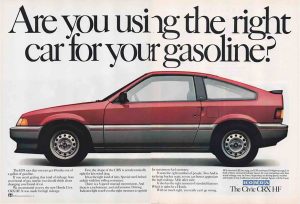
It was the old Civic CRX, especially the HF variant. It was a flyweight and it was capable of higher mileage than the current Civic hybrid, without needing the hybrid drivetrain because it was light. It also cost less than half what the Prelude costs.
Of course, such a car such as the old Civic CRX would not be compliant today. Neither would the 2001 Prelude, for that matter.
And that’s why we get cars like the 2026 Prelude – for $43k.
. . .
If you like what you’ve found here please consider supporting EPautos.
We depend on you to keep the wheels turning!
Our donate button is here.
If you prefer not to use PayPal, our mailing address is:
EPautos
721 Hummingbird Lane SE
Copper Hill, VA 24079
PS: Get an EPautos magnet or sticker or coaster in return for a $25 or more one-time donation or a $10 or more monthly recurring donation. (Please be sure to tell us you want a magnet or sticker or coaster – and also, provide an address, so we know where to mail the thing!)
If you’d like a Baaaaa hat or other EPautos gear, see here!







 Prelude.)
At 43k to start, they ain’t gonna sell many…..
Just too expensive for what it is.
Morning, Rich –
Yup; that’s how I see it also. The car companies seem to think it’s viable to sell luxury priced cars as mass market cars. That’s a contradiction in terms. I think they assumed that debt financing would allow it, but that’s reached the end of its viability, too.
Prelude to failure.
This new Prelude is shit compared to the fine car that it used to be.
However, if it were on par with previous Preludes from 1992 forward, $43k might be about right in today’s devalued dollars. Here’s my quick and dirty AI analysis of Prelude MSRPs and as adjusted for inflation:
Year Original MSRP Approx. 2025 MSRP (inflation-adjusted)
1983 $9,645 ≈ $31,300
1985 (Si) $12,850 ≈ $34,900
1990 $17,777 ≈ $38,600
1992 (S) $16,540 ≈ $33,000
1992 (Si) $19,540 ≈ $39,000
1992 (Si 4WS) $21,860 ≈ $43,500
1995 $23,790 ≈ $44,500
1996 $24,365 ≈ $45,000
1997 (base) $23,595 ≈ $43,100
1997 (Type SH) $26,095 ≈ $47,700
1998 (base) $23,695 ≈ $43,000
1998 (Type SH) $26,195 ≈ $47,600
1999 (base) $23,865 ≈ $43,200
1999 (Type SH) $26,365 ≈ $47,800
2000 (base) $23,915 ≈ $42,900
2000 (Type SH) $26,415 ≈ $47,400
2001 (5-speed) $23,600 ≈ $42,300
2001 (auto) $24,600 ≈ $44,000
2001 (Type SH) $26,100 ≈ $46,800
It’s probably more fair to say hybrids in a free market would probably still exist. There’s demand that they might meet, MPG being one. Some people would probably buy them thinking they’re helping the environment. In a truly free market people can buy or sell whatever they want based on whatever criteria they deem important. Doesn’t even have to be rational.
However a truly free market would also meet the demand for an honest car at an affordable price. Even with currency debasement. For one whether you call them sticky or stagnate or simply insulting wages the demand for cars still exists and it’s very hard to imagine that without compliance manufacturers would be selling cars to meet the price.
I bet the market would absolutely vacuum up that 1st gen CRX HF. I’d be all over that funky mid 80s body and interior if they did a mild update with a 2nd gen EFI 1.5L VTEC. That would be a cool daily driver and would get 40+ MPG easy. I had a 1983 3BBL 1.3L CVCC Civic, which was a neat little car, but even being about as heavy as a golf cart it was not powerful enough for greater than 55 MPG Interstates, which VTEC solved.
Had a CRX Si, fabulous little car. Wish they still made them that way too.
AutoX’d it, jumped it, beat the crap out of it, and unfortunately my shenanigans caught up with me and I centerpunched a pole at a decent speed which tore off the front engine mount (alum.). Didn’t have collision insurance and couldn’t afford the total loss.
Learned my lesson on why FWD sucks trying to carve corners at speed (no nannies back then).
Made a deal with a cool auto-body guy that desperately wanted to ride my roadrace bike and it got fixed.
I had a 1991 Honda Civic that I bought new, forget hiw much I paid but it was a nice small car that managed to fit four people comfortably. The back seat was tight but the kiddos were small back then so it wasn’t a problem. Having a timing belt was a terrible idea though. First time it broke was a week before I had it scheduled for replacement so ended up having to get towed, luckily wasn’t too far from home. Second time it broke I said f*ck it and junked the car, was getting rusty by then anyway but I made sure after that never to buy a car that had a timing belt – chain or gears only.
bought/fixed/sold and fixed for friends a lot of those timing belt honda’s. Made a good living for a teenager and early 20’s guy. The worst was when it bent the valves (interference engine, which was new to us American’s back then), which was the majority of the time.
And I moved on too to the pretty darn good 90’s GM’s even though I hated FWD.
Sad news about the new Prelude. But what isn’t these days. The middle class and lower will be hurt even more with none of these affordable to fix in 10+yrs.
Had a late 80’s Prelude. My mom paid 12K? for it new. I bought it from her for $6K, for my first decent car after school. But I ruined it, full throttle for 1-2 hrs on a very late night high speed run to make a roadrace in Georgia. 100+, the car was never the same after that. It obviously didn’t like running at full bore for too long. And why I switched to larger American cars after that, Cutlasses and Bonneviles.
‘It comes only with a CVT. But you do get simulated shifting.’ — eric
How fake and gay. Does it also come with a Fratzonic exhaust note simulator, so it makes a little burp with each ‘shift’?
Honda has lost the plot. Not sure I would even buy one of their motorcycles anymore. Don’t like doing business with compliant clowns who hate me for my clutch pedal.
The value of the dollar meme is so far out of date that it is ridiculous.
Silver is now $51.25 vs the $16 referenced in the meme.
The silver dollar increase is a function of the worth-even-less fiat dollar, too. Paper $1 gets you about 2 eggs rather than 6, etc, etc.
$50 for a silver eagle. Does that sound expensive?
An 80:1 gold:silver ratio is historically about in the average band for the last decade and it’s hard to imagine silver ever really retreating back much under $50. The demand will skyrocket so even if the paper price goes down the premiums just to get hands on the physical will increase to fill the margins.
“ What good is a high-mileage car if you can’t afford to buy it?”
That’s one thing neither the Greens nor the Regulatory Ayatollahs grok. In order to be truly effective at conserving energy and reducing emissions, high-mileage cars need to be widely adopted, that is, a lot of people, probably the majority of people, need to buy them. A car that costs north of $40,000 is not going to be widely adopted. A high-mileage car that costs $20,000, like the late VW Golf TDI will be widely adopted, and one that costs $13,000, like the Toyota Hilux, more so.
And it’s not prohibitively expensive to build high-mileage cars. It IS, however, if those cars are to be “compliant.”
Regarding the Prelude they can charge whatever they want but it doesn’t matter if people can no longer afford to buy it. I avoid debt like a politician avoids answering questions and I suspect many of Eric’s readers do also.
That brings up my mechanic asking me what I’d do if my current all season daily driver was written off or experienced a catastrophic failure which is quite concerning to me as I want no nanny tech and minimal blind spots. I suspect that I’d be looking for another 1995 to 2005 car or truck to drive.
Unfortunately these cars are now antiques and parts are less available and come winter might well be in storage so harder to find.
It’s worth looking ahead and constantly being on the lookout for your next daily. I have used this strategy for decades, never owned a new car, always bought something with minor problems cheap, fixed it, and sold it in 6-12 months for more than I had in it.
This is getting harder as the disposable electronic car approaches 25 years old, but it still can be done. Over the last 30 years I estimate it’s allowed me to pocket 300000 vs driving new/nearly new cars. But if you’re not mechanically inclined, it won’t work.
I would also note that collector car prices in general haven’t kept up with new prices, so it is quite possible to get something really nice if you’re willing to spend 10-20k on a car that’s not “hot” from the past.
Hi Ernie.
I’m reasonably handy when it comes to car repair but the problem is lack of parking spaces. I’ve got 5 cars/ bikes but I only drive one in the winter. Hence the lack of desire to buy in advance but I wouldn’t be scared off from 5K in repairs on a 3K car if it was rust free.
Electronics are the Achilles heel. I’m dealing with that in a 2002 beater now. I think the majority of people would have junked the car by now but being an embedded controls designer I’ve taken on the little glitches as a challenge. The car’s mechanically fine, rust is starting to get a foot hold and the 300K miles on the transaxle have taken their toll. It’s a manual, though, so it’s got life even if it’s got a rattle in there.
Still a simple car, crank windows and such. But the ECU decided to stop recognizing the gauge cluster, it seems the cluster no longer communicates the car’s VIN properly. This seems to have it’s root ultimately in the chip key amplifier box under the dash. This is a Nissan, so the system is Denso. But things get old, electronics fail. I could replace parts, re-code the system and probably get it working like Nissan expects me to. But that would cost money (not to mention anything I’d get from the junk is either also failed or could at any time) and so far I’m only out $0.50 for a new EEPROM in the ECU, already having all the tools i needed (e.g. software tools, EEPROM/Flash reader/programmer, PCB rework station, etc.).
I did need to get an OBD-II interface but that I figured fell into “I’m gonna need anyway” unless I end up with something older than 1992 or so. At this point you can’t ignore the fact that ECUs and OBD are the reality. If we get hit with an EMP you’ll have two choices. Compete with 8 billion other people for the few remaining carbureted cars or learn to get the millions of them with computers running again. I’m hedging my bets that the vast bulk of people will fight over that one 1976 Cutlass in town while I’ll have my pick of a thousand Tauruses and S10s from which to cherry pick parts to get a running vehicle.
Heck, that might be my after tomorrow gig, getting EFI cars running again. Plus, without the EPA to constantly be looking for “modifications” that at this point make building your own ECU only legal for non-road use the floodgates will open for anyone who knows how to flash new firmware and crimp a few terminals, building opensource and DIY ECUs for people.