


Most people have heard about the electric vehicle battery replacement issue; more finely, they have heard about the cost of replacing an electric vehicle’s battery pack. They have heard that it is a big cost. Which it is. Around $5k on the low end and well over $10,000 on the high; the cost varies from EV to EV, with Tesla battery packs being among the most expensive to replace and a Nissan Leaf’s being among the least expensive (in relative terms).
How many have heard about battery replacement costs in partially electric vehicles?
These are more commonly called hybrids – the hybridization being the combination of a gas-burning engine that both provides propulsive power (i.e., it moves the vehicle) and serves as a generator that makes electricity, used to power electric motors that also move the vehicle (some more, some less). There is also an EV-like battery pack (usually but not always lithium ion) that stores the electricity generated by the gas-burning engine, to power the motors and run the vehicle’s accessories when the gas engine isn’t running.
The idea being to cycle the gas-burning off for as long as possible, so as to reduce to the extent possible the burning of gas – and not just to save it. The original batch of hybrids consisted of models such as the eponymous Prius and its imitators, like the Honda Insight two-seater of the early 2000s. These were designed to be hybrids exclusively; i.e., they were not hybridized iterations of non-hybrid models.
Then came the compliance hybrids. These are variants of almost every model of everything on sale today. The hybrid part isn’t so much there to save gas but to reduce gaseous “emissions” of carbon dioxide, not because buyers care about that but because the vehicle manufacturers are forced to care about that. 
And now, so must we.
Or at least, so must the people who buy a hybrid – which it’s getting hard not to because some iteration of hybridness is fast becoming standard in many vehicles. Pretty much every new Audi, BMW and Lexus, for instance, comes standard with a “mild” hybrid drivetrain at the least. The “eTorque” system Ram installs on the 3.6 V6 and the soon-to-be-available-again V8 in the 1500 pickup is a “mild” hybrid setup.
You pay extra for this up front, of course – because the motors and battery pack don’t cost nothing. But how much do you pay down the road – when the time comes to replace the hybrid battery pack? That time will come, too. Not right away – and not as soon as it would if you bought a 100 percent EV, because the latter’s battery never gets a rest and is also (typically) discharged down to near-“empty,” regularly because that’s necessary to drive the thing any distance The heavy discharging (followed by “fast” charging) takes a toll on the battery, which gradually loses it capacity to accept/retain charge – at which point you need a new battery.
The battery in a hybrid is smaller and it has an easier life. The hybrid system usually prevents heavy discharging of the battery by automatically restarting the engine to recharge the battery as you drive – and of course, the battery is not usually powering everything, all by itself. Still, it is a battery and all batteries wear out, just like we all do eventually.
So much will it cost?
On average, about $1,500.
Of course, that’s just for the battery. There will be labor charges to install it, so add another $500 for that. So – about $2k, depending – in addition to the several thousand extra you paid to buy the hybrid in the first place. As a case-in-point, the 2025 Mazda CX50 I just got finished test-driving is available with a hybrid drivetrain. The base price of the latter is $33,970 vs. $30,300 for the base trim iteration of the non-hybrid CX50. This amounts to an up-front difference of $3,670. For that extra, you get a hybrid that gets 39 city, 37 highway vs. one that gets 25 city, 31 highway – a difference of about 10 MPG overall.
The Mazda’s tank holds about 16 gallons; assuming about $3 per gallon, it costs about $50 to fill ‘er up. If you have a cookie jar with about $3,600 in it, you could use that to fill ‘er up about 72 times. If the non-hybrid Mazda averages about 28 miles per gallon, it can go about 400-ish miles on a full tank. That times 72 fill-‘er-ups comes to about 28,000 miles of driving. That would be about the odometer reading at which point you’d begin to save money (as opposed to just gas money) if you’d bought the hybrid. But this leaves out battery replacement costs. Add another $2k for that and now you’d probably have to drive another 20,000 miles to get back what you “saved.”
Higher insurance costs (based on the higher replacement cost of the hybrid ought also to be factored in.
There’s one other thing, too.
It is already the case that replacement battery packs are not available – from the manufacturer – for certain older model hybrids, such as the first generation Honda Insight. Aftermarket ones are available, but like aftermarket parts generally, they can be sketchy. Regardless, they’re not cheap – and unless you have the cash to pay the bill then probably you’ll be paying interest on the bill, too.
The sad – and stupid – thing is that these expenses are entirely not necessary, if all you want to do is spend less on gas without having to spend more to buy the car. If, that is, it were still legal for manufacturers to offer lightweight, high-efficiency cars such as the Geo Metro sold as recently as 1997. Well, granted, that wasn’t so recently. But the point is that when you were still allowed to buy cars like the Metro, you could save a lot of money on gas and the vehicle. The Metro’s mileage was as good or better than any current hybrid’s but it didn’t need a hybrid drivetrain to deliver it, so it didn’t cost anything close to what the least expensive new hybrid costs.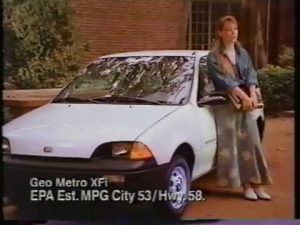
It was also a car that didn’t “emit” much in the way of C02, either – because it used (and so burned) so little gas. This fact is apparently unimportant, which is interesting in view of the apocalyptic assurances we’re given that the “climate” is “changing” and to a great extent on account of C02 “emissions from vehicles and all stops must be taken out to reduce these “emissions.”
Except insofar as allowing people to buy low-“emissions” (and high mileage and low cost) vehicles like the Metro. They are unsafe, you see. Because they are so light – which is what enables them to be so efficient.
If you drive into a tree you will be less protected.
But is being safe more important than averting what we are told is imminent and catastrophic “climate change”? If the “climate” does “change” then what will it matter whether we are less safe, if we drive into a tree?
Never mind.
. . .
If you like what you’ve found here please consider supporting EPautos.
We depend on you to keep the wheels turning!
Our donate button is here.
If you prefer not to use PayPal, our mailing address is:
EPautos
721 Hummingbird Lane SE
Copper Hill, VA 24079
PS: Get an EPautos magnet or sticker or coaster in return for a $25 or more one-time donation or a $10 or more monthly recurring donation. (Please be sure to tell us you want a magnet or sticker or coaster – and also, provide an address, so we know where to mail the thing!)
If you’d like a Baaaaa hat or other EPautos gear, see here!








At least there is ONE car company bailing completely on electric.
Unfortunately, it’s only Pagani, the Italian maker of V12 powered hyper cars that only makes about 50 cars a year.
Our customers don’t want electric cars, they say.
https://www.motor1.com/news/766203/pagani-customers-dont-want-an-ev/
Congrats for not bankrupting themselves, though they did waste a good amount of money developing a car they will now not make. They have no plans for hybrids either.
And you wonder why a space frame chassis is illegal in place of the regular, light and rusty chassis on an old Beetle. Because it is light and safe, and cheap. It would be legal, if mass produced and saftey tested, but no manufacturer has done this.
Basically light cars would be safe if the manufacturer would put roll bars. They would rather sell you so much more vehicle, because there’s a lot of money on servicing more car. So much so, they can’t even keep up with all the bits.
Here’s a thread on servicing the bearings on the e-Torque system, when the dealer has no ETA on fixing it.
https://5thgenrams.com/community/threads/etorque-bearing-replacement-fixed-grinding-noise.64818/
And when the module is shot, good luck getting them from a junk yard. That kind of part goes straight to the ebay seller they let in before they open, because he worked there(at least here in Richmond, orange haired little prick).
In 1800, Alessandro Volta invented the world’s first battery. It consisted of alternating discs of zinc and copper, separated by brine-soaked cardboard, and produced a continuous flow of electricity. The following year, after observing his voltaic pile, Napoleon made Volta a count.
Pretty impressive, in the infancy of electricity, before telegraphs, telephones, electric motors and the like.
But 225 years on, battery technology is getting old. It brings back bad memories of Boy Scout days, using D-cell batteries to power an incandescent-bulb flashlight that converted 99 percent of the battery’s puny output to heat, not light.
For serious light when camping, one needed a white-gas fueled Coleman lantern. After its copious CO₂ emissions had burnt the ozone layer away, the Milky Way glowed like crazy. 🙂
Eric,
Your analysis of the added initial costs of a hybrid vs gas savings offset with the replacement costs is spot on.
In construction particularly institutional and government projects, Marxist group-think and green fever have architects and engineers (who should know better) pushing the industry into adding every new fad green/CO2 saving item into projects no matter what the cost.
Back in the day, the old school analysis was whatever added system/component for energy savings feature is being proposed, better have a 5-year or less payback or it is not viable. The issue is future value of money. For example, your solar panel system takes 6-10 years to earn its initial cost back from the electrical meter, after which you start banking savings. However, it will never overcome the total money gain if invested in a relatively safe annuity or some other vehicle earning as little as 5% for the same period. Moreover, you will not have a system to maintain or eventually replace down the road which wipes out any savings made at the electrical meter. Private developers get this, government and large institutions do not.
“You will never understand bureaucracies until you understand that for bureaucrats procedure is everything and outcomes are nothing.” —Thomas Sowell
Thanks, Hans!
I’ll add that I think hybrids could be something spectacular – if a diesel-electric system could be used (forget it, “emissions”) in a lightweight, say 2,500 lbs. car (forget it, “safety”). That kind of hybrid would likely be capable of 80-plus MPG.
So what we get instead are costly “solutions” for politically correct reasons.
My daughter drives a RAV4 hybrid. The battery, 12 volt, died, was probably old for more than five years. Car wouldn’t go, had to order a new battery for the RAV4.
She had a loaner, a Toyota Highlander, she complained that she had to use gas all of the time and missed the RAV4 hybrid because you can drive 39 miles and the 4-cylinder engine isn’t burning gas at all. A hybrid does save on gas consumption.
A new replacement battery runs about 3000 dollars.
If you want to reduce CO₂, close every brewery in the US, Germany, China, Brazil, Australia, and India. Canada, too, no more Molson for you.
Barley production would tank, home brews would thrive, hop crops would have to downsize, it would be an economic disaster.
You would have less CO₂ in the atmosphere, for your own good, of course.
It will never happen, riots would ensue.
The same for cars, no cars, there will be riots.
Here’s an idea: leave people alone, stop picking on everybody and their mother.
Trump is a mess again today. Clutching his Mikimotos all of the time, no time for anything else.
Shark jumping gets old.
What price for a static environment? What price would you pay to make sure that the powder snow always comes to Aspen, the beach is never going to erode away, the plantation sized property is never going to flood?
Rich people worry about climate change because they have a lot of wealth tied up in real estate. If the fundamentals of their investment change, so does their net worth. So of course they’re worried. The rest of us? Well, the Earth was warmer during Pax Romana and Han dynasty, and humans seemed to be doing OK then. What’s the issue then? Some of us might have to move to higher ground? Crops might grow better in a longer growing season?
If you aren’t wealthy, wealth destruction doesn’t register as a threat.
One thing that strikes me about the whole climate change thing is that The Powers That Be are ignoring solutions that are practical, cheap, and simple.*
*That is, if you believe CO2 is a pollutant.
You see, the only way to reduce CO2 emissions (and emissions of other kinds) is to Burn Less Fuel. There are already a host of ways to do just that. Let me share a few.
-Decent small cars. We have had the ability to make small cars that get 40-50 MPG and even more since the car was invented. Among them are the original VW Beetle, Fiat 500, Mini Cooper, Rambler American, Nash Metropolitan, Geo Metro, Ford Festiva, VW Rabbit, and others. These cars were light, simple, and cheap—and were adopted en masse. Today’s technology means that these vehicles can be built and equipped far better than they were originally, and can cost less than $20,000, or even less than $15,000. Yet they’re not safe, that is, not compliant, nor are they profitable.
-EU-spec diesels. Vehicles with diesel engines get better mileage and thus also Burn Less Fuel. And they’re clean, even without horse whizz injection. And VW and Mazda’s diesels are affordable. But thanks to VW’s technical foul, we can’t have them.
-Motorcycles people actually can enjoy riding. There are lots of folks who like riding cruisers, hogs, and crotch rockets. But lots of folks don’t. Hence bikes like the original Hondas and BMWs. But how many bikes like that do you see on the market now?
-Remote work. Many jobs don’t require you to be in an office—just to have an Internet connection. Perhaps the only good thing that came out of the Covfefe Virus was that remote work was proven feasible on a mass scale. Yet companies are walking back remote work—because protecting their commercial real estate interests is more important than protecting the environment.
-Nuclear energy. Nuclear energy produces ZERO CO2 emissions, and can provide reliable electricity. What’s more, there are new technologies and designs that mean meltdowns are impossible. Yet when was the last time a nuclear power plant was built? Yeah, because they’re so dangerous. I know no one who was killed in a nuclear power plant. I know dozens of coal miners who died either in mining accidents or from black lung…and dozens more who lived near mines and coal planta who have breathing disorders.
But it’s not about controlling emissions—it’s about controlling YOU.
RE: Nuclear. Can’t make money when there’s plenty.
All these “green” power generation systems are spoken of in how many homes they can intermittently power. They never ask how many carbon-arc steel furnaces they can run, or how many River Rouge assembly factories they can run, or how many Internets they can run. No, just households, which are pretty efficient if they have a decent R rating insulation. Especially now that LED lighting is common, and tube TVs have largely disappeared.
But now that the Internet (technically, the World Wide Web and Apps) have made our devices into dumb terminals feeding massive datacenters that might as well be IBM mainframes, the people who harvest our data are looking at the electric bill and asking why so high. So all the sudden nuclear is back on the menu. For them at least.
Yeah, power can’t be too cheap to meter.
I remember in the early days of nuclear power the phrase “it will be too cheap to meter”. Too bad the NRC bureaucrats shit all over that. The utility I worked for had an entire office building just to deal with all the paperwork required, every bit of work in the plant had to follow an NRC procedure to the letter; practically had to follow a ten page “procedure” to change a light bulb. More proof that government makes everything worse.
At least Mazda still makes the non-hybrid drive train available.
Toyota eliminated the non-hybrid option in the Camry. I recently managed 55 MPG average in a 2025 Camry rental doing a mix of highway and city driving in LA, but I can push my non-hybrid compliance transmission 2018 to 50 MPG highway with ethanol-free gass, mid 40s with adulterated fuel.
While city driving has the penalty of low 30s MPG in the 2018, the jury will be out for a while on the savings tradeoff vs. the hybrid drivetrain’s battery life and true replacement costs in 7-8 years.
Hi Roscoe.
You pointed out the other scam in that they demand ever higher fuel economy while increasing the ethanol component in blended gasoline’s that lowers the fuel economy of the engines that use it. It’s a never ending scam.
I liked the 2018-2023 Camrys quite a bit. How did you get 50 mpg? I rented one and was happy to get 33 mpg at my usual 80 mph cruising speed. When I kicked back to 71 or so, I was getting 37. I have a heavy foot.
If there wasn’t all of that safety distraction nonsense, it would be a perfect automobile.
Ethanol free gas and not stopping until the next time the car needed a fill up. Religious maintenance.
I just checked the pic I took of the trip stats the last time we did a long drive. 48.6 MPG. Sorry about the fudging, but it isn’t as wide as a K Car getting upper 40s MPG as the ads proclaimed back in the day.
The downside of the 2018-2023 is the compliance transmission. That thing is weird at times and has nearly killed me on a few occasions.
The 2025 hybrid drivetrain is very smooth accelerating and delivering power when it counts. I will give Toyota that.
Oh, and keeping the speed just under 70. I’m not a Clover, however.
You can be a hyper miler and still be a competent, courteous driver. There is, however an awful lot of people out there who think getting off the throttle is a major effort they shouldn’t have to make, who will ride your ass and be jerks rather than just driving in traffic.