

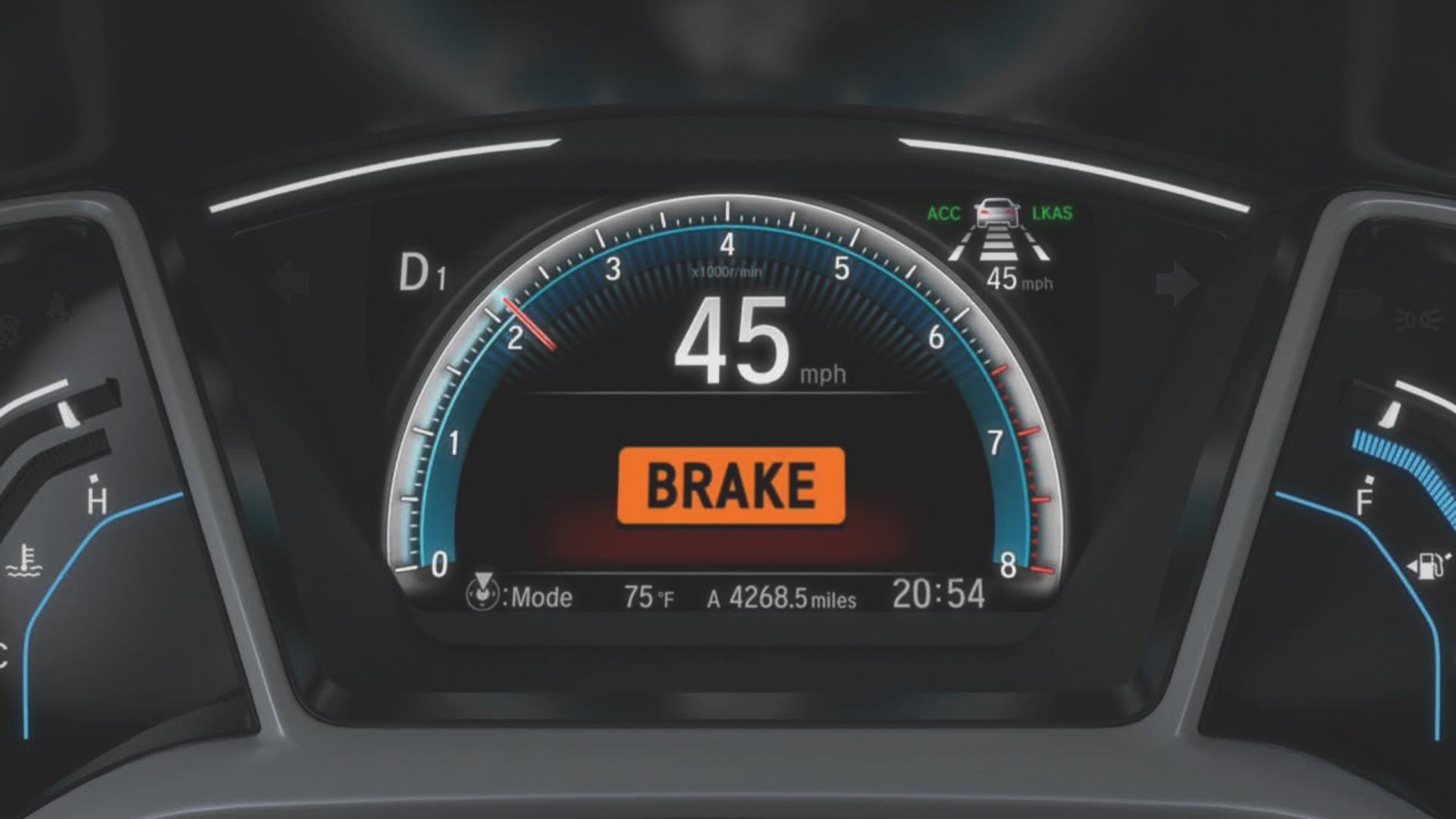

The other day, I was driving along in a ’26 Honda Pilot (you can find the review here) when all of a sudden and for no reason I could divine, a bright orangish flashing box appeared in the main instrument cluster.
BRAKE!
It practically screamed at me.
Thing is, there was no reason to BRAKE! Nothing was in front of me. much less slowing down in front of me.
But the Pilot – its automatic emergency braking (AEB) system thought differently. It can do more than that, too. Depending on its judgment – that is, the judgment of the software – the AEB system can slam on the brakes if it decides it is necessary to slam on the brakes. The Pilot didn’t but I have had other AEB-equipped vehicles do it when the software thought I was getting too close to a vehicle in front of me that was slowing down. I could see that it was slowing down – and was ready to brake if the situation (in my judgment) required it. The software’s judgment superseded my own – and on came the brakes.
Abruptly and forcefully.
This superseding brings up the issue of agency. Put another way, who is in charge of your car? If the car can brake on its own – and contrary to your own judgment – then it’s pretty clear that to a degree at least, you are not in charge of your car. This, in turn, brings up another, related issue that is likely to become a big issue in about three years from now, come 2029, when all new vehicles will have to be equipped with AEB (many already are, in anticipation of the pending federal mandate). It is: When a car automatically brakes – and an accident results – who will be held responsible for the damage/injuries that result?
Accidents, for instance, that occur when an AEB-equipped car suddenly brakes for no apparent (to the other driver) reason and the following car’s driver wasn’t ready for it or didn’t react in time. This is certain to happen. It could have happened to me. If the Pilot had braked when there was no good reason to, if someone had been behind me, there’s a good chance they’d have rear-ended me. Not because they were “following too closely” but because the braking event was unpredictable. You are behind another car on an otherwise clear road. You can see what’s ahead of you both – and you can also see the car ahead isn’t slowing to turn off the road. There’s no red light or stop sign coming up. You are just driving along when – all of a sudden – the AEB-equipped car glitches – and BRAKES! – and your reaction time isn’t quite quick enough or you didn’t brake hard enough to avoid rear-ending the car that BRAKED!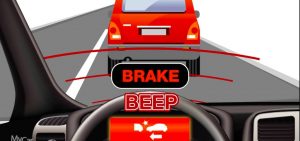
This, in turn begs an ominous question: Will our Safety Overlords say the problem isn’t AEB but rather older cars that do not have AEB? The likely answer is, of course yes. Because it’s what they do – to riff a little on what Dr. Evil said about his North Korean sidekick, Random Task.
Here’s how it’s likely to go. More precisely, here is what the Safety Overlords are likely to say:
Cars with AEB are not the problem. Cars without it out are the problem.
In the scenario I described, the AEB-equipped car that was following the AEB-equipped car would also BRAKE! when the AEB-equipped car in front BRAKED! because it glitched (or saw a shadow in the road). You see? The problem is those unsafe older cars that do not have AEB. The Safety Overlords might not outright bar them from using the government’s roads but it is very likely the insurance mafia – which effectively is the government, ex officio – will impose exorbitant premiums on the owners of non-AEB-equipped vehicles, citing the higher risk they present.
Gas meet light, anyone?
But you see the point. The way it is likely to go, once AEB becomes something like ABS and all the other “safety” stuff that, bit-by-bit, has taken away the last little bit of agency we used to have over our vehicles and given it to the vehicle.
No, that’s not quite it. The vehicle is after all just a tool made to work a certain way by its designers. These designers are, of course, typically just rank-and-file engineers whose job is to engineer these things. The orders come from higher up. And it is the corporation – another ex officio adjunct of the government – that has control over what’s engineered and by dint of that, has control over you (assuming you bought one of their vehicles). This did not happen all at once but gradually, bit-by-bit and one thing at a time over a period spanning several decades. Few saw the implications of ABS and traction control, for instance – and now we have Speed Limit Assist and Lane Keep Assist and (coming next year) Drowsy/Distracted Driver Assist.
Soon there will be AEB, too.
Your car may already have it.
Soon more will, just the same as (at first) only a few cars had Lane Keep Assist and Speed Limit Assist and now they pretty much all do. It’s kind of like those Flock cameras that are sprouting up everywhere, as if by osmosis or magic. It is changing the world – or will soon change the world – in ways that are unpleasant to think about.
Which is exactly why we ought to be thinking about it a lot – and hard – right now.
. . .
If you like what you’ve found here please consider supporting EPautos.
We depend on you to keep the wheels turning!
Our donate button is here.
If you prefer not to use PayPal, our mailing address is:
EPautos
721 Hummingbird Lane SE
Copper Hill, VA 24079
PS: Get an EPautos magnet or sticker or coaster in return for a $25 or more one-time donation or a $10 or more monthly recurring donation. (Please be sure to tell us you want a magnet or sticker or coaster – and also, provide an address, so we know where to mail the thing!)
If you’d like a Baaaaa hat or other EPautos gear, see here!




Sheesh! That pre-OBD2, F-150 with the straight 6 and manual transmission is looking better and better with each passing day!
The 2nd quarter is well underway.
We were supposed to have flying cars by now, instead we get this 🐂💩.
Eric, has any of these vehicles air bags suddenly deployed because the AEB decided it was a great time to slam on the brakes for no good reason? All we need now is the car to actually talk to us (or talk back) the way Kitt did in Knight Rider. At least that was a nice looking car and had cool features. Our “new & improved” vehicles? Meh, not so much.
‘Cars with AEB are not the problem. Cars without it are the problem.’ — eric
Unwittingly, this result was foreshadowed 25 years ago, when the ‘dancing Israelis’ were stopped in northern NJ on 9/11/2001:
Sivan Kurzberg, the driver of the detained van, reportedly stated to the arresting officers: “We are Israeli. We are not your problem. Your problems are our problems. The Palestinians are the problem.”
Drive an older vehicle without all the latest mod cons? You’re the problem. We’re all Palestinians now. 🙁
It’s happened to me. Going about 35 around a bend, and there was a car parked right on the white line. My car was a 2018, and nailed the brakes violently. If someone was close behind they would have rear ended me. And very likely been their fault. So if they did hit me, would there insurance company fight my OEM software that made a bad and damaging decision?
I learned how to stay more towards the center line when I saw any cars parked very close the road. So now we have to learn how to avoid stupid computers and software coders from making decisions for us.
I’m going to have to create a spreadsheet of questions when I car shop now.
“can I turn off, x,x,x,x,x,x,x,x,x………………”
“Can you or me permanently turn off x,x,x,x,x,x,x………..”
Good idea for you to create one of these Eric, and sell them, since you know way more about this stuff than almost everyone.
If anything it will really piss off the car salesman, cause they won’t know, and then the General Mngr., etc….
I wonder what it would take to reverse these changes.
Automatic braking (AEB) is now required by law, but not until the 2029 model year. Lane keep assist (LKA) isn’t required yet, so that’s all voluntary from manufacturers. I think LKA is worse than AEB given it’s ability to cause an accident.
It seems that the NHTSA and IIHS award higher car safety ratings if they have these systems, though, so it’s mainly being rammed through by the insurance mafia for now, until 2029, when it’s mandatory.
In European cars, it’s all mandatory today, so lots of European cars have the same software for US/EU and so, we get to enjoy Europe’s mandates.
Given what I’ve seen in my job from automotive regulators, I think it’s also inevitable that cars will have no-go zones or automatic tolling based on location. London has these congestion zones where it costs a lot to drive into the zone, and Paris is thinking of making exclusion zones for combustion vehicles. They’re talking to ADAS manufacturers to enforce these on the car.
‘Our rulers are always acutely aware that there are a whole lot more of us than there are of them, and that we could turn on them at any time. This has been the case for as long as there have been rulers. History is full of examples of the masses turning against their government and establishing a new order, and the oligarchs and empire managers have long been preoccupied with the task of ensuring that this never happens to them.
Autonomous killing machines nullify many of the problems presented by human security forces.
You don’t have to worry about the robot army siding with the people, or refusing to fire upon their fellow citizens.
An army of militarized police robots would provide the oligarchs and empire managers of the western empire with a perpetually obedient force of bulletproof trigger-pullers who can shut down any uprising when the time comes.
The increasing ubiquitousness of police robots is not separate from
the exploding prevalence of surveillance cameras and AI facial recognition,
the push for digital IDs
and the eradication of online anonymity,
or the increasing instances of online censorship and Silicon Valley algorithm manipulation.
A technological cage is being constructed around the public to ensure that we can be stopped from turning against our masters.
The story of humanity in the 21st century is the story of a race between revolution and the technologies designed to prevent it. A race between the awakening of collective consciousness to the urgent need for revolutionary change on one hand, and the technological ability to quash a people’s rebellion on the other.
We’re all in this race, whether we realize it or not. We’d better pick up the pace.’
— Caitlin Johnstone
https://www.youtube.com/watch?v=iLVuOJ0tnNE&source_ve_path=OTY3MTQ&embeds_referring_euri=https%3A%2F%2Fwww.unz.com%2F
‘The Mechanical Hound slept but did not sleep, lived but did not live in its gently humming, gently vibrating, softly illuminated kennel back in a dark corner of the firehouse.
The dim light of one in the morning, the moonlight from the open sky framed through the great window, touched here and there on the brass and the copper and the steel of the faintly trembling beast.
Light flickered on bits of ruby glass and on sensitive capillary hairs in the nylon-brushed nostrils of the creature that quivered gently, gently, gently, gently, its eight legs spidered under it on rubber-padded paws.
Montag slid down the brass pole. He went out to look at the city and the clouds had cleared away completely, and he lit a cigarette and came back to bend down and look at the Hound.
It was like a great bee come home from some field where the honey is full of poison wildness, of insanity and nightmare, its body crammed with that over-rich nectar and now it was sleeping the evil out of itself.
“Hello,” whispered Montag, fascinated as always with the dead beast, the living beast.
At night when things got dull, which was every night, the men slid down the brass poles, and set the ticking combinations of the olfactory system of the Hound and let loose rats in the firehouse areaway, and sometimes chickens, and sometimes cats that would have to be drowned anyway, and there would be betting to see which the Hound would seize first.
The animals were turned loose. Three seconds later the game was done, the rat, cat, or chicken caught half across the areaway, gripped in gentling paws while a four-inch hollow steel needle plunged down from the proboscis of the Hound to inject massive jolts of morphine or procaine. The pawn was then tossed in the incinerator. A new game began.
Montag stayed upstairs most nights when this went on. […]
“I was just figuring,” said Montag, “what does the Hound think about down there nights? Is it coming alive on us, really? It makes me cold.”
“It doesn’t think anything we don’t want it to think.”
“That’s sad,” said Montag, quietly, “because all we put into it is hunting and finding and killing. What a shame if that’s all it can ever know.” ‘
[Some time later …]
“Montag ran.
He could feel the Hound, like autumn, come cold and dry and swift, like a wind that didn’t stir grass, that didn’t jar windows or disturb leaf shadows on the white sidewalks as it passed.
The Hound did not touch the world. It carried its silence with it, so you could feel the silence building up a pressure behind you all across town. Montag felt the pressure rising, and ran.”
–Ray Bradbury, _Fahrenheit 451_ (1953)
My 2016 Cherokee has this “feature.” I’m glad I’m able to turn it off, although it will still go into conniptions on the dash. Usually at sunrise or sunset because the cameras get blinded by the light.
Around these parts people see someone following the three second rule as an opportunity to play NASCAR and occupy the vacuum. I’m used to it, but the poor Cherokee never learns. Before I discovered the off switch (which thank you Mr software engineer is persistent across starts) it would slam on the brakes like I hit a wall and no amount of right foot into the throttle did any good until it decided to stop worrying. Like giving a nervous passenger a brake pedal.
Hi RK,
This is intolerable – to me. I would never abide it in a car of my own. It’s not just an annoyance; it is dangerous. The irony is rich, isn’t it?
Not only that but the reason it exists is for distracted drivers. I know when someone jumps into the left lane to get around that truck. I know that all I need to do is let up on the gas or shut off the cruise control (and mutter my opinion of the driver). But the software doesn’t. And it assumes if I don’t take the action it deems appropriate I’m distracted or something.
Full autonomy, where I can catch up on my reading on the way to work is fine by me as long as I’m completely off the hook for any moving violation or accident. This half- or quarter-assed “assistance” is for the birds.
The biggest problem I see with these things is this – it is a computer. Preprogrammed with the data it needs to operate. It does not count for ‘load” or added weight, as is a work truck with tools, inventory, or other heavy stuff which goes in and out.
IF it slams on the brake with a heavy load in the back you are going to go “around” as in spin in reverse as the heavy load comes to the front, as the brakes do not stop a loaded truck stop in a straight line. OR worse SIDEWAYS as the load tried to take over.
Even trucks like mine with cabinets and shelving bolted to the floor and sides still has the “load problem” which no computer can predict how much you have back there and brake accordingly.
Trust me — I have been driving work trucks for over 50 years and still do today. IF you do not “drive ahead” and keep some distance from anything — you could find yourself in a spin even on dry roads. NEVER mind wet roads or worse icy or show covered roads.
SO tell me Mr Gov. How do you compensate for that?
Sorry work trucks will always have to be manually controlled to keep everybody else safe, not some stupid computer programmed by an idiot who has no idea of what a tradesman can stuff into one of these things.
OH YA — one last shot — so you are going to “outlaw” trades trucks and their supplies? Good luck! How do you expect to get things built, repaired, installed, or otherwise made useful? Your call — not mine.
I will give up my service truck – mini van when they pry it out of my cold dead hands.
The M
But Eric, that’s a major feature of government, to look for somebody to blame.
Hi John,
If there was an award given out for Internet comment of the month, your comment could well win it. Government invariably looks for somebody to blame for something instead of themselves. Just look at the last several years and the various somebodies they tried to blame for something. Examples include Russia, Putin, the unvaccinated, Anti-vaxxers, Anti-maskers, Science Deniers, Far right extremists, White Supremacists, etc.
We saw something somewhat similar just a few years ago when it came to the increasingly obvious failure of the then experimental COVID vaxxes to prevent COVID infection, let alone “Stop its spread”. Instead of admitting that the COVID vaxxes were NOT “Safe and Effective!” but actually making people MORE likely to get the dreaded ‘Rona, government and corporate media tried claiming that the UNVACCINATED were the problem and CAUSING people to get COVID, and too many people ate it up as TRUTH. Considering that there are sociopaths who WANT to reenact COVID era tyranny, we need to be on the lookout for government efforts to reimpose such draconian measures that not only had little to no effect on a virus, but instead caused MASSIVE damage to modern society.
Waiting to see how the inevitable lawsuit shakes out in that scenario – rear ended because the AEB decided to slam on the brakes just for shits and giggles. Just hope it’s not a massive gravel truck behind you.
Yes, they are reigning in the automobile, in addition to perpetually and relentlessly and incrementally confiscating the firearms. These are two ideas sprang that forth from the minds of plebs that really kept them up at night, just like that five dollars in his worker’s pocket that Huey Long said keeps a billionaire up at night.
But they would never tinker with public school curriculum to insure that such revolutionary inventions and innovations never occur again. No, they would never do that. That we know.