

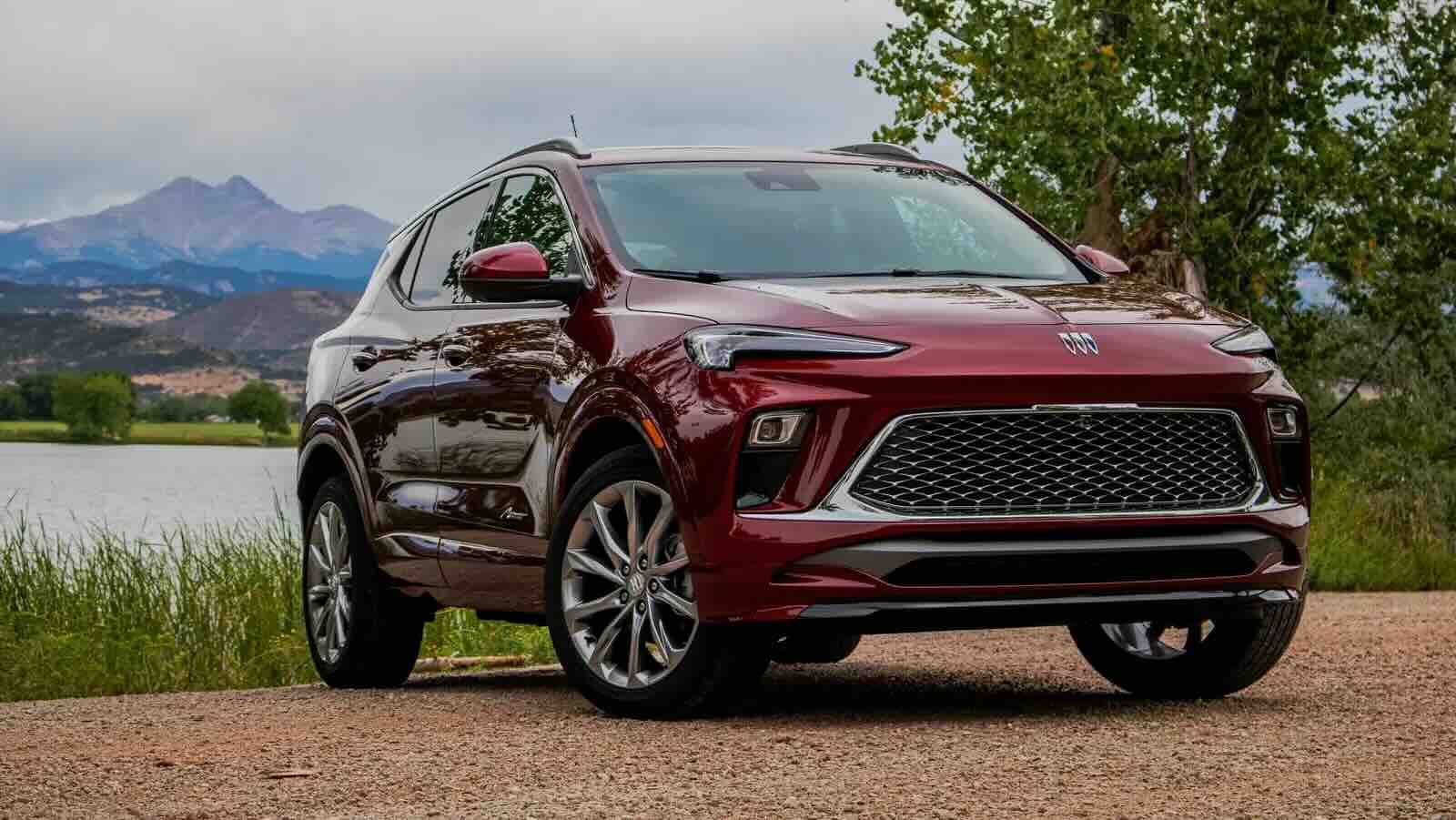

Buicks aren’t usually associated with affordability. Not that there’s anything wrong with affordable brands. The point is that Buick is generally considered at least an almost-luxury-car-brand, in the same general class as Audi, Acura and Volvo – if not quite Lexus and Mercedes.
None of the latter sell anything that starts under $30,000.
But you can get a new Buick for about $25k.
What It Is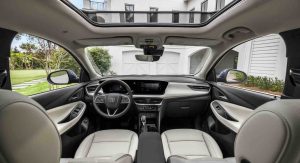
The Encore GX is a small crossover from Buick that costs about the same – or less – as small crossovers sold by Toyota, Honda, Hyundai and Kia.
It stickers for $25,900 to start – for the Preferred trim – and for that you get a digital instrument cluster, LED headlights and a six speaker audio system. A 1.2 liter, three cylinder engine paired with a CVT automatic is standard, as is FWD; you can add AWD as a stand-alone option – which also includes a nine-speed automatic transmission in lieu of the CVT.
This brings the price up to $27,900.
The Sport Touring starts at $27,100 and that gets you a larger, stronger 1.3 liter engine plus upgraded synthetic leather upholstery and special black exterior/interior trim. You can go FWD or (optionally) AWD) with this engine, too.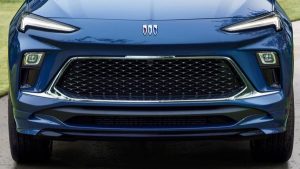
A wireless phone charger and adaptive cruise control can be added to both of these trims in a bundled Technology Package ($1,095).
The top-of-the-line Avenir – $31,400 – comes with the 1.3 liter engine, heated seats and steering wheel, dual-zone climate control, real leather upholstery and 19 inch wheels. The Avenir can also be ordered with an upgraded seven speaker Bose stereo and hands-free power liftgate. Once again, you can pick either FWD (standard) or AWD (optional).
What’s New For 2026
The Encore GX carries over into 2026 unchanged. It hasn’t been updated since 2020, so it is likely this will be the last year for the current model. Expect a major update for the 2027 model year.
What’s Good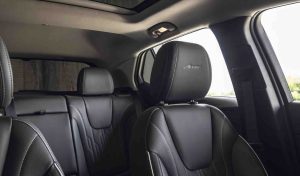
Stacks up favorably in many ways to small luxury-brand crossovers from Lexus and Audi – but costs non-luxury-brand money.
Plush, Buick ride.
Doesn’t have hybrid augmentation – and you can choose not to go with a CVT automatic.
What’s Not So Good
Standard (and optional) three cylinder engines are the smallest and least powerful engines in the class.
To avoid the CVT (many people dislike CVTs) you have to buy AWD.
Annoying “assistance” technology such as Lane Keep Assist is standard (ditto all the others in the class, as well as the others in the luxury class).
Under The Hood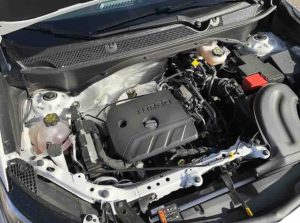
Buick is a brand that was once famous for its big cars – models like the Electra 225 that was 225 inches long (longer than a new Cadillac Escalade, which is a mere 211.9 inches long) and had among the biggest engines you could get in a car, such as the 7.5 liter 455 V8 that came standard in the Electra.
Now Buick sells crossovers exclusively and some of them – like the Encore GX – have the smallest engines you’ll find in a vehicle shy of a motorcycle. And some motorcycle engines are larger than the Encore GX’s standard 1.2 liter three cylinder engine. Your Libertarian Car Guy owns a Kawasaki sport bike that has a 1.2 liter four cylinder engine; there are big cruiser bikes that have 1.8 liter (1800 cc) or larger engines, too.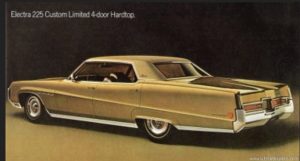
The Buick’s standard 1.2 liter turbocharged three makes 137 horsepower; as it happens, this is about the same power produced by the 1.2 liter (1200 cc) four cylinder engine my sport bike has – without a turbo. My sport bike can also get to 60 MPH in 10 seconds – about as quick as a supercharged Dodge Charger Hellcat or Tesla Plaid – because it only weighs about 450 lbs. The Encore GX weighs 3,023 lbs. – which is actually light for a vehicle that isn’t a motorcycle these days. The ’26 Lexus UX300 – which is only slightly larger than the Buick – is a lot heavier. It weighs 3,455 lbs.
But it has a 2.0 liter turbo (and hybrid-augmented) four that touts 196 horsepower; the Audi Q3 also has a 2.0 liter, turbocharged four that touts 228 horsepower.. Both are for this reason much quicker getting-going than the Buick – which takes about 9.5 seconds to get to 60 with the standard engine.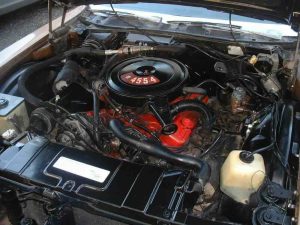
Better performance is available in the Sport Touring and Avenir trims, which get a larger (1.3 liter) three cylinder engine that offers 155 horsepower. Equipped with this engine, the Encore GX can get to 60 in about 8.8 seconds, which is on-par with the 0-60 times of non-luxury-badged small crossovers such as the Honda HR-V. Interestingly, the Honda’s larger, 2.0 liter four makes about the same power (158 horsepower) as the Buick’s much smaller turbocharged three – and the only transmission available with the Honda is CVT.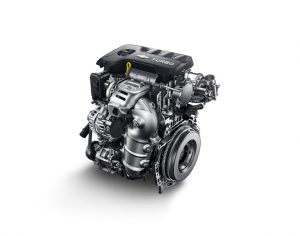
The Encore GX is one of not-many under-$30k crossovers that still offers a conventional automatic that shifts through gears – as opposed to varying the ranges, as CVTs do.
Also interestingly, the Buick’s touted mileage with the 1.3 liter engine – 29 city, 31 highway – is better than the mileage touted by the Honda (26 city, 32 highway).
Another interesting thing is that Buick says this small crossover can pull a small trailer weighing up to 1,000 lbs. Most of the others in this class are not rated to pull anything.
On The Road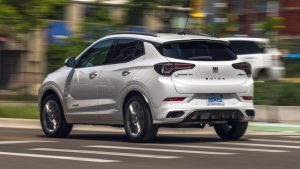
This is a very different kind of Buick – relative to what Buicks were once like. But it is also pleasantly similar. Though much smaller – and FWD/AWD rather than rear-wheel-drive and V8-powered, as the great land yacht Buicks of once-upon-a-time were – this Buick offers similar serenity. It is not designed to roar to accelerate like a sports car; it is designed to gently and comfortably get you where you want to go. The seats are cushiony and so is the ride quality. The weird obsession with making everything “sporty” is just that. “Sporty” is a wonderful attribute in a sports car or sport sedan. It is a weirdly incongruous thing to attempt to make a luxury vehicle “sporty,” because it inevitably results in a compromised vehicle. One that is sort-of-sporty and rides like it, too.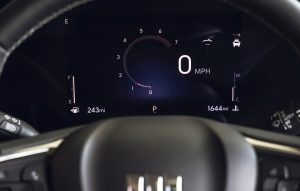
The Encore doesn’t try to be something other than a Buick – which is nice, if you’re not interested in a Buick that’s trying to be a Lexus, Audi or BMW.
Don’t be turned off by the size of its engine – unless you are interested in something “sporty.” The Encore’s engine may be small, but the turbo enables it to produce its peak torque (174 ft.-lbs. for the 1.3 liter three) at just 1,600 RPM – which is almost literally idle speed. The point being that this engine’s maximum torque is almost always available whenever the engine is running; i.e., you do not have to rev it much to get a response. In this respect, it is very much like the great land yacht Buicks of the past, which were esteemed because of the right-now torque generated by their big V8s.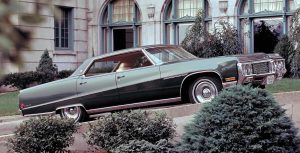
And – this is interesting – if you go back to that era and have a gander at 0-60 times, you will discover that those great land yachts with those huge V8 engines accelerated to 60 in about the same 8-ish seconds it takes for this three-cylinder-powered latter-day Buick to get to the same speed.
But who’s in a hurry? What matters in the real world is whether the vehicle’s engine responds adequately when called on to move the vehicle, as when accelerating from a dead stop when the light goes green – as opposed to when the Christmas Tree at a race track goes green. Whether you can get going quickly enough to match speed/merge with highway traffic, pass – and so on. The Buick’s torquey little three handles those jobs better than some of the larger engines in other small crossovers that you have to work harder to get a response out of.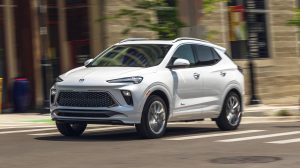
Another very nice thing about this Buick is that you can get it without a CVT. It is getting very challenging to find a small crossover under $30k that doesn’t come only with a CVT.
CVTs are not bad transmissions, but some people legitimately do not like their operating characteristics, including the shiftless transitions, which can feel as if the transmission is slipping – as well as their sound, which is a consequence of the engine being kept at higher RPM during the transitions. The nine speed automatic that you get when you select the larger 1.3 liter engine eliminates both problems. It is also something this Buick has in common with more expensive small crossovers, most of which also have transmissions that shift through gears rather than vary through ranges.
At The Curb
The Encore GX is about the same length (171.2 inches) as other subcompact crossovers such as the Honda HR-V – and luxury-brand subcompact crossovers, such as the Audi Q3 and the Lexus UX300. Where it differs from both, chiefly, is that it looks like it could be a luxury-brand crossover but costs about the same as the non-luxury-brand crossovers.
This is true both inside and out. Especially inside. It looks and feels more upscale than its $25k-ish to start base price would lead you to expect. It is not that bread-and-butter-brand small crossovers such as the HR-V look cheap; it is that the Encore looks nicer-than-its-price.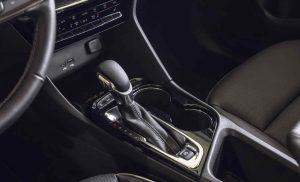
Also – again – it feels in tune with what Buick is supposed to be. While there is a big LCD main instrument panel, there are also still easy-to-operate toggles for important functions such as making adjustment to the climate controls, turning on (and off) the heated seats – and so on. The LCD screens icons are also large – and so easier to tap accurately while you’re driving. Another pleasant control is the gear selector lever – which isn’t an array of buttons or a wheel you spin. The selector has intuitive feel. Park is all the way forward – as it has been for generations. Reverse is one notch down from Park. Then Neutral and Drive.
It’s natural and that always feels right.
Though this Buick can be compared with much more expensive small crossovers, it also compares very favorably – on practical grounds – with the utilitarian crossovers like the Honda HR-V.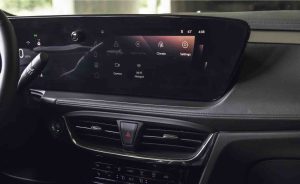
The Encore has 23.5 cubic feet of cargo space behind its second row and with the second folded down, the space opens up to 50.2 cubic feet. This is about the same amount of space as you’d find inside the HR-V, which has 24.4 cubic feet of space behind its third row and 55.1 cubic feet of total available space. It is also more space than you get in the Lexus UX300 – which has only 17.1 cubic feet of space available behind its second row (and less usable total space due to the lower/more rakish roofline).
The Buick’s front passenger seat also folds flat – an unusual feature – and that makes it feasible to carry unusually long items with the rear liftgate closed.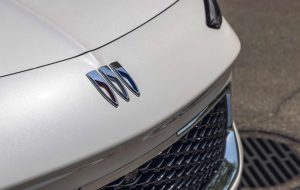
The Rest
You can use E85 fuel if you buy an Encore GX equipped with the standard 1.2 liter engine. GM has tuned the engine (and designed the fuel system) to handle this fuel, which has 15 percent ethanol alcohol rather than just the 10 percent that E10 regular unleaded has. The main advantage to using E85 is that it is typically about 20 cents cheaper per gallon than E10. However, E85 contains less energy per gallon, so you’ll probably see a mileage-per-gallon drop using E85 rather than E10.
The Bottom Line
This little Buick is an interesting alternative to the Hondas, Toyotas, Subarus and Hyundais it’s priced to compete with – and an even more interesting budget-friendly alternative to the luxury-brand small crossovers it compares favorably with.
. . .
If you like what you’ve found here please consider supporting EPautos.
We depend on you to keep the wheels turning!
Our donate button is here.
If you prefer not to use PayPal, our mailing address is:
EPautos
721 Hummingbird Lane SE
Copper Hill, VA 24079
PS: Get an EPautos magnet or sticker or coaster in return for a $25 or more one-time donation or a $10 or more monthly recurring donation. (Please be sure to tell us you want a magnet or sticker or coaster – and also, provide an address, so we know where to mail the thing!)
If you’d like a Baaaaa hat or other EPautos gear, see here!









Advice from AI:
‘Yes, a typical inline-3 engine with a 120° crankshaft has perfect primary and secondary reciprocating balance (forces are cancelled), but it creates an inherent end-to-end rocking couple (vibration) because the middle piston is out of sync with the outer ones, requiring a balance shaft to smooth it out.
‘Here’s a breakdown:
‘Primary & Secondary Reciprocating Balance: The 120° crank spacing means the up-and-down forces (primary) and the faster-moving secondary forces (twice engine speed) cancel each other out perfectly in the vertical plane, similar to an inline-6.
‘Rocking Couple: Because there’s no rotational symmetry (unlike an I6), the engine naturally wants to rock back and forth (front-to-back), creating vibration.
‘Solution: A balance shaft, rotating at engine speed, is often added to counteract this rocking couple, making the engine much smoother, especially at idle.’ — AI Overview
Not addressed in this discussion is that a 3-cylinder engine offers only half the combustion impulses per revolution compared to a straight six. True luxury means more cylinders, not fewer. But it’s way too late for Buick, under the stink eye of EeeVee Mary, to aspire even to a six, much less a V8. It’s more important to placate Big Gov with tiny, compliant engines. 🙁
The real serious problem not mentioned for the tiny 1.3L engine is the wet rubber timing belt, bathed in internal engine oil.
It will randomly shed the rubber teeth, and clog the internal oil passages and destroy the engine.
But, YMMV….
The last Buick that I found interesting was the Regal Tour X wagon. Was a pretty good looking car that was basically an Opel Insignia. I see a few around here once in a while. Of course, it didn’t sell as everyone needs to have an SUV because they need to be high up.
I liked that car too. Even looked at maybe getting one, but the Opel thing turned me off, and then the 4cyl sealed the dead deal.
I wonder if these Manuf. know or even care of things like “100 people were interested, but only 10 bought it, 40 walked when the saw the 4cyl” ,etc…. ?
Yeah, I was considering it too. It’s a bit of an orphan car though so you have to wonder how long parts would be available.
Three cylinder, automatic? How rough is that idle while in gear?
I had a 3 cylinder Yamaha years ago, not a smooth idle and odd vibes below 2200 RPM. Take some serious counterbalance and motor mounts to tame a 3 banger.
not sure when your experience was. The newer 3-cyl yamaha 900’s are awesome and have been around a while in the nice Tracer, XSR and MT09 models.
I had a 2017 FZ09 (MT09) and that 3 cylinder is amazing. Way torquier than the smaller bore 4 cylinder bikes and had a fantastic sound, esp w aftermarket exhaust. On a funny note I never got the ECU re-mapped which didn’t seem to make much difference, only occasionally under heavy throttle shifts it would let out a backfire like a gunshot. I am certain drivers next to me peed a little when that happened.. but you know, it’s a good thing if it made them wake up and pay attention to bikes
GM should have terminated Buick years ago when they killed off Oldsmobile and Pontiac. It’s bad enough that GM did away with those Buick V-8’s to comply with Uncle’s mandates. But when the ultra dependable 3.8 engine was ended, Buick died. What is made today is just another copy of everybody else’s with a Buick badge that will not give years of dependability.
“ dependable 3.8 engine was ended, Buick died “
So too Buick City, under redevelopment now but no cars. Hello China, Korea, Mexico for the little Buicks Envision, Encore.
Loved that 3.8 V6.
I agree. Best engine ever made by GM. The tooling is probably in China now. Might see a comeback there in a few.
They wanted to keep the Buick name, because in those days Buick made a minivan for the Chinese market. And they sold a crapton of them there.
I went to China for an extended stay back in 2005, and every other car was a Buick minivan then.
3.8 was one of the best. My fav. was the 3.8 supercharged. Had many. And coincidently the last buicks I had as well.
“A 1.2 liter, three cylinder engine paired with a CVT automatic is standard” This helps to explain why every Buick driver travels 10 mph under the speed limit.
And does it take a Hellcat 10 seconds to get to 60?
he must have meant 1/4 mile. his ZX would do 0-60 in about 3s.