

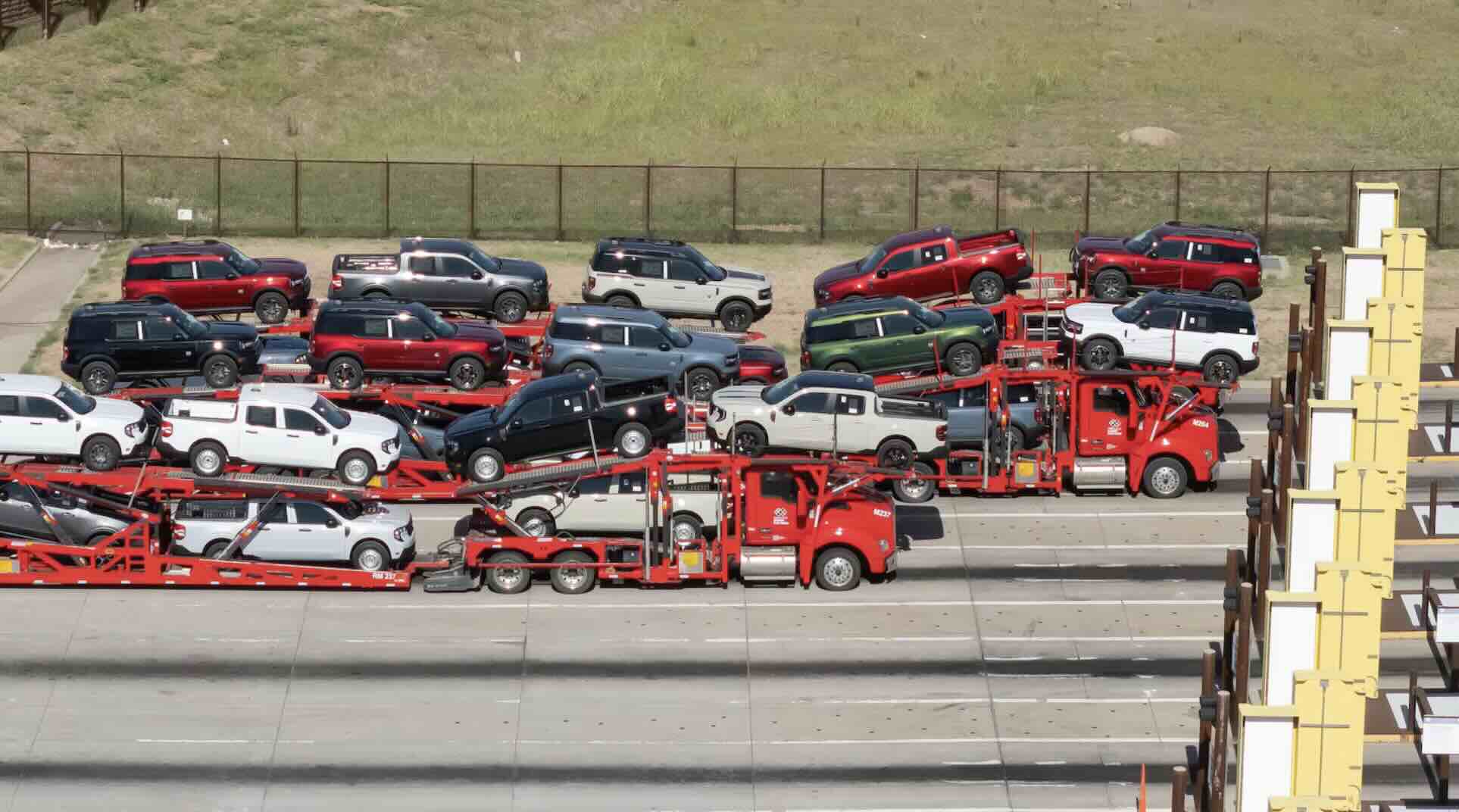

In some states – among them Virginia – they hit you with what is colloquially known as a “car tax” ever year. Meaning, if you own a car you get hit with an annual tax. Trump has imposed a federal tax on cars but many people do not understand they’re paying it because they are called “tariffs” instead.
It is remarkable, when you think about it a minute, that merely using a different word for the same thing – and getting people to use the new word – causes some people to not see that it is, in fact, the same thing. To think of it as different thing.
A good (rather than bad) thing.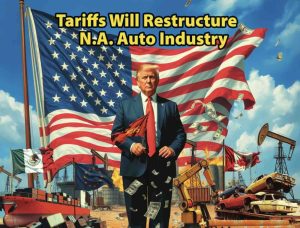
One example of this is the way the government bureaucrats you’re forced to deal with at the DMV and other three-letter government apparats have taken to using the word “customer” to describe us. The word implies we’re at the DMV because they have something we want – and are willing to pay for – as opposed to something we’re forced to pay for that we don’t want.
It’s the same with these taxes that are styled “tariffs.”
It is easy enough to prove they are one and the same by pointing out it’s the same people – us, that is – who pay them. Some people believe it is foreign corporations who pay them, not noticing that these foreign corporations merely raise the price of what they sell, in order to get us to pay them.
In theory, this is supposed to correct what are styled trade imbalances and specifically, the problem of companies being able to sell things for less because it costs them less to manufacture them somewhere else. This, it is asserted, gives them an unfair advantage over companies that manufacture the same or similar items (like new cars) here. This is true. But taxing the cars – and parts – made where it costs less to manufacture them does not reduce the cost of cars or parts here. It merely eliminates any savings people might have availed themselves of by purchasing the lower cost car (or parts) made elsewhere.
Why is this so? It is because the cost to manufacture cars and parts here has not been reduced. Specifically, nothing has been done to reduce regulatory compliance costs. So all the tariffs have done is “even up” the cost of everything, to the same high level.
How much have Trump’s taxes-styled-tariffs aded to the cost of a new car? An article in Automotive News says the the price of new vehicles made in Canada has gone up by 10 percent over the past seven months, coinciding with the imposition of the taxes Trump styles “tariffs.” That works out, according to another article, to a tax of $4,000 per vehicle, according carscoops.com. That article goes on to say that “Japanese models climbed by about $3,300, German cars by just over $2,800, and Mexican built vehicles by more than $1,500.” 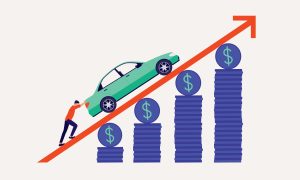
This, by the way, is taken to be good news by some analysts.
“At the very beginning, there were predictions that prices were going to go up by $5,000 or $8,000 or whatever as a result (of the tariffs) and that didn’t happen,” says Rick Wainschel,who is vice president of analytics at CatalystIQ, which analyzed the data.
In other words, it could have been worse.
It is true that some makes/models have not increased in price so dramatically – including models made in Korea by Hyundai and Kia. But the thing to focus on here is that Hyundais and Kias haven’t gotten less expensive. All that’s happened – so far – is that Hyundai and Kia haven’t yet increased the prices of their cars. More finely, no one is paying less. Most are paying more.
This is how it generally is with regard to taxes.
Parts have also gotten more expensive, so even if you don’t buy a new vehicle that costs more due to these taxes styled tariffs, you’ll still be paying more the parts you’ll inevitably need to keep the car you have running. Taxes have a ripple effect throughout the economy, too. Costs imposed are costs transmitted down the line.
Maybe this would be a price worth paying – if manufacturing (regulatory) costs were reduced such that companies making things in other countries would make them here instead. That is unlikely to happen. It certainly has not happened. So there is little to be gained (from the point of view of Americans who pay for these things) to these things being made here, where it costs more to make them. The argument is that Americans will be paid more to make them and so have more money to buy the more expensive things they make.
That might be so. If they were paid more – a dubious proposition – and not just enough to offset the higher cost, but enough that things they made here were actually cheaper. As opposed to just making everything equally expensive.
. . .
If you like what you’ve found here please consider supporting EPautos.
We depend on you to keep the wheels turning!
Our donate button is here.
If you prefer not to use PayPal, our mailing address is:
EPautos
721 Hummingbird Lane SE
Copper Hill, VA 24079
PS: Get an EPautos magnet or sticker or coaster in return for a $25 or more one-time donation or a $10 or more monthly recurring donation. (Please be sure to tell us you want a magnet or sticker or coaster – and also, provide an address, so we know where to mail the thing!)
If you’d like a Baaaaa hat or other EPautos gear, see here!









There is a war powers esque strategic manufacturing argument to be made as well. If Chiina dumps cheap slave labor bearings on the US market, so cheap that it’s not worth making bearings here, then we won’t. Dependency on foreign nations is not a good thing. But as said in “Network” (1978), “There are no more countries anymore. No Borders. There is only ITT. And AT&T, US Steel, Union Carbide, DuPont and Exxon~ (totally butchered) Those are the nations of the world.”
The warm fuzzy idea is to create a market where it’s worth a fair go at making something here. A lot of times at the machine shop a run of 1000 or 10 simple parts costs only a fraction more than 200 or 2. Make enough and constantly and it may be worth hiring a guy and buying a new machine and start makin’ chips.
It’s sad the automakers are so terrible that any benifits from increased sales (L.O.L.) will never reach consumers. They’ll just raise prices if they can while remaining competitive – then it really is a car tax.
Nobody says you have to buy foreign after all. But the result for cars is the same or less choice at the same or higher prices.
For parts it’s probablly not a terrible thing that we can still make bearings instad of shutting our doors. China’s parts suck anyway so more choice here doesn’t hurt that bad. What really sucks is going to the parts store and finding that all they sell anymore is chineese quality parts.
Realistically our markets shouldn’t be dominated by foreign goods, it’s a total transfer of wealth out of the country. When there’s no money left and no jobs either that really sucks. The best way to foster growth here is get rid of stupid globally harmonized GMP quality systems regulations BS. Saftey culture is killing us!
/rant
Hi Steve,
If I had the power, I could fix this at a stroke – of a pen. By making it legal to sell any type of vehicle that people wish to buy. Period. No more “safety” so-called “standards.” If private entities wish to rate vehicles according to crashworthiness and so on, fine. If a defective car is sold, let it be a matter for the courts. But no more government imposed requirements that new cars have to have air bags or back-up cameras or roofs that can support the weight of the vehicle if it rolls – or even seat belts. No more government fatwas regarding gas mileage, either. As far as “emissions”? Any car engine that’s compliant with the standards in force in 1995 is legal to sell. Almost all of the meaningfully harmful “emissions” had been cleaned up by then via TBI and three-way catalytic converters. Nothing more is required by any sane cost-benefit standard.
Result? A whole new – real – market would suddenly exist for simple, low-cost vehicles that could be manufactured by small companies. The competition this would create would effectively force the existing car companies to be competitive with the start-ups or go out of business.
Imagine the boon to the economy if people could buy a brand new vehicle that got 40 MPG and cost $8,000.
I see quite a few comments on here, saying that tariffs are a good thing. While in theory, yes, tariffs CAN help boost a country’s economy by encouraging more local manufacturing, don’t think for once that Chump actually gives a damn about us, or America. This is just yet another part of the plan to turn vehicles (and everything else) into “unobtainium” (for us proles, that is). Tax the shit out of EVERYTHING, until only the RICH can afford them.
Slavery and Tariffs are Plunder
Slavery is a violation, by law, of liberty. The protective tariff is a violation, by law, of property.
It is a most remarkable fact that this double legal crime – a sorrowful inheritance of the Old World – should be the only issue which can, and perhaps will, lead to the ruin of the Union. — Fredrick Bastiat – The Law – 1850
100 percent. grey!
The proof lies in the lies told about “tiny cars.” Does anyone see them being made available for sale? Why not? Because we’re not going to be allowed to buy low-cost, basic vehicles ever again.
I think that’s probably true, Eric.
Not sure it was a lie per se. More a concept he saw and was spitballing. And which went over like a lead balloon. Once people, especially the car ‘zines started talking about how these were too cheaply made to be saaaaaaaaafe….
High and ever-changing tariffs on raw materials like steel and aluminum have reduced US-based manufacturing
Since when prices for those change literally month-to-month there is no way to plan.
Easier to move all manufacturing offshore and just pay the lower tariff on finished goods you import from overseas (China, Vietnam, Mexico, etc.) into the USA.
Some, I guess, Bill. The gutting of US manufacturing started way before Trump, or even trade “deals” like NAFTA or the formation of WTO, so it’s not just or even primarily tariffs.
Hi Eric,
Taxachusetts also has a “car tax” which is called an “excise tax” whatever that is supposed to mean. As if the sales tax isn’t enough of a hit for buying a car the excise tax is based on the book value of the car, and no matter how old of a car you own there is always a tax on it. I pay $30 on my 22 year old car, which isn’t much but it’s still a pita and if you don’t pay up your registration gets cancelled.
IMO, he’s trying to force manufacturing back to the US. IMO, it’s a hail mary.
If he fails, don’t we all fail, in the US, eventually?
Hi Chris,
Yes, I have heard that also. But if manufacturing (regulatory) costs in this country are not dealt with, then it seems unlikely to me that any foreign manufacture is going to malinvest in manufacturing here.
Also, why invest here, when foreign investors know that in four (now two) years there will be a regime change, and they may get screwed by an administration not friendly to them or their cause?
Agreed. I think at this point, most are waiting him out.
But it is also my opinion that if we don’t get Manuf. back here in a significant way, we will lose in the long run. And also agree that regs, 3 letter agencies, and big gov/biz corruption must be dealt with or we continue to erode the middle class, if it’s not too damaged already?
The regulatory rollback under Trump is better than anything since Reagan, maybe Carter, depending on what metric you want to use. Is it enough? I doubt it.
Not enough to counter all the $15 minimum wages rolling in over the next year or two, since union wages tend to be figured based on minimum. That 9+% inflation under Biden is going to be hard to undo, if it is even possible.
Hi Steve,
I like the kiboshing of the endangerment finding. But if the GOP loses control of the House and presidency, all of this will come back with a vengeance.
Thats what I’m afraid of. The White House is a complete fuck show and not in a good way.
Agreed! Which is why I’m always going on about local, local, local. Somehow we need to figure out a way to decentralize power, bring it back to at least the state level, and, ideally, mostly the individual household.
Seriously, if it were up to you and your neighbors, how many aircraft carriers would you own, let alone have in the Middle East right now?
If he and anybody else are serious about manufacturing cars (or anything) here again, then start by doing away with the BS regulations that have absolutely NOTHING to do with “saaaaaafety” or “DUH VIIIREMUNT!!!” But of course, hell will freeze over before that ever happens!
The concept of tariffs had it’s orgins in the country’s founding. It was supposed to create a barrier to imports so that domestic industry would then grow. In the constitution, authority was given to congress to levy them, duties, imposts, etc. I personally have no problem with it. The free trade economy wrecked every single industry in this country. The record is clear. 120,000 factories shuttered, record low labor participation rates, 10 million plus manufacturing jobs lost and a 20 percent reduction in real wages until the reshoring phenomenon took hold in 2013 or so. No amount of Austrian economics bullshit can out argue what has happened. Domestic industries have been hollowed out, small towns decimated beginning in the 1980s when corporations got the bright idea to outsource swaths of the manufacturing sector. The only thing that kept it afloat was Raygun’s “defense buildup” which kept the welfare plants open.
When that pipeline stopped, Americans were left wondering where the “peace dividend” that Bush the faggot promised. The peace dividend was more unemployment, recessions and war. the Iraq war wasn’t about anything good, so the recession continued from 1990 to 1993.
During the 1990’s, our textile industry got killed. US made clothing made up 61 percent of total sold in 1991. By 2000, it was 3 percent. Today, it is barely 2.
Our car industry used to have it’s own internal supply chain until they sold it off to the lowest bidders. Remember Philco radios, AC Delco (before it became a repacakager of junk), Delphi-packard? Motorcraft? These are aftermarket suppliers now. Selling cheap chinese junk. The car industry didn’t even need free trade to commit suicide though. They needed to crawl in bed with government. As they did. The results are clear.
Tariffs and a real reducions of regulations would have taken care of this and the tariffs would be “affordable” since Americans would have afforded basic necessities had we not been hollowed out by junk bonds, NAFTA, the WTO and greedy companies operating without having the anti-trust legislation enforced on them.
Instead, this is where we are. Trump did a decent job with targeting tariffs properly in the first round.
His second term is an unmitigated disaster. In the mean time, the usual globalist suspects are after the tariff.
Well said, rat.
Yes, well said!
The key factor usually ignored in tariffs is whether and to what extent a welfare state exists. You need root hog or die to keep a downward pressure on wages, taxation and regulations. With a welfare state, though, there is no such pressure and we are at Katie bar the door.
Once we hang all the welfare state proponents, we can go back to tariffs. In this, too, the order is important.
Sadly, you’re mistaken.
If it was ‘free trade’ that ‘wrecked every single industry in this country’, then why have free trade between the states that form the USA? Or even cities or individuals?
You could grow oranges in Minnesota if only you could put sufficient tariffs on Florida, right? It would probably be at a cost only the rich could afford, but what the hell; it’d be worth it! Think of all those jobs for people employed in the glass houses!
Sarcasm aside, the mistake you make is, unfortunately, very common. People hark to the past and tend to ignore the fact that nobody would want to work in textile factories or similar jobs these days, and especially not for a dollar an hour or so. Are you prepared to pay $50 for a pair of socks?
A hundred years ago, more than a quarter of the population worked in agriculture. We could go back to that, too? All those jobs that would be recreated, if we again used hand tools rather than tractors!
Automation, technology and increasing efficiency of production increase wealth and give people options they didn’t have in the past.
Comparative advantage and benefits of specialization apply as long as governments don’t hinder it – in other words, Florida has an advantage in growing tropical fruit, and trading oranges with Kansas for wheat benefits both.
Where there is unrestricted free trade, people can freely choose if they wish to buy products from other countries. If they do, then what right does the government has to hinder that choice?
Once you start adding regulations, myriad of taxes and licensing rules, unions, welfare system and, of course, pure fiat currency, you’ll distort the market to what it is today. The more of it you do, the closer you will get to a command economy. You’ll also create ideal conditions for corruption, because do you really think those who stand to benefit from such impositions will not do their best to buy the politicians’ favor?
Tariffs and more government will not bring those jobs back. It will only benefit a few and further hurt the many.
Yes, regulation, pointless taxes, fiat currency, and all the rest are the problem. In fact, those are the real problem. Tariffs are nothing compared to debasing the currency while sucking more and more value out of the economy by and for government and all of the grifters found there. You have to have something to protect in order for tariffs to make sense.
Trump had been using tariffs as a club to drive international relations, which can work to some extent, but without addressing the real problems, what is the point?
Exactly! Those in power only benefit themselves.
Free trade is good. Water is good. Oxygen is good. Beer is good. Food is good.
Too much of anything is harmful or lethal. Jerry Pournelle said it very well, the problem with capitalism is you end up with too few capitalists. The problem with absolute free trade is you end up with too few traders.
Easy answers are always wrong.
Well-said, John –
And: I return the compliance costs issue. Until these are reduced to such an extent that it costs less to make things here, it will always cost less to make them elsewhere – even including the cost of shipping the stuff overseas from there to here.
And here is a possible answer, or at least part of one. Piracy. If US stopped spending a trillion here a trillion there protecting shipping, the costs of shipping would necessarily rise. This would at least partially offset anything you had to gain by manufacturing in Malaysia and shipping to US.
In a way, a tariff is simply recouping some of the costs of fighting piracy.
Already, the Learning Resources tariff case is roiling the waters. Headlines this morning at thehill.com — GOP set for internal battle over Supreme Court tariff ruling … Senate Democrats unveil Trump tariffs refund legislation.
What a ‘mess’ — a term of art that’s actually quoted, multiple times, in the Supreme Court opinions [plural]. I took the trouble to read Kavanaugh’s dissent, which is posted here:
https://supreme.justia.com/cases/federal/us/607/24-1287/
K. cites the Constitution but once: ‘The plaintiffs … rhetorically emphasize that Article I, Section 8, of the Constitution assigns Congress, not the President, authority over tariffs. That rhetoric is a red herring in this case because no one disputes the point. Everyone, including the President, agrees that Congress possesses constitutional authority over tariffs. The important principle here, as everyone also acknowledges, is that Congress may in turn authorize the President to impose tariffs.’
Using the Court’s own prior precedents, Kavanaugh argues at length that “Congress—in giving the Executive authority over matters of foreign affairs—must of necessity paint with a brush broader than that it customarily wields in domestic areas.”
He then invites Trump to use other trade legislation to impose tariffs: ‘For example, Section 122 of the Trade Act of 1974 permits the President to impose a “temporary import surcharge” to “deal with large and serious United States balance-of-payments deficits.”’ Trump just did so last weekend, imposing a 15% global levy.
Remarkably, Kavanaugh is totally uninterested in whether it’s an actual emergency. The US has run trade deficits for decades. But now, in response to nothing new except a Supreme Court decision, the trade deficit suddenly is a dire emergency?? Only for a perp caught in flagrante delicto!
Behold ‘judicial conservative’ Kavanaugh, who wants to license the executive with unbridled power, especially in foreign affairs. He cites the Constitution but once and then leaves it behind, to hack with his machete through the tangled, self-referential thicket of the Court’s own prior pronunciamentos — his personal creed and hymnbook, ringing down the ages with its encrusted barnacles of wisdom. /sarc
I have no use for such ‘conservatives.’ Enabled by them, Donnie Demento cries, “I can do anything I want.’ And the country gurgles down the gutter, as these R-party reptiles snap at the swarms of flies gathering to feast on its carcass.
Kavanaugh is a vile Federalist Society authoritarian stooge. The “me-too-ing” of him was meant create a distraction, to get ordinary “conservatives” to line up in support of his nomination, to protect him from the “evil vindictive woman”. The accusations were fake, but so is Kavanaugh who is slimeball for other reasons.
This was the exact same template with the Clarence Thomas-Anita Hill circus, and despite what his fanboys on the right think, he is also Federalist Society authoritarian stooge. He and Kavanaugh are mediocre legal minds, no better than Sotomayer or Kentangi-Jackson.
You left out one of Kavanaugh’s key points — that if one accepts the idea that embargos or quotas constitute “regulation” of trade, why don’t tariffs? Indeed, as @swamprat(?) pointed out earlier, the foundering fathers used tariffs to protect internal industry, and were not shy about saying that was the whole idea.
A friend of mine is trying to start a new business and Trump’s tariffs nearly doubled the price of the building he was wanting to build. Then throw in the local-yokel code enforcement and zoning and he’s probably not going through with it. Lucky for him he’s in his mid-20s and has both electrical and mechanical engineering degrees. He should be OK.
That’s progress.
If your friend is in BC, isn’t that the wood capital of NA?
Build it out of wood? No tariffs, or shouldn’t be.
I could see pre-engineered metal buildings, probably from china would be a lot more.
Thing is, the easiest way to fix a trade “imbalance” is to force a weak dollar. But weak dollars mean the public can’t afford anything. Trump wants cheap dollars more than anything, and even greater credit expansion to offset purchasing power. Somehow this will lead to prosperity.
Wishing won’t make it so.
If it rebalances with a very weak dollar and vastly numerically increased working class wages, it is a way out of this very convoluted mess. But good luck getting that money to where it’s needed and deserved.
The alternative is that the United States becomes a nation of savers. In Japan the reason why the printing press hasn’t led to hyperinflation is because the Japanese people just sock away all that new money. Good luck getting Americans to do that!
“The alternative is that the United States becomes a nation of savers.”
Oh, darn!
That’s to a large degree the reason we are in the situation we are. Government punishes savers with everything up to lethal violence, and sometimes even that. People respond accordingly.
Ants and grasshoppers and all that. Forgotten wisdom.
Be careful trusting the government on saving statistics. On paper, I have very little savings. Having conventional savings means being exposed to every thriving lawyer and politician. One of the nicest things about gold and silver is they are easily concealed without a paper trail. Likewise things that our modern brainwashed society doesn’t value, old tools, run down houses, old cars. There is more or less a paper trail on some of them, but the values are quite subjective.
Theiving, not thriving.
I don’t get why he is being allowed to get away with this dictator shit is everyone that afraid of him or paid off im guessing its discussing I have seen everything double since his 2020 lockdown he was right when he said he could shoot someone on 5th Ave and get away with it
If you consider that before the introduction of income tax that GovCo was funded by tariffs it might make sense but sadly since GovCo has gotten so large I doubt you could fund it entirely with tariffs.
The one big benefit of tariffs is that they “encourage” manufacturing at home as opposed to offshore. Between high regulatory costs and essentially zero import costs is it any wonder that most of what we consume is made offshore? This might not be a problem if we could all find a good paying job (relative to expenses) but as many can’t then it’s a big problem.
On a unrelated topic.
Here’s a reason Eric might want to move to West Virginia.
https://www.zerohedge.com/political/west-virginia-introduces-bill-sell-machine-guns-american-citizens
In response to that West Virginia bill — as a wide-eyed Dorothy might have remarked to her dog in Wizard of Oz, ‘Toto, I don’t think we’re in Commiefornia no more.’ :-0
Hell, I might move to WV. But WV will not be the first to restore the primacy of the second amendment. Meanwhile California, Minnesota, New York, etc all are treasonously making war on their militiamen by attempting to disarm them and rule over them.
Have you not heard? WV had introduced a machine gun bill that would allow the state to sell post-1986 machine guns to its citizens.
I doubt it goes anywhere but it is one heck of a shot that needs to be taken.
I believe Montana already has that. Manufactured in state, kept or sold in state, not illegal. Problem is it’s a lot like a similar law in Kansas or Arkansas or Missouri or some state thereabouts. They don’t defend you against the ATF. It’s just you against the Feds. And you don’t need to be Weaver or Koresh to come to their attention.
Not first, last. I can’t even blame autocorrect for that, that was plain dylsexia…