


You have probably heard that Ford is working on an “affordable” and “universal” electric truck that it hopes will sell – unlike its unaffordable (and impractical) Lightning electric truck, which got cancelled after three years of not-selling. Well, it looks like this second swing is almost ready. A prototype has been spotted – under wrap – driving around Southern California.
You can also sneak a peak at Ford’s web site. 
It appears to be smaller than the current Maverick pick-up, which is already smaller than other currently available available non-electric pick-ups, including the Ranger – which hasn’t been compact-sized since 2011. Ford cancelled it that year and there was no Ranger at all until 2019, when Ford brought it back as a much larger (and much more expensive) mid-sized truck – to compete with the other formerly compact, but now also-much-larger (and much-more-expensive) Toyota Tacoma and Nissan Frontier and Chevy Colorado pickups.
Back in 2011 – the last year for the compact-sized Ranger, the base price was $18,160. For that, you got a regular cab truck with a six foot bed. The 2011 Ranger was 189.4 inches long, so only abut six inches longer than a current compact-sized car such as a Toyota Corolla (which is 182.5 inches long). It came standard with a 2.3 liter four cylinder engine (no turbo, no hybrid augmentation) and a five speed manual transmission. 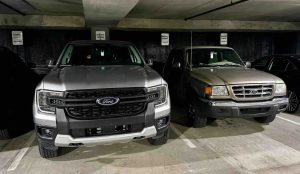
Today – in 2026 – the “mid-sized” Ranger is 210.6 inches long and – like its rivals – comes only in four door-door/crew cab form and only with a five-foot bed. It comes standard with a 2.3 liter engine, like the old, compact-sized Ranger – but this time it’s paired with an automatic (only) and turbocharged. It is much more powerful, of course – 270 horsepower now vs. 143 back then – but it’s also a lot less affordable (as well as practical, insofar as being able to carry things, on account of the shorter bed).
It is also a lot larger – hence the air fingers quote marks bracketing “mid-sized.”
The current “mid-sized” Ranger and its rivals are longer (and taller) than full-size trucks were before they got super-sized about 20 years ago. Current “full-size” 1500 series/half-ton trucks, meanwhile, are taller and wider than 2500 series/three quarter ton trucks were back in the early 2000s.
Until 2022, there were no small, affordable (under $30k) trucks on the market – in this country, anyhow.
That year, Ford announced one had become available. It was the Maverick, which Ford said would have a starting price of about $20k. Many orders were placed, indicating strong demand for an affordable truck. What Ford said turned out to be only briefly true. Initially, the Maverick’s base price was as advertised – $20,995. Then the price went up. The current Maverick’s base price is $28,145 – which is about $10k higher than the MSRP of the last compact-sized (2011) Ranger.
Enter the as-yet-unnamed “under $30k” electric truck under cammo that’s been spotted driving around in Southern California. It appears to be actually compact in size (the Maverick, which is 199.7 inches long, is nearly a foot longer than the last compact-sized Ranger) but its bed appears to be even shorter than the Maverick’s. Most of the truck’s length is taken up by the four-door cab, so it looks like the emphasis is on people hauling, with a baby bed in back for the dog and small loads.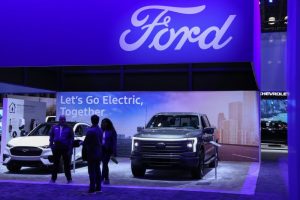
That – and it being electric. Which Ford seems perpetually interested in trying to sell even though its effort to sell “electrified” vehicles have cost Ford a great deal of money (reportedly, $20k down the drain on the “sale” of each Lightning and more than $20 billion overall). This time, it’s supposed to be different.
Well, why? What is the sell here, given you can already buy a larger/roomier and much more practical Maverick hybrid for under $30k? One of the Maverick hybrid’s biggest sells is its xcellent fuel economy – 42 city, 35 highway. This is vastly better than the old Ranger’s 22/27 and also the current “mid-sized” Ranger’s 21 city, 25 highway. But the Maverick’s biggest sell, arguably, is that it isn’t electric. It does have a battery pack and an electric motor. But it doesn’t have to be plugged in and so you never have to worry about running out of charge – or not having time to wait for one. It has a near 600-mile driving range in stop-and-go “city” driving; so what would be the advantage of an electric truck that probably hasn’t got anywhere near that range – and less on the highway, where EV range is always much less?
This little electric truck Ford is about to reveal will require plugging in, which means being tethered to a cord. Or – at least – to the range you can safely drive it before it runs out of charge. So, what’s the sell? That it’s electric? Just because, in other words? Certainly, there are people who can be sold on that. But it is hard to see how this new little truck can sell itself as practical – or “affordable” – unless its sticker price turns out to be a lot less than the Maverick’s base price of $28,145.
Electricity isn’t free – and time costs, too.
Now, if Ford can bring this thing to market with a base price in the vicinity of what it initially said the Maverick would sell for – around $20k – then it might sell. But whether Ford can make money selling it is another question.
. . .
If you like what you’ve found here please consider supporting EPautos.
We depend on you to keep the wheels turning!
Our donate button is here.
If you prefer not to use PayPal, our mailing address is:
EPautos
721 Hummingbird Lane SE
Copper Hill, VA 24079
PS: Get an EPautos magnet or sticker or coaster in return for a $25 or more one-time donation or a $10 or more monthly recurring donation. (Please be sure to tell us you want a magnet or sticker or coaster – and also, provide an address, so we know where to mail the thing!)
If you’d like a Baaaaa hat or other EPautos gear, see here!










[…] talk and listener calls. https://www.ericpetersautos.com/2026/06/15/53-mpg-no-hybrid-required/ and https://www.ericpetersautos.com/2026/06/17/an-electric-ranger-sort-of/ along with […]
Never mind the electric Ranger — Ford’s got a game-changer EREV up its sleeve, according to the New York Slimes:
A New Era of Super-Hybrid Cars Is Coming
Extended-range electric vehicles promise to reduce costs and appeal to America’s appetite for adventure. And they’re coming to showrooms soon.
‘Most automakers still believe electrification is inevitable. The next era is likely to include extended-range electric vehicles, or, inelegantly, EREVs.
‘The first extended-range electrics to hit showrooms should be Jeep’s Grand Wagoneer REEV and the RAM 1500 REV from Stellantis. Due in late 2026, these body-on-frame trucks feature a V6 engine turning a 130-kilowatt generator that’s a wingman [sic, LOL] to the 92 kilowatt-hour battery.
‘After suspending production on its all-electric F-150 Lightning, Ford will use the same name for an extended-range electric. Doug Field, Ford’s chief EV, digital and design officer, said: “Our next-generation Lightning EREV is every bit as revolutionary as the Lightning BEV. It keeps everything customers luvvvvv — 100 percent electric power delivery, sub-five-second acceleration — and adds an estimated 700-plus-mile range and tows like a locomotive.”
‘The smart money [sic] for delivery is early 2028, when the next-generation F-150 is expected.’
https://www.nytimes.com/2026/06/17/business/extended-range-electric-vehicles-erevs.html
As usual, the frayed-collar presstitutes of the Lügenpresse dutifully serve as the ink-stained flacks of the dying auto industry.
Infinitely credulous, they faithfully parrot the absurd pabulum dished out by glib-tongued executives spewing marketing myths tailored to appeal to the communist regime that takes office on Jan 20, 2029.
‘Tows like a locomotive’ ==> ‘This way to the egress, folks!‘ 🙂
Slate is planning a radically simple, no-frills,
two-seat electric pickup targeting a price tag
around $27,000. To keep costs down,
the base model features crank windows
and zero infotainment, but it is designed
for heavy DIY customization
Standard 52.7 kWh pack offering
approximately 150 miles of range
Ford is using a highly compact Lithium Iron Phosphate (LFP)
structural battery pack estimated at around 48 to 51 kWh.
The Ford target is 300 miles of range
Slate claims half that range for a similar sized battery
(nickel-manganese-cobalt (NMC) lithium-ion battery)
NMC (Nickel Manganese Cobalt) has higher energy density
For a physical battery pack of the exact same size
(volume and weight), a Nickel-Manganese-Cobalt (NMC) battery
provides roughly 30% to 50% more driving range
than a Lithium Iron Phosphate (LFP) battery.
The Ford 300 miles of range target is not credible
given the Slate 150 miles of range claim
the slate price has been lowered
to $24,950 and the battery
has been reduced to 135 KW
from 150 KW
the estimated 150 mile range
would be lower with a smaller battery
but they didn’t mention that
https://arstechnica.com/cars/2026/06/the-slate-trucks-price-may-have-leaked-starts-at-24950/
According to the article you linked, the specified 135 kW and 150 kW power levels refer to the electric motor for the rear wheels, not to the battery.
EV batteries are typically rated in energy storage capacity — kilowatt-hours (kWh) — not in units of power.
It will be a cold day in hell before I buy a battery box on wheels. Maybe that thing will work and be just fine where there is no such thing as Winter. ‘Cause up here where we have Summer, Winter, More Winter, and Still Winter, that device is going nowhere fast. And even if it could go fast, it would not be very far, and you just might freeze to death first. Cannot tow a trailer with snowmachines or four-wheelers on them, cannot take them out in BFE to go hunting…. so what is that thing worth anyway? I suppose it looks pretty in the parking lot at the dealership, though…
I don’t care how cheap this electric truck is. It won’t sell in the numbers needed for Ford to make a profit. Electric vehicles are just a massive inconvenience.
And I think with an obese population that sees trucks as tall luxury cars, a bare bones mini truck would be a hard sell. A 1500-sized truck or a midsized truck like a Ranger are overkill for 90% of suburban jobs.
Now I’d buy one. Having owned a 1984 Toyota pickup (pre-Tacoma) with optional cruise control and air-conditioning, it was a perfect truck with a bed much larger than those in most full and midsize crew cabs.
It was also a bulletproof reliable truck that is still on the road with the neighbor who bought it from my father.
Add that to my list of ‘things I’ll never spend a dime on,’ for a thousand $$$ Eric.
Maybe a smaller lighter, KEI style version for around the doom stead, I’d be interested. Or, better yet, a 90s style Ranger with a 5.0 V-8, I’d snap one right up. Sadly, Ford seems obsessed with making overpriced shit that has to be corn holed onto consumers. As opposed to making the Maverick more affordable. Don’t know what is wrong with Ford. Chevy might have something in the Montana. If they can make it cheap it wont matter that it’s a gutless 3 cylinder.
‘Electricity isn’t free — and times costs too.’ — eric
‘Time wounds all heels,’ as a colleague of mine used to say about the dirtball politicians of the day.
Lightning Jim Farley isn’t so much a heel as an idiot. Like a puppy who growls and refuses to unclench his teeth from a stuffed toy, Lightning Jim has a burning obsession with e-pickups.
Since no one on Ford’s board will whack him with a newspaper, probably his insane quest will continue until something breaks, such as Ford’s solvency.
Lightning Jim took ol’ Tom Wolfe’s Electric Kool-Aid Acid Test — and flunked miserably. At this late date, electroconvulsive therapy is probably his last resort. BZZZZTTTT!!!!
I suspect that an EV Ranger will sell just not here. Perhaps in the EU or in Asia.
So it has a huge, fat ass and you probably can’t reach the bottom of the 4-foot deep bed over the side, and even then it’s nearly useless being 2 feet long. Basically a big sedan with an open trunk.
When will we see the end of these “design features”?
That said, if they can sell it for ~$20k or less, it will still sell like cocaine.
I’m keeping my ’98 Ranger for as long as humanly possible.
DOA.
Even if this thing was $10k, would you still want it?
This column has long been documenting the hassle of dealing with recharge nonsense.
Besides, if it’s as small is it appears, nobody will buy it.
Americans are no longer sized to fit in the original S10 or Range and they’re diminutive by 2026 standards.
At least not until all the US Americans on those creepy weight loss vaccines they prescribe to the fatties.
If this was $10k I’d buy it in a second. Also, it doesn’t look that small to me. Regarding charging and this column, most of Eric’s problems stem from him trying to charge these vehicles with an extension cord connected to a 110v outlet. It’s like trying to charge your laptop with a phone charger. At some point he will have to bite the bullet and get a Level II setup or else all the reviews will be the same.
Hi Klink,
I hear you. But even at what are styled “fast” chargers, the wait is absurd. Thirty minutes to recover a partial charge. Even if that were cut in half, it would still be absurd given one can fully refuel any vehicle with a gas engine in about five minutes.`Yes, you can charge faster at home – but you’re still waiting there. Maybe you can do something while you wait. It’s beside the point – which is that you still have to wait.
On the Level II thing: It’s more complicated than that – for me. EVs do not have universal plug-in apparatus. I think it’s the case that you have to have a specific Level II set-up (not just a generic, dryer-type outlet) for your brand of EV. That’s a problem for me because I test drive different brands of EVs. It’s not practical to get multiple different set-ups for each one – never mind the cost!
PS: The Ioniq 5 is being dropped off for me tomorrow!
I could be wrong, but I thought there were universal chargers available for homes? I think all new ones use NACS standard so in theory you should be able to charge them all with the same setup.
Basically, you need a 240v dedicated line (ideally, anyway) and you need an EV charger with 1 of 2 different plugs, either the “Tesla” plug (otherwise known as NACS or “North American Charging Standard”), or the “other one”, which is CCS (Combined Charging System), otherwise known as “J1772”.
You need your 240 breaker to be at least 10A higher than the max rated draw of the charger you use, for best performance and consistency. A 50 or 60 Amp line will handle pretty much any 240v charger up to 11.5kW. There are, of course, slower / lower spec chargers out there, but if speed is your thing (and I think that’s a safe bet here, lol), you want to feed it the highest current you can afford to set up.
A 16-amp level 2 charger will give you about 12 miles of range per hour of charging time.
A 48-amp level 2 charger will give you about 35 miles of range per hour of charging time.
When you pick what plug style (Tesla or J1772), I highly recommend just getting a Tesla-style plug (which most American car makers have now adopted) and getting a J1772 adapter to fit the Tesla plug on your charger. This will allow you to charge 99% of what you might encounter. At least, for now.
Serious question for you, as I do not know the answer. How does charging of an EV work if the vehicle sits outside where it is cold during the Winter? For a regular vehicle, we just plug it in, and with an auto start (very handy), you can have a vehicle that will start up in the morning, with the same amount of gasoline that was in the tank when you left it the night before. We “Winterize” with an engine block heater, battery blanket (no bringing that thing in the house at night anymore), and oil pan heater. But an EV is much different. Would it even charge enough to get you somewhere at -40 below? Or even a nicer, 0 F? How much range would one lose trying to keep warm in the cabin? Just a few questions, ’cause it just does not seem like an EV is compatible with the cold. At least for now.
Morning, Shadow!
I have personal experience with this and can tell you that in my experience, an EV sitting outside in the cold, not plugged in, will lose range. In my experience, the loss is typically the charge equivalent of about 10 miles of driving range. The reason why is that the EV consumes power even when it is parked. There is a thermal management system that heats (and cools) the battery pack to keep it from getting too cold (or hot) and, obviously, this uses power (electricity). Keeping the EV plugged in (or in a warm garage) will prevent this but not everyone can do that.
So the EV sits outside where it may be a cooler (for us) 0 F. Or hell, even 32 F. I come home with a near-empty EV battery, and plug it in for the night. Sitting in the cooler temperatures. Next morning I come out. Will the battery have actually charged to a decent, drivable range? Or-because of the cold-merely maintained the range I had the night before? Worst case scenario, will the battery have actually lost range after parking, and even when plugged in, because it was colder out? That old saying of not fixing what was never broken comes to mind with such questions.
Hi Shadow –
It depends. Using a standard 115V outlet – Level 1 – you’re not going to have recovered much range overnight. Even when it’s warm, this way of charging might get you 30 or so miles of driving range. A Level II (240v) outlet will fully charge the EV in (typically) eight hours or so (it varies from EV to EV). But that requires the 240V circuit and – probably – a garage (it’s much more involved to run the wires and a box, etc. to outside the house).
And – why do all this? It astounds me that anyone is willing to put themselves through all this hassle and expense when they could just drive a gas-engined vehicle and never have to worry about any of this nonsense.
What a pain in the butt. I would not want to stick that EV device in a garage, lest it burn the garage and the rest of my house down. It reminds me of how people (or companies) will spend a hundred bucks to save a penny.
100 percent agree, Shadow –
It sometimes wears me out debating defenders of the faith, who try to argue that it isn’t a ridiculous hassle to have to wait even 10 minutes to fully charge an EV. This is not even possible, by the way; I am just using it to make the point. Ten minutes is still more than twice as long as it takes to pump a full tank of gas. Imagine waiting 10 minutes for a tank of gas. Yet some people are willing to wait 20-30 minutes to get a partial charge.
But if you have Level II charge capability at home, you can fully recharge in only 6-8 hours! They will say it’s not a hassle because you’re home. Yes, but what if you need to go somewhere? How about the small but not nonexistent hassle of having to plug the stupid thing in when you get home and then unplug it when you are ready to go? The cord is a heavy gauge thing that is unwieldy and bulky.
Why? When it is not necessary to have to deal with any of this? Why would anyone want to deal with it?
98% of the chargers on the market are going to be waterproof, and a huge number have “smart” features which will allow you to check things like charge state remotely via your phone. So, you can mount them outside and use them in pretty much any weather condition, including extreme cold.
Of course, lithium battery capacity and efficiency drops in temperature extremes (either hot OR cold), so if you live in a cold weather climate, I would make sure I got a smart charger and I’d set my charge time to finish around the time I get ready to go to work in the morning, instead of as soon as you plug it in at night. That way, the battery will have the maximum charge level as well as being warmed up a bit by the charge cycle. Proper strategy when you live in extreme conditions is important.
There’s pretty much only 1 place where an EV makes any sense at all, and that’s Hawaii. Temps not too hot and not too cold, and it’s an Island. You’re not going that far, anyway. California and Hawaii lead the US in EV car purchases for good reason, and it’s not just because of the green loonies trying to save the world by strip-mining for lithium for their batteries and burning coal to charge their cars because they don’t want to use…fossil fuels…to charge their EV…from the grid…which uses lots of coal…but yeah, the weather in those states is much more conducive to EV ownership than, say, Alaska, or Minnesota.
Hey Eric,
Given your job, I think Mr. Klink is correct. Others have given some decent input, but here is the Level 2 charger I’m considering:
https://www.amazon.com/Grizzl-Ultimate-Electric-Certified-Hardwired/dp/B0D9HV151X
They claim. regarding your concerns: “Compatible with all EVs and PHEVs sold in North America.”
I think it would, at least, give you a better experience, especially if, when they drop off the vehicle, you can plug it in and have a full charge the next day when you wake up. You’re right when you complain about the “fast” chargers being a bitch for both time and expense, but the other side of that is being able to skip the gas station if you charge at home. That feels good, especially with today’s gas prices.
I hear you, BaDnOn –
I have another issue, though. The Level II outlet would need to be in my garage. (I suppose it’s possible to run wire to an outside location but that would get into a lot of money). I won’t park an EV press vehicle in my garage for two reasons. The first is that I’d have to park one of my vehicles outside and I’m not displacing my truck or my TA for the sake of an EV or any other vehicle that’s not mine. The second is that I am unwilling to risk my house (and the TA along with it) being burned to the ground due to an EV fire, Yes, I know – the risk is slight. Usually, I am comfortable with risks. The ones I have some control over. But I have no control over whether an EV spontaneously combusts – and I am uninterested in assuming that risk for the sake of an EV press vehicle.
That’s all understandable, Eric, though the charger to which I linked is a “Indoor/Outdoor Electric Car Fast Charging Station”. Theoretically, you could have it on the outside of the garage and charge your press cars in your driveway as you normally do.
Just trying to help out a bit. I know you’re probably just as inclined to install an automatic ass-flogger.
Hi BaDnOn!
An “automatic ass flogger”! Ok, that made my day!
Glad to be of service. 🙂
Eric, don’t wait! Install your Level 2 charger now! — before the federal tax credit expires on June 30. Why, you could claim 30% of the installation cost, up to a maximum tax credit of $1000. Free money! The more you spend, the more you save!
Hi Strait,
Yeah, I know! I also know I won’t be a party to this EV stuff. At least, not until there are sub-$10k EVs that can easily and inexpensively be recharged at home, without elaborate apparatus and without any “connectedness.” This latter is arguably the real danger of the EV Agenda.
“At some point he will have to bite the bullet and get a Level II setup or else all the reviews will be the same.”
Eric, all you need is a slightly faster charger, then you will learn to love EVs! Imagine being able to “fill the tank” in only a few hours!
You know it — Eric’s killer app has arrived: an EeeVee with a V8.
https://i.imgflip.com/6nn1ke.jpg
Eric said “You have probably heard that Ford is working on an “affordable” and “universal” electric truck”
Nope, out of that loop. Never bought a new car or truck, probably never going to buy one as I fade out of this hell reality. Another fact (which many will find hard to believe, but not so much on a Libertarian site) is that I don’t have a credit card, I have never borrowed money for any purchase (includes homes/cars/vacations/etc.).
I actually hold how most people live with utter contempt. They enjoy their debt slavery. I am not them. I do not want to be them. When I see a Tesla truck I laugh, who is the damn fool who would buy that ugly thing? It looks like some futuristic garbage can you would see in a scifi spoof like Idiocracy. IMO the fact that anyone purchases a cyber truck is proof we are living in Idiocracy, and with Trump as a vile violent maniac in chief, bombing whoever he wants it is absolute proof we live in a time ruled by complete idiots and assholes.
I do not like car commercials, they universally show a brand new AWD thing tearing up the wilderness, going fast off road. Obviously the people who are motivated to buy some really expensive $40 K adventure vehicle have never actually taken a car or truck offroad as being advertized. If you are way back in the middle of nowhere you do not want to get stranded by driving like the Dukes of Hazzard. They had used over 250 “General Lee” cars.
“Production crews used an estimated 255 to 325 Dodge Chargers throughout the run of The Dukes of Hazzard. Because the show’s iconic jumps routinely bent frames and destroyed suspensions, an average of two to three cars were wrecked per episode. Fewer than 20 original stunt and hero cars are believed to survive today.”
Ford can build an affordable ICE truck. All they have to do is remove all these stupid federal regulations and build copies of what they used to build, just a basic truck with a radio. And these trucks could be ultra easy to maintain and reliable, with better engine technology and suspension.
For one thing, take engine displacement. Take a Corolla with a 1.8l engine (which gets good mpg), why can’t that engine be put in a 2wd Toyota truck? Why does the Tacoma have to have a 2.4liter engine or bigger, both vehicles weigh about the same.
God forbid we would build trucks which drive slow like trucks and not perform like race cars.
Obviously Ford engineers and corporate staff don’t read this site. But if they did they might be clued in that what they are building is contemptable shit, not what we want, and is purchased by morons with too much credit.
I am never going to own a car which spies on me. I would rather walk or ride a bike. I am never going to participate in this ultra controlled society run by Zionist lunatics. I am a neo Luddite refusenik, hear me roar.
As you are probably aware, Ford engineers have No say in what gets made. They are lackeys to the bean counters, planners, and marketing. Most are afraid to speak up about anything lest they might lose their job. The vast majority of “car people “ at ford have long since retired voluntarily or involuntarily. I don’t think the company will make it on its own.
One of the best “trucks” Toyota ever built was the 1985 Toyota Tercel SR5 wagon.
“1985, the North American Toyota Tercel 4WD Wagon carried an original base MSRP ranging from $8,623 for the Deluxe trim to $8,973 for the upgraded SR5 trim. It featured a light curb weight of 2,216 to 2,271 pounds and was powered by a 1.5-liter inline-four engine”
It got excellent fuel economy, it could be used like a truck to carry lumber, it had a small engine and was a 4wd. (Compare the low curb weight of this Tercel to a Tacoma.
“The 4WD Tercel wagon was notable for utilizing a longitudinal layout rather than a standard transverse setup. Manual models featured a unique 6-speed transmission that included a specialized “Extra Low” (EL) first gear. This gear could only be engaged when the manual lever was pulled back to lock the vehicle into four-wheel drive, simulating a true truck low-range gear for tricky terrain.”
Along with low cost Suburu AWDs, in rural areas, these vehicles were popular, many Tercel wagons are still in use today, I see them frequently. It remains one of the longest lasting 40 year old carburetor cars ever. Note how a small displacement 1.5 liter 4 banger did the job just fine!
I will tell you all something many of you do not want to hear, engine displacement and IQ are inversely proportional.
Great stuff, Jack!
And – I agree. I’d love to have one of those old Tercels. I also love my Trans-Am, but it’s just a toy I drive around the neighborhood every now and then. I like useful, practical vehicles for daily-drivers.
Jeez you’re unhappy person.
I drive a 1985 Toyota pickup that came with a 2.4L carb engine originally.
It’s got a 4.6L Police Interceptor motor in it now. It’s MUCH better. I’m in NE Utah and >10K passes used to be painful. They are not now.
Years ago this thread inspired me: https://www.pirate4x4.com/threads/5-0l-into-1984-toyota-a-thread-with-actual-tech.957748/
I don’t dispute your displacement/IQ relationship but frankly I don’t care. I might be dumb as a box of rocks, but damn, driving a 3000 lbs 4wd truck with a V8 is as much fun as it sounds.
My brother-in-law bought one of he hybrid Mavericks and loves it. Always touting the MPGs. I make fun of him because it beeps like a UPS truck when it goes in reverse.
Hi Philo,
I’ve driven several Mavericks and – on balance – liked driving them. I would like the Maverick much more if it had a manual transmission (I despise automatics) and no touchscreens. Still, it’s very functional and it’s hard to not like the 40-plus MPG.
More proof the car makers are completely insane. The solution to loosing money trying to sell electric vehicles? Make more electric vehicles. I assume they think if they keep doing it, people will get used to the notion.
Dealer insiders killed the $20k Maverick because Ford lacked the volume to overcome the grift in the F&I room.
A $20k *electric* truck would result in a feeding frenzy like you would see nightly on the old Discovery Channel during Shark Week.
Ford killed the $20k pricing because people were buying them at $20k and flipping them at $30. And they had buyers.
And because dealers were marking them up over MSRP.
So Ford simply priced them at $30 and pocketed the money themselves…
But, but, I thought no one had money to buy inflated priced cars. Demand curve will bend to meet supply, it’s known as price discovery. We’ll never know if the demand at $20k could have truly been sustained since Ford didn’t have to test it. They have been able to sell units at the higher profit the market supported, the purest free market response. It’s easier to drop your price later to create demand than it is to ramp up a supply chain and factory to build inventory that supports what is obviously a price lower than market.