


One of the most unusual cars ever mass-produced by an American car company is arguably the Chevrolet Corvair. It had a rear-mounted, air-cooled engine, very similar to the VW Beetle’s but instead of four cylinders, the Corvair had six. It had two rather than just one carburetor and four were available in high-performance Corsa variants. An even higher-performance Spyder version was available that had a turbocharger – and 150 horsepower.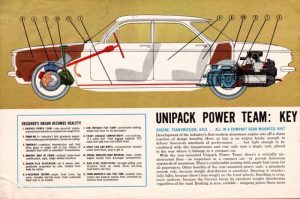
It was a kind of Super Beetle years before VW offered one (and when it did, it didn’t have a six or multiple carbs).
There was another thing the Corvair had that the Beetle had less of. Space. The Beetle was called that in part because it was such a little car. It had very little room inside, especially in the rear. It was possible to sit back there. It just wasn’t easy to get back there or especially comfortable to sit back there. Also, when four people were inside a Beetle, the added weight severely taxed the air-cooled four’s capabilities. To say it was a little underpowered is something like saying the traffic in DC is a little heavy. (I used to drive a Beetle – a Super Beetle – in DC traffic back in the ’90s and it was ok, provided I was by myself. With others along for the ride, it was an experience trying to merge with traffic running 75 MPH on the DC Beltway.)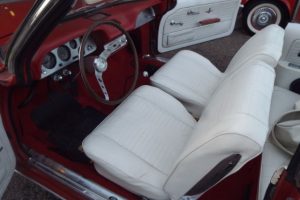
The Corvair had room – and power. I can attest to this, because I also drove one in the same DC traffic, back in the ’90s – when I owned a ’64 Monza, which is a Corvair with the optional, 110 horsepower version of the air-cooled six. It had enough power to merge with – and to keep up with – DC-area traffic. It could hold 75 MPH, which was very close to the Beetle’s top speed. It also had a much more spacious interior, including the backseat area. The low-back front seats (later out-regulated by the federal government in the name of saaaaaaaaaaaaaafety) were easily folded forward and it was easy for passengers to get in – and out of the Corvair.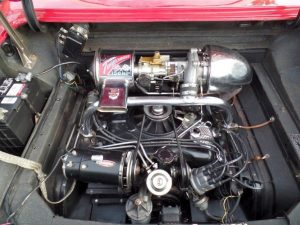
Even more so if you got the sedan. The Corvair was available with two or four doors. The four door was a family-viable car. The two-door-only Beetle was fundamentally a commuter car.
The Corvair had another thing that was – in my experience – better than what the Beetle had: An effective heater – and much more effective ventilation. My Super Beetle’s heater produced a little bit of warmth. Enough to keep you from freezing, if you wore enough clothes.
The Corvair’s heater was toasty.
It had automatic/thermostatically controlled baffles that controlled the airflow over the engine, which served both to keep the engine cool and (when you needed it) the car’s interior warm. The converse – a thing not often discussed when this subject comes up – is that when you wanted to cool down the interior, the Corvair’s system of vents was much better than the Beetle’s. In addition to the wing-vent quarter windows that both cars had, which could be opened to direct air from outside into the cabin, the Corvair (like other GM cars of the era) had under-dash knobs you could pull that opened ducts that admitted lots of air from the outside into the car. You could close the wing vents (which tamped down the noise inside the car) and open these ducts and be cool inside the car. It was poor man’s AC – and it worked, too. I got to work in downtown DC in my ‘Vair wearing a dress shirt without pit stains under my arms. 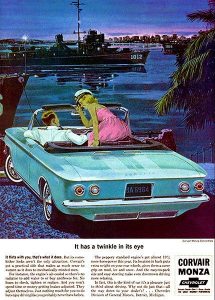
So why did the Corvair fail?
Well, to begin with, it didn’t. It just didn’t do as well as GM had hoped it would. And it didn’t do as well as the Beetle did. GM sold several hundred thousand of them, which isn’t bad. But VW sold millions of Beetles. Why the disparity? Several reasons come to mind, the first being that the Corvair was out of place in the GM family. It was a kind of red-headed stepchild. It was the only air-cooled and the only rear-engined car GM had in its lineup. It was weird, in other words – especially in the eyes of most GM buyers. VW, on the other hand, only sold air-cooled cars (at the time) and people who came to a VW dealer came there specifically because they were interested in a weird little car with an air-cooled engine.
Chevy dealers had to explain to customers what the Corvair was and had to persuade them that the weird layout was desirable. That’s a harder sell, usually. And so it proved to be.
The other thing was bad timing. The Corvair – which was introduced in 1959 as a new-for-1960 model – debuted just in time for the Mustang and its emulators (such as Camaro and Firebird) to eclipse its appeal as a sporty car because even though it was sporty (it has been described, accurately, as a kind of poor man’s Porsche) it could never match the performance of cars like the Mustang and its emulators. At the same time, it cost more than the Beetle, which never tried to be sporty and so didn’t have to worry about competing with cars like the Mustang.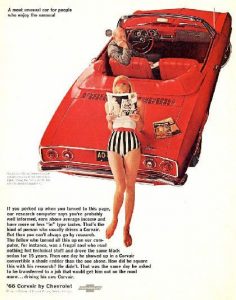
Ralph Nader didn’t help, of course. But he only hammered the nails in the Corvair’s coffin with his hit-book, Unsafe at Any Speed. More than anything else, arguably, the Corvair was the victim of bad timing and bad marketing. It is very possible that had it been introduced in the early 1970s, in time for the gas lines and gas price hikes – when sporty and economical was very much back in style – it might have put the nails in the Beetle’s coffin.
. . .
If you like what you’ve found here please consider supporting EPautos.
We depend on you to keep the wheels turning!
Our donate button is here.
If you prefer not to use PayPal, our mailing address is:
EPautos
721 Hummingbird Lane SE
Copper Hill, VA 24079
PS: Get an EPautos magnet or sticker or coaster in return for a $25 or more one-time donation or a $10 or more monthly recurring donation. (Please be sure to tell us you want a magnet or sticker or coaster – and also, provide an address, so we know where to mail the thing!)
If you’d like a Baaaaa hat or other EPautos gear, see here!









You mean you can do 75 on the DC Beltway? The last time I drove on the Beltway was a few years ago, and we were barely moving; if we were doing 30-40, we were lucky. It didn’t matter when I hit the Beltway, either; morning, afternoon, or evening, it was a parking lot. It was ALWAYS JAMMED! After that, I found an alternate way to NoVA, one that entirely bypasses the DC Beltway.
Ugh, did you see Leno’s latest video? He talks to the Biden Thing about his Corvette. I haven’t the stomach to watch it yet.
https://www.youtube.com/watch?v=J1d3vDNmgDg
I still say a reliable, air-cooled engine with decent performance could be built today. We’ve had 60+ years to work on the tech. Somebody with a few million bucks lying about should start a REAL car company.
I agree, Letmepic you –
I think the Beetle’s engine could be modernized; in fact it has been – in Mexico. The last production Beetles had throttle body EFI, I think. That plus a five speed transaxle and you’d have a simple, daily-driver-viable economy car.
I mean, it’s a good base design. I love the horizontally-opposed engine design, and if I was going to design and build an engine from scratch, that’s what I would start with. The big thing nowadays is going to be weight – with all the govt mandated crap like air bags you have to put in, weight can spiral quickly.
Luckily, there’s a lot you can do to keep weight under control if you’re starting from scratch. Things like going to a 24 or 48v electrical system will save you a LOT of weight in the wiring department, as you can use physically smaller, lighter wire to carry the same energy levels. I’d also invest heavily in composites – it’s high time cars start using carbon fiber as a standard building material rather than some exotic super-material. CF has been around commercially since the 1960’s. Big Aluminum and big steel keep it out of our factories. The time is long past to invest seriously in carbon fiber infrastructure to bring it from the fringe to the mainstream.
It sure would be nice to win the Mega Millions.
The last 993 GT2 was basically this in 1998. Twin turbo, 3,6L air cooled, still just 2 valves per cylinder, simple 6 speed manual gearbox and they went from all-wheel back to rear wheel drive to make it legal for GT racing. It made 450 HP up at as much as almost 600 HP fully dressed for racing whilst still being air cooled. And it looked alright. Very rare car since Porsche only made enough to technically qualify it for FIA as a road car.
Did someone put sand in your little vagina?
Mexico, even in DF Mexico, didn’t have anywhere near the emissions requirements that caused the VW Beetle to leave the US market after 1978. They did tighten theirs up since. Air-cooled engines by inherent design are “looser” so they won’t be so prone to seizure and engine fires, a problem that plagued high-performance aircraft engines like the Wright Duplex Cyclone and the Pratt&Whitney Wasp.Majot. Such looser tolerances inherently increase “blow-by” and HC emissions, beyond even the ability of a well-designed Evap, PVC, and Catalytic Connverter to cope with. Shame, too, because that Beetle engine and the Corvair Flat Six made the RR layout feasible. Not IDEAL, as both vehicles still had a nasty tendency to swap ends, save the tire pressures were scrupulously maintained within specs. The Corvair was more prone to that and the rollover accidents that often resulted simply due to owner neglect, unfamiliarity with the handling characteristics, and a higher cruise speed than the Beetle. But Nader’s screen was full of false accusations and gross exaggerations. Also, by the time his book came out in 1965, the Corvair had been essentially supplanted by the Nova (Chevy II), and those wonderful.Greenbrier vans and curbside pickups, based on the Corvair, were history. It become essentially a sports coupe patterned after European makes until production ceased early in 1969.
All true, Douglas –
But, I wonder whether the basic concept – air-cooled flat four – could be mnodernized such as to be clean enough (in terms of a reasonable standard for exhaust emissions)? Porsche did it with their air-cooled six. (I know that, eventually, Porsche was forced to go with water-cooling because emissions standards had become so ridiculously stringent it was no longer possible to comply; but the point is that the last air-cooled Porsche was surely clean enough by any reasonable standard).
Tighter tolerances, a higher-capacity oiling system to keep the engine cool and a throttle body fuel injection system; a cat and 02 sensor. That ought to be clean enough by any reasonable standard. Pair that with a five speed transaxle (overdrive, to reduce engine RPM at cruise) and put that in a body that weighs 1,600 lbs. and I bet you’d have a 45 MPG economy car. The high gas mileage alone ought to be considered an “emissions control” – but of course it’s not because the object has never been reasonable control.
True, REASONABLE emissions standards could probably enable an air-cooled auto engine, or, possibly a Wankel…look how long Mazda persisted with the RX series of rotary-powered sports cars, which had their, *ahem*, “features, but were reasonably competitive in terms of power, reliability, and fuel economy for what they were. On a less exotic note, a return to engines made mainly of IRON for the block/crankcase and heads, which has the ideal metallurgical characteristics for rigidity, strength, machinability, and wear. Various iron alloys and steel forgings can simplify production, like the 455 HO engine that likely came with your TA. Generally, the simpler the machine, not only the cheaper, the more reliable. We could return to simple, naturally-aspirated inline fours and sixes, the latter, in about a 3 to 4 liter size (183 to 244 cubes), with present-day engine control tech and multi-port fuel injection being fairly cheap to mass produce, could deliver, depending on application, between 150 to 300 ponies, and 200 to 400 foot-pounds of torque, more than enough for most standard light vehicles.
Many cite the VW flat-four as an example of elegant simplicity in engine design, and indeed, even a kid with two years of auto shop can easily yank a VeeDub’s motor, tear it completely down, replace worn parts (it’s most common to just swap out worn-out cylinders, which detach from the crankcase, for rebored units, IDK that any new castings are being made by any aftermarket suppliers, and likely NOS items are just about gone by now), reassmble, and re-install, in a WEEKEND. Ferdy Porsche had the same idea that Preston Tucker had, post-war, for “overhauls”, engines would be readily removed and swapped with rebuilt units, which, BTW, lends itself for fleet use, especially with the MILITARY. That German “Kubelwagen”, which, when Hitler had the original Volkswagen AG commissioned in 1936, was REALLY the vehicle he had in mind, financed, not by bank LOANS, which he believed were predatory in nature, but by a stamp book savings program, financed by payroll deductions by workers interested in saving up for a car of their own. This was how the Volkswagen production was financed, and it’s debatable whether the Nazi regime ever had a genuine intent to actually deliver VW “Kafer” cars to the customers, as only a handful of civilian “Beetles” were ever produced, one of them going to Der Fuhrer himself! Anyway, the engine itself was a masterpiece of engineering simplicity, and that it used a magnesium alloy for the crankcase, cast-iron cylinders (the Corvair uses aluminum ones with auto-fretagged iron cylinder liners), and aluminum heads, which had an excellent power/weight ratio for an engine that could run on 75 octane “pool” gasoline, but with ONE “wee” problem which would greatly hamper wartime production of VW Kubelwagens…the alloys, particularly the crankcase and the heads, had elements which came from source OUTSIDE Germany, to take advantage of then-available processes…i.e., things like Tungsten from Spain and Manganese from the Congo, China, and RUSSIA. Peacetime trading could source those strategic materials in exchange for German exports (precision-made, high-quality gyroscopes,for example). There are anecdotes of WARTIME trading which, astonishingly, even the Nazis and the Communists still carried out, through third parties, obviously, and no, IDK if they were just part of the “Syndicate” of “Catch-22”! When you’ve got a choice of very LIMITED materials available, and have to choose between aircraft engines for FW-190s, versus VW versions of the US “Jeep” (which, BTW, after evaluating captured intact examples, the Germans seriously considered copying in favor of the Kubelwagen, they were going to have it produced by the Czech firm Tatra, which had produced the pre-war Tatra 97, considered to be so “copied” by Ferdy Porsche that indeed a lawsuit was in the works in the World Court in 1938, which Hitler said he’d “settle”, later, much after the War, Tatra, then under control of the Czech communists, still sued the new VW AG for patent infringement, and a 10 million marks settlement was reached in 1965).
Government interference and political military goals don’t necessarily coincide with engineering “reasons” that a free market will generate. That’s especially true when we’ve got too many Leftist dingbats who have grandiose notions of “fifteen minute cities” and “getting people OUT of their cars”, as it’s anathema to them that a person actually amass property, both real and personal, to himself and his family, and ENJOY it. Even when they reject the notion that they may as well adorn the Hammer and Sickle, they still have their “collectivist” notions of some “all-knowing” authority deciding who gets what, and who DOES what, and, of course, that authority “magically” turns out to be THEM. More of Jerry Brown’s “less is more” bullshit. And, as Brown and his California cronies, like thankfully outgoing (due to term limits enacted during Deukmejian’s governorship) governor “Gabbing Nonsense” (Gavin Newsome, who has delusions of attaining the White House in 2028) are some of the wealthiest figures in the USA, it’s obvious that it’s just another scam, i.e., “rules for thee, not for me”, which nearly got him kicked out…sometime later, let me explain how THAT recall election was “fixed”!
Indeed, Douglas –
I have owned a number of old, air-cooled VWs and used them as daily drivers, which impressed me hugely given that I was driving them in ’90s-era DC traffic and they (the Beetle, at any rate) was by then a nearly 60 year old design and still viable as a daily driver in ’90s-era traffic.
It would be fascinating to see what could be done with the basic concept, but updated. Tighter tolerances, increased oil cooling capacity and a TBI with 02 sensors to maintain ideal A/F. It is nothing less than tragic how things are regressing rather than progessing.
My grandfather would regale us kids with the story of his Corvair and how its engine fell out crossing railroads tracks one day.
The Corvair engine mount places bolts in tension with the weight of the engine hanging on them. It’s not a design flaw strictly speaking. The 4th generation VW Jetta does something similar with the right side motor mount.
With the Corvair it was something that happened periodically if you didn’t keep an eye on the bolts or forgot to replace the cotter pin or in some cases such as my grandfather experience a large enough jolt.
GM had the additional issue that they way they were designed motor mounts back then was assuming an engine on top of the frame so if the mount broke or tore it would collapse into itself and make a racket but otherwise mostly not be dangerous. GM hadn’t yet figured out how to make a reliable mount and especially in this application.
None of this is to speak negatively of the Corvair. They were fun cars. More to the point that when things were designed and made by inventive humans you sometimes lived and learned. These idiosyncrasies are what made things interesting and cars have a soul.
Nader’s disgusting assault on the Corvair and the VW Bug and Bus is a disgusting example of how mere words, in conjunction with the complicity of a publisher and a tyrannical nanny state, can allow a communist douchebag who doesn’t even drive to destroy a product which millions of people wanted and willingly paid to buy, even though they had an abundance of other choices. Then, why should this surprise me, seeing that such is typical behavior for a communist- “Do as we say!….it’s for your own good, of course…oh yes, it really is, uh-huh”.
Nader’s a faggot. ‘Nuff said.
Hi Douglas,
I have heard that about Nader. But he seems to be more an incel or asexual, which is to my way of thinking worse since (if it is correct) he lacks even that aspect of what it means to be a living being. He strikes me as a man without joy; someone who exists but does not live. And that is why he has spent a lifetime screwing with the lives of others.
“He strikes me as a man WITHOUT JOY”. And not just experiencing the “joy” of banging the bee-jeezus out of some dame, but also of taking RISKS either in pursuit of project, or simply because, well, “it’s THERE”! If that queer had his way, we’d not bungee jump nor mountain climb, because they’re not “safe”. Nader’s most famous tome was precisely about how “unsafe” the cars and trucks bought by consumers could be. Guess what? The buying public, contrary to what Nader arrogantly believes, is NOT stupid! They know that lightweight design sacrifice crash-worthiness, but they are cheaper and use less resources to build and operate, which one would THINK these “green” obsessed morons would favor. However, NO free market solution WRT to cost, safety, reliability, and impact on the “environment” will EVER satisfy them, as the simple concept of “trade-offs” and COMMON SENSE eludes them. In their Polyanna world, they reach out to others that can ostensibly read but not comprehend, or even just watch but with the attention span of a three-year-old. Just as things are getting to the point of “Negro fatigue”, or “Joo Fatigue”, maybe we’re starting to see “consumer advocate”, or, hell, any “advocacy” fatigue also? I’d welcome an article or series of them on that subject.
As a kid in the ‘60s I liked the Corvair, a right sized car & the restyle in ‘65 made a very attractive car.
As a side note, you youngins take note, that girl in the ad copy was NORMAL size in the ‘60s. See also the ‘80s blonde in the Dodge 400 article. No muffin tops, bologna diameter arms, ass the size of New Hampshire. The only place to find chicks with tats was the circus.
Mote like an “arse” that’d go from El.Paso to Port Orange.
The Corvair didn’t compete with the VW for a couple primary reasons. The early VW fit and finish were absolutely top notch, to the point where closing a door made your ears pop and required a little slam. Chevy was nowhere near that.
The Vairs were nicely styled, light, and sporty/powerful enough. Their handling woes came from copying VWs low pivot swing axles, which VW copied from early 30s designs. They cope great with rough terrain, not so much with high speed diminishing radius curves.
The other thing that really sucked was the goofy fan and alternator belt setup. It went from the crank pulley, around a couple right angle pulleys, horizontally around the cooling fan, and I forget where the alternator went in all this. While one of the engineering advantages of belts is the ability to turn corners, even on agricultural equipment this makes a belt a high maintenance item.
I knew a guy who drove a VW Kombi across Africa. Somewhere out there he broke his last fan belt. In the nearest village they improvised- a pair of twisted and knotted panty hose went around the pulleys, just enough to make it 100 miles to a place with belts available.
I’d have carried spares if I were dumb enough to drive across Ape-freak-ah
I think that 60-64 Corvairs had the best styling. I wish I could afford a mechanically decent one to use as a driver. It literally drives a stake in the tye of the SAAAAAAAfety and anti pollution nuts.
Amen, Swamp!
I will dig up some pics of my ’64 Monza and send them to you. It was Daytona Blue with a white parchment interior. Beautiful car – and also a fun car. I stupidly (in retrospect) sold it in 2002 when I was still living in Northern VA. My garage was overflowing and I felt I had to get rid of one car – and it wasn’t going to be the Trans-Am.
If it’d came to that, keeping the ’76 TA was the right move. He’ll, I still pine for my ’80 ‘Doba.
Morning, Douglas!
Yup. I am grateful to the Motor Gods that I have had the TA all these years. It is an interesting thing to have had a vehicle for half one’s life; when I get behind the wheel – the same wheel – and sit in the same seat – it is as if time has not passed and I am 25 again. I know this car photographically, in my memory. I can visualize every every part of it. It is like having a favorite horse that never dies.
Even during the “Malaise” Era, there were rides like your ’76 TA that were, as the late Richard Pryor’s Grover T. Muldoon, in “Silver Streak”, described a “Jag-yew-wire” (Jaguar) that he and train-riding writer George Caldwell, were about to boost from a Garden City, KS car lot as “pure pussy”. Even among GM makes, there was still a degree of “personality” of each make, i.e, even though based on the same platform, when you got into a TA or Firebird, it was DIFFERENT than a Chevy Camaro, and “Bowtie” versus “Blunt Nose” enthusiasts still debate to this day which is better.
Today vehicles seem to have all the personality of a LG stainless-steel-skinned refrigerator with the pull-out bottom freezer and the ice/cold water dispensor. As the late Dom DeLuise, as some unnamed Roman Emperor in “History of the World, Part I”, put it, before the Roman general Marcus Vindictus (Shecky Greene) displays the wares that the corpulent monarch will take his “Treasure Bath!” in…”Nice. Nice. Not thrilling…but nice.”
The only new car my dad ever bought was a Corvair. I would be about 3 years old so don’t remember it aside from some photographs. I know it took us from Lenoir NC to Dayton Ohio and back.
Dad owned not one but two Corvairs, serially. According to mom he bought the only one the dealership had in stock in 1959, which apparently didn’t want to sell it to him (HA). Liked it so much he bought another a few years later, apparently it was a Monza so it had more power.
I wasn’t around then, so I can only imagine. But when I see one, I smile and remember that the old man was pretty cool back in the day.
Some interesting facts:
-Ralph Nader also criticized the safety of the VW Beetle in a book “Small On Safety.” In fact, the VW Beetle was far more unsafe than the Corvair ever was.
-There was also a Corvair station wagon, and a Corvair-based cab-forward pickup truck, along with Corvair-based vans, including a passenger van called the Greenbrier.
-If you followed the tire inflation instructions with different pressures for the front and rear, you had a lot fewer handling problems.
-The Corvair was borne of a recession in 1958 that dealt a significant blow to auto sales, as well as a change in customer tastes.
‘There was also a Corvair station wagon, and a Corvair-based cab-forward pickup truck, along with Corvair-based vans, including a passenger van called the Greenbrier.’ — Bryce
Today these configurations would span multiple Big Gov regulatory categories — including sedans and light trucks — each with different CAFE, safety and other regulations.
Whereas then, at the dawn of the Sixties, manufacturers were free to conceive and build any far-out vehicle configuration they could imagine, with no adverse consequences other than those imposed by the market.
In human terms, the sunset auto industry is a 95-year-old with clogged arteries, deepening dementia and arthritis-locked joints. Who needs it?
The Corvair project started in 1956. Many Chevy buyers were already complaining that the Chevy was TOO big and thirsty.
“ It had automatic/thermostatically controlled baffles that controlled the airflow over the engine, which served both to keep the engine cool and (when you needed it) the car’s interior warm.”
One would hope you realize the VW has the same thermostatically controlled airflow and had it long before the Corvair was existed? GM wasn’t innovating, they were copying.
That’s true, Luftkuhlt!
The ‘Vair had the advantage of a bigger engine that naturally produced more heat. My ’64 was toasty in very cold weather. It was a great car and I wish I had kept it.