


Everyone knows crossovers are practical. So are refrigerators. Neither are things most people get much excitement out of. You buy them because you need them.
Mazda makes crossovers that are fun and practical – not necessarily in that order. More finely, in either order.
What It Is
The CX-30 is Mazda’s smallest and least expensive crossover.
Base price is $26,375 for the 2.5 S trim, which comes standard with a 2.5 liter four cylinder engine (no turbo) paired with a six speed automatic transmission. AWD is standard (it’s optional in several rivals).
The $28,060 2.5 S Select Sport has the same drivetrain but comes standard with larger (18 inch) wheels, synthetic leather seat covers, heated front seats, roof rails and dual zone climate control.
Moving up to the $29,690 2.5 S Preferred adds a sunroof, larger (10.25 inch) touchscreen and a wireless phone charger, among other upgrades.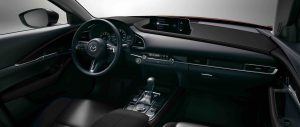
The $30,250 2.5 S Aire Edition is basically an appearance package that’s the same as the Preferred but has unique 18 inch wheels, black roof rails and white synthetic leather seats.
Similarly, the $31,430 2.5 S Carbon Edition is basically a Preferred with gray paint, chrome-silver trimmed rear spoiler and roof rails. This version of the CX-30 has red synthetic leather seat covers.
The $33,640 S Premium adds real leather upholstery, a heated steering wheel, adaptive headlights, a Heads Up Display and a power rear liftgate.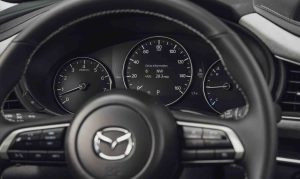
As the name implies, the $34,410 Turbo Aire Edition is the Aire Edition with a turbocharged version of the 2.5 liter engine.
At the top of the roster is the $37,900 Turbo Premium Plus, which gets the turbo’d engine, plus enhanced adaptive cruise control, paddle shifters and a gloss black grille.
What’s New For 2026
The Aire Editions are new and Preferred and higher trims get the larger 10.25 inch LCD touchscreen. The CX30 last got a major makeover six years ago, so the current model is probably the last iteration of the current model before the next major makeover.
What’s Good
A practical little crossover that’s also a fun little crossover.
Standard transmission isn’t a CVT automatic.
Standard engine is big enough to not need turbocharging.
What’s Not So Good
Optional turbocharged engine requires expensive premium gas to deliver its maximum power.
Visibility to the side and behind is restricted by the relatively tall beltline, short side glass and low roofline.
Rotary knob/push interface for the stereo system and other secondary systems can be awkward and distracting to use.
Under The Hood
One of the unusual things about the CX30 is that its standard 2.5 liter four cylinder engine is an appropriately sized engine. Put another way, it is big enough to make enough power – 186 horsepower – without the assistance of a turbocharger – to adequately power the CX30. It can get to 60 in about 7.8 seconds, which is certainly quick enough to not feel underpowered. Many of the other small crossovers in the segment – such as the Honda HR-V, for instance – have smaller, less powerful engines (2.0 liters, 158 horsepower).
Another unusual thing about this Mazda is that its standard transmission is a six speed automatic rather than a CVT automatic. Other small crossovers like the Toyota Corolla Cross and Hyundai Kona come with CVTs – and some of them (like the Kona) do not come standard with AWD; it’s an extra cost option. It’s standard in all CX30 trims.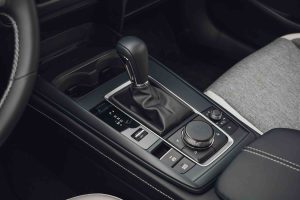
Also unusual is the CX30’s optional turbocharged engine, which makes as much as 250 horsepower if you pump premium unleaded into the tank. Most of the other small crossovers in this class don’t offer an optional engine – or the power/performance that the CX30 does when equipped with its optional engine. Even if you don’t put premium in the tank, this engine still makes 227 horsepower (and 310 ft.-lbs. of torque). This is about 60-70 horsepower more than is available in the Kona, the HR-V and Corolla Cross.
Also, you will not hurt the turbo’d engine by putting less expensive regular unleaded in the tank. In the past, high compression/turbocharged engines were vulnerable to detonation – also called “ping,” which was the sound you heard when you put regular in the tank of a car with an engine that required higher-octane premium. It was the sound of the low-octane gas prematurely exploding inside the engine’s cylinders; the explosion occurring while the piston was still traveling up – imparting huge and destructive forces on the pistons, connecting rods and bearings. Modern high-compression/turbocharged engines avoid that via sensors that detect the lower-octane gas and dial back the boost (in turbocharged applications) or the ignition timing to compensate for the lower-octane fuel. The power goes down – but there’s no damage done.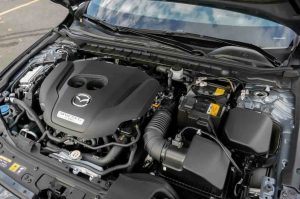
Gas mileage is 24 city, 31 highway with the standard 2.5 liter (no turbo) engine and 22 city, 30 highway with the turbo’d version of the same engine. It’s interesting to note that there is almost no difference in gas mileage with the much stronger turbo’d version of the engine – although you will (per above) have to spend a little more on premium gas to get the most power out of this engine.
On The Road
The CX30’s an easy sell relative to the other small crossovers in this class because it’s the only crossover in the class that is more-than-just an appliance. The Kona and HR-V and the Corolla Cross and VW Taos are fine little appliances. There is nothing wrong with appliances. We all need them. The CX30 is something you might want.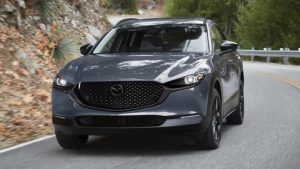
There’s an important distinction there.
It’s not just the available power/performance, either. You will understand as soon as you sit behind the wheel and see the instrument cluster. Not the digital display. The CX30 has real (analog) gauges, dials and needles. There’s also no eye-movement monitor. Not yet. Mazda – unlike a number of other car companies – hasn’t yet, in anticipation of the federal requirement that goes into effect net year, put the creepy-cloying “drowsy/distracted” driver tech into the CX30. It will have to be there next year. But it is still this year.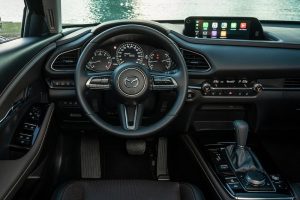
The same theme carries over to the other “safety” tech that has leached its way into the standard equipment roster of every new vehicle, regardless of make or model. The CX30 does have Lane Keep Assist, but the “assistance” can be fully turned off; same for the Forward Collision Mitigation (Mazda’s term for automated emergency braking). Even the seat belt buzzer isn’t especially obnoxious and you can shut it up easily enough by just sitting on the “buckled” seat belt. The sense one gets is that Mazda is a reluctant follower of the tenets of the Safety Cult, like an apostate priest who goes along with the rituals but doesn’t really believe in them.
The long and short is this Mazda accepts that you’re the driver – and it it is a car that likes to be driven (as opposed to trying to control your driving). It’s also 80 percent a Speed3 – the no-longer available high-performance version of the Mazda3 hatch (last sold back in 2013). The Speed3’s engine was only a little stouter (263 hp) but what made it such a hellion was that all its power was sent to the front wheels exclusively and exclusivlely via a six speed manual transmission. It was hilarious fun to drive because of the skittering left-right torque steer and the rubber smears it could leave all over the road. Fast-forward to now and what you’ve got here is a more civilized hellion, with the 250 horses (in the turbo trims) sent to all four wheels, so no left-right skittering and no greasy smoldering smears of rubber – and it’s automatic-only – but it gets the same job done more discreetly.
Less attention from the cops – and the insurance mafia, too.
At The Curb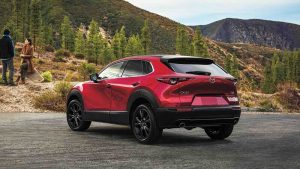
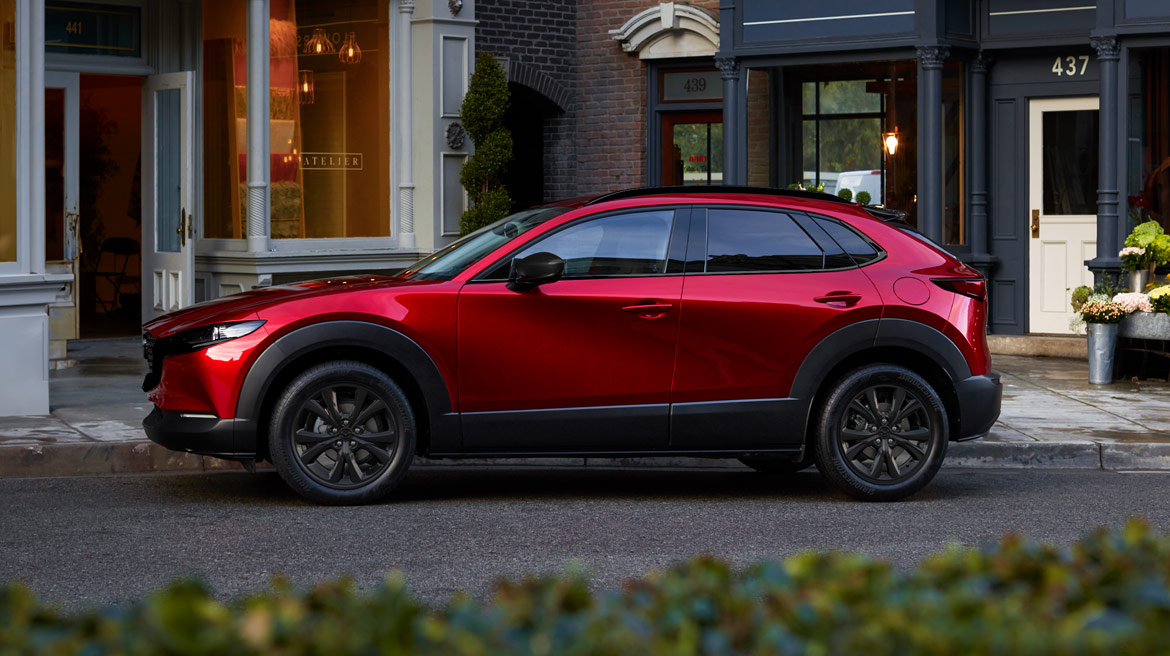
The CX30 has the silhouette of a large caliber bullet – something like a hollow-point .45 – slightly pinched and tapered. The roof seems almost chopped due to the relatively short door side glass. It looks great, but like many other things that look great, there are some practical downsides. Visibility to the side isn’t as good as it is in some other crossovers, but it’s a small price to pay for something that’s nice to look at. Something that doesn’t look like everything else. Also something that hasn’t got kabuki face (or angry catfish face). Maybe because the CX isn’t insecure about itself. When you’re packing 250 horsepower, you don’t need kabuki (or angry catfish) face.
You also don’t need a lot of room – to park. The CX is only 173 inches long. To get a sense of that, the compact-sized Mazda3 sedan is 185.3 inches long – nearly a foot longer overall. Even so – being a small sedan – it has a small (13.2 cubic foot) trunk. The CX30 has a 20.2 cubic foot cargo area behind its back seats and if you fold the back seats down, that more than doubles, to 45.2 cubic feet. That is almost four times as much space for whatever you need to carry than the Mazda3 sedan can carry in its trunk. This is why crossovers have largely taken over the role that cars once played. A small car like the Mazda3 is a fine commuter car or single person’s car but it is too small a car for a family car. A smaller – on the outside – crossover like the CX30 can serve as a family car. It’s much more practical. Of course, this is true of all the other crossovers, too. The difference is the CX30 is more than just practical.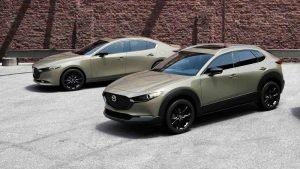
The console-mounted dial/push wheel that is used to do things like find the station you want to listen to is not the greatest thing since sliced bread. Or a simple/separate “tune” knob. To find the tuner controls, you have to go through a process of pushing the wheel left then down to select the menu you want, then again to control the function you want. It’s an “all-in-one” arrangement that does de-clutter the car’s interior, but having a separate knob to change stations is a control interface that’s probably not possible to improve upon. So why try to “improve” upon it?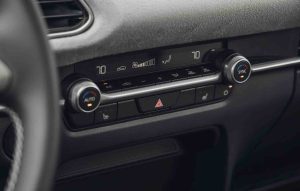
All CX30 trims are equipped with the necessaries as well as many features (such as LED headlights) that would have been considered luxury feature not that long ago. Even the base 2.5 S trim compares vert favorably with Audi and BMW and Lexus crossovers and when you factor in the availability of the 250 horsepower turbo’d powerplant, it compares even more favorably.
The Rest
One small gripe about this CX30. If you rotate the lefthand stalk that controls the headlights from “auto” to “off,” the headlights will turn off. Assuming the car isn’t moving. Once it starts moving, the lights come back on. This means driving around in broad daylight with your headlights on, which is kind of silly – as well as an annoyance to the people ahead of you.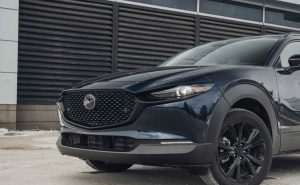
There may be a way to keep them from coming back on but I wasn’t able to find it.
The Bottom Line
In a class of appliances, the CX30 stands out as something more than just another appliance.
. . .
If you like what you’ve found here please consider supporting EPautos.
We depend on you to keep the wheels turning!
Our donate button is here.
If you prefer not to use PayPal, our mailing address is:
EPautos
721 Hummingbird Lane SE
Copper Hill, VA 24079
PS: Get an EPautos magnet or sticker or coaster in return for a $25 or more one-time donation or a $10 or more monthly recurring donation. (Please be sure to tell us you want a magnet or sticker or coaster – and also, provide an address, so we know where to mail the thing!)
If you’d like a Baaaaa hat or other EPautos gear, see here!









I might be too late to get this comment noticed, but on the premium gasoline topic that you discussed Eric…
I just bought a 2014 mini cooper countryman sport (calls for premium) from a friend of mine. He has *not* been using premium and didn’t think it was a big deal. Can I just switch over now that i own the car? Motor sounds fine with unleaded.
Hi JSR,
Yes, absolutely. The vehicle will know you’ve put premium (higher octane) gas in the tank and will ramp up the boost accordingly!
[…] https://www.ericpetersautos.com/2026/06/29/2026-mazda-cx30/ […]
If I were to buy a car/suv type vehicle, it would be a Mazda for the reason you highlighted. No turbo, no CVT, no super nanny nonsense (yet).
But I fear this will all come to an end shortly.
We looked at the CX-30 but got a ’23 CX-5 PP for my wife. Reasons were much better visibility and MIJ vs MIM. Some of the MIM CX-30s and Mazda 3 sedans we looked at had some fit and finish issues. When I looked subsequently it looks like most of the issues have been resolved. The CX-30 is a more attractive car but the poor visibility IMO is a safety issue.
Made in Mexico, so hard no for me. Plus I don’t want to have to push buttons and scroll through menus every time I start a vehicle to turn off all the safety crap.
Back in 2000 I bought a Golf. I was on the TDI club forums back then and there were constant arguments about whether the Golf was a better car to buy because it was made in Germany while the Jetta was made in Mexico. People were convinced it made a difference. I bought it because I wanted a hatch. That was over twenty years ago. I was just on those forums a few months ago and there were people talking about how it turned out to be a non-issue. Mexico has been assembling cars for over 50 years at least. And VW has been there too as well as in S. America the whole time. There was no difference in quality between the models. I hear the same arguments for Mazdas. Some are built in Hiroshima and some in Mexico. I’m willing to bet there’s no difference.
It might have made a difference back then, but now with Europe’s open borders a made in Germany can is most likely being assembled by 3rd world immigrants.
All I know is I’ve had two made in Japan vehicles, a 1999 Corolla and my current 2014 Mazda 3, and both didn’t/hasn’t needed any kind of repairs, unlike my American/Canadian made vehicles. And, yes, the Mazda was made in Hiroshima. I just think the Japanese still take some pride in the quality of their work.
The CX-50 is made in Alabama in the same factory as the Toyota cross shop the Corolla Cross.
Driving home from work today, I believe I witnessed a Nissan Rogue’s CVT transmission die in front of me at a light.
The light turned green and the car started to move, but, suddenly, the hazard lights came on and a hand popped out of the driver’s side window waving me to go around.
I figure the car was 6-7 years old. I’m not sure what the female driver had planned to get the car out of the way of what was shortly going to become a very busy intersection.
Where’s Brie’s empowerment when you need it?
Those CVTs cost a MINT to replace, hence any Nissan with the Jatco CVT that was the subject of a class action lawsuit have the resale value of a Trabant.
Not a bad ride really. I’m considering it for my wife when it’s time to get rid of her old Forester. Not a big fan of the limited visibility out of the back and sides though it seems better than the 3 hatchback for sure. By the way, I’ve seen videos of this thing off road. Is pretty impressive for what it is. Was able to climb some pretty steep inclines. Unfortunately, I’m sure the next redesign will bring the giant touchscreen interior like they did with the CX-5.
The visibility on the 3 hatch borders on dangerous. The lack of visibility on modern cars has affected accident and fatality rates.