

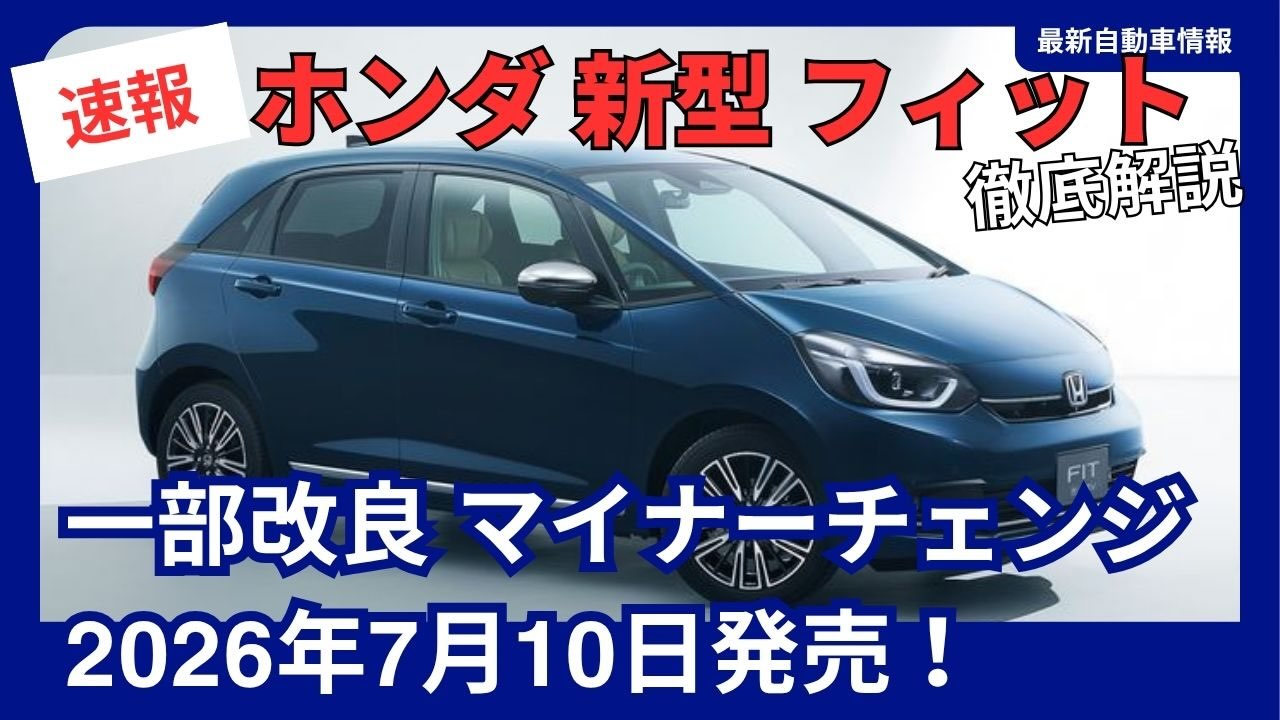

A couple of weeks ago, I wrote about the $10,000 Mazda Flair Americans aren’t allowed to buy. It’s not the only one we’re not allowed to buy. If you lived in Japan, you could buy a brand-new Honda Fit for just a little bit more than $11,000. Interestingly, the Fit is a car we were once allowed to buy. We can’t buy it anymore because the current iteration isn’t compliant with all the federal rigmarole all new cars must comply with before their manufacturer is allowed to offer them for sale in this country.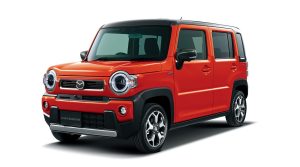
The Fit was last sold in this country six years ago (2020). Honda decided to stop selling it in this country because – six years ago – small, inexpensive cars weren’t selling very well because Americans were able to afford larger (and more expensive) cars. There was thus more money to be made selling less-affordable cars.
This is the main reason why there are almost no small, inexpensive cars available for sale anymore. Ford stopped selling the Fiesta in 2019 and no longer sells any cars at all, except the Mustang (which is small but hardly affordable). GM stopped selling the Cruze around the same time and now sells no cars at all, except the Corvette and a couple of Cadillacs (none of which are affordable). Dodge dropped the Dart ten years ago and also no longer sells anything affordable – a working definition of which is anything that costs less than $20,000.
But it is not 2020 and millions of Americans can’t afford the cars (which are almost all crossovers now) that are available.
There are probably millions of Americans who’d like to buy an affordable small car such as the Mazda Flair – or the Honda Fit – but they’re not allowed to because Mazda and Honda aren’t allowed to sell them in this country. The 2026 Fit that’s available in Japan and other parts of the world is basically the same as the 2020 Fit that was available in this country. But more compliance is required now than it was back then and making the Fit compliant would probably mean extensive and expensive updates that would make it too expensive to sell here, except at a loss.
This is the Catch 22 as regards “tiny cars.” In order for them to be affordable, they almost have to be tiny and that means they almost have to be light and that means it is almost impossible to make them compliant without making them larger (and heavier) and no longer affordable. Put another way, you can make a car tiny and affordable but you can’t make a tiny car that’s affordable. Integrating the structure needed to comply with federal roof crush/side-and-rear-impact requirements alone renders the “tiny car” concept oxymoronic, almost by default. (It is probably possible to build a compliant “tiny car” using high strength materials such as carbon fiber but then you have a “tiny car” with a big price and that defeats the purpose of the exercise).
People without much money to spend will generally put up with a small, sparsely equipped car precisely because they haven’t got much money to spend. If they did, most would probably spend more on something larger and better-equipped. First-time and younger buyers tend not to have the money to spend; there are also lots of people who just don’t have the money to spend – or don’t want to spend it. That’s why, for most of the history of cars, there were always economy cars, which were (generally speaking) synonymous with “tiny cars.” The old VW Beetle was certainly tiny. So was the original Honda Civic and the Chevy Chevette and the Geo Metro – to cite just a few of the many such cars that were once available for those who wanted to buy them.
Italics for an important reason that bears on the discussion about what’s not available – what’s not allowed – today. “Tiny cars” such as the Flair and the Fit ought to be available so that those who want to buy a small, basic – and inexpensive – car would be free to do so. As opposed to the government forcing everyone to buy only the kinds of cars the government allows to be sold. Why is choice so controversial? Imagine if the government only allowed people to buy stuff at expensive stores rather than the Dollar Store. The result would be lots of people who were priced out of buying anything. It’s functionally the same situation as regards the cars the government allows people to buy.
Why do we allow this?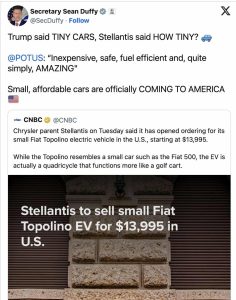
There was a time when Americans were free to buy just about any kind of car they wanted to buy – ranging from tiny cars like the VW Beetle and the early Honda Civic to Fleetwood Brougham Cadillacs. Choice is given a lot of lip service but the reality is it’s held in contempt by the government and – to be fair – a lot of Americans, too. Many of the latter support the government limiting what’s allowed because it assures only “safe” (that is, compliant) cars are allowed. It is not enough that people who want “safe” cars are free to buy “safe” cars; they insist everyone be made to buy only “safe” cars, too.
Before too much longer, they’ll have us all doing calisthenics every morning in front of the TeleScreen.
Meantime, Trump informs us we will be allowed to buy the Fiat Topolino, a “tiny car” that’s perfect for knocking around The Villages in. But if you want an actual tiny car – with more than a rope for a door (and a top speed higher than 25 MPH) you’ll have to go to Japan or Mexico or Europe, where people are allowed to buy and drive them.
. . .
If you like what you’ve found here please consider supporting EPautos.
We depend on you to keep the wheels turning!
Our donate button is here.
If you prefer not to use PayPal, our mailing address is:
EPautos
721 Hummingbird Lane SE
Copper Hill, VA 24079
PS: Get an EPautos magnet or sticker or coaster in return for a $25 or more one-time donation or a $10 or more monthly recurring donation. (Please be sure to tell us you want a magnet or sticker or coaster – and also, provide an address, so we know where to mail the thing!)
If you’d like a Baaaaa hat or other EPautos gear, see here!









“It is not enough that people who want “safe” cars are free to buy “safe” cars; they insist everyone be made to buy only “safe” cars, too.”
Exactly. Just like “kew-vid”, where it wasn’t good enough for the douche-bags to wear masks; EVERYONE (except for the “elite”) had to wear one! And so on, and so forth. Society has officially become a CULT, which of course, demands 100% participation. NO stone is to be left un-turned!
As I have said here before ad nauseam, one of many reasons why I, well, have lots of trouble believing the narrative that climate change caused by CO2 emissions is an existential threat, or at least that TPTB are serious about it, is that there is a Grand Canyon-sized gap between the rhetoric and the action around climate change.
If indeed climate change is as serious a problem as it’s made out to be, or if it’s a problem at all, it stands to reason that small vehicles like the Honda Fit, Mazda Flair, and Toyota Hilux are the kinds of vehicles we need to be building a lot more of.
You see, using less fuel is what we need to do—and small vehicles use less fuel at every step of the way. It takes less fuel to build them, to drive them, and to scrap them. Furthermore, because these vehicles are inexpensive, more people can buy them—and we need to be driving more small vehicles, not fewer.
Plus, with the current repeat of That 70s Show with gas prices and inflation, there is demand for small, affordable vehicles—just as there was then. The difference is, small, affordable vehicles were more available—in contrast to today.
It’s not something we can’t do—it’s something we WON’T.
This is an excellent angle, Bryce. Either use their own rhetoric to change things for the better in some respect, or otherwise get them to show their true intentions.
C’mon Bryce,
Do you seriously expect our overlords to follow logic, especially if it’s at odds with their agenda?
Nope, I’m just pointing out how illogical they are. It’s actually kind of funny, although I don’t know whether to laugh or cry.
What’s laughable is how these sociopaths constantly claim that the frankenfood they’re making in a lab will “Stop cliiiiiiiiiiiiiiiiiiimate change”, and if you try to point out such nonsense to people who’ve bought into the cliiiiiiiiiiiiiiiiiiimate change narratives, they accuse you of being a “Conspiracy theorist”, “MAGAT”, or “Far right extremist”. But it’s coming straight from these sociopaths’ mouths. One example would be SAVOR, which is making lab grown butter out of, IIRC, CARBON DIOXIDE.
Having these kinds of requirements for cars is ridiculous while we allow bicycles, scooters, motorcycles, 3-wheelers, dune buggies, Spiders, Slingshots, etc. on the roads, NONE of which would pass the same standards which are insisted on for automobiles for some reason.
Anyone remember the Toyota Corolla of the 1970s? 1200 cc engine, 4 speed manual, rubber floor mats, wind up/down windows and so on. No AC, cruise control and I don’t remember a radio as being standard. Utterly basic transportation and 50+ MPG.
I do, Freeholder!
Also, the Datsun B120. I had a high school friend who had one. We mocked it back then, because of course we wanted Chevelles and Mustangs and Camaros. I’d love to have a B210 today. Sturdy, good gas mileage and actually kind of fun to drive – relative to modern transportation appliances.
Orlando has a dealer for the EV Moke. I’m sure these are a big hit in The Villages and similar communities around Central Florida.
https://mokeamericaorlando.com/
@Eric – The Villages is for real fascism, enabled by FS 720, a piece of legislation signed by Shrub’s little brother Jeb! when he was Governor.
Don’t even *think* of moving there.
Haha haha you don’t know what you’re talking about
Hey Roscoe,
Firstly, “Moke” sounds like some kind of pejorative.
Secondly, though it’s a very interesting vehicle, being essentially an adult Power Wheels Jeep, they’re selling it for fucking $27,350.
$27k.
And I’m fairly certain that they can build them for an order of magnitude less. This is the problem. What the hell is wrong with these people?
Can you point to documents that say it’s FMVSS compliance as to why the Fit is no longer sold in the U.S.?
Looks like domestic sales had just started to fall and then COVID dropped it even more.
Peak was 80K Fits sold in 2008, fell into the mid 50K annually from then on. By 2017 the annual sales had dropped to 49K and then 2018 to 2021 they were in the mid 30K sold annually.
Honda on their part, per Car and Driver, just says it was falling demand.
https://www.caranddriver.com/news/a33337398/honda-fit-discontinued-for-the-us-despite-new-global-model/
This is a car that seems to sell around 500K globally annually. At some point if people aren’t buying there’s no reason to sell and support them in a market. It doesn’t have to be some grand conspiracy, just economics.
-Anon
Hi Anon,
It’s not a conspiracy that federal “safety” and “emissions” regs render cars such as the ones under discussion illegal to offer for sale in this country. The Mazda Flair has air bags, but – like most Kei cars – likely does not comply with roof crush/side-rear-impact requirements. The interesting thing is that probably a third to half (maybe more) of all vehicles that were legal to sell as 2020 models (like the Fit) would not be legal to sell as 2026 models, assuming they were not “updated” to comply with every jot and tittle of current FMVSS and also EPA regs.
A couple of months ago, I wrote about a practical little commuter EV that’s available in Europe but illegal to sell here – because it hasn’t got any air bags.
Well, so?
No one is being forced to buy an air-bag-free new car. If you don’t want a car without air bags, don’t buy one!
Meanwhile – to highlight the idiocy – I can legally drive my 50-year-old muscle car, despite it having no air bags. I could sell it, too – and the next owner could legally drive it also.
But it’s illegal for Mazda to offer the Flair.
You say ‘likely’, so you’re speculating and asserting these things based on what?
The USA isn’t the only country with regulations so how can they sell these cars in Europe, Asia, Australia in light of EURO emissions and NCAP regulations?
Just because you think it and say it doesn’t make it true. Aren’t journalists supposed to investigate, get quotes, bring evidence?
-Anon
Hi Anon,
As you probably know, the regs in Europe (and so on) differ from those in force here. For example, in France, it is legal to sell even tinier cars – with no “safety” equipment to speak of. Diesel engines are readily available in many vehicles sold in the UK but their US-available analogs (e.g., LandRovers) are not available with diesels here, because of compliance issues.
Being illegal is different than noncompliance. Honda and the others can sell subcompact cars just choose not to go through the hoops with EPA engine certification and DOT crash testing when they don’t sell in enough numbers to justify it. No one is saying they can’t sell these cars, which is different than Kei cars which are a classification that doesn’t exist here, unlike subcompact.
-Anon
The truly terrifying agenda is yes, you can drive your classic car, for now, whenever you want, and the next owner can also, but legislation is pending is about 14 states to outlaw that, and order you that will only allow you certain days that you can drive your classic car.
Or perhaps outlaw them completely because of age or lack of safety equipment.
Oy Vey!!!
YMMV….
Face it, Americans can no longer have nice things, we no longer rate. Not that tiny cars are necessarily nice. It was having the ability to choose, without the scurrilous narratives, imposed by dictate of the toddler state that was nice. It’s a sad condition when even Mexico has more choices.
Once upon a time, we rose up with force of arms against a king and crown for less. We kicked the living shit out of them by not accepting their rules of war. Would be doable again, even with the surveillance grid. Just need to take off the gloves and stop giving them safe passage on our continent.. Still have hope that ordinary people will open their eyes and see. Anyone in government, media, or regulatory agencies is/should be your sworn enemy.
We have a leviathan, grown up around us, eyes everywhere looking for ‘crimes’ to use against us, new cars are an integral part of this agenda. It’s slowly squeezing away our sustenance in boa constrictor fashion. Helluva time to be alive.
“Anyone in government, media, or regulatory agencies is/should be your sworn enemy.”
That statement is something too many people these days don’t seem to grasp. If they’re Democrat voters, they tend to think that anything Democrats do in political office/ power is GOOD regardless of what it is. Same with many Republican voters. People have also been made to belieeeeeeeeeeve that regulatory agencies are looking out for the “Public interest” and keeping them saaaaaaaaaaafe from wrongdoing by corporations. However, as we saw during COVID, regulatory agencies are looking out NOT for the “Public interest”, but rather the interests of the industries they purportedly regulate. There’s a name for that…. it’s “Regulatory capture”.
It’s also astounding how many people STILL watch corporate media (ABC, CBS, CNN, FOX NEWS, MSNOW, NBC, etc.) and think they’re reporting NEWS.
I think this is on its way out. The only people I know watch that stuff are pretty long in the tooth.
There’s someone I know whom I assume STILL watches Rachel Maddow for news, even though she didn’t take the “Safe and Effective” COVID vaxx, and in corporate media, Maddow was one of the BIGGEST pushers of the COVID vaxx narratives. Remember the NUMEROUS claims from Maddow and others that if you took the COVID vaxx, you wouldn’t get COVID, and that the virus “Stopped with every vaccinated person”? It’s astounding there are people who STILL belieeeeeeeeeeve the narratives on the COVID vaxxes. It’s almost like it’s a cult right up there with the cliiiiiiiiiiiiiiiiiiimate change nonsense, because there are also people who belieeeeeeeeeeve that Climate change would be stopped if everyone who drives an automobile were driving an EV instead of a DIRTY GAS VEHICLE.
9-11, just the flu, bros, climate change, our elections, all so fake and gay they make all the other fake and gay things pushed by the Kharzarian mafia and their theatre kids look normal. Next false flag will need to be met by a huge outpouring of mockery and scorn by the men of these United Staes. In unison, and with furious abandon. No American should fight in any war outside his own AO.
Morning, John!
Watching Maddow is difficult. At least the Fox bimbos are easy on the eyes (if not the ears).
Good one Eric! I concur with you on the females on FOX News, though I haven’t watched that channel in quite a while, as I haven’t been a cable subscriber for years. I don’t like the idea of having to pay a monthly bill to get hundreds of channels I never even watch. If I had the option to decide what channels I’d want instead of hundreds of channels that carry sports or peddle propaganda from the Uniparty establishment and/ or corporate advertisers, I might be a cable subscriber again. I don’t know if you already knew, but at one point just a few years ago, even FOX News was pushing the COVID vaxx narratives, as if they also got money from Big Pharma and/ or the Biden regime to do so.
Amen, John –
Even the streaming services are becoming unwatchable. They make you pay extra fees to avoid being serially pelted with the most obnoxious ads imaginable. I’m about done with all of it. I find solace in my books and my garage.
There’s something to be said for having physical copies of books, old movies, and TV shows you like instead of having them downloaded on, say “The Cloud”, on a Kindle, or watching movies and TV shows on “Streaming Services”.
That’s my view as well, John –
I was talking with Gard Goldsmith about this last week. About the importance of possessing important books and other physical things that cannot be taken away except by force and that are impossible to greasily alter for the sake of political correctness.
PS: Just seeing clips for this new movie about the Odyssey makes me want to smash something.
Regulators look out for number 1 first. Maybe after they’ve made themselves into demigods they might protect the industry. And as long as the individual corporations toe the line they get protection too.
As for the media… They’re in it for access, not eyeballs. At this point only about 20% of the US households still pay for cable or satellite TV. Numbers of who’s watching traditional news channels over streaming apps are hard to pin down, but outside of short clips and shared content on social media the numbers watching are around 10% of the 1970s peak where the big three networks divided the country into thirds and the local newspaper dominated the breakfast table. And that changed the goal for the reporter. Instead of wanting to bring down The Man™ the new newspaper reporters want to see into the machine, and become part of the action.
Interesting read from Hoisington Investments: Capital Scarcity and the End of Globalization’s Disinflationary Era
https://hoisington.com/pdf/HIM2026Q2.pdf
The TL:DR summary is that since the end of the Cold War we’ve been in a pricing free fall. Increased productivity from computing and telecom on the high end, a flood of cheap labor for factory work, etc. We all know the story. But now we’ve not only wrung all those gains out, we’re shifting away from “best price” to safety and buffers. That costs money and the consumer pays.
The thing is I don’t feel like the 90s and 00s were all that fantastic a deal for consumers or producers. Sure, gas stayed about the same price, and technically adjusted for inflation it got cheaper, but it sure didn’t feel cheaper. And every time we got ahead, Uncle Sam would be there to pull the rug out, pushing ever higher budgets and printing ever more dollars despite record low unemployment, record low prices and out of left field deflationary tech like fracking.
The government got the peace dividend. We got the shaft. Now that resources (taxpayers) are getting a little more scarce through the boomer retirement wave, they’re starting to get nervous. They can’t reliably print whatever cash they want and we don’t notice. It’s hitting us -hard, and unfortunately at least half of us have no idea who’s to blame. And that half continues to vote for the big spenders.
Just wait until our borrowing costs rocket up. Not so much the debt, but the interest that is about to go hockey stick. Anything that big money does these days looks to be nothing more than a poorly disguised attempt to drive we plebes into their rent seeking casino. I hate gambling unless it’s a friendly poker game, so thats a problem for me. And now that I’m about to get my SS, all I hear is how SS is just another entitlement, no different than free shit for illegals and layabouts. I almost know, down to the dollar, what I paid these cocksuckers over my working years.
I would give up aa my SS if leviathan released me from all further income tax and property tax. Penciling it out, it’s a fair deal, more for them than me, cause I don’t figure on living 20 more years. Still, I’d gladly take that deal. It should be offered to everyone once your house is paid for. Especially in light of the fact that that our money is turning into fly laden shit. I read Vans report. Pretty comprehensive. It’s the kind of thing I’d read all the time if my money was still mostly in the casino. As it stands my biggest fear is waking up one day to find I’ve become unbankable, with my fiat funds unavailable. I say too many mean things to be left alone from this coming pogrom.
Same boat, Norman –
The best/worst part for me is that I expect when I am old enough to collect SS, they will raise the age or just void the deal altogether. Like you, I’d agree to forfeit any future “benefits” in exchange for being free from the got-damned rent (property tax) I am forced to pay every six months to avoid being kicked out of the house I supposedly “own.” I’ve already had to pay a tax amounting to about 20 percent of its purchase price. This is confiscatory. The greasy bastards will say: But your house is worth mooooooooore now. As if that justfified it. As if that were relevant in view of the fact that I bought my place to live in it, not to sell it.
Crucify them all on the tree of woe.
It costs about the same in terms of labor to build a tiny car as it does a big gas-powered Crew Cab truck with all the bells and whistles. The difference is in profit margins of the end products. The profit margin is so narrow on the tiny cars that they are sold nearly at cost, while the big luxury trucks have enormous profit margins. If you owned a car company, would you want a big profit margin or a little one? This is a stupid article written by an economic moron who doesn’t have a business and doesn’t understand the nature of businesses that MUST make a profit. There could be a “loss leader” tiny car to give this idiot author what he wants, but each assembly line making a tiny car at no profit is one that COULD be making highly-profitable big trucks at a much greater profit. Don’t go blaming government safety mandates and required features; it comes down to profit, pure and simple!
Hi RLA,
Labor, yes – materials no. A small car almost by definition requires less material to make and so there’s an inherent cost savings there.
You say the article is stupid. Well, VW once sold millions of tiny cars and made a lot of money doing that. So did Honda with the early Civic and Toyota with the Corolla. Volume makes money. Small, inexpensive cars built those companies. Selling fewer and fewer high-cost cars to a dwindling number of people affluent enough to afford them is a kind of reductio ad absurdum; ultimately, it is a recipe for fewer and fewer car companies; eventually, many will go out of business or be consolidated by the remaining few. It does not seem like a good plan to me.
But what do I know?
You apparently don’t know that Volkswagen was started by Hitler’s German government and didn’t make a profit for several years. Likewise, ALL Japanese cars are subsidized by the Japanese government. Our own electric vehicles were subsidized on our income taxes; when the subsidies dropped, so did EV sales.
Yes, with a high-enough volume of sales, even a tiny car can make a profit. But the retooling costs and the long operating-at-a-loss time for marketing makes the investment costs in the BILLIONS, with no guarantee that the market will EVER support the concept of throwaway tiny cars. Only governments can afford to start up such a company, which won’t even show a profit for probably two decades. If there were a feasible path to profit, don’t you think Elon Musk would have been interested? Instead, he built cars for the very rich, status-conscious consumers–as have all the other car manufacturers. Why do you think we USED to have “tiny cars” and now no longer can buy them? BECAUSE THEY AREN’T PROFITABLE!
RLA,
C’mon. Do you think I am unaware of VW’s origins? WW II ended in 1945. VW only produced a handful of civilian Beetles (KdFwagens) during the war years. VW didn’t start selling Beetles (and Beetle derivatives) in volume in North America until the ’60s and then it sold millions of them. VW emulated the business model of Henry Ford. The Model T also sold in the millions. Your claim re the Japanese government subsidizing its domestic brands is true, but it is also true that models such as the early Civic, Corolla and so on were hugely successful on the merits. So were domestic brand small cars such as the Pinto, by the way.
EVs never have been successful on the merits; at least not as volume sellers.
If – as you assert – small cars are not profitable, why are millions of them sold in Asia, Europe and Central/South America? Are these all money-losers? Why do the car companies continue to make them, if so? Does this make sense to you?
Re “tooling”:
It’s a non-issue because dozens of these cars are already being manufactured. They would merely have to be shipped here to be available here.
There is one reason and one reason alone cars cost so much to make here which in turn makes small cars unprofitable:
Multi-layer taxation. First, you tax the machines that dig the ore out of the ground. You tax the diesel that runs them and the oil that lubricates them. You taxed the sale of the machines, you taxed the metals that made the machines you taxed the sale of the ore. You taxed the electricity at the foundries that made the metal you taxed the men that dug the ore you taxed the insurance companies that sold the men and the businesses their required policies. You taxed the property of the foundries, you taxed the property of the auto makers, you taxed every single part, right down to the plastic push pins that hold the fender liners in place, and in fact you taxed the chemicals the push pins were made of and you taxed their utilities as well. You finally get a car produced after every single component in the car has been taxed at least a dozen times between manufacture and installation, and then it’s finally time to tax the car itself when the manufacturer sells it to the dealer. You tax the money the car dealer makes you tax the dealership property and its utilities. You tax their insurance policies you tax every employee you tax the person that buys the car.
This long-winded diatribe is actually a ridiculously under-stated list of every tax we endure to get a vehicle from the ground to the driveway. I think if we did a serious analysis of the entire taxation tree, we’d find that a car which sold for $60,000 was, by matter of fact, $50,000 worth of taxation and $10,000 worth of actual material value and corporate profit.
This is why we can’t have profitable small cars, folks. This is the one singular reason, and there is absolutely NO other reason why this is so. I defy anyone to prove this incorrect or inaccurate.
Well-said, letmepicyou!
Were it not for all the taxes you mention (and then some) we’d probably be able to buy a very nice car for the equivalent of two ounces of gold.
A friend of mine, their uncle had bought their first house for $30,000 dollars back in the late 60’s. People pay more than that, now, just for a car, and never mind a house. Gotta love the worthless dollar (no gold to back it up), coupled with the endless money printing and spending by BOTH political parties, and the taxes? Yeah, no wonder we cannot afford nice things anymore.
Excellent post!
It’s one thing to marshal facts and logic in support of a position, it’s another entirely to engage in ad hominem attacks. Eric is wrong on occasion, like all of us, but he surely isn’t a moron. So skip the name-calling please – it’s a gigantic fucking bore, and evidence of a weak mind.
Unless I’m mistaken, the Mitsubishi Mirage G4 is the only remaining tiny car under $20k you can buy in the US. It doesn’t have a 14″ iPad in the dashboard and you have to crank the windows by hand, and it does 0-60 eventually, but it sure does get great fuel economy.
Hi NW,
The Mirage was last available in the U.S. in 2024.
If, as you say in an earlier post, that tiny cars ARE profitable–why are they not available in the US? The retooling was in a discussion for a hypothetical US-made car manufactured from carbon filament; please keep up with the context of a discussion before you comment. But even with current standards of manufacture, it still takes BILLIONS, to first establish the market for tiny cars (since no one else seems interested in having a tiny car), then add on the airbags, AC, and other amenities, then establish a price that allows a profit within 5 years or so. EACH of the “bells and whistles” of the bigger trucks ADD PROFIT to the vehicle, and the time for each vehicle coming out of an assembly line is about 4-5 minutes’ difference between a tiny car and a big truck, only with a MUCH greater profit margin for the big boys; you won’t be able to put many bells and whistles into a tiny car or it will no longer be tiny, and certainly not cheap to buy.
Hi RLA,
Really? It “takes billions to establish” a market for tiny cars? Why? If there is a market for them, then the market exists – it does not need to be “established.” Your premise is that people have to be sold on something – as opposed to wanting to buy something. Henry Ford did not have to spend money to create a market for the Model T; the thing sold itself. So also the Beetle. Things that make sense tend to sell without being pushed. Things like EVs and “vaccines” have to be pushed.
I do a lot of radio and of course writing and – while this is anecdotal – I am constantly asked about affordable cars.
In any event, it would be interesting to see what would happen if Toyota could just put HiLux Champs on dealers lots (and Mazda could sell the Flair and Nissan and Honda their small, affordable cars – etc.) and then we’d see whether there is a market.
You make my point re air bags and so on. These things are forced on us by the government. If you dislike EVs being forced, then you also ought to dislike air bags and so on being forced on us, too.
Imagine what a salutary effect it would have on dealers if – as an example – you were truck shopping and walking down the rows with the salesman looking at new $40,000 Tacomas but the next aisle over had $15k Hi-Lux Champs…. do you imagine the dealer might “work with you” a bit more to get you into that Taco knowing you could just buy the HiLux instead?
Actually Henry Ford DID have to create a market for his cars. They started as conveniences that only the rich could afford. Then he dropped prices so that his employees could afford them, expanding his market with cheaper but still profitable prices due to volume selling. He also established the 40-hour work week, Monday through Friday, with Sunday being the Lord’s day and Saturday reserved for his employees and their families. The expanded leisure time Henry Ford created for his employees also gave their families the incentive to invest in a car.
If there WAS a market for tiny cars, the car makers would MAKE them. There was never a market for EVs, and the government WANTED EVs for everybody instead of ICE cars–so they could limit travel and control individuals’ movements by remote disabling of their EVs–somethings that’s harder to do with ICE cars. Most Americans TRAVEL, for work and for vacations; I drove 1500-4000 miles per month, carrying parts and supplies for my job as well, cutting me out of the tiny car market. NOBODY driving those miles wants to do it in a tiny car; they are only made for city-dwellers, not rural or suburban citizens who travel greater distances and who vastly outnumber car owners in the cities.
Your cheap imports still have the same laws, rules and regulations governing their manufacture and sales as domestic vehicles, so that’s a straw man argument. My druthers was to keep the government out of the car business, but my point is that it’s the same red tape for ALL car makers–including tiny car makers. I doubt the price for tiny cars will be much cheaper than other cars since they have the same government overhead expenses. So they CAN come to the US, but there’s NO MARKET FOR TINY CARS. If there was, they would be here!
Since you don’t seem to understand economics and the market forces that control which cars are sold where, this discussion is at an end. You enjoy your ignorance!
RLA,
The Model T was never “a convenience only the rich could afford.” It was always a car almost anyone could afford. That was the whole point, you see.
You keep repeating the line that “If there WAS a market for tiny cars, the car makers would MAKE them.” I have pointed out that they do, in fact, make them. Millions of them. They just don’t sell them here. You might read my article from a few months ago about the many new cars available in Mexico for well under $20k; many for $15k or thereabouts. Here it is: https://www.ericpetersautos.com/2026/04/21/its-not-just-inflation/
These cars all have AC and also your beloved air bags, by the way.
So much for my “ignorance.”
PS: Use of ALL CAPS is bad form. It comes off as angry old man ranting (like Trump).
And “big trucks” are Killer Trucks. At least that’s what the Gladys Kravitz’s at Consumer Reports sez…
https://www.consumerreports.org/cars/car-safety/the-hidden-danger-of-big-pickup-trucks-a9662450602/
There’s no winning with these misanthropes.
Then there’s the market distortion that creates the luxury pickup. Used to be if you had an Airstream or maybe a horse trailer for your daughter’s “sport” you bought the Cadillac with the 501 V8 to pull it in style. These days a Caddy can’t tow anything, so you’re shopping at the Ford dealer. But the wife isn’t going to put up with 1500 mile road trips in an F100 without AC or FM radio, so the creature comforts get piled on. Pretty soon that’s all they sell, because once you get an airbag equipped adult sized child safety seat approved you just put it in everything and hope economy of scale will bring the price down.
Or not. They seem to sell pretty well, and there’s always leasing for the fleet buyers (or factory delete orders), so why not just flood the market with over the top “utility” vehicles that look like a Coupe De Ville?
Morning, Eric. Re: “(It is probably possible to build a compliant “tiny car” using high strength materials such as carbon fiber but then you have a “tiny car” with a big price and that defeats the purpose of the exercise).”
I agree with you, however, the reason this is so, is because there has been very little large-scale carbon fiber infrastructure investment in America, least of all by the automotive industry.
There are 5 or 6 major utility-scale carbon fiber manufacturing plants in America.
However, the U.S. has approximately 1,350 to 1,750 metalcasting facilities overall. Specific breakouts show roughly 400 to 450 aluminum foundries and 150 to 200 steel foundries operating nationwide.
If the auto industry wasn’t so deeply connected to big aluminum and big steel and if they were investing their resources properly, I think infrastructure investment could, in rather short order, completely flip the financial end of things to favor carbon fiber as the CHEAPER material rather than the more expensive one.
It should be categorically easier and cheaper to produce carbon fiber than to mine and make usable aluminum and iron. If the infrastructure was in place, we’d be making EVERYTHING from carbon fiber.
B-b-b-but “carbon” is evil. You’re going to make fibers out of it? I don’t think so. Reduce your “carbon footprint” or the planet will die.
Remember, you are the carbon they want to eliminate.
Roger that, letmepicyou!
Another benefit would be corrosion resistance. Steel rusts and so has to be coated and treated to not rust (eventually, it does anyway). Carbon fiber probably would last much longer; possibly forever.
Hi Eric,
“ Carbon fiber probably would last much longer; possibly forever.”
Which is probably why they will never use it. Every model vehicle I ever owned prior to the late 90’s rusted out well before the engine died. Without that the car manufacturers would eventually put themselves out of business, but all the craapola electronics in new cars assures a constant replacement cycle.
Carbon fiber does have a lifespan. What it excels in corrosion resistance and strength-per-weight it gives up in impact and abrasion susceptibility, UV and ozone degradation. There’s also some hurdles in the repair side. Ask any body shop if they like fixing Corvettes and they’ve been using fiberglass for 70 years in those so the techniques are well known and despised. The reality is carbon fiber has some auto applications where it would be ideal but the infrastructure and institutional knowledge for steel and aluminum make it a tough inroad. Couple with the fact the war machine rolls on new mechanical engineers and material scientists are absorbed by the money and prestige there rather than consumer stuff. So you only get the trickle down and what mostly drives it is racing. Car racing, bicycle racing and the like driving any adoption of the technology in various fields and those things are not cost sensitive applications so can’t always drive real world manufacturing use.
So you crash a metal car; it goes to the shop for repairs. The carbon filament tiny car goes to the junk yard because it can’t be repaired, and due to the cheap price it could never be profitable to be repaired even if it was repairable.
We used to have repairable toasters, waffle irons and lots of other household equipment. Where did the small-appliance repairmen go? The price of new stuff is lower than repairing the old stuff! Same for your throwaway carbon filament tiny cars!
Hi RLA,
The news stuff is also less repairable, chiefly due to “tech” but also because of complexity. Formerly simple jobs such as replacing a water pump can entail partial engine disassembly. This is fine, perhaps, provided you can afford it. Most people cannot, which is why so many people are crushed by debt and live hand-to-mouth. I consider this a bad thing for the individual as well as the country. It chiefly benefits the finance/shyster class.
Many people have – unfortunately, in my view – bought into the idea of financing what they cannot actually afford; i.e., buying debt in order to live beyond their means. Things like the six year loan provide proof of this. You may not remember, but car loans used to be three years because most people lived with their means. The finance/shyster class tempted them to live beyond their means by structuring “affordable” debt. It’s a fine way to keep people in debt forever.
All that would have to happen to have a country where every family can afford the things it wants and needs with ease would be to go back to a metal-backed money system that isn’t issued as NOTES (instruments of debt), and the outlawing of interest.
This would end money devaluation and turn money from our master into a tool we could use to build the future. We’ve got to get rid of jewish banking first, though. This is why the really hated Hitler – he took control of the banks away from the jews and ended interest. This yanked Germany out of the jew-banker-created global great depression and turned them into a global superpower. The people went from starvation to prosperity in less than a decade.
This is why you see people lined up by the tens of thousands just to catch a glimpse of him. Hitler was an ECONOMIC ROCKSTAR. And that’s why the jews hated him so. He broke their chains of economic slavery and turned the white man free. If only we had picked the correct side in WW2, the world would be a paradise today.
Never mind tiny cars we can’t have. The Lügenpresse is moaning piteously over the EeeVees we can’t have — because bad, bad men cancelled them:
‘The E.V. revolution [sic] … was an opportunity for Detroit to rediscover its capacity for ingenuity and to re-establish credibility in an industry it helped to create.
‘Instead, whipsawed back and forth by shifting political headwinds and afflicted by all manner of self-enforced error, it appears to be in the process of sealing its own doom — at the precise moment interest in E.V.s is surging in the United States.
‘In April, 26 percent of prospective buyers were “very likely” to consider an E.V. for their next car. And that was before the chaos in the Strait of Hormuz helped push the price of unleaded gasoline to a four-year high.
‘In the worst case, [the US] retreats onto what the economist ‘Susan Helper’ calls a “shrinking island of ICE,” churning out outlandishly large trucks and not much else. At which point, the obsolescence of the mighty U.S. automobile industry would be all but guaranteed.’ — NYT
https://archive.ph/dyCKt#selection-8415.245-8415.586
‘A shrinking island of ICE’ — I LOVE IT! Vroom, vroom!
Here the EeeVee pushers take off the mask, making brutally clear their marching orders when our newly-elected communist president takes office on Jan 20, 2029:
“I talk to a lot of car dealers, a lot of automakers in the U.S.,” says Scott Case, the chief executive of Recurrent, an E.V. analytics company. “And I think all of them would agree with the statement that we’re headed toward a fully electric future.”
‘Good E.V.s, he pointed out, are superior products to ICE cars in nearly every way: They accelerate faster; they’re quieter; maintenance costs are lower. “The debate isn’t about that,” he went on. “The debate is about the rate at which we’ll get there. The whole globe is aimed in one direction.”
‘In short, the United States will require the same type of incentive and investment programs that have paved the way for E.V. growth in other parts of the world.’
____________
EeeVees are a superior product — but require incentive programs to sell, admit the EeeVee pushers. What we’re dealing with here, obviously, is a cult. Its idée fixe of EeeVees taking over the world is impervious to facts and logic. And this cult is based in specific locations:
‘From 2012 to 2023, close to half of [new EeeVee registrations] were logged in the ten most Democratic counties in the country, while a third were made by buyers in ultraliberal enclaves like California’s Bay Area and Cambridge, Mass.’
Jesus. Hate to say it, but the communist united front is coming for us again with EeeVee tax credits and federally-funded billion-dollah baaaaaattery plants. It’ll be like the halcyon days of the Two Joes (Manchin and Biden) all over again. Count on this NYT article being incorporated in the 2028 D-party presidential platform.
EeeVees for all; ICE polluters for none!
Maintenance costs are NOT lower–because you have to buy $20,000 to $50,000 in batteries every four-five years! Electric cars are also more dangerous in an accident, tending to explode and catch fire; I for one would rather be trapped in an ICE car that won’t explode than in an EV that will. They also are an extreme danger to any First Responders who want to rescue you, but they and YOU will be electrocuted if they try to force your doors open.
H RLA,
I agree with you on this – generally. But – to be fair – EV battery packs do usually last longer than four or five years; they often show signs of beginning to lose charge capacity by then but – usually – they’ll be viable for another several years. You’re right though that inevitably, they will become useless (effectively) and the replacement cost is exorbitant.
The potential for spontaneous combustion is a big problem, even if the actual incidence is relatively uncommon. Still, the prospect of an EV just lighting up is understandably alarming.
Without the government’s tax subsidies, NOBODY wanted an electric car. A BIL bought an all-electric Honda; four years later, before he even paid it off, it needed $27,000 in batteries. It went to the junk yard while he was still paying the loan for it!
Hi RLA,
There are some people who want an EV and the fact that some EVs continue to sell (absent subsidies) establishes this. But they are (as things stand) fundamentally a niche product that was pushed to be a mainstream product and I doubt they ever will be until they are as or more practical than a car with an engine as well as cost-competitive.
To anyone currently living in the Canadian wildfire smoke, it should be painfully obvious that every penny spent on emissions regulations equipment is a complete waste. It’s like a giant ‘Rube Goldberg’ machine of complexity that wastes tons of resources and has negative results.
Yup, and don’t forget the occasional volcano eruption (way worse).
It was never about emissions, it’s about control of a market and to limit competition.
At the expense of the middle-class and lower. i think we are currently seeing the big Manuf. starting to realize that they have gone to far.
Excellent observation, the wildfire smoke last week was probably equivalent to years worth of IC engines “emissions” across the entire country. It was so weirdly dark and overcast here one day that it felt like I was in an episode of the Twilight Zone.
I was wondering when someone would notice that. You are the first.
For clarity – I don’t disagree with your premise that there ought to be a free market.
“There are probably millions of Americans who’d like to buy an affordable small car such as the Mazda Flair – or the Honda Fit – but they’re not allowed to because Mazda and Honda aren’t allowed to sell them in this country.”
However, you keep ignoring that the market has spoken. When the Fit, Fiesta, Geo Metro, etc were available they didn’t sell millions. Even when these cars were being made, they were not profitable.
As a libertarian supposedly in the Austrian tradition I would think you could admit your premise is wrong. Why it’s wrong could be debated for days. Monetary policy, regulations, American psychology all contribute. But the reality is the market has spoken and they don’t want what you keep pushing. Certainly not in the millions.
Hi Kim.
I specifically wrote that times have changed. It is not 2020. The market has changed. But we’re not allowed to have an actual market. Small, inexpensive cars like the Flair and Fit can’t be legally sold here. So there isn’t a market, in the Austrian tradition.
“Cars that only weigh about 2,000 pounds can get pushed out of their lane by the slipstream of a passing semi.”
Look in the mirror at who’s not promoting small cars.
What exactly is so different in 2026 vs 2021 when the Fit was last available? Why do you all of a sudden think a car like the Fit is going to sell in the millions or be profitable? Where’s the data? The data on small cars sales and profitability is directly at odds with your premise.
I’ve driven 2000 lb -2500 lb cars all my life. Have never been pushed out of my lane by a semi slipstream.
On the one hand you bemoan the lack of small cars but then turn around and basically try to scare people out of them.
So argumentative.
Kim –
Do you grasp that conditions have changed? In 2020, the average price paid for a new car was not $52k – as it is in 2026. It was about $38k. The cost of everything else was also at least 20-30 percent less in 2020, too. Average Americans are wanting more affordable everything. This is not my claim. It’s the expressed want of millions of Americans who are no longer able to afford basic necessities, including a basic car.
What I “bemoan” is the absence of choice imposed by the government and exploited by the major car companies. I would like to see a free market – which you seem to take issue with.
Hi Eric,
Kim has a point though…the market has spoken and small cars are not what they want. This is why most sedans have been replaced by crossovers and SUVs. Mazda Miata’s, Toyota Corollas, and Mitsubishi Mirages are all available to purchase. I came across a 2018 Nissan Versa this morning for $3300. They aren’t flying off the lots. They are out there if people want them. People don’t want them.
Hi RG,
Well, the market spoke… six years ago. Now it’s a different market, I think. In any case, I’d like to find out. That’s the main point here; why not let the market be free to anyone who wants to sell – and buy?
The US has NEVER had a completely free market. As it is, all car makers have the same laws, rules and regulations to sell cars in the US–CA has even more thanks to Leftists. The fact that most cars have all the bells and whistles show that most consumers WANT the bells and whistles; otherwise they would sell tiny cars with NO bells and whistles. There just isn’t the market to sell tiny cars at a sufficient profit margin to make it worthwhile to manufacture them!
Hi RLA,
I don’t understand your defense – so it seems – of the regulatory regime. My argument is to hell with the regulatory regime. I say people ought to be free to buy whatever they want to buy – and companies ought to be free to sell what they think or just hope will sell. That is in fact how it once was, you know. There were very few “safety” regs prior to the mid-1960s, for instance.
You assert that ” most consumers WANT the bells and whistles.” But this is circular. The fact is these “bells and whistles” have been largely made standard and that effectively forces people to buy them. Again, I get a great deal of feedback from people all over the country that is contrary to what you assert. Would you like to be able to buy something like a Tacoma, but without air bags? Or a turbo/hybrid-augmented engine? With a simple V6 and a manual transmission but no got-damned touchscreen and maybe – heaven forfend! – roll-up windows? For $28k instead of $35k?
I know I would!
Most people do NOT want manual transmissions, nor manual windows. Airbags are a SAFETY feature, not an option you can do without–and you’d be the first one to sue your car maker if you got hurt because you didn’t want to pay for airbags! Most people prefer touchscreens because they add value at a relatively low cost. Or do you want to use paper maps and mechanical radio tuners? Air conditioning is another luxury you can do without, right? The point is, most people LIKE luxuries in their cars. For you, you just need to build what you want from the ground up, since modern cars are built for the MAJORITY of people, not niche markets like you.
Hi RLA,
Air bags are a hypothetical “safety” feature. They confer no actual benefit unless you get into a fairly serious wreck. If not, they are as superfluous as a vial of Gypsy Tears. Just much more costly. Both are absolutely an option I can do without. Observe that you are making a value judgment and applying it to others. That’s exactly what the EV pushers do. Think about it, please.
As far as the rest: Again, you are making a personal judgment and using that as the basis for assuming everyone else agrees. I am not the only one who does not.
AC? Yes, I like AC. Touchscreens and “assistance technology”? No, I don’t.
Does RLA stand for Righteous Lefty Arsehole?
Could be, to5!
I don’t understand his anger – or his argument with me. It’s a fact that inexpensive small cars are available pretty much everywhere else in the world, which (to me) established that there is a market for them. It’s also a fact that it’s illegal to sell many of them here, due to regulatory compliance issues – so we have no way of knowing whether there’s a market for them here. I’d like to see.
His stentorian insistence that air bags are a SAFETY feature that EVERYONE (I’m using RLA’s ALL CAPS) must have establishes that he’s an authoritarian type who thinks it’s his role to decree such things for everyone else.
Does to5 mean that’s how high you can count?
Schumpeter predicted that capitalism would degenerate into basically a combination of socialism and corporatism. That is what we have today. We do not have an auto monopoly (as Marx predicted) we have a triopoly, in which two of the Big Three were bailed out by the State and all of them are more or less adjuncts of the government.
They are not interested in “free markets,” they are interested in preserving their position within the corporatist system and if that means selling fewer cars to fewer people but having higher profit margins per unit and keeping the elites and the government happy, that is what they will do.
You will get the car they allow you to have, and if you can’t afford it, they will let you pay on it for seven years and make bank on the interest.
Hi X –
Yup. But that model only works so long (literally). Seven years is probably about as long as it can work, due to depreciation. Well, we’re there right now – or close to it. A relatively inexpensive new vehicle, such as the least expensive version of the Toyota Taco I wrote about a few days ago, lists for about $35k. That means $500 per month for six years, assuming zero interest. Of course, there is interest – so that actual payment is probably closer to $600 per month. This does not factor in the cost of insurance, which of course is based on the replacement value of the vehicle. Probably, the average person will be paying at least $100/month to “cover” a new $35k vehicle. So now it’s $700 per month – loosely – just to have the vehicle. Filling the tank costs around $70 at current prices. Most people have to fill up once a week, so (roughly) $250 more on top. We’re now around $1,000 month to own/drive a sort-of “affordable” vehicle such as the base trim Taco.
I don’t think that’s – as they say – “sustainable.”
I bought a used 3-yr-old pickup truck, mint condition but very few bells and whistles, for $19,000. I paid cash, so my cost per month is closer to a tenth the inflated price you quoted, including gas and insurance. Meantime I’m saving some extra money each month to pay cash for my next used vehicle. Anyone buying a new car with 7-year financing is a fool.
I agree with you on this, RLA –
Debt is something like cancer; it eats you up if unchecked. I have always paid cash for my (used) vehicles, too.
I just got back from Iceland. Tiny country but there were so many neat small cars there A Mazda 2, Toyotas and Hondas that we do not get here and cool small station wagons. It appears that cars from the US are easy to import. I see small cars in AZ from Mexico that would be fun to drive. But noooo!
Avery interesting point. In 2017 I bought a significantly discounted, leftover ’16 Focus with a stick for about $12,500. Full list was just about $18,000. People were just not buying these cars in droves.
Personally, I LOVE it but I am not and never have been in step with everyone else.
And there is something else unmentioned here:
The top 10% of household incomes account for HALF of consumer spending:
https://www.newsnationnow.com/business/your-money/wealthy-consumer-spending/
Since the covid hoax the car companies have adopted the business model of taking orders for high-dollar, high-profit vehicles from the wealthy and selling lower volume. They’ve done away (as much as they can) with letting loss-leader stripped cars sit on the lot until the end of the model year and then offering rebates.
The manufacturers DGAF about selling cheap cars in large quantities to the poors, they have rejected Ford’s business model of a century ago.
Hi X,
Yes, this is true. But it also creates a huge potential market for low-cost cars. This market is legally shuttered by the regs. If there were an actual market, anyone would be free to try to sell any kind of car they thought would sell – and people would be free to buy it. That’s the way it was, once. I wish it could be that way again.
Of course there is no market for small affordable cars, since no one is allowed to sell one. One cannot determine there is or is not a market for anything until and unless it is on the market. The free market is the genius of any economy. Government intervention is the bull in the China shop.
Regulations are nearly always pushed by Big Manufacturing–in order to limit competition through expensive compliance costs. It isn’t the government’s idea for nearly all regulations; they are anti-competition measures asked for by the Biggies and put into law by the government at their request. The bull in the china shop was let in by Big Manufacturing!
Fuel Mileage, Emissions & Safety, three things working at cross purposes…and GovCo ignores the Law of Diminishing Return.
The Ratchet of Control only clicks in one direction. And GovCo never sleeps.
It’s all part and parcel of the Empire of Idiocy we’re forced, at gunpoint if necessary, to fund and obey.
Like that old saying goes; “you can have it fast, cheap or good. Pick two”
The same should apply to cars again and maybe then we might wind up with some good enough cars at an affordable price.