

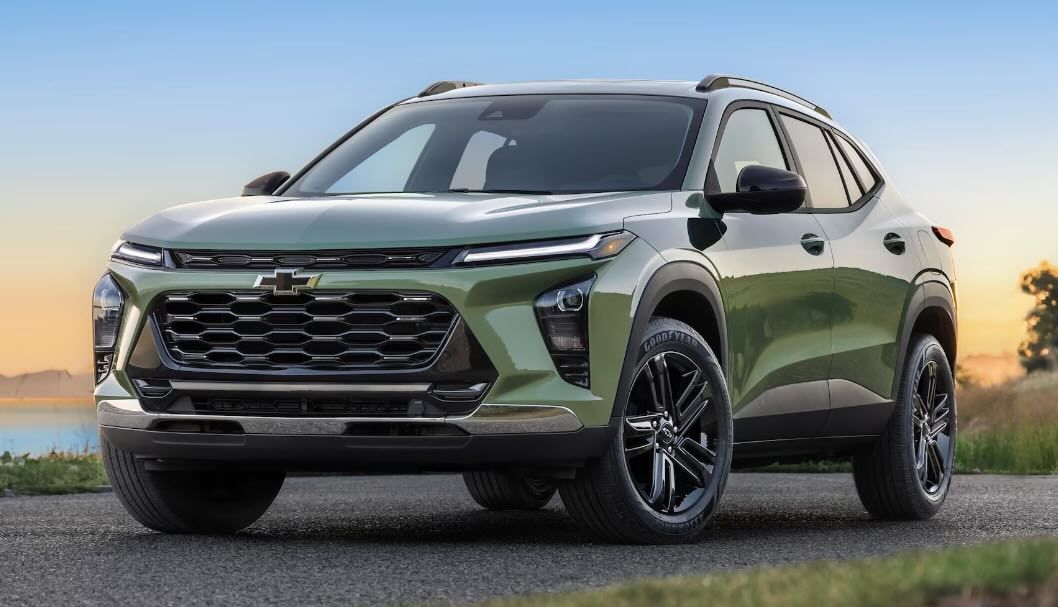

The number of new vehicles you can buy if you’ve only got about $22k to spend is on par with the number of habitable planets in our solar system. There’s Earth – and theres’ not much else.
The Chevy Trax is something like that. In fact, it is one of just two new vehicles you can still buy for a little less than $22k.
What It Is
The Trax is a subcompact crossover and one of just two new vehicles of its type or any type that you can still get for less than $22k. The other is the Hyundai Venue – which at $20,550 to start takes the win as the most affordable new vehicle you can still buy in this country.
Base price for the Trax LS is $21,700 – but for that you get a significantly larger, roomier subcompact crossover (the Chevy is 178.6 inches long vs. 159.1 for the Hyundai) and one with a more powerful (if smaller) engine paired with a six speed automatic instead of a CVT automatic.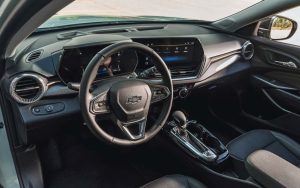
You also get a Wi-Fi hotspot, a decent four speaker stereo, AppleCarPlay and Android Auto, LED headlights and 17 inch steel wheels.
There are four other available trims. The $23,200 LT gets a better (six speaker) stereo and a larger (11 inch) LCD touchscreen as well as automatic climate control AC and 17 inch aluminum wheels. The $23,200 1RS gets 18 inch alloy wheels, gloss black exterior trim, roof rails and a heated/flat-bottomed steering wheel and the better six speaker stereo. The $25,400 2RS gets 19 inch alloy wheels as well as the LT’s available Convenience Package, which bundles heated front seats and steering wheel, keyless entry and heated outside mirrors. The also- $25,00o Activ gets the same upgrades but different cosmetics as well as unique-to-this-trim 18 inch wheels.
All Trax trims come standard with the same drivetrain, which consists of a turbocharged 1.2 liter three cylinder engine paired up with a six speed automatic and front wheel drive. Like its main penny-pinching rival, the Hyundai Venue, the Trax does not offer AWD.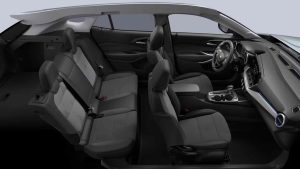
What’s New for 2026
This year is a carryover year with no major changes from last year. The base price has gone up – but by just $200 vs. 2025.
What’s Good
More than just affordable, the Trax is practical.
Standard engine may be smaller than the Hyundai Venue’s – but it’s stronger because it’s turbocharged (the Venue’s isn’t).
Almost four inches more backseat leagroom and almost 20 cubic feet more cargo room.
What’s Not So Good
That little engine is under a lot of pressure to make enough power to adequately move this Chevy.
Standard 17 inch wheels impart add weight and impart rolling resistance that hurts fuel economy.
AWD isn’t available (if you care about that).
Under The Hood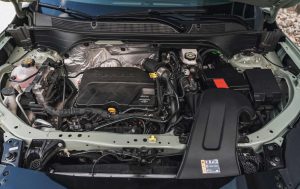
The Trax has the smallest engine you’ll find in anything with four wheels – that isn’t an ATV or side-by-side. Just three cylinders and 1.2 liters. I have a sport bike that has a 1.2 liter (1200 cc) four cylinder engine – and my bike only weighs about 450 pounds. The Trax weighs 2,983 lbs. – empty. With two average-weight people on board, the Trax will weigh around 3,300 lbs. – which is a lot of weight to place on the shoulders (so to speak) of a 1.2 liter, three cylinder engine.
That’s probably why it’s got a turbo – which boosts the output to 137 horsepower and 162 ft.-lbs. of torque (at 2,500 RPM). This makes it stronger than the Venue’s larger 1.6 liter four cylinder engine, which only makes 121 horsepower and just 113 ft.-lbs. of torque (at 4,500 RPM). Both cars tout a 0-60 time around 8.8 seconds, but the Chevy feels quicker and doesn’t sound like it’s given ‘er all she’s got, cap’n just trying to keep up with traffic (about which more below).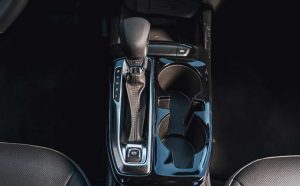
Unusually, a six speed automatic that shifts up and down through gears is standard. Most inexpensive new cars – including the Venue – have CVT automatics, chiefly for the fuel efficiency advantage. In this case, though, there’s little difference. The Trax rates 28 city, 32 highway vs. 29 city, 33 highway for the Venue.
Chevy could probably have squeezed an additional 2-3 MPG out of the Trax by fitting it with 15 inch (rather than the standard 17 inch) wheels that are lighter and impart less rolling resistance. In the past, economy cars usually had 14 or even 13 inch wheels and that is part of the reason why many of them were more economical than today’s entry level cars. What happened? “Rims” slang for big wheels – became a thing and that’s why all new vehicles now have “rims.” Maybe they look good – to some. But they hurt gas mileage by adding weight and rolling resistance.
Gnomesayin’?
On The Road
The Trax has torque – more than the Venue does – and it is torque more than horsepower that gives any vehicle the feeling there’s power available (EVs set you back in the seat because their electric motors produce immense torque – immediately). If you went by just the 0-60 stats of the Trax vs. its main low-cost rival, the Venue, you’d be hard-pressed to tell the difference. But you can feel it when you drive these two small crossovers back-to-back.
The Trax’s little 1.2 engine feels stronger, sooner – and with less pedal effort – because it is. All of its 162 ft.-lbs. of torque is produced (as note above) at just 2,500 RPM, an engine speed just above a fast idle. It is – effectively – available almost as soon as you begin to accelerate away from a dead stop and once you’re rolling, the engine is in the sweet spot of its torque curve. You don’t have to floor it – and rev it – to get going at faster than a box turtle’s pace, in other words. The engine RPMs – and so, engine noise – also decrease as you accelerate because the six speed automatic shifts up to the next-highest gear as you accelerate. In a car with a CVT, the engine revs increase as you accelerate – and stay high, as you accelerate (because the CVT doesn’t shift up). In a car with a marginally powerful engine, the effect is magnified. The engine sounds like it’s being abused but you almost have to abuse it in order to get going at faster than a box turtle’s pace.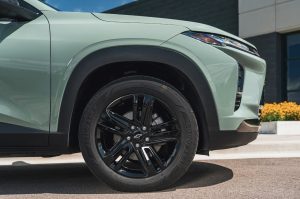
The Trax isn’t a drag racer. But it’s not a box turtle.
Its weight also has some good points. The economy cars of 40 years ago typically weighed closer to 2,000 than 3,000 pounds and while that was great for fuel economy (many economy cars of the ’80s got better gas mileage – 40-plus MPG – than today’s entry-level cars) it wasn’t so great for high-speed stability. Cars that only weigh about 2,000 pounds can get pushed out of their lane by the slipstream of a passing semi. This small crossover is nearly as heavy as the mid-sized cars of the ’80s and so it feels more planted. The big 17 inch wheels help with that, too – even if they do not help with gas mileage.
The Trax is also more pleasant to be in for longer – especially for passengers – because it’s roomier. More about that follows.
At The Curb
Though small, the Trax is significantly larger than the Hyundai Venue, which is the only other small crossover available for less than $22k. The Venue is 159.1 inches long vs. 178.6 for the Trax, which is not that far away from qualifying as a compact-sized (rather than subcompact-sized) crossover and sometimes, size does matter.
When it comes to practicality, at any rate. 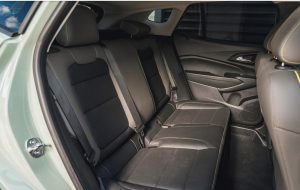
The Venue’s a great little commuter and having the rear doors and rear seats does mean it’s feasible to carry more than just two people. But it’s much more comfortable for more than two people inside the Trax, which has 38.7 inches of legroom for the backseat occupants vs. 34.3 inches in the Venue’s back seats. That is not a small difference. It is the difference between being able to sit back there without your knees rubbing up against the backs of the front seats – and having space between your knees and the backs of the front seats. 
There is also much more space – almost double – for cargo in the Trax: 54.1 cubic feet with the back seats folded forward vs. 31.9 in the Venue. The Trax also has 25.6 cubic feet of space behind its back seats vs. 18.7 in the Venue.
The not-slittle Chevy’s looks belie its price. Put another way, it doesn’t look cheap relative to more pricey small crossovers such as the VW Taos ($26,500 to start) or the Honda HR-V ($26,500 once again) or the Toyota CorollaCross ($24,580) and its standard equipment roster leaves nothing essential off the table. Power windows, locks, cruise control and a pretty decent stereo with connectivity are all included. With the larger (11 inch) LCD touchscreen and LCD main gauge cluster, the inside of the Trax looks a lot like the inside of an Audi or Lexus from not-so-many years ago. Also a Camaro – which is not by-accident. Chevy borrowed styling cues (including the canting of the secondary LCD screen toward the driver) and the big, ball-type air vents from the Camaro, which of course you can no longer get. But you can get distant echoes of it.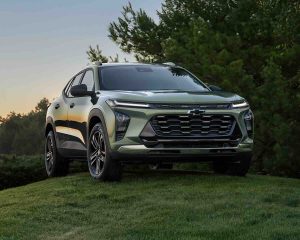
The Rest
Given how hard AWD has been sold as a must-have thing, some may see the absence of AWD as a big negative. It might be worth some more thought. Yes, of course, AWD increases traction and that helps keep you on the road (and moving forward rather than sideways) when it snows. But the truth the car companies would rather you not know is that a set of good snow tires makes a FWD car almost as grippy in the snow and you can save a lot of money by not paying thousands more for a feature you may only need a couple of weeks out of the year – if you need it at all.
The Bottom Line
Americans looking for an affordable car that isn’t cheap – there’s an important distinction there – or impractical ought to take a look at the Trax.
. . .
If you like what you’ve found here please consider supporting EPautos.
We depend on you to keep the wheels turning!
Our donate button is here.
If you prefer not to use PayPal, our mailing address is:
EPautos
721 Hummingbird Lane SE
Copper Hill, VA 24079
PS: Get an EPautos magnet or sticker or coaster in return for a $25 or more one-time donation or a $10 or more monthly recurring donation. (Please be sure to tell us you want a magnet or sticker or coaster – and also, provide an address, so we know where to mail the thing!)
If you’d like a Baaaaa hat or other EPautos gear, see here!










This would be the closest equivalent to replace the 2005 ION I have owned since new. This is what I would be looking into.
For the pleasure of “upgrading”, I would lose a cylinder, timing chain, add turbo complexity, 500 lbs of weight, nanny devices, tons of crap I don’t need and $25,000 burned for the pleasure. And still get worse mileage on the freeway [32-36-37].
Yes, it’s an ION. A Truth About Cars TWAT Award winner and a consistent member on many ‘Worst Cars Ever” lists. But… it’s never given much trouble, has less than 90,000 miles, looks like a late model, rides well, quiet, plenty of room, minimal tech, no On Star and great visibility. The perfect size [as have been all of my cars : 176-186″] and weight. 23+ in town, tight turning circle. Trunk room is enough that in all these years I have needed to rent a truck one time and that includes moving from one state to another.
It will never happen. GM is dead, at least the one I was interested in. It died in BK. I don’t know WTF this cluster **** is currently. But my instinct to look at a GM offering first still remains.
Sorry. That timing belt in oil thing is a built in failure point and deal breaker. 7500 mile recommended oil change intervals with GM specific Dexos oil, 17″ wheels and tires [boutique maintenance requirements] don’t belong on an entry level car.
[…] https://www.ericpetersautos.com/2026/07/17/2026-chevy-trax/ […]
I just got through driving an Equinox. It has a 1.5 something engine. It’s got a CVT. Slow and loud.
3 cylinders? What is the world coming to?
Chevy does/did have a 1.4 L 4 banger. Had some minor issues that could be fixed that put out about the same horsepower – so assume it could goose a little more now. Why not use that? That one does have a timing chain.
This engine would scare me off instantly.
Hi Dan,
Yeah. I wish this vehicle and others like it came with a 2.5 liter or so naturally aspirated four. That’s what they used to come with – because that’s what made sense. Unfortunately, sense is in short supply now.
When I see one of these newer electronic prison-grid-mobiles and the morons sitting in them, I tend to puke-up a little in my mouth.
Today’s ‘modern’ humans seem happy to put up with any and all nasty garbage foisted upon them.
Meanwhile, the rest of us are dragged along into this new anti-civilized existence of living Hell.
Seems there is just no cure for stupid.. and boy is it rampant.
I believe it’s a wet belt engine so run as fast as you can worsted design ever.
A great report on a car with great potential with only one Achilles heel…the engine uses a wet timing belt, not a chain, nor a dry regular belt.
I had seriously looked at buying one of these…it checked all the boxes, inexpensive, an actual shifting transmission (not CVT), 4 doors, a reasonable longer body, decent ground clearance, did i say how cheap it was?….
But then the engine wet belt reared its head…basically a timing belt, but submerged in oil(!)
So, I held off on buying one to see what the users said…and it wasn’t good….if you have an extended warranty, which cost more $$$, you might be ok, but if the belt started to shed bits, it would get into the engine oil, clog oil passages and destroy the engine…ouch!!! And you wouldn’t know rhe belt was doing thia t until the engine was already pretty damaged.
Sure, change the oil properly, and it should go to the 10 year/150K expected lifespan, and then what? Either sell or trade the car before it ruins it’s own engine due to a terrible design flaw, or pay big $$$ for a new wer belt.
You’ll Pay for the belt change, now around $1500, hopefully before it sheds bits, and grenades the engine.
But if it was a standard non-interference timing belt, good to 100K, or better, a chain, good for the life of the engine, it’d be perfect…you could change ir yourself, or not have to do it until the engine was almost dead.
But, once again, GM snatches defeat from the jaws of victory, by letting bean counter accountants drive what I’m sure was cheaper than a timing chain to build, upfront, to go with a design flaw wet belt that will further alienate buyers from GM products for a long time, perhaps life? If i was a young person, looking at a starter do it all car for what i could’afford, this it’d high on the list, but if it blew even in 10 years, I’d walk away from chevy, and probably GM forever.
I got a Plymouth reliant K car used, in the 80’s, and the timing belt broke after about 5K miles, bending the valves slightly, and even though the belt was replaced, the car never really ran right and the transmission died soon after. I never even considered a chrysler product for over 20 years after that experience, and when I got one, it was only with the maximum warranty, which I’ve used many times. And chrysler, now stellantis, is struggling to survive, like GM, for poor design and build qualities. Customers are sick of overpriced and under-engineered, crappily built vehicles.
YMMV…
Excellent info, Saxons –
I did not kn ow about the wet belt. Go almighty. Why do they do these things? Well, I suppose I know why…
Why would a wet belt wear any sooner than a dry belt?
It looks as though they are pretty common now, not just GM but Ford, Toyota, Honda, Peugeot, Citroen use them in their small engines. In Ford’s case it’s some of the larger ones, like the 2.7L Ecoboost.
From what I’ve been reading the wet belt saga has more than meets the eye. For one being a wet belt it’s not simple to inspect like dry belts are. A wet belt is like a timing chain and will require significant disassembly to get at.
They also drive important things like oil pumps. That was true of chain but that seems fine from a reliability standpoint. Driving the oil pump with a belt seems risky.
VW drove the water pump in a girlfriend’s car with the dry timing belt and that led to a disaster. When the water pump started leaking it ruined the belt, which broke and wrecked the engine. This was a 2003 Beetle, not recent. Back when cars were simple you’d get some warning when your water pump was failing and the weeping was just annoying, not catastrophic.
-Anon
Amen, Anon –
I dislike timing belts (wet or dry) because they fail. Timing chains rarely do. They stretch over time, sure – but that is far less disabling than a timing belt failure, which leaves you instantly stuck (best case).
I don’t think it’s cut and dry. Timing chains like in a push rod small block Chevy are life of the engine things. They are multiple row, short, not stressed.
With overhead cams this because much less true. Early ones were double row but still were very long and required stout tensioners to work. They’d last a long time but were noisy, heavy so slow to rev.
They lightened them up but that lead to breaking and stretching. Being a chain they weren’t easy to inspect or replace. With variable valve timing an engine will have multiple chains and they will be miles long.
So the belt was actually kind of an improvement. Cheaper, easy to replace periodically, worked fine. For a long time the split was interference (chains) vs non-interference engines (belts) but over time as belts proved to be reliable enough they showed up on all engines.
This wet belt thing seems like a step back, but I don’t know that’s true or not. I don’t really hate dry belts mainly because if you follow the schedule it’s proven not to be a serious problem and really not usually the worst of jobs to R&R.
-Anon
True, Anon!
I’ll stick with timing chains, myself. Of course, I am referring to timing chains as used with old school OHV American V8s, such as my much-loved Pontiacs. I’ve owned many of these, several 400s and now the 455 in my ’76 TA. The timing chain is probably the last thing that will ever fail in these engines. If you ever do need to replace one, it’s only a few steps more than changing out a water pump.
Wet belts have been a thing for a while in many European cars, and the consensus is that they suck, with many engines dying at about 40k miles. Stellantis and Peugeot have had lawsuits over the wet belt issues, and while they have managed to slightly improve reliability, they are still terrible.
Stellantis re-engineered those engines finally, to use a chain because of all the adverse publicity and reliability nightmares. Ford had the same belt in oil disintegrating problems and law suits in Europe, the UK and the US.
Not to be trusted.
‘The Trax weighs 2,983 lbs.’ — eric
For comparison, a 1960 Ford Falcon — 3 inches longer than the Trax — weighed 2,423 lbs, with twice as many cylinders (six).
That’s 560 lbs, and minus three cylinders, of enshitification. In the 21st century, cars have steadily degenerated to the point of undesirability.
Euthanize the auto industry.
It’s the degenration of this country; auto industry, culture, government, economy. military, hell care, even the churches.