


If you’re a car guy (or car girl) you probably know the opening monologue to Mad Max II (aka The Road Warrior). I, too, can remember. A time of less chaos; a time when America made some sense. An example comes to mind. You have to go back to another time – to crib a line from the monologue. To the mid-late 1980s. This was a time when you could have bought a brand-new Mustang LX 5.0 for about $7,100.
For those too young today to remember, Ford used to offer the Mustang GT’s performance equipment in a basic Mustang. The LX 5.0 was that Mustang. It had everything you got in the base, four cylinder Mustang – which was next to nothing, other than the shell and the glass and so on. But you did get the Mustang GT’s 5.0 liter V8, the five speed manual and the related mechanical upgrades, including the bigger wheels and tires, etc. You also got less weight – because the LX 5.0 didn’t have all the other stuff that came standard in the Mustang GT. So what you got was a quicker and less expensive Mustang GT in a plain brown wrapper (so to speak; the LX 5.0s were commonly white).
Inexpensive is more like it.
Adjusted for the diminished buying power of the dollar – what’s styled “inflation” – a brand-new ’86 Mustang LX 5.0 hatchback cost $16,817 in today’s devalued dollars. It bears reiterating: In 1986, you could have bought a V8 performance car for less than it costs today to buy a front-drive, four-cylinder shitbox (as Brock Yates styled them). But you do get a touchscreen and “advanced driver assistance technology” as a consolation prize.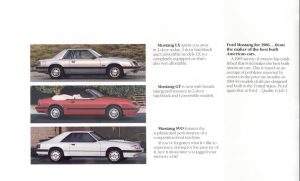
By the way, the LX 5.0 was far from the only mass-market, V8-powered performance car people used to be able to buy. There was also the Pontiac Firebird Formula, which was a lower cost Trans-Am. As recently as the ’90s, GM sold V8-powered Impalas and they were family cars.
Well, what happened? Why is it that there’s no such thing – today – as an affordable V8 performance car? (The base price of a 2026 Mustang GT is $46,560.) Or an affordable V8-powered car, period?
There are several reasons why.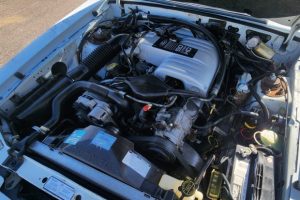
The first reason why has to do with “safety” costs, in particular air bags. The ’86 Mustang LX 5.0 did not have any air bags. It is important to understand that it is not just the air bags that add to the cost of a car. It is having to build the car around multiple air bags. It is not just a matter of putting an air bag into the steering wheel. It is a matter of designing the entire dashboard, the structure behind it and the entire car around the air bag system. This alone had added thousands to the cost of every new vehicle. It is also important to understand that vehicle without air bags are not unsafe. That is a hysteria fomented by bed wetters and control freaks. It just means they do not have air bags. It is a distinction that matters.
The second reason is that it got expensive – for the vehicle manufacturers – to mass market V8 performance cars. Or V8 powered vehicles, period. The more they sold, the lower their Corporate Average Fuel Economy (CAFE) numbers and that led to fines for non-compliance that had to be folded into the cost of the non-compliant cars. As time went on, another compliance cost got imposed. Carbon dioxide was declared to be a “pollutant” and thus subject to being regulated as an “emission.” There is only one way to decrease the “emissions” of carbon dioxide and that is by burning less gas. V8s burn more gas than small fours and that is why – for compliance reasons – the car companies no longer make mass-market V8 performance cars. The handful of V8 performance cars that are available – like the current Mustang GT – are affluent people’s cars.
It’s a weird Catch 22. The incentive – if you want to use that word in this context – is for the car companies to make fewer of the cars people want, such as affordable V8 performance cars and to stamp out as many four-cylinder/FWD shitboxes as possible.
Another example is the way manual transmissions are becoming exotic equipment, available only in a handful of vehicles and usually only in the high-trim/expensive versions of those vehicles; viz the 2026 Toyota Tacoma. It is available with a six speed manual, but only in one expensive trim. The rest are all automatic-only. Why? Because manual-equipped vehicles use a little more gas (and thus “emit” more gasses) and so the incentive is to build fewer of them, never mind whether there’s a market for them.
Will we ever again see a new car like the old Mustang LX 5.0 available for sale? It could happen. But not before everything changes and returns to the way it was, back then.
. . .
If you like what you’ve found here please consider supporting EPautos.
We depend on you to keep the wheels turning!
Our donate button is here.
If you prefer not to use PayPal, our mailing address is: EPautos 721 Hummingbird Lane SE Copper Hill, VA 24079










It’s clear that America needs a new car company that is intent on making reasonably priced ICE cars.
I’ve been watching old episodes of The Price is Right from the 1980s while the current show is on summer hiatus. It’s hard to believe how inexpensive new cars were back then compared to new cars over the past 6 years. Most cars offered on the show then had 4 digit prices, though you’d occasionally see new cars anywhere from $10,000 to around $30,000. Nowadays, whenever you see a new car on the show, they’re ALL over $20,000, some even over $30,000, plus they look like beasts or something out of a potential future Mad Max movie.
Ditto that, John!
Lee Iacocca demanded the Pinto be priced at $2,000 to start. Imagine that. People (some people) laugh. Yes, the Pinto was a basic car. A basic car that people could afford. Imagine that.
Hi Eric,
My grandmother once had a Ford Pinto station wagon when she was still alive and could drive. I don’t know how many of those were made back in the day, or what the price was.
Fast forward to 2026, and it increasingly seems that the federal government and the wealthy sociopathic elite they actually serve don’t want basic cars available that ordinary people could afford. But of course, they’ll use BS excuses like “Cliiiiiiiiiiiiiiiiiiimate change”, “Cliiiiiiiiiiiiiiiiiiimate Crisis”, or “Saaaaaaaaaaafety”, and people who’ve been thoroughly propagandized eat it up as TRUTH.
I think that’s it, John –
“Safety” (and “emissions”) have been used to render cars increasingly unaffordable; it’s been a very effective stealth campaign to push the working and middle class out of cars. This has been a long-term goal of the “elites” for at least the past 50 years and they are damned close to realizing their ambitions.
It appears to be right out the WEF’s wet dream (for the masses) of “You’ll Own Nothing and Be Happy.” Speaking of the WEF, did you ever see their 2016 video titled “8 Predictions for the World in 2030”? It was one of the creepiest things I’ve ever seen, complete with creepy music, though it was framed as, among other things, “Saving the planet from climate change” & “Promoting Equity”.
Tragically,, it’s not that cars, or everything, for that matter, has gotten so expensive….
The true tragedy is that our dollars have (((been made))) to be worth so much less by TPTB….
It’s almost like a conspiracy, or something,eh????
The tribes agenda at work, once again….
Oy Vey!!!
YMMV….
Two thousand bucks, two thousand pounds curb weight, two years development.
Although the 5.0l lx is a great example of how cool cars were relatively cheap in the 80’s. I looked at my original window sticker in my 1972 Buick GS Stage 1 and it was $4500. Compare that to my friends 1987 Buick Grand national window sticker of $18000. That works out to 9.68% inflation per year. Yikes
Morning, Auto!
Yup. I have the original paperwork for my ’76 TA. It is a loaded TA, with many options (including power windows, locks, electric rear defrost and AC). It sold new for about $5,400. The only modern/current equivalent is a new Mustang GT. The starting price is $46,560.
Yikes, indeed.
I had a 1988 Mustang LX 4 cylinder with an automatic transmission that I managed to get 188,000 miles on. The sticker on it was less than $10K. It did not have factory AC that was added as an aftermarket item (which crapped out in only a couple years) but basic maintenance was pretty straightforward. It was also easy to replace non-mechanical items – I replaced both front seats and all of the head and tail lights over time myself. The V4 was definitely underpowered when going up steep hills but on the highway was perfectly fine.
It would be nice if something simple but sporty was available for young people just to get around to work or school like that.
Ummm the sticker price on my 86 LX hatchback was $13,680 in SLC UT. What planet sold them for $7k?
So the good ol daze was still a double down ripoff or what ?
My first new car was a ’91 GT. I think I paid a little over $16k here in NJ. It was a fast car for its day but other than that it was kind of unremarkable.
I believe the ’86 4 cyl LX notchbacks stickered for ~7K. Here’s what the internet tells me:
1986 Mustang GT 3-Door Sedan $10,691
1986 Mustang LX 2-Door Sedan $7,189
I think the 5.0 was an option on the LX, but I can’t seem to find the option price. I’m sure it came in somewhere in between the 4cyl LX and GT prices, above.
Here’s an ’85 GT reviewed by Motorweek which stickered for $10,284 (7:20) https://www.youtube.com/watch?v=FV0g5AL0u-I
Sounds like you got it good and hard from your local Ford dealer, Rain. Ouch! That would explain the snark. 🙂
I remember those days. But not fondly. I wanted a new notchback Mustang 4 cylinder, and couldn’t afford one because I was poor. Jobs were disappearing in the Rust Belt. Factories were closing by the hundreds. Layoffs were daily news.
The economy was changing back then. If you were already established in the old industrial economy, you could still do pretty well for yourself (if your factory hadn’t closed yet). If you were a new Gen X college grad, it was “Fuck you, kid.”
I personally knew Boomers a few years older than me, who graduated in the early to mid-1970s, who bought new cars with cash AND paid their college tuition by working summer jobs in construction or unionized auto plants. I personally knew people with degrees — one guy with a law degree — who stayed in construction for a few years after getting it because the money was better.
By the mid-1980s that was over. $3.35 was the minimum wage. Seven bucks an hour was a fortune. Affirmative action was starting to get difficult for us white boys at the time, too — insofar as anyone was hiring, they were practically begging for blacks and women. The NAFTA, negotiated by a Republican and signed by a Democrat in 1992, codified into law and cemented what had already been occurring for a decade — offshoring of jobs to the Third World, chronic trade deficits, annual budget deficits, and “bend-over-here-it-comes-with-no-lube” for the white working class.
After the 1980s, the way you got ahead in the financialized economy was to have a semi- professional dual-income household with few or no kids, preferably in the government sector where there were no layoffs and you could still get a pension and retire after 20 years (i.e., a cop and a teacher). Or you flipped real estate and got into stocks. Clinton and his hag wife epitomized this type of grift with the Whitewater and Rose Law Firm rackets.
But dual income households with disposable incomes pulled away from the working class and exacerbated wage-pull inflation. They were better able to afford consumer items while the working stiffs couldn’t.
I did have 1980 fox-body Mustang hatchback with a straight-six that I bought used for $800, though. I do remember that car fondly, if not the era itself.
Your historical recount of the period is spot on. Personally, I experienced the exact same thing. The 80’s sucked.
Add in the still present 55 mph speed limit being enforced now by more militarized police. The overt militarization of police accelerated in the 1980s under Raaaaaaayguuuun. I was a fool for voting for him. I shoula stayed home in 1984, not that it would have made a difference.
Eric made a statement in another article that things soured in teh 1980s. They sure did.
Coming from being a free trade Republican, my first brush with job loss, I became a full fledged economic populist
Exactly. The first election I voted in was 1984, a landslide for Reagan. I remembered the inflation and oil shock of the 1970s, and the miserable Carter years.
Reagan sure seemed a LOT better. And maybe he was, for a few years. But it was a chimera. He was an actor, and it was all paid for with debt.
I hated the Clintons in 1992 (and still do), but they were hugely popular because they resonated with the new, largely fraudulent generation of girlbosses, racialized politics, and grifter economics.
The 1980s represented the death of the postwar American Empire, and the Clinton era was the first generation of vultures to get fat off the rotting flesh of the carcass.
Speaking of “teaches”, let’s hop into the Wayback Machine to 2020. Dave Ramsey did a survey of millionaires. Check out #3 on the Top 5 list…
https://tinyurl.com/ms49k2zu
Oh, you should see the racket public sector employees have here in New Jersey. There are so many retirees who are 55 and have lifetime benefits and fantastic pensions. The cops are some of the worst. They will become chief for a few years then retire. Pension is based off of the final years’ salary, so they get a nice boost before retiring. The chief in our town earns $224k. Then they’ll often get another gov’t job and start all over. Like the rest of NJ government, it’s completely unsustainable but there’s no will to change it. Like the rest of the country, the racket will only end when a collapse happens.
Yup, in my ‘small’ town in the NE, same. 3-4 Chiefs in 6-8 yrs.
And we’ve doubled the amount of cops while the population has not changed.
Probably some state law that changed to X many cops per people. Pay off the union bosses.
I golfed with one of the chiefs a while back and what I learned is that they are lied to by their unions. They believe in their heart that their ‘racket’ is justified compared to the private sector. It’s not even close, but they still believe.
I’ve heard similar thoughts here as well. My friend’s son is a cop in my town. A Sargeant. He makes good money I’m sure, but he says most cops feel let down by the last deal the union negotiated. They feel they deserve more somehow. If these guys had to work in the private sector they would be earning nowhere near what they are making now.
yup, same same. The ‘chief’ said “we get paid less now for more later, you private sector guys get paid more now for less later”. Certainly a union talking point. But I followed up on it, and found he was getting paid 3-4 times average wage with first year cops getting 2-3.
I presented him with the facts and they still don’t believe. just brainwashed over 5-10yrs and they will never get it. And of course the ‘but our lives are in danger’ thing came out.
And I am good friends with lots of cops, and most of them get it too, but some don’t.
Klink,
Yes, you should encourage yer buddies son has been screwed by the deal the union made, so he and as many other people like him on the force should immediately quit, and all get private sectors security or other similar type jobs.
This is how we fix the problem. The nearby cop force here had so many vacancies for so long, the town simply said, you cant fill the jobs, we’re going to use the money elsewhere, and/or reduce.the budget.
But I’m sure they didn’t drop the taxes….
Teachers are my bete noir as far as government employees are concerned. They get well paid for what’s basically a part time job – summer and school vacations off – along with gold plated pensions that frequently have cost of living increases built in. Makes me see red every time I get my property tax bill, knowing a good chunk of it goes to pay those leeches.
Amen, Mike –
It’d go down a little easier if the kids actually learned. Many are functionally illiterate and innumerate even after 12 years of schooling. They cannot identity the United States on a map. They cannot tell you a thing about the Civil War, beyond Abe Good. How the heck is that even possible? A child of normal intelligence ought to be able to read and write and do supermarket math by the age of ten and to be capable of thinking conceptually by then. If not, whoever taught them is incompetent and deserves to be keelhauled.
Mrs Savant worked in the system for 32 years, you would want a two month break if you had to endure public school fuckery. The inmates run the asylum. All the misfits, retards and mentally challenged are “included to be with their peers”, hence the teacher is forever putting out fires. The only thing that gets taught is act up and get attention.
They are also threatened and face physical abuse. I wouldn’t make it to recess without someone having their teeth rearranged.
As my oldest stated in grade 4″ how far can Joey stick his fist down his throat today.”
Thinking is not encouraged at any level, rote memory is all that is required
Sorry to hear that Nova,
When I was in school (50’s-60’s) if you acted out you would get disciplined, sometimes physically. If you made the mistake of complaining to your parents that Mr. So and so slapped me you would get another slap from them because you must have done something to deserve it. I guess now if a teacher raises his voice to a kid the parents want the teacher fired. I blame today’s parents for most of this, their precious offspring need discipline; my mom used to say “the world doesn’t owe you a living” so wise up. They also had ‘special class’ for the misfits which seems to have disappeared also.
‘Not before everything changes and returns to the way it was back then.’ — eric
Eh, that never happens, except in our dreams. But if one applies the Fourth Turning analogy in an 80-year social cycle pointing back to the 1940s, the future might at least rhyme.
When WW II wound down in 1945, experts expected that millions of returning soldiers would swamp the economy with unemployment, as in the harsh deflationary recession in 1920 after WW I ended and Big Gov stimulus lurched to a stop.
This time, with much weaker US demographics, a killer recession could unfold when Trump’s stupid, evil war grinds to a halt. Depression I in 1929-1933 brought a big shakeout among auto makers, and a total rethink of automotive and aircraft design, launching both into their modern configurations.
Let it bleed.
Yeah, I feel like I’m going to be too weak and old to see anyhing resembling good. Are we in the crisis period yet?
1943-1964 High
1965-1983 Awakening
1984-2007 Unraveling
2007-present crisis?
This is based on Strauss and Howe’s, the worlds #1 demographers, recount of events. Correct me if I”m wrong.
It seems like the unraveling took longer than it might have otherwise. It could have been extended until 2020. I would say 2020 was the beginning of the crisis, but I make no pretentions of any knowledge whatsoever.
Have you read their book? I have, and the historical events upon which they base their theory are for the most part unknown and irrelevant, unimportant in the overall sweep of time. The world’s #1 demographers? Really?
The twin myths of epic collapse versus endless human progress continue to beguile humanity. Neither have ever been true, nor will they be true in the future.
Civilizations have risen and fallen since the beginning of recorded history. None did so on a schedule.
You have to read the updates. 2030-2032 is the end of peak crisis. You can see the insanity building. Attacking Iran after giving Ukraine all those weapons, was a super bad move that we’ll start seeing the fruit of come fall. As if the oil situation weren’t bad enough, there are other things that exit the straight, like fertilizer and aluminum. Think about it, our refineries that produce diesel are maxed out. Even if they weren’t they aren’t geared for the same kind of crude.
What screwed up their thesis is that the boomers were supposed to be the generation heading into the sunset. Yet they aren’t, and we have more than a few decrepit Silents still clinging to power. Gen Z is about the most ignorant and useless generation ever. I don’t think that was factored in either.
Gonna suck. Especially with me having any hope of retiring (I wont’ be 70 when that shitshow hits)
Same here, himself –
One of the things that drives me up the wall is that by the time I’m eligible to collect SS and get back some of the money (15 percent of everything I’ve earned these past 30 years) extracted from me, they’ll raise the “retirement” age or the money will be worthless. Meanwhile, Trump’s 20 year old son is worth $150 million, courtesy of his greasy con man father’s crypto grift.
Everything started when the people that went and fought in WW2 all came home after the war and they all realized that they fought on the wrong side. They killed their Teutonic brothers and helped give rise to the satanic communist jews.
And here is the secret reason none of our grandfathers ever spoke about the war. I don’t care who in your family served in WW2, there are next to NONE of them that want to talk about the experience. Knowing they participated in a great evil led to a generation of silence and regret.
That period of silence and regret carried on into the formative years of the boomer generation. Imagine if you participated in the slaughter of your own people at the behest of your racial enemy. Imagine how much that’s going to fuck you up as you go through the rest of your life. Imagine how that affected the boomers growing up where the fathers were silent and the only thing now guiding their lives was “Leave it to Beaver” and “I Love Lucy”.
The ripple effect of that shame and guilt echoes through each and every generation. Each consecutive generation carries that echo a little differently. Think about each generation after the boomers, and understand that the hallmarks of that generation are the opposite swing of a pendulum that started with guilt and shame borne in WW2. It puts things in a new perspective to see them this way, generationally speaking.
There is only 1 way to heal from the guilt and shame. We have to stop the pendulum from swinging.
The only way to do that is through truth and acceptance.
The TRUTH is, we fought against our own people in World War 2 to serve the goals of the fucking jews.
The TRUTH is, we were duped and fooled as a people through propaganda and brainwashing into believing Hitler and Germany were the enemy.
The TRUTH is, we were the bad guys in WW2. We were wrong, and the “greatest generation” was actually the greatest generation of FAILURES because they failed to know their enemy and they failed to know who and what to fight for or against.
And the TRUTH is, the jew has always been, and will always BE, the greatest enemy that mankind can ever face.
We will never become what we were meant to be until we shed the hidden and unspoken guilt of our forefathers and destroy our eternal enemy, the satanic jews. And I’m sorry to all you non-believers out there, but the origins of the jewish hatred of the white race is literally in the book of Genesis and it ends with jews murdering Jesus. The Bible isn’t meant to be a religion – it’s simply the history of the white race. Genesis 5:1.
When we all figure this out, we can explore the cosmos together forever in peace and harmony.
Demographics is likely the elephant in the room that is seldom spoke of.
It’s almost as if the entire USSA work force is slowly evaporating.
Was out to dinner with a pair of union electricians and they are WAY short on apprentices at their local.
Last week I was at the local auto repair shop and overhead the counter guy on the phone as they needed a battery delivered posthaste.
Shop guy told me that the parts stores are so short on drivers, they now will DoorDash parts to repair shops.
We are now living in the “Jenga” economy.
How many blocks can you remove before the whole thing collapses?
They’re short because they pay shit and offer no job security, no advancement, and no benefits. So they import Pakistanis and Afghans and Mexicans who will do these shitty jobs in the gig economy.
I was a driver for a major auto parts chain (briefly) about five years ago during the covid nonsense. The corporate people were really big on that. I made $14 an hour with no benefits and my co-workers were absolute lowlifes and losers. I did it because I had a work ethic and I figured “Hey give it a try, and see what happens, any job is better than none.” It was one of the most depressing and demoralizing things I ever did. I actually got fired. Good riddance, assholes. They actually had a TRANNY as a manager of the store after I got canned. The corporate types were really big on treating he/she/it according to his fetish, of course. But he didn’t last, either. The entire company was a big minimum-wage revolving door.
Fuck them. ALL of their auto parts were either Chinesium or sourced from some other Third World shithole. Their entire line of brake pads came from India. Think about that. A country with no fucking toilets is selling brake pads in the U.S. that you trust your life with.
I’m sick of hearing about how everyone is lazy and no one is willing to work. That is certainly true in many cases, but it is equally true that employers expect people to sacrifice their time on God’s green Earth for jobs that pay absolute shit with shitty working conditions where they will never, ever be able to get ahead.
Indeed, I just finished CDL training for a new job with the promise of benefits, and now it looks like only the people with seniority have access to that, and new hires only get part-time hours whenever they are needed and no bennies. And they were absolutely BEGGING for help. Now I know why, because they are fucking liars in the job advertisements.
I have a novel idea: I will work for you if you give me decent pay, working conditions and benefits. If not you can go fuck yourself.
Preach it, X!
I have one for you, also. I have had to replace the drive belt on my riding mower twice in the past two years; the belt used to last at least five years. But that was when they made them here. Now they are made in Injia, donchaknow.
The Jeetification of everything continues.
“Oh you please to be buying our filters now!”
https://youtu.be/jiKbyi9fEmE?si=J3mQtZeCxMyBvmaA
Exactly. “We have all these openings!” Sure, but you won’t pay a US citizen a humane wage to do that job. STEM! OK, now those go to H1B imports in another scam that is never prosecuted. Labor? Factory offshore machine shop closed. Any remaining won’t pay or can’t pay to compete with China imports.
Local trades? Here in central WA dominated by 2nd gen Hispanics. Two recent HVAC guys both Hispanic, very pleasant and grads of a local Tech School but where’s the native white cohort? Why?
Meanwhile ‘playing office’ in a useless government job is where the money is. Land a gig in a university administration bureaucracy you’re set with high pay and benefits for doing next to nothing and zero anything productive. ‘Course as a white male that’s out too.
Ahh one exception locally, we have a two building four bus school district (yes that 5 acre 2 building footprint is a school district) white male is the district administrator and he makes well north of $200,000 a year plus benefits.
By design? Sure seems like the perfect divide and conquer setup.
X wrote: “They’re short because they pay shit and offer no job security, no advancement, and no benefits… I was a driver for a major auto parts chain… I made $14 an hour with no benefits and my co-workers were absolute lowlifes and losers…”
I’m going to be brutally honest with you:
Expecting good pay, benefits, job security, advancement opportunities from a job that anyone on earth could do easily with minimal training or competence is… delusional.
You want to “get ahead”? You MUST make yourself VALUABLE by learning an in-demand skill that not very many people have.
I was making shit wages at a job anyone could do. Then, soon after I got married, I realized this was not going to be enough, and I got turned on to a training program in the construction industry by friends. In 6 months I had a good paying job (compared to what I was making before), and I slowly and methodically became an expert in my field, with pay that is commensurate to my experience and expertise, and have been doing it for 27 years now. I have built a damned good life for my family.
I’m not bragging or gloating. Anyone can do what I did. I’m not special, but I am valuable and my skills are in demand. You just can’t expect to enter a market saturated with “absolute lowlifes and losers” with no specialized set of skills, and demand to be treated as if you are valuable. Because to them, you aren’t.
Well written, Philo. 👍