

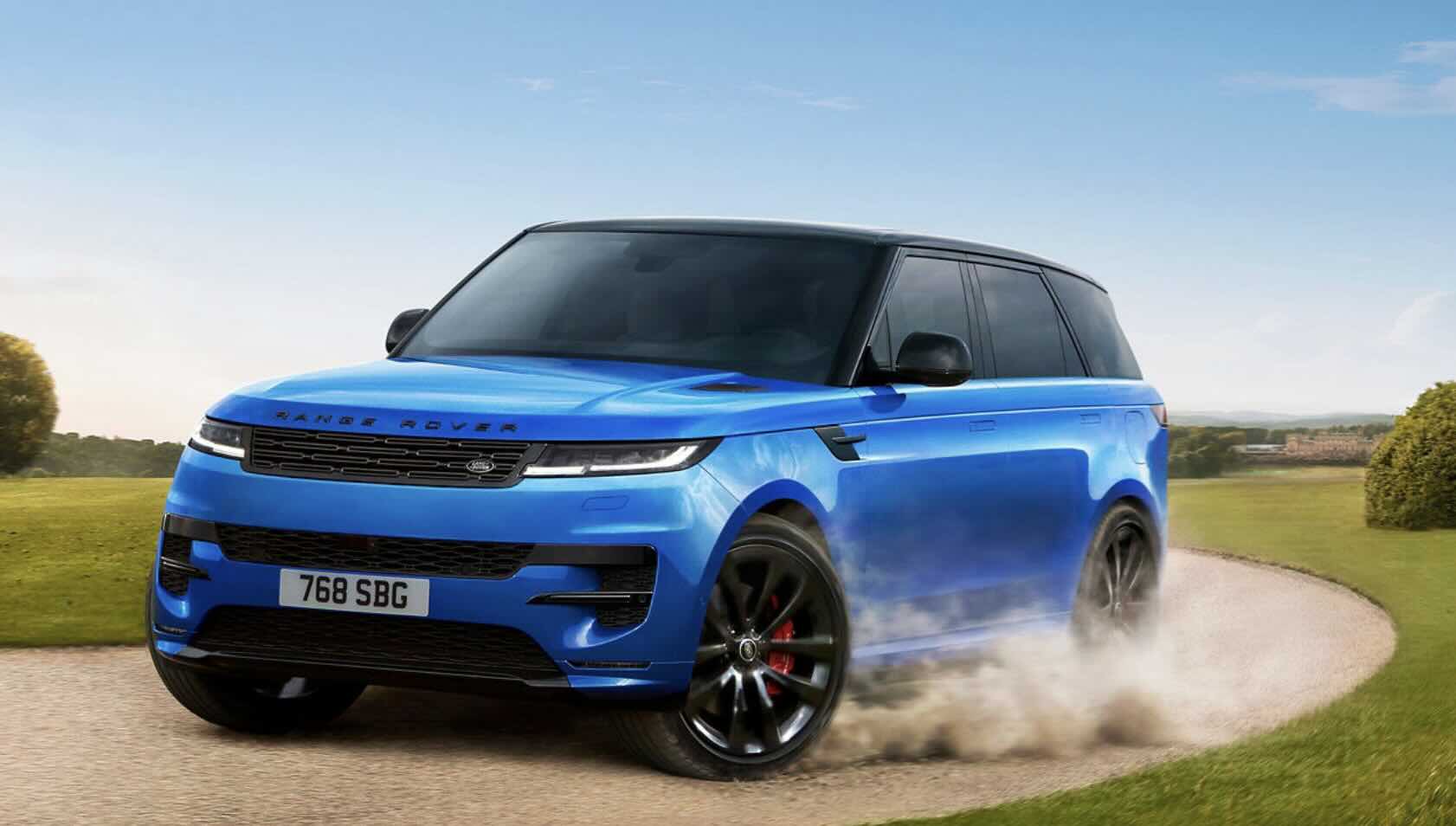

Is 4.2 inches more worth $35,700 more?
That’s one way to look at the difference between a Range Rover Sport – which lists for $77,600 to start – and it’s only slightly bigger brother, the regular Range Rover – which lists for $113,300 to start.
There are of course some other differences. The slightly bigger Range Rover does come standard with an air suspension, three-zone climate control and you can get a third row. But there are also a lot of similarities – including the same standard and optional drivetrains and off-road capabilities.
What It Is
The Range Rover Sport is a mid-sized ultra-luxury SUV that’s very similar to the Range Rover. It differs chiefly in being a few inches shorter – and a lot less expensive.
Prices start at $77,600 for the P360E. The slightly longer Range Rover starts at $113,300 for the P400 SE. The P400 trim does comes standard with a more powerful version of the 3.0 liter six that’s standard in both of these Land Rovers, as well as a few other amenities that aren’t included with the base Sport P360E. However, you could get most of those – and the more powerful versions of the six – in the Range Rover Sport P400 Dynamic SE for $90,800 and pocket the $23k and change difference.
The Sport is also available in plug-in hybrid P460e ($95,100) form, turbocharged V8 P530 Dynamic SE ($103,700), P530 Autobiography ($120,900) which subs out the V8 for the plug-in hybrid and adds a bevy of additional luxury features, such as massaging seats, a Meridian sound 3D sound system and a refrigerated center console; the P550e ($118,700) gets a stronger version of the hybrid powertrain. There are also P635 SV ($152,000), P635 SV Black ($161,600) and P635 SV Carbon ($169,500) versions that all come with a twin-turbo V8 augmented by a mild hybrid system, along with an adjustable “6D Dynamics” air suspension, plus additional luxury features and 23 inch wheels.
What’s New For 2026
Ambient lighting is standard in all trims. There’s also a limited production Twenty Edition with retro stying cues.
What’s Good
The Sport part isn’t just marketing; this luxury off-roader can corner, too.
The standard engine isn’t a four.
Very similar to the Range Rover but for tens of thousands less.
What’s Not So Good
If you need a third row and want a Range Rover, the Sport won’t do.
Highly desirable massaging front seats only available in the six figure-plus trims.
LCD displays no longer look fancy because everything has them now.
Under The Hood
Many luxury brands have cheapened their brands by putting 2.0 liter fours in vehicles that used to come with at least a six. These fours may produce comparable power, but that misses the point. Fours were once almost exclusively found in small, economy cars. When you find them in large, luxury-brand cars, it draws unpleasant associations. Not because there’s anything wrong with fours. Just as there’s nothing wrong with peanut butter.
It’s that peanut butter isn’t prime rib.
The RR Sport does not come with “peanut butter.” In fact, it comes with the same “prime rib” that you get in the slightly longer (much more expensive) Range Rover, which is Land Rover’s flagship vehicle. Both come with essentially the same 3.0 liter turbocharged inline six, augmented by a mild-hybrid system that cycles the engine off when the vehicle isn’t moving (as well as during coasting/deceleration) to improve fuel economy and lower C02 “emissions,” which all vehicle manufacturers are under regulatory pressure to reduce. When the engine isn’t running, it’s not burning any gas at all – and if it’s not burning gas, it’s not creating any gas. The system operates in the background and is hardly noticeable when you’re driving; you may notice at stoplights that the engine has cycled off – and that it cycles back on when you take your foot off the brake, when the light goes green and it’s time to get going. But only if you’re paying close attention.
The version of the 3.0 six that’s standard in the P360 S and SE RR Sport makes 355 horsepower and 369 ft.-lbs. of torque. This is not as stout as the up-rated version of the 3.0 six that’s standard in the Sport’s slightly bigger brother, which isn’t offered in P360 trim. The regular RR’s base trim is the P400, which gets a 395 horsepower and 406 ft.-lbs. version of the engine. This engine is also standard in the RR Sport P400 trim, which as mentioned above is priced much more attractively.
You can move up to a 4.4 liter turbocharged V8 that makes 523 horsepower and 553 ft.-lbs of torque; it offers formidable acceleration – 0-60 in about 4.3 seconds – but the gas mileage (16 city, 23 highway) means you’ll drain the tank pretty quickly. At this price point, the issue with this isn’t the cost of fuel but rather of time. The having to stop for gas more often. Enter the plug-in hybrid option, which pairs the 3.0 six with a more powerful hybrid system that can be externally recharged and which can propel the vehicle about 20 miles entirely on battery power. If you do a fair amount of short-distance driving, you might be able to greatly reduce the number of times you have to stop for gas every month. You’ll get closer to 400 miles in city driving on a tankful, regardless. However, highway mileage plummets to just 415 miles – vs. 547 with the V8. This is due to the additional weight of the larger battery and the electric motors that are used to propel the RR when in “EV” mode
The final option is a 606 horsepower version of the 4.4 liter V8; it drops the 0-60 time down to just under 4 seconds. Interestingly, there is almost no gas mileage (or driving range) penalty for the extra power. Equipped with this engine, the RR Sport rates 16 city, 22 highway – essentially the same mileage (and range) as you’d get with the 523 hp version of the 4.4 V8.
All engines are paired with an eight speed automatic and a full-time 4WD system.
The max tow rating is 7,716 lbs. with all the available drivetrains.
On The Road
“Sport” is a much over-used marketing pitch. It is of a piece with “Limited” – as applied to vehicles they make tens of thousands of. There are “Sport” trims of minivans.
The RR Sport is not like this. It is actually sporty – in the sense that it can take curves with almost sports car gusto, which is spectacular for a high-riding (8.7 inches of standard ground clearance) 4WD luxury SUV. It is wonderfully incongruous – something like a Corvette that’s excellent in the snow. There’s is no discernible body lean and only if you’re really moving will the stability control gently intervene. The italics are to emphasize something important – and laudable. In many other vehicles, if you approach the threshold of grip, the stability system will intervene abruptly, with disconcerting brake force and throttle dial-back. Sure, it keeps you from losing control, but it does that clumsily. The RR does it elegantly. And – again – you have to be almost autocrossing the thing to experience any intervention. You can drive this RR at a Miata-like pace without any of that – and that is something.
It is also something to not hear the inherently tinny, small-engined sounds of a 2.0 liter four. You will never hear that sound in a RR Sport. You will, on the other hand, feel the luxurious smoothness of the in-line six, which makes rich sounds without any unpleasant sensations. It is as smooth as an electric motor but with the feeling that there is something alive under the hood. Batteries have neither feel nor sound. They are in this way a kind of death. Only the living feel and hear.
If you want to feel – and hear – even more – get the V8. If, of course, you have the means (per Ferris Bueller).
Regardless of what’s under the hood, what’s not in your business is “advanced driver assistance technology.” There is remarkably little. Just Lane Centering (LR’s version of Lane Keep Assist) and it can be turned off. There is a collision warning thing that sometimes flashes a . . . warning in the main instrument display if the system thinks you’re cutting it too close (as during a thread-the-needle pass in traffic) but there’s little – if any – interference. The throttle isn’t dialed back – the brakes are not abruptly pumped. It is nice to be the one in charge. It is a kind of luxury these days.
At The Curb
The big difference between the RR Sport and the Range Rover is about 4.2 inches in length – and also that the RR Sport isn’t available in a longer length, as the Range Rover is. Also, there’s only room for five in two rows of seats. If you need a third row and seats for 7-8 then you’ll need the Range Rover rather than the RR Sport. But if you don’t need the extra row (and seats) you can save a considerable amount of money and otherwise get to drive the same basic vehicle.
There are some subtle styling differences, but you’ve got to look closely to see them. You’ve got to look at the standard/optional equipment differences to see the meaningful differences. The chief one being that the RR Sport is available in a relatively lower-cost trim – the P360 – while the Range Rover starts with the P400 (the next-up trim in the RR Sport line). What this means is that the Range Rover comes standard with the air suspension (and adjustable ride height) that’s optional with the Sport. The Range Rover also comes standard with three-zone (rather than just two-zone) climate control, heated rear seats and a rear-wheel steering system. Most of these features are, however, available with the RR Sport; you just have the luxury of deciding whether you want to pay extra for them.
Like just about every other new vehicle, the RR Sport has an entirely LCD display interface. There are only a few vestigial non-tap/swipe controls, including the stubby gear selector on the center console. This does de-clutter the dash but it also draws comparison with all those other vehicles that have basically the same thing. This is the Catch 22 of the LCD display interface. It was – about a decade ago – something that only luxury-brand cars had. Now it is something pretty much all cars have and that takes away, arguably, from the luxury. Some handsome analog-style instruments might restore the more-prestigious look a vehicle such as this ought to have on the inside. LR does try to upscale the LCD interface by making it convex and glass-faced. It is easy to use for a smartphone-emulating interface, with large icons and haptic pushback feedback.
The Rest
Massaging seats are a real luxury in that they are to be found almost exclusively in luxury-brand (or at least, luxury-priced) vehicles. They are available in the RR Sport – but they are limited in their availability, which (arguably) they ought not to be. The RR Sport is, after all, a nearly $80k-to-start machine and at that price point, massaging seats ought to at least be available as an option. Unfortunately, they are restricted to the much-more-expensive trims.
On the other hand, you get an excellent Meridian premium audio system in the base trim and you can get an even-more-excellent one in the higher trims.
One other thing to know is that choosing other than white adds a not small sum ($710-$1,750) to the price. LR is by far not the only vehicle manufacturer dinging people for non-greyscale colors.
The Bottom Line
The RR Sport is truly the thing meant by the phrase, iron fist in a velvet glove. It’s just a more affordable version of that.
. . .
If you like what you’ve found here please consider supporting EPautos.
We depend on you to keep the wheels turning!
Our donate button is here.
If you prefer not to use PayPal, our mailing address is: EPautos 721 Hummingbird Lane SE Copper Hill, VA 24079









‘Is 4.2 inches more worth $35,700 more?’ — eric
Well if you only had three inches to begin with, hell yeah! Oh wait, we’re talking about cars … sorry!
Actually the choice posed between a $77,600 RR Sport and a $113,300 ‘regular’ Range Rover is the venerable old ‘A-B choice’ salesman’s close. A discerning buyer would respond with option C: they’re both absurdly overpriced. The LCD display interface is downright insulting. It’s like buying a $3 million mansion and discovering that its living room floor is surfaced with … linoleum.
Concealed behind the veil of the absurd prices (in terms of near-worthless counterfeit dollars) are serious innovations in engine and suspension engineering. Unfortunately, these are unavailable at any price in the simple, maintainable platforms offered mere decades ago.
We can dream, though, that after the Great Reset, they will be! 🙂
Morning, Jim!
Yep. It’s a shame, too – because other than the cheap-looking screens, this is a very nice rig. The cornering it’s capable of is remarkable; I know my crappy video didn’t quite convey this, but (trust me) you can haul ass in this thing – and not just in a straight line.