


Mitsubishi used to sell a sturdy, body-on-frame SUV called the Pajero – known in the United States as the Montero – and it looks like Mitsu is going to resume selling Pajeros again. Just not in the United States. Probably because the new Pajero is powered by an efficient (and thus, inherently “clean”) diesel engine – and we can’t have that here.
If you look around, you’ll see that diesel engines have been systematically withdrawn from the passenger vehicle marketplace. You can still find a few as high-dollar options in heavy-duty/commercial grade vehicles such as the 2027 Ford F-250 Super Duty I recently reviewed. But there are no diesel-powered SUVs available anymore.
The Cadillac Escalade was one of the last SUVs to even offer it. Other SUVs – such as those made by Toyota and Land Rover – do offer them. Just not here. They are readily available in Europe, Asia, Australia and Central/South America.
The paucity of diesel engines in the U.S. SUV segment is interesting because – under normal circumstances – diesels and SUVs go together like V8s and muscle cars. Diesels make more torque (and sooner in the powerband) than gas engines; this is very useful for towing and also for slogging – as through mud and snow. They are also (usually) made of stronger parts and have fewer service parts (such as spark plugs and ignition systems) that makes them less expensive to maintain and more durable when worked hard – pulling and slogging. They also use less fuel, a big plus in a type of vehicle that usually uses a lot of fuel because of weight, poor aerodynamics and higher rolling resistance (due to aggressive tread/large tires, etc.)
The thing is, “normal circumstances” aren’t in place.
The government has systematically rendered diesels everything that is unappealing about gas engines – and then some – thereby eliminating most of their appeal. Diesel engines used to be simpler engines, which tended to make them more reliable as well as less expensive to own. That changed when the government – its regulatory bureaucracy – began to really turn the screws on diesel engines in terms of allowable exhaust emissions. This was about ten years ago.
It wasn’t merely that they had to be made to emit less of the stuff – such as particulates (soot) and oxides of nitrogen that in large amounts meaningfully foul the air. The regs demanded reductions so slight as to be meaningless in terms of air quality – but which required elaborate (and expensive) modifications to meet. Today’s diesel engines are as complex and even more expensive than gas engines and they are as or even more maintenance intensive. They have additional emissions controls (e.g., particulate traps and Diesel Exhaust Fluid injection systems) that gas-engined vehicles don’t have.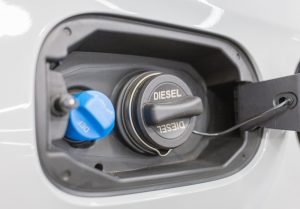
On top of that, diesel fuel is now much more expensive than gasoline. As of early September, unleaded regular costs about $4.15 per gallon. A gallon of diesel is about $5.50 gallon, so about $1.35 more per gallon. To get some sense of this cost disadvantage, the tab to fill the 34 gallon tank of the ’27 Ford F-250 I recently reviewed with gas is about $141 at current prices. The cost to fill the diesel-powered version of this truck’s tank (also 34 gallons) is about $188 – or $47 more. The F-250 also has a seven gallon DEF tank that has to be filled. The DEF costs about $4 per gallon, so about $28. The DEF tank doesn’t have to be filled as often as the fuel tank but (typically) it will need to be filled up about once every other month, depending on how many miles you drive.
You probably see the problem. The much higher cost of diesel fuel pretty much washes out the “savings” a diesel would otherwise deliver by burning less fuel. If you do the math, it costs about 25 percent more to fill up the example F-250 diesel’s tank with . . . diesel. You get about 25 percent better fuel efficiency but it doesn’t save you any money. The sole remaining advantage is the diesel-powered vehicle’s longer legs. The F-250 has a highway driving range of more than 600 miles, comparable to a Prius hybrid – but the F-250 weighs three tons and can pull 22,000 pounds.
There’s another aspect to this that ought to be talked about more but rarely is. It’s interesting, because it bears on the whole “diesels bad because not clean” thing – which is what has served as the pretext for pushing diesel engines off the market in the U.S. via ever-more-difficult-to-comply-with regs. It is that their emissions are inherently lower because they are inherently more efficient. A 25 percent difference in fuel efficiency is not a little bit. It is a lot more than a half-a-percentage (or less) reduction in name-your-emission – which is what we’re talking about with regard to the requirements that have forced diesels off the mass-market over the last decade or so. The VW Diesel Thing is a case in point. The “cheating” involved literally fractional differences – under certain conditions! – of oxides of nitrogen emissions. It was much ado about nothing, in other words.
Have you even seen a cloud of soot emanating from a late-model TDI Jetta or Beetle? It is like looking for the bogeyman. In both cases, it’s about scaring people (and in the case of VW, it was about convincing people that something good is bad so as to get them to be ok with a good thing being taken away from them).
That is why we’re not going to be able to buy the new diesel-powered Pajero – even though it will be propelled by a small (2.4 liter) four cylinder diesel that will probably enable this mid-sized/three-row, body-on-frame, 4WD SUV to get better mileage (and thus produce lower emissions) than a compact-sized, two-row, unibody FWD/AWD crossover with a gas-burning 2.0 liter four.
Choke it down, goyim. It’s all for your own good!
. . .
If you like what you’ve found here please consider supporting EPautos.
We depend on you to keep the wheels turning!
Our donate button is here.
If you prefer not to use PayPal, our mailing address is: EPautos 721 Hummingbird Lane SE Copper Hill, VA 24079