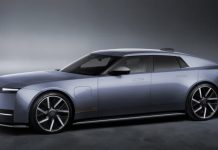


Hyundai has made it easier to choose the hybrid version of its popular Tucson crossover – by pricing the hybrid Tucson just $1,600 higher than the non-hybrid version. That $1,600 is hardly a blip in terms of the difference in your monthly payment over the next six years while the hybrid’s 5-10 MPG fuel economy advantage – and its almost 40 horsepower advantage – are differences you’ll benefit from (and feel) every day you drive the thing.
Plus, the hybrid comes standard with AWD.
It’s extra-cost with the non-hybrid.
What It Is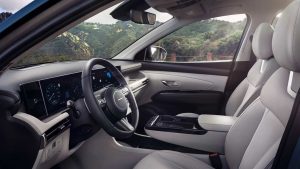
The Tucson is a compact-sized, two-row crossover that competes with others in the same class such as the Honda CR-V and VW Tiguan as well as the Toyota RAV4 and Mazda CX50 and Kia Sportage, among others. It’s available with an entirely gas-engine drivetrain or a hybrid drivetrain and the two are only about $1,600 apart.
Base price for the gas-engine-only Tucson SE with FWD is $29,700; the same basic SE trim with a hybrid gas-electric drivetrain and standard AWD lists for $31,300. Both Tucson SEs come standard with LED headlights, a six-speaker audio system, keyless entry/pushbutton ignition and a 12.3 inch curved LCD touchscreen.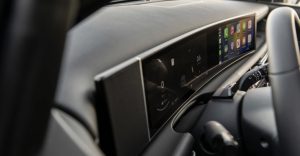
There next up SEL trim ($31,050 for the non-hybrid and $32,750 for the hybrid) adds heated front seats, roof rails and a hands-free power liftgate, among other upgrades.
There are some trims that are only offered with the non-hybrid drivetrain, such as the off-road-themed XRT ($33,725) which uniquely comes with a specific set of 18 inch wheels and exterior body cladding, plus a tow hitch and higher-capacity roof rails. And some trims are exclusive to the hybrid versions, such as the $42,925 Night, which has specific finishes and also comes with everything else that comes with the Limited trim ($39,657 for the non-hybrid and $42,425 with the hybrid drivetrain).
What’s New For 2026
Other than some trim shuffling, the Tucson carries on unchanged.
What’s Good
Hybrid’s horsepower, higher gas mileage and standard AWD advantages hardly cost more than the less fuel-efficient, less powerful and FWD Tucson.
Non-hybrid 2.5 liter engine doesn’t need a turbo to make enough horsepower.
Second row legroom (41.3 inches) is nearly as much as up front (41.4 inches).
What’s Not So Good
Hybrid’s smaller 1.6 liter engine does need a turbo to make its power.
Both trims come standard with eye-movement monitoring system that pesters you if it thinks you’re “drowsy” or “distracted.”
Steering column-mounted stalk for engaging Drive and Reverse can be a little awkward to use.
Under The Hood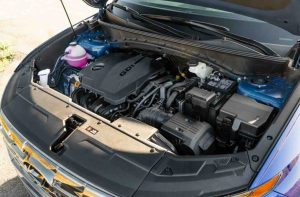
The non-hybrid Tucson comes standard with a 2.5 liter four that doesn’t need a turbo to make 187 horsepower – enough to get this crossover to 60 in about 8.8 seconds. That may seem slow relative to the sub-four-second times touted by many EVs, but “ludicrous” speed isn’t what you need to keep up with traffic.
An eight speed automatic (not a CVT) automatic is the standard transmission and you can go FWD or AWD.
Gas mileage is 25 city, 33 highway, which bests the Mazda CX50 (24 city, 30 highway) and pretty much matches the VW Tiguan (26 city, 34 highway).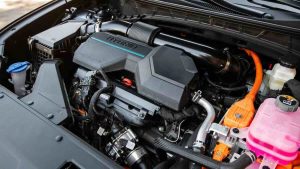
If you’d like better gas mileage – and more power – the hybrid has both. It has a 1.6 liter four that is turbocharged as well as augmented by a mild hybrid system powers accessories electrically when the vehicle isn’t moving as well as during coasting and deceleration. During those light (or no) load moments, the gas engine is automatically shut down, during which moments it uses no gas at all.
That’s why the hybrid tours 38 MPG in both city and highway driving. The hybrid side of the powertrain also boosts the total output to 231 horsepower and this cuts the 0-60 time down to about 7 seconds, which is about as quick as a ’90s era Mustang GT with a V8, by the way.
The hybrid has a six speed automatic (also not a CVT) and comes standard with AWD.
This Hyundai is rated to pull 2,000 lbs.
On the Road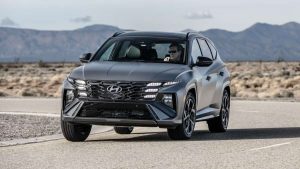
Aside from the savings at the pump you’ll get by going with the hybrid, you’ll also get to go much farther on a tankful
Gas it up and the hybrid Tucson has a driving range of 520 miles. This is city or highway driving. The non-hybrid has a city driving range of only 357 miles, because stop-and-go driving uses more fuel than highway driving in a non-hybrid vehicle – because the engine is always running (even when the vehicle is not moving and also because the gas engine alone has to get the vehicle moving, which uses more fuel than keeping it moving (as on the highway).
The range disparity is less on the highway; the non-hybrid can go 471 miles on a full tank. Still, if you do mixed-use driving, the hybrid is going to take you farther in between fill-ups, saving you time as well as gas money.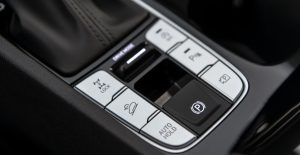
The hybrid is also more fun to drive because it has more giddyap than the non-hybrid. It’s not explosively quick, but it is quick enough to get past slowpokes faster than the non-hybrid. It also feels much stronger because the turbo engine (courtesy of the turbo) makes about 100 ft.-lbs. more torque – 271 vs. 178 – and it is made sooner in the powerband. That translates into less pedal effort to get a response; also, the six speed automatic feels snappier than the eight speed. This is probably because the eight speed spends more time finding the right gear for the moment. There’s less RPM drop, too, between say sixth and fifth ad eighth and fourth.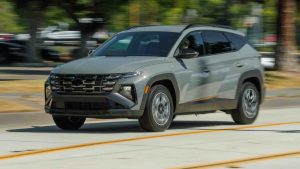
Either way, the Tucson is a pleasant-to-drive vehicle, with an exceptionally comfortable ride that makes bad roads feel good. The only hair in the soup is the unavoidable unpleasantness of the eye-movement monitor that’s already in this car, even though it isn’t a 2027 model year car. 2027 is the year when all new cars must have this “technology.” Or – rather – they must have some “technological” means of (supposedly) identifying when a driver is “drowsy” or “distracted” and the method chosen by every car company to comply with this federal requirement is the eye-movement monitor. You can see it on top of the steering column – and it sees you, too. If it thinks you’re “drowsy” or “distracted” – established by your looking left or right (or down) too long for the system’s liking – it will trigger warnings lights and chimes that are, arguably, themselves distracting. The good news is you can easily stymie the “technology” by using a small piece of tape to blind the eye-movement monitor.
At The Curb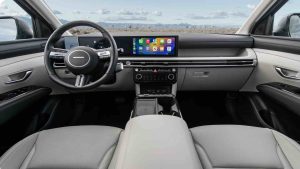
The Tucson is 182.7 inches long, so it has about the same footprint as a small sedan, such as Hyundai’s Elantra (which at 185.4 inches is actually slightly longer) but it is vastly roomier, both for people and cargo. It has 41.4 inches of front seat legroom and almost the same rear seat legroom (41.3 inches) which also almost 4 inches more rear seat legroom than you’d have in a small sedan such as the Elantra, which only has 38 inches of rear seat legroom. Put another way, the Tucson is not a crossover for two adults and maybe two young teenagers in the back. It has legroom for four adults – and three can ride in the rear without torment.
You’ve also got 38.7 cubic feet of cargo space behind the rear seats, which is more than twice the space inside a small sedan like the Elantra’s 14.2 cubic foot trunk. Fold the Tucson’s rear seats forward and the usable space increases to 74.8 cubic feet. It’s this spaciousness for the footprint that’s why crossovers have largely replaced sedans.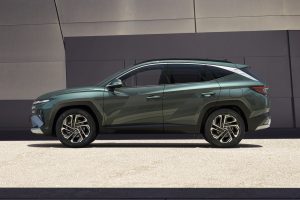
This crossover is also one of the more stylish in the class. The stacked vertical slit LED headlights and side curves add some flair to a body shape constrained by the need to be practical.
Though this is not an expensive vehicle, it comes standard with what until recently you had to buy an expensive vehicle to get, most notably the single sheet 12.3 inch curved rectangular LCD instrument panel/infotainment display. The unit has large icons, which makes it much easier to use, too. You also do not have to use it to adjust the climate controls, which are rotary dials rather than tap/swipe interfaces. There are also volume and tuner knobs for the audio system. It’s a well-designed (because functional rather than cutesy) layout. It also lets you use it while the vehicle is moving if you “agree” to a pop-up that says it’s not the driver who is using it (while driving). 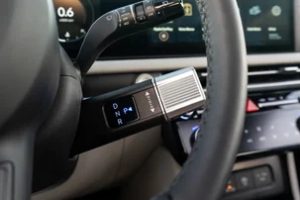
The gear selector for the automatic transmission is a little funky. It’s a stalk that you rotate to engage Drive or Reverse (Park is selected by pushing a button). It’s easy to accidentally mistake it for the adjacent stalk for the windshield wipers. (Don’t worry; the electronics prevent the transmission from being moved into Reverse while you’re driving.) The stalk does free up space on the center console for a smartphone charge pad, though.
Also standard are two USB-C power ports up front and two more in the rear seat area. However, there are no of the old-school small rectangle-style ports, so if you have an older device, you’ll need an adapter.
The Rest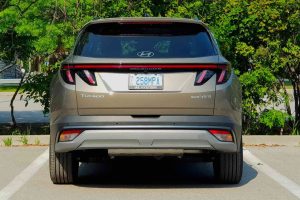
The Tucson is also available with a plug-in hybrid drivetrain that can be driven at normal road speeds for about 32 miles on a fully charged battery; however, it only averages 35 MPG when the engine is running (3 down from the regular hybrid) and the base price of this Tucson – $40,675 – is about $10,000 higher than the base of the standard hybrid, so you’d be spending a lot more to save on gas.
However, if most of your daily driving is 30 miles or less, you could potentially drive without using any gas and maybe (over time) earn back what you saved up front.
Assuming the cost of electricity doesn’t skyrocket along with the cost of gas.
The Bottom Line
As gas prices have risen, paying more for a hybrid that uses less can be a way to save money. Especially when the hybrid only costs a little more than the same thing without the hybrid drivetrain.
. . .
If you like what you’ve found here please consider supporting EPautos.
We depend on you to keep the wheels turning!
Our donate button is here.
If you prefer not to use PayPal, our mailing address is: EPautos 721 Hummingbird Lane SE Copper Hill, VA 24079