



It’s worth devoting a few minutes to compliance technologies – what they are and how they cost us. The why is of course contained in the term itself. They are technologies developed for the sake of compliance; that is, they are technologies developed by engineers to enable vehicle manufacturers to comply with federal regulations.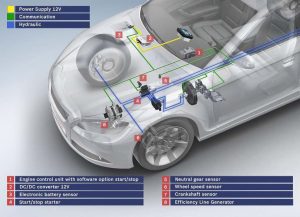
ASS – automatic stop/start – is one such compliance technology. It helps vehicle manufacturers comply with federal “emissions” and “fuel efficiency” regs by shutting the engine off as often as practically feasible. Why would anyone wanrt to do that?
Well, because an engine that isn’t running doesn’t “emit” anything and it also doesn’t burn any gas. Fractional reductions in “emissions” are thus achieved; also fractional increases in miles-per-gallon. This is the only reason why ASS comes standard with almost every new vehicle. (Some people believe Trump “ended” ASS; the problem is there was never an ASS requirement. There was however pressure to comply – and ASS is among the technologies used to comply.)
ASS costs in several ways. One cost – that most people don’t know about until they find out – is an extra battery that acts as an energy storage system for the constant re-starting of the engine during every drive that would otherwise deplete the main battery’s charge and shorten its life. This second battery is buried deep inside the vehicle’s guts, so when it dies you will probably have to pay the dealer to replace it. ASS may also shorten the life of alternator as well as the starter motor, both of which have to work harder in a vehicle equipped with ASS.
Electric-assist power steering is another compliance technology that many people do not recognize as a compliance technology.
It has largely replaced hydraulic-assisted power steering, which involved nothing electronic. But why? Well, because hydraulic-assisted power steering is driven mechanically, by the running engine – which turns a pulley on a power steering pump. This slightly reduces fuel efficiency, much the same as an engine that isn’t running when a car is stopped at a red light does – and that slight reduction in fuel efficiency entails a slight increase in “emissions” – of the dread gas carbon dioxide, produced by the running engine. By using an electric motor to power the steering, the slight parasitical drag of a mechanically powered hydraulic power steering system is eliminated.
Electric-assisted power steering is also handy in that enables the steering to be controlled electronically. This is why Lane Keep Assist is now pretty much standard in every new vehicle. The electrically-assisted steering can be ordered to turn by the computer that controls the electric motor. This assists in making you compliant.
Electric-assisted power steering costs us more – when the time comes for repairs – because there are expensive sensors and electronics involved that are absent with hydraulically assisted power steering systems. With the latter, you may at some point have to replace a power steering pump or hoses; this is simple mechanical work that doesn’t entail any electronic work.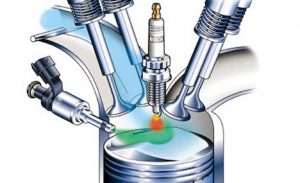
Gas Direct Injection (GDI) is another “hidden” compliance technology that many people don’t know is a compliance technology. GDI is an extremely high pressure (as high as 3,000 psi) fuel injection technology that helps vehicle manufacturers comply with both “emissions” and “fuel efficiency” regs by spraying extremely high pressure (and so, finely misted) fuel directly into the engines cylinders. Slightly less gas is burned – and what is burned, burns just slightly more cleanly. The cost is a much more elaborate fuel-delivery system, with two fuel pumps rather than just one and – as a compensatory measure – a separate port fuel injection circuit that has been added to fix the carbon fouling (of the intake valves) that occurs in GDI engines that don’t have the separate PFI circuit to wash down the backs of the intake valves with gasoline, which acts as a solvent as well as a fuel.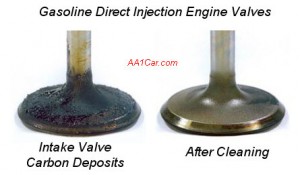
The Continuously Variable Transmission (CVT) is a compliance transmission.
Like other compliance technologies, it offers slight – but important, from a compliance point of view – increases in fuel economy which also helps decrease the “emissions” of that dread gas (CO2) that has as much to do with pollution as reducing the severity of symptoms has to do with vaccination.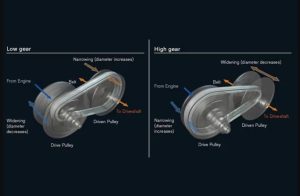
The chief cost of the CVT is replacement costs. CVTs are less durable because of the band or belt they have inside that enables the varying through ranges (as opposed to shifting through gears) and when that band or belt fails (due to stretching/metal fatigue) it usually means the end of the CVT transmission. They are generally not rebuildable. They have to be replaced – and the cost can often be as high as $5,000 to do that.
But you might get 3 or so miles per gallon better gas mileage until that happens.
Plastic engine covers are also a compliance technology – one that is used to mask the sound of another compliance technology.
Engines that have GDI make an unpleasant tick-tick-tick sound, which sounds like an engine that has a mechanical problem, such as sticking valves or clacking lifters. This is obviously undesirable in a brand-new vehicle, so the vehicle manufacturers cover the engine with these plastic – acoustic, sound-deadening – covers. There are also drive-by sound regulations – and these covers help comply with those, too.
The cost pf this “technology” is the blandification of what’s under the hood. All engines look pretty much the same now, irrespective of make or model or type of engine – because you can’t see any of them. And of course one must deal with the black plastic over in order to get at anything on the engine. It’s a small hassle, perhaps.
But we still get to pay for it.
. . .
If you like what you’ve found here please consider supporting EPautos.
We depend on you to keep the wheels turning!
Our donate button is here.
If you prefer not to use PayPal, our mailing address is:
EPautos
721 Hummingbird Lane SE
Copper Hill, VA 24079
PS: Get an EPautos magnet or sticker or coaster in return for a $25 or more one-time donation or a $10 or more monthly recurring donation. (Please be sure to tell us you want a magnet or sticker or coaster – and also, provide an address, so we know where to mail the thing!)
If you’d like a Baaaaa hat or other EPautos gear, see here!










No turbos, no CVT.
Pay the hybrid tax to avoid both of those.
I’d stick with Toyota’s proven hybrid approach.
Stuck with direct injection for the foreseeable future, though.
Regularly, Eric rails about the average new car price having reached $50,000. Turns out, this has a cumulative detrimental effect:
‘In the fourth quarter of 2025, a record high of 27 percent of vehicle trade-ins involved negative equity of at least $10,000, Edmunds reported on Jan. 15. Just more than 17 percent of trade-ins involved loans with $10,000 to $15,000 of negative equity, while 9.2 percent of trade-ins had loan balances exceeding $15,000.
‘The average negative equity of $7,214 that was rolled over into new auto loans in the fourth quarter was the highest amount ever recorded.
‘Ivan Drury at Edmunds said carrying negative equity into a new auto loan can be a difficult cycle to escape. “Rolling debt forward may offer short-term relief, but it often leaves buyers with higher payments, and fewer options the next time they’re in the market.”’
https://www.zerohedge.com/personal-finance/underwater-auto-trade-ins-reach-record-highs-edmunds
Turns out them $80,000 giant pickups have a dark side! Who would’ve thought … 🙁
When you ponder it, inescapable negative equity — that is, usury — is a compliance technology.
Ol’ Maynard Keynes didn’t sugar-coat it: he called it ‘the euthanasia of the bourgeoisie.’
Don’t forget multi displacement systems, or ‘turn off cylinders’ mostly on V8’s.
I loath them, and turn them off as much as practical.
The government always was adept at fixing something that was never broken, while telling us it was for our own good (for the environment, for the children…)
Compliance is the solution to a non-problem that has been imposed.
In other words, compliance compounds problems. Compliance is for cowards, cuckolds, crawling craven conservatives. Compliance kills. Never contemplate compliance.
You win today’s alliteration trophy, hands down.
Fred’s friend fried fresh fritters. 🙂
Hehe thx 🙃
Back in the day I used to dabble in some spoken-word stuff. That one was mine, but I had a (ultra ultra liberal) friend who really really liked to pepper his work with that hard C / K sound, because it was kind of a “power sound.” He at least used to publish in Rattle somewhat regularly. That one’s for him.
As I’ve said for years: “It’s not that I can’t afford to buy a new car, it’s that I can’t afford to own one” or as Lois Alexander the owner of AGCO Automotive in Baton Rouge said about the fuel saving technology in modern cars never saving enough on gas to pay for their repair when they break.
That’s why everything I own and use regularly is old. I can fix it myself and know that it’s not leaking data on me.
Indeed, I’ve become very retro. I’m using these long winter months to get another 76 year old flathead Ford back on the road. I’m thinking this one will stay crusty and beat up, but doing a quickie overhaul and valve job was a couple hours of easy, pleasant work. And a painted up flathead is mechanical poetry, art of the finest kind. By the end I’ll have about 2500 in an overhauled engine, completely new brakes, completely new fuel system, and a set of tires.
Another one is DEF/DPF systems on diesels. Literally $5K in ‘content’ added to every diesel vehicle. I refer to these systems as the ‘Rube Goldberg’ emissions reduction system. Colossal waste.
They are so much worse than a waste, they make a reliable, economical technology expensive and unreliable. Taking a nice, free breathing turbo diesel and clogging up the exhaust system with a ceramic honeycomb makes me want to scream.
Yes. You have to be insane to buy a diesel today. I laugh when I see people wish they could still get diesel in cars here today. Why would you want it when the premium plus the cost of keeping it running far outweighs any fuel savings? Maybe if you live in a state where you can do a delete, but regular people aren’t going to do that. I’ve heard about lots of F series buyers opting for the Godzilla gas motor instead of the Powerstroke because it’s just not worth the headache.