

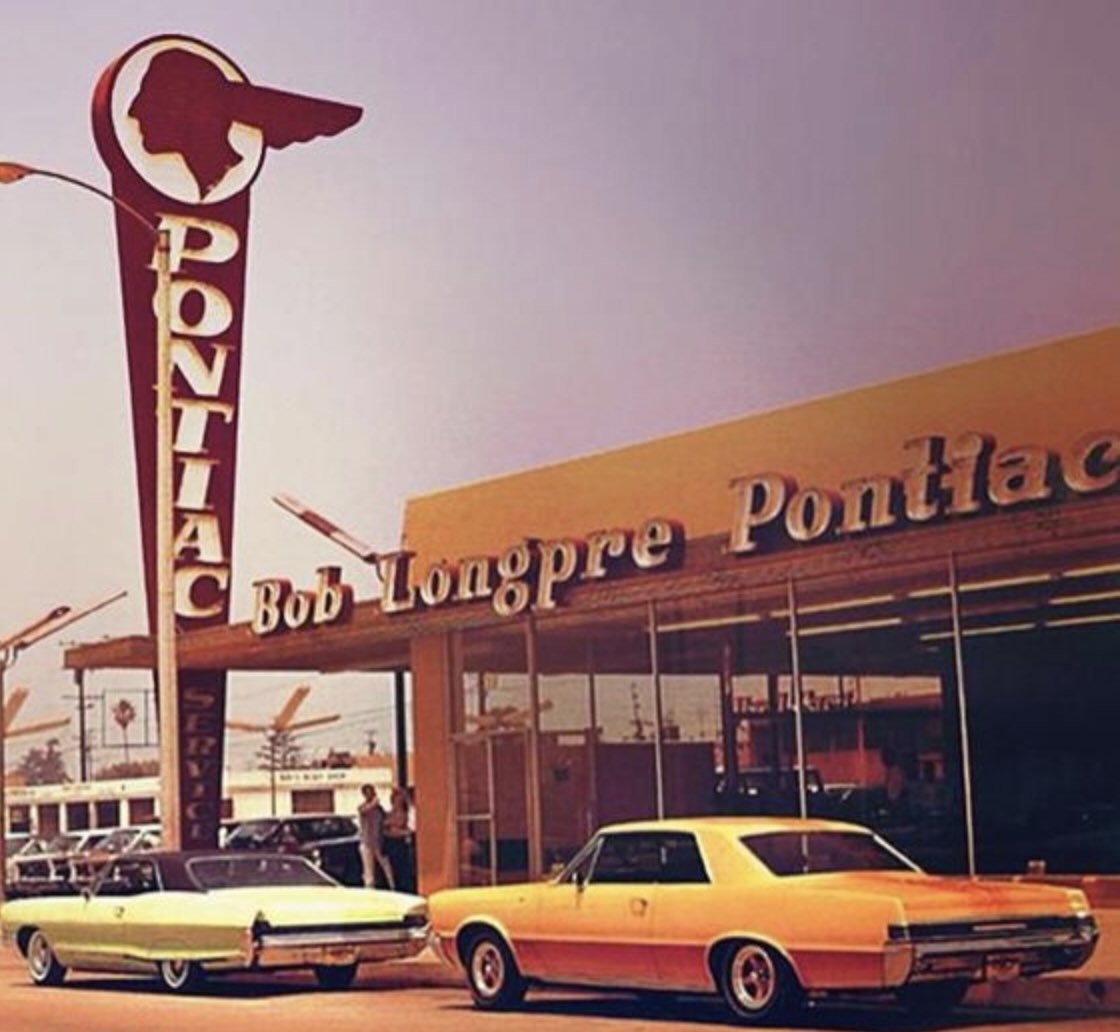

GM used to be a great company that made great cars. Part of this greatness was the way GM once made cars that were literally made to be modified. A good example being my 1976 Pontiac Trans-Am. I am in the middle of transforming it from automatic to manual – and GM designed (and manufactured) my car to be easy to transform.
Though it had an automatic transmission installed at the factory, GM made it much easier for me to install the manual transmission it could have come with from the factory by drilling the subframe to accommodate a manual car’s hardware mounting points, such as the Z bar bracket and the bracket for the clutch return spring. All I had to do was tap the existing holes, so as to be able to screw in the bolts that hold the brackets – which align exactly right, which is no small thing. If GM had not drilled the holes in the front subframe. I’d have had to very carefully establish the correct location and then drill (and tap) the necessary holes. This would have been a much more delicate operation; if I didn’t get it just right, the brackets would be misaligned and the geometry of the clutch linkage all screwed up.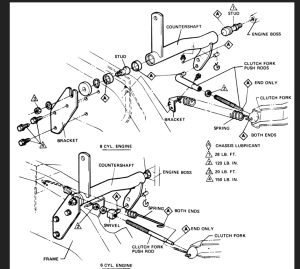
But it’ll be as exactly correct as if the car left the factory with a manual.
Then there’s the 455 V8 engine in my Trans-Am. It originally came from another Pontiac and was not paired with an automatic. It bolted right up because it was designed to bolt right up. It was also drilled – and tapped – to accept a very crucial component, the stud that screws into the block that supports the Z bar. All I had to was screw in the part. The Z bar was thus easily and correctly installed.
The 455’s crank had also been factory drilled to accept a crucial part for this conversion – the pilot bearing. All I had to do was tap the new pilot bearing in. If GM hadn’t anticipated that someone might want to convert their vehicle from automatic to manual and only made manual cranks for factory-manual-equipped cars, I’d have had to take the engine apart to take the crank out, in order to take it to a machine shop to have to altered to be able to accept the necessary part.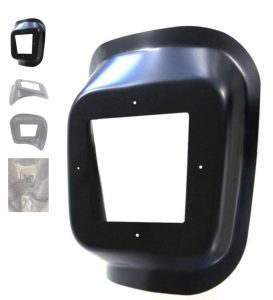
The rear of the 455 – its bellhousing – accepts either the automatic or the manual – without any modification or adapter plate. Everything fits as if it were factory.
It gets better still.
Installing the all-important third pedal – the clutch pedal – is also made easy because GM left a guide for where the hole for the rod that goes in and out (operating the clutch) when you push down on the clutch pedal is supposed to go. There’s a black plastic trim plate just above the carpet with a slot – and that’s where you drill. The rest is as easy as pushing the rod through the hole and securing the other end to the Z bar with a snap clip.
There’s still a hole – for the shifter lever – that must be cut through the driveshaft tunnel but that is also just grunt work because it’s obvious where the hole needs to go and once you’ve cut it, there’s a factory-style hump that goes on top, to which the boot/trim bucket bolts. It’s not rocket science.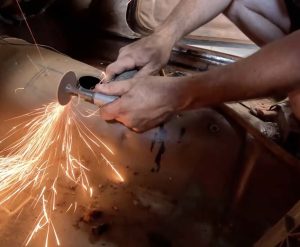
It would be much harder to do a similar conversion of a current GM vehicle because they are built to be exactly the way they left the assembly line and no other way. If the car originally came with an automatic, it has a computer that was designed to run with an automatic that will likely not work if you replace the automatic with a manual. You will probably need to change the computer – and maybe even the engine, since it was probably made with sensors designed to work with an automatic. In other words, if you wanted to convert a factory automatic car to a manual car, in all probability, it would be necessary to replace the entire drivetrain and the computer.
That gets into money.
Not that my conversion has been cheap. But it has been affordable. I was able to defray much of the cost – of the new clutch and pressure plate and bellhousing as well as most of the incidental hardware – by selling the automatic transmission to a guy who plans to install it in his Corvette.
Mark that. The transmission that was in my ’76 Pontiac – which was originally installed in an ’80s Buick – is going to be bolted in an earlier ’70s Corvette, behind a Chevy engine.
GM was great once. I wish it would be again.
. . .
If you like what you’ve found here please consider supporting EPautos.
We depend on you to keep the wheels turning!
Our donate button is here.
If you prefer not to use PayPal, our mailing address is:
EPautos
721 Hummingbird Lane SE
Copper Hill, VA 24079
PS: Get an EPautos magnet or sticker or coaster in return for a $25 or more one-time donation or a $10 or more monthly recurring donation. (Please be sure to tell us you want a magnet or sticker or coaster – and also, provide an address, so we know where to mail the thing!)
If you’d like a Baaaaa hat or other EPautos gear, see here!









Thank every single non-gear head person who got in to GM and the industry as a whole who ruined it completely (via the gov handlers). These companies used to be great and were run largely by automotive engineers or people who fully understood. And yes, rereading Atlas Shrugged will sour your world view. 🌎
The MBAs running things usually ruin them. At this point most good things that were started by enthusiasts because it was interesting to them are nothing more than businesses.
On the other hand Fender was started by a guy who couldn’t play a note of music but Leo loved what he did tinkering with electronics and listened to the musicians who told him what they wanted. As a business it was always teetering on the verge of failure but it was his passion. He sold it to CBS when it wasn’t anymore and they nearly ended it up running it so poorly.
Is it possible that the holes were tapped to enable easy installation of either tranny? Either way, it also made for an easy conversion later; NFW could you even think of doing that on a modern car!
It’s sad that your T/A is now a 50 year old antique. And my 70-80 year old stuff is not much different. We saw a maturing of automotive technology between 1920 and 1950, after that it was just evolution.
It is amazing how often things from the same family used to interchange across decades, you could swap a Ford 289 or 302 into Ford frame from the 30s or 40s and most things fall into place. Or a 454 Chevy into an Olds, etc.
Now you can’t buy a junkyard engine for an “old” car without worrying if all the sensors and bosses are for the exact year and model.
It’s not just GM anymore, it’s all of them. Granted they were probably the first to lock down all mod’ing. They’ve all gone down the proprietary e-component path now. Want to add an accessory or option that didn’t come with the car. Nope.
For a short time, when these e-control things were coming out, you could get the dealer to install it and unluck it in the computer. Not anymore.
There’s a decent aftermarket servicing the retro-mod scene, but ya gotta do the whole car, and not cheap.
I fight proprietary systems all the time. So I have a question:
If you could buy a non-proprietary car, but it cost 20-30% more, but you could theoretically fix it forever, would you? Would the masses?
20-30% above “prohibitively expensive for almost everyone” is a big ask.
If I could afford it, then yes I would definitely buy it.
Potentially a value proposition would be lower parts/repair costs over time. Probably also lower insurance costs — easier & less time consuming, therefore cheaper, repairs — the caveat here is it can’t result in more injuries. (Note that I did not say deaths). (Yes it’s about to get morbid up in here). A major driver of car insurance prices is healthcare costs, which are incurred whenever someone is injured. Dead people don’t need healthcare…
Publius, it’s all baked in the cake. $4-6K headlights! They know they’re going to make money down the road. So they sell it cheaper now.
It would not be hard to take a modern compliant body/frame and add a mostly non-computerized engine and off-the-shelf e-components. But, whoever would make that car, has to make money now, not later, or they die.
Most likely, instead of GM anticipating that someone might want to convert their vehicle from automatic to manual, it incorporated the features Eric mentions for the convenience of its assemblers.
Likewise, the improbable odyssey of a Buick transmission taking up temporary residence in Eric’s Trans-Am before finding its forever home in a Corvette, harks back to Henry Ford and even Eli Whitney, who demonstrated interchangeable parts for muskets to Clowngress in 1801 — a scene comparable to lecturing a pack of stray dogs on quantum physics.
Cars were once designed to be maintainable by non-specialists, because buyers demanded it. Now buyers have been conditioned by their unmaintainable cell phones to accept cell phones on wheels, with cell phone-style user interfaces, that are unmaintainable black boxes.
Basic engineering principles, such as avoiding catastrophic single points of failure (i.e., a software bug or a chip that can shut down multiple functions) have gone by the wayside. GM is going the opposite direction: ‘the new computing platform will add 10 times more over-the-air software update capacity, 1,000 times more bandwidth and 35 times more AI performance to support autonomous driving and other advanced features. The software-based system will continue to evolve via over-the-air updates.’
https://www.wardsauto.com/news/gm-ai-plans-debut-eyes-off-driving-super-cruise-cadillac-esclade-iq/803665/
NO. Unacceptable. Nobody’s gonna ‘over-the-air update’ me or my vehicles.
We can all blame Elon Musk
He stepped across the line
With lots of watts, he took control
The first one of its kind
— ZZ Top, Heard It on the X
All cars a shit today low build quality high price terrible design basically all the same car with different logos tiny lawn mower engines either a cvt dual clutch or some million gear POS I miss the beautiful car that have so much design and style love the days of v8 and crome you could tell the people who designed and built them really cared about what they did not just bean counters.
Ha! You had me at: “All cars [are?] shit today”.
So true.
Eric’s article made me think of a 1968 GMC C-10 pickup with a manual (granny gear, too) I had back in The Day.
It was a bomb-proof tank compared to the fragile crap of today.
‘We’re Told This Is Progress, But It’s Actually Anti-Progress’ – October 16, 2024
“We need a new definition of Progress, and a reset of the mythology guiding our descent into “Anti-Progress”.
There’s a curious disconnect between our glorification of Technological Progress and our real-world experience.” …
https://www.oftwominds.com/blogoct24/anti-progress10-24.html
“… it has a computer that was designed to run with an automatic that will likely not work if you replace the automatic with a manual. You will probably need to change the computer – and maybe even the engine…’
It’s even worse than that, the dash clusters and modules like the airbag module are all coded to the ECM and the original VIN, so you’d have to change those, too.
This goes back decades. If your car uses a chip key then -something- is encoded to be unique. It might not be all the computers on board but the critical ones that control the ignition and engine will only run if they are VIN matched. There’s an aftermarket of varying legitimacy of people who will do the VIN match on a junkyard ECU. In some cases the dealer can’t do it. I ran into this with a VW. If the owner doesn’t have the code (known as the SKC) for a car from 1999 to about 2006 then you may be out of luck trying to repair the inevitable (at this point) engine immobilizer failure unless you’re a computer hacker.
Part of what allowed GM to be great was that while cars got reskinned every 3 to 5 years the underlying mechanical parts might have around for potentially decades and were debugged by the time you bought a new car. Today due to rapidly changing regulations and cost cutting done in hope of making a profit your new car is probably all new and may well have issues.
To give you an idea of how a company can redesign a product and destroy its usability just consider the difference between the Milwaukee 2967-20 impact wrenches, the ones with A in their serial numbers worked while the ones with a B in their serial numbers were junk and yes my B series impact was replaced under warranty.
In other words I have serious doubts that unless GovCo is reigned in that GM will ever be great again. As proof of that just look what’s happening with Toyota engines. Rushed into production to meet GovCo requirements then towed in after they break. Progress!
One thing to note Eric is that parts back in those days were easily exchangeable because leaving the factory, the frames and engines were designed to be that way. It reduced production costs by making items that worked in a wide range of products, and even reduced the cost of replacement parts. You have often noted that the EV industry has tried to adopt this model my making a “roller skate” chassis that they can drop a body on and badge to reduce costs. We have drifted far come this very efficient model for traditional cars and need to return to it.
GM’s (government morons) decline has been, like a great many things people are noticing lately, “slowly at first, and then all at once”.
I think it began in the late 70’s, when the accountants and government regulations took precedent away from designing and engineering vehicles that people felt moved to purchase because of a visceral appeal. And when the real GM corporation closed in 2009 and reopened as the GM company, we’ll, folks, the fat lady sang, and Elvis left the building, fer sure.
We’ll never see anything like the old big three again, from before 1980, unfortunately. And I hold our (((government))) requirements and regulations firmly at fault, along with all the boot-lickers in the auto management ranks.
“He’s dead, Jim”, as “Bones” McCoy would say, to paraphrase another summary of modern American Auto manufacturing, tragically.
Prepare accordingly, as there’s a boom coming in old car resto-mods for the independent minded folks still here.
Good luck, y’all, we’re going to need it.
GM back then had dealers like Yenko Chevrolet in Pennsylvania too! They were all car guys through and through. Not these miserable dealer “groups” that exist now.
michael67 has it right. Everything stated in the article is just part of manufacturing at the lowest cost possible for all the possible options that exist. They do the same thing today, design to produce at the lowest possible cost.
And a plain jane car manufactured today has far higher power output while getting better mileage than the old cars. They can routinely go 300K miles without problems. Better materials and better engineering without question. Most of the problems are due to government interference and unrealistic demands.
Sounds like my 1968 Olds Delta 88: I added a remote mirror, dual exhaust, 4-barrel carburetor, and front disc brakes—all factory options. All the necessary holes and fittings were easily accessible and all the parts were easy to find.
Which brings me to this: A lot of options GM (and Ford and Chrysler and AMC Jeep) offered weren’t installed from the factory, but could be ordered at and installed by the dealer, even for things that would otherwise be installed at the factory. If you knew the right people and knew what to ask for, you could basically customize your ride by checking a few boxes on the dealer’s order form. And this was common practice, as I’ve seen quite a few dealers’ “pink slips” denoting even engine and transmission swaps done by dealers.
GM became grift motors after 08 bailout.
I notice a local small billionaire ghetto with its own public utility neon nightmare driving around in a massive fleet of white grift motors trucks. Its lords on high are a major auto distributor network.
Grift Motors
G.M. still does this! With a monthly subscription. You can have remote start, Navigation,Voice Assistant, Wi-Fi & streaming, Super Cruise!!! your car is built to accommodate all those options. Now don’t you fell silly. Gm never changed. Ooo except that they cant build an engine thing.
You probably know this, but GM did all that to save money – design something as common as possible to keep supplies simpler. Otherwise, they’d have a stack of automatic frames, tubs, etc… and a stack of manual frames, tubs, etc…, making it a pain for the factory and the dealer when needing parts. Land Rover did something similar with their old 2.25L engine – mostly the same for both gas and diesel. This made the gas version nearly indestructible, given the block and head were made for diesel.
I’d be willing to be that there’s a lot of commonality on newer cars too, it’s just that it’s buried as the car is assembled – wiring, computer modules, etc… Plus the programming, which is likely a one-time factory thing.
Toyota did this. My previous truck the engine was a 22R gasoline with a 5 speed stick. We didn’t get them in the USA but the diesel engine was a 2L (not 2 liter, 2L designation) and it mounted to the exact same points on the frame and would mate to the same transmission with matching bellhousing. It was all erector sets because they made the same Hilux truck in 3 different plants in 3 different countries for tons of markets in dozens of different combinations of wheelbase and body style (single cab, double cab 4 door, long cab 2 door, pickup, tray, etc). That was back when the customer was king and manufacturers were about meeting demand in the most efficient way.