

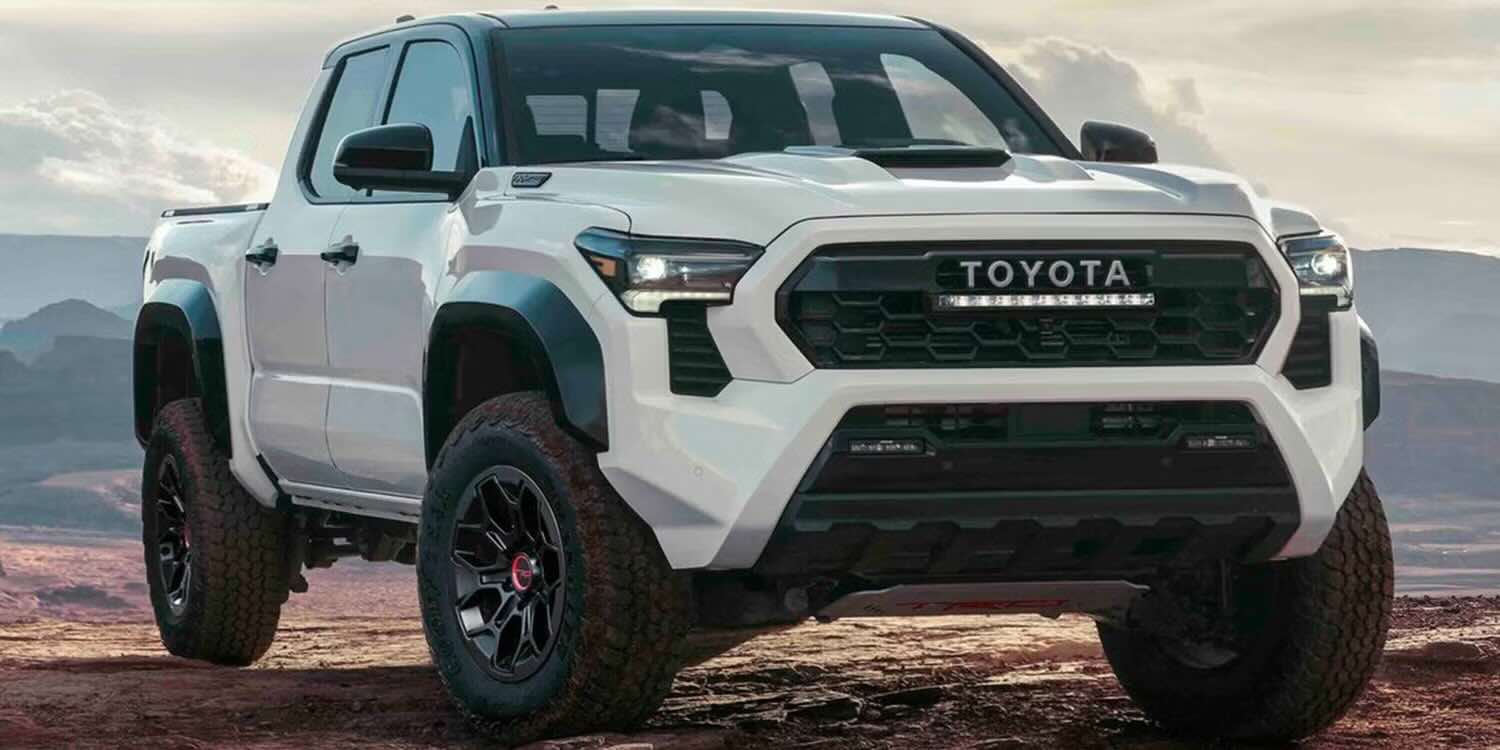

There are five mid-sized pickups available right now but there’s only one that even offers a manual transmission – something that was once usually standard in pick-ups. The Ford Ranger, the Nissan Frontier, the Chevy Colorado and its GMC sibling the Canyon are all automatic-only.
If you still like to row your own, there’s only one choice.
The Toyota Tacoma.
What It Is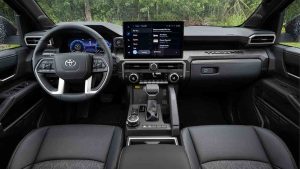
The Tacoma is a mid-sized truck available in two-door extended cab (called XtraCab) and four-door Double Cab configurations, with the two-door/extended cab version having a six foot bed while the four-door Double Cab comes with either a shorter, five-foot bed or (optionally) the longer six foot bed. All trims come with a 2.4 liter four cylinder engine in three different output levels (one of them hybrid-augmented).
The Tacoma is also the only currently available mid-size pick-up that’s still available with a manual transmission.
Prices start at $32,445 for the SR extended cab with 2WD; 4WD can be added as a stand-alone option. So equipped, the MSRP goes up to $35,645. The SR comes standard with the 228 horsepower version of the 2.4 liter four, an eight speed automatic, 17 inch wheels and LED headlights.
The SR5 gets a stronger (278 hp) version of the 2.4 liter four, along with an upgraded rear suspension (coil springs instead of the leaf springs that come with the SR) as well as a bed rail/moveable cleat tie-down system for the bed. The 2WD version lists for $36,535; with 4WD the MSRP increases to $39,735.
You can also get the XtraCab/six foot bed version of the Taco in TRD PreRunner form ($39,035). This one comes standard with 4WD and the more powerful version of the 2.4 liter engine, along with a lifted suspension, locking rear differential, skid plates, trim-specific 17 inch wheels, a digital main instrument cluster and leather trim.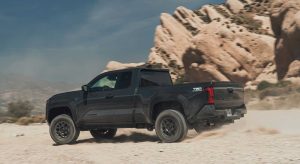
The Double Cab is available in more trims – as well as the base SR and SR5 trims, with prices for those beginning at $34,105 for the former and $37,605 for the latter. In addition, there is a TRD Sport ($40,315) that’s eligible for the six speed manual transmission – paired with the 278 horsepower engine. It starts at $40,315 with 2WD (with the automatic) and the five foot bed or $40,815 with the six foot bed. If you want the manual six speed, it lists for $42,715 and you get the shorter, five-foot bed. The six speed isn’t available with the six foot bed – or with 2WD.
There are also TRD OffRoad ($40,315), Limited ($53,470), TrailRunner ($63,659) and TRD Pro ($64,650) versions of the Double Cab.
What’s New For 2026
The TrailHunter trim is new. It comes standard with the strongest (hybrid augmented) version of the 2.4 liter engine (326 horsepower) and additional off-road upgrades, including Old Man Emu shocks. rock rails and additional underbody protection, 18 inch bronze anodized wheels and 33 inch knobby tires, plus an ARB bed utility bar with removable panels.
What’s Good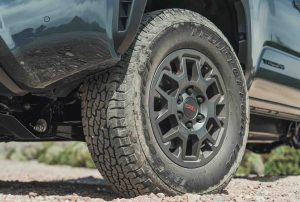
Standard engine is much stronger than the previously standard engine.
You can still get a manual transmission.
You can still get a two-door (and a six foot bed).
What’s Not So Good
You can’t get the manual in the less expensive (2WD) trims or with a six foot bed.
Standard price has gone up by about $3k vs. the previous generation Taco.
No more V6 engine.
Under The Hood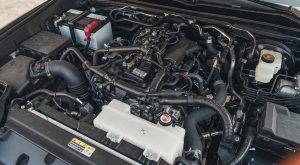
The previous generation Tacoma was available with both a four cylinder engine and a V6 engine and neither of these engines were turbocharged (or hybrid-augmented). The formerly standard 2.7 liter four wasn’t very powerful – it made just 159 horsepower – but it was a durable workhorse and because it didn’t have a turbo, a Tacoma equipped with one cost less to buy and also less to keep as the years and miles rolled by – because there was no turbo or intercooler to go bad and need replacing. Also, the engine was under less pressure – literally – and that usually correlates with longer life. The non-turbocharged four cylinder engines that used to be standard in the Tacoma and all of is rivals were known to be almost unkillable, which made up for their being on the underpowered side.
The Taco’s previously standard 3.5 liter V6 was certainly adequately powerful (278 hp) and it was revered for being at least as durable as the 2.7 liter four.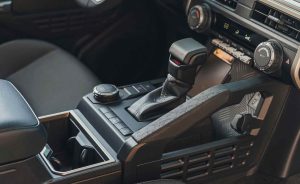
Well, they’re both gone now – in favor of a smaller (but much stronger) 2.4 liter four that is turbocharged and also (in its strongest variant) hybrid-augmented).
The standard version of the 2.4 turbo’d four makes 228 horsepower – 69 more than the old 2.7 liter four – and also a lot more torque (243 ft.-lbs. at 1,600 RPM vs. 180 at 3,600). Gas mileage is slightly better than it was, in spite of the power uptick: 20 city, 26 highway vs, 20 city, 23 highway previously. However, the Taco’s maximum tow rating with this engine is still just 3,500 lbs., the same as it was for the previous generation with the much-less-stout 2.7 liter four. That’s odd, because the new four probably can competently pull more than just 3,500 lbs. (while the old 2.7 liter four was definitely close to the limits of what it could pull with a 3,500 lb. trailer hitched to the rear bumper).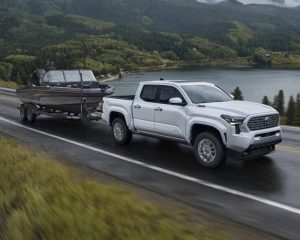
More power – and towing capacity – is available if you opt for the 278 horsepower version of the 2.4 liter four. Note that this engine’s rated output exactly matches that of the old 3.5 liter V6. So also the max-rated towing capacity (6,400 lbs.) Fuel economy is also about the same: 20 city, 24 highway vs. 19 city, 24 highway with the old V6. It’s pretty obvious Toyota tailored the up-rated 2.4 liter four to mirror the output and capabilities of the old 3.5 liter V6, so that Taco buyers who want the output/capabilities of a V6 will be ok with a turbo’d four.
Another change is what’s bolted to the four. Both iterations comes standard with an eight speed automatic now; previously a six speed automatic was used. You can still get a a six speed manual, but only in higher-trim Double Cabs with 4WD. Still, the fact that you can get it gives the Taco a unique appeal over its automatic-only Ford Ranger, Chevy Colorado, GMC Canyon and Nissan Frontier rivals. By the way, the only of these four competitors that still even offers a V6 is the Frontier, which actually comes standard with one.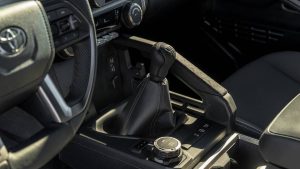
There’s one more option to consider – if you buy a Double Cab Taco. These are available with hybrid-augmented drivetrain that Toyota calls i-Force Max. It pairs the turbo’d 2.4 liter engine with a battery pack and an electric motor to provide an increase in on-demand power to 326 horsepower (and 465 ft.-lbs. of torque) while also reducing fuel consumption by cycling the gas engine off as often as possible as when the Taco’s not moving or during deceleration/coasting. When the engine is off, the battery powers accessories. The hybrid’s mileage – 22 city, 24 highway – is slightly better than that of a Taco with the non-hybrid, 278 hp iteration of the 2.4 liter four but because of the additional weight, the max tow rating goes down a bit to 6,000 lbs. Also, the hybrid drivetrain is only available with 4WD and with the automatic transmission.
On The Road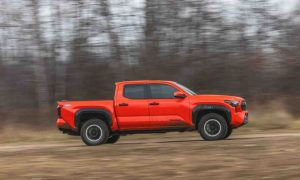
When the Taco was a small (compact-sized) and inexpensive truck, it drove like one. It wasn’t bad. But it was bouncy and light-feeling. You sat close to whoever was riding shotgun, too. That’s what you got for the money. The current Taco has the beefy, solid feel of a full-size truck (by early 2000s standards) it almost is full-sized in every way except width – and even that’s close.
The thing is, early 2000s full-size trucks were a nice size – and so is the current Taco. It’s big enough to not feel small but not so big it feels huge – as current full-size trucks are. The Taco can be driven comfortably in between the cement abutments at a bank drive-through and you’re not so high up off the ground that you can’t reach down to get your hands on the tube that goes through the vacuum chute to the teller inside. It doesn’t hog up so much space to either side of the cars parked beside you at the supermarket that you can’t open the doors all the way to get out/in (at least, not without denting the sides of the car parked next to you.
In a word, it is manageable.
This is the appeal of the thing. It’s a real truck – not a toy truck. But it’s not a monster truck, either.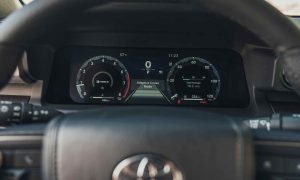
Or a slow truck. Even with the standard (228 hp) version of the 2.4 liter turbo four, the current Taco can get to 60 in about 8 seconds. The previous generation Taco with the 2.7 liter four (159 hp) needed about 11 seconds. That’s not just a big difference; it’s a big real-world difference. (The difference between a given vehicle that can get to 60 in say 5.8 seconds vs. one that takes 5 seconds is about half a car length’s difference at the end of a drag race; a three second difference is a much bigger difference).
With the stronger (278 hp) version of the 2.4 liter four, the 0-60 time goes down to about 7 seconds. The hybrid makes the run in about the same time (the extra power is offset by the extra weight).
It’s the manual that makes all the difference, though – since the Taco is the last truck in the segment that offers this option. Quantifying this is not as easy as noting 0-60 times. In fact, the 0-60 times quoted for the manual-equipped truck are a few tenths slower than with the eight speed automatic, which shifts smartly, without ever missing a shift 0 which happens sometimes when you shift yourself. That said, shifting for yourself is just fun – and that kind of fun is only available in the Taco.
SR5 and higher trims have a coil spring rear suspension that noticeably smooths out the ride on rough roads, but even with the the leaf spring set-up in the SR the ride control is vastly better than it was when the Taco was a compact-sized truck.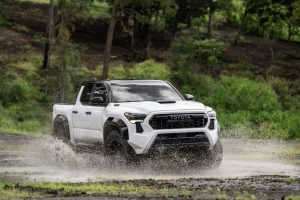
At The Curb
It’s not an exaggeration to compare the current Taco to the full-size trucks of the early 2000s. The two-door SR5 with the short (five foot) bed is 213 inches long and the Double Cab with the six foot bed is 226.2 inches long. For reference, back in 2001, a full-size (half-ton) Tundra SR5 was 217.5 inches long. It was also 70.7 inches tall and 75.2 inches wide. The 2026 “mid-sized” Taco stands 73.8 inches tall and is 76.9 inches wide. The lifted TRD PRO versions are taller. So tall, in fact, that I was only just barely able to raise the hood and get the prop rod that holds it up in place – and I’m a 6ft 3 dude with long arms.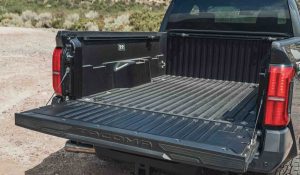
Still, it’s manageable. A step ladder or old bucket to stand on is not needed to get at whatever you put in the bed and you don’t need running boards to climb up into the cab. Getting in and out is about as easy as getting in or out of a current crossover. Once inside, there’s room enough that you don’t feel crowded. Again, it feels very much like being in a full-size truck from the early 2000s. You’re up high, but not monster truck high – and you don’t have to worry about smacking mirrors with another truck coming down the same road you’re on, in the opposite direction.
Outside, it looks rugged – not steroidal. If we were talking gym talk, the Taco would be the guy who’s naturally built. Current full-size trucks look juiced and angry. Cartoonishly so. Their huge blunt faces and hyper-macho stances give off a copdpiece vibe. The Taco’s for the person who doesn’t want that look or need the over-the-topness of current full-size trucks.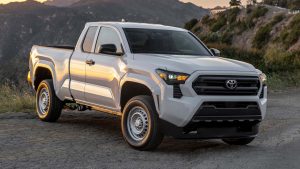
The Taco’s bed is made of a lightweight composite material that doesn’t dent. But it does crack.
If you spring for the available JBL premium audio system, you’ll get a neat feature: The center speaker that’s mounted on top of the dashboard can be removed (just push the button) and used as a portable Bluetooth speaker.
The Rest
The one thing the new Taco hasn’t got is an affordable price tag. Even the base SR with just 4WD is already south of $35k; the tested Double Cab/4WD model with the TRD off-road upgrades was south of $55k. Back in 2001, a full-size Tundra listed for $20,895. Yes, really. And – yes – inflation. But still. There is no denying that trucks – like everything else – have gotten a lot more expensive. Yes, they’re a lot nicer. But what does that matter if you can’t afford them?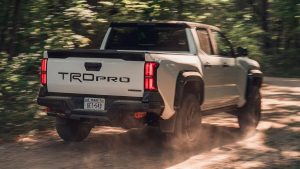
It’d be interesting to see how well a basic, work truck iteration of the current Taco priced around $25k would sell. Give it a non-turbocharged engine that’s powerful enough, along with a six speed manual and maybe AC and that’s it. Skip the power windows and locks and the extra-cost electronica. Lots of people might like that a lot. Without doubt, lots of people could afford that a lot more than a starting close to $33k truck.
The Bottom Line
The new Taco is a very different truck than previous Tacos, which has its good and its bad points. Mostly, it comes down to whether you can afford all the good points.
. . .
If you like what you’ve found here please consider supporting EPautos.
We depend on you to keep the wheels turning!
Our donate button is here.
If you prefer not to use PayPal, our mailing address is:
EPautos
721 Hummingbird Lane SE
Copper Hill, VA 24079
PS: Get an EPautos magnet or sticker or coaster in return for a $25 or more one-time donation or a $10 or more monthly recurring donation. (Please be sure to tell us you want a magnet or sticker or coaster – and also, provide an address, so we know where to mail the thing!)
If you’d like a Baaaaa hat or other EPautos gear, see here!









Also, the engine was under less pressure – literally – and that usually correlates with longer life.
I’m wondering if there’s been any data tracking engine repairs over the last few years, comparing the naturally aspirated 6 cylinder variants with turbo 4s, now that the majority of vehicles are running turbos. Seems like some data would begin to emerge, pro or con, showing trends.
I know that my TDI’s Achille’s heel wasn’t the block, it was the timing belt. Most reports I read about were either the timing belt failing or the turbo shredding itself after being starved of oil, which then sent shards of turbine metal into the intake. The block, piston rings and seals or gaskets were never called out as a problem.
Not trying to be a clover, I’m just wondering if it is a problem or not, considering if I need to buy a new car anytime soon it’s likely to be a turbocharged 4.
Rented one recently, had it for a week. It is a you describe it. The four cylinder did the job without complaint. However, when you need to gun it the motor sounds like it’s under a huge amount of stress. It was a rental, so….assume it was treated like crap. Although this one only had 3K miles on it. The mandatory safety garbage was slightly less bad than my Outback, but no easy off switch that I found.
Decided I would not argue, put on the saaaaaftey belt, and used my turn signals every time. Still had that ‘pay attention shimmy’ whenever the speed limit was exceeded. The creepy eye monitoring thing is beatable by holding the wheel by your fist at 12 oClock, and sitting down slightly in the seat. I would consider owning one if they were about 20 thousand dollars less in price. At least you can turn radio stations by hand without the car having a hissy fit.
Down side, full connectivity. Had no cell phone or E-gadgets with me, yet when I turned the truck back in they jammed me up for about 100 bucks in tolls. I dint even think the toll booths were working, no one inside and everyone just sped by, but, apparently I was getting charged each time I went back and forth over that confounded bridge.
The current “Tacos”, along with every other new vehicle sold here in America, is why I’m glad I managed to get one of the last 3rd gens brand new. It’s about as modest of a truck as one could get about 2 1/2 years ago. No hybrid, no turbos, no direct injection, no tractor-trailer gearbox, no nonsense. Just a relatively simple, port fuel injected four-banger, paired to a 6-speed automatic driving the rear wheels. But of course, modesty is a crime here in the good ol’ USSA!
Once upon a time I had a 89 Toyota truck. 5 speed 22RE. Someone had put a slight lift and 31 inch tires on it. Rode like a tank to the point of being painful, but I absolutely loved it.
Kept it through 1 engine failure and had to give it up when I realized it couldn’t handle a car seat and a passenger. Should have just kept it.
I used it like a truck. Hauled firewood and took it to offroad hunting spots. That little SOB got me up unplowed dirt roads with many inches of snow from the valley to the the main roads and chugged right along through a foot of snow in the President’s day storm of 2003 to rescue the wife from work.
As a point of comparison, for another $10,000 you can get a heavy duty work truck with 4WD, double cab, 8 ft bed that will actually tow and carry lots in the bed.
Could we just get a galldang compact pickup like the 70,s 80,s and 90,s? This is ridiculous.
The base price of a real body-on-frame truck in this country will be whatever a clever F&I room can squeeze into a $500/moth car payment, arguably manageable on the median household income in the US.
Right before the pandemic, with easy paper, this was $40,000. By a strange coincidence that was Elon’s promised street price on the Cybertruck as well as Ford’s for the F150 Lightning.
The feature set will be what is the minimum that culture defines as a “man’s” truck.
Papi wants a truck that his compadres at work won’t tease him as being a “grocery getter”, but Mama says that $500/month is the limit.
I saw the sales pitch in action three times in the space of a couple of hourse the last time I endured a Toyota dealer’s service department for a maintenance item.
Hi Roscoe!
$500/month is getting tight; over six years, that’s $36,000 (assuming zero interest). In other words, just barely gets you into a base trim Taco. With interest, it’s going to be well over $500/month. And then of course there’s insurance….
Pre-pandemic, the biggest local Chevy dealer would move the 4 cylinder Silverado pickups for $40k using 90 month loans and low interest rates.
I clearly remember the terms stated in the commercials airing up until New Years 2020.
These days, I’ve heard rumors of Turo brochures appearing in the F&I room.
BTW, the Chevy dealer is part of the Van Tuyl auto group, now owned by Berkshire Hathaway.
Capo Gecko!
A Tacoma SR5 4×4 with 6-foot bed weighs 4,500 lbs, vs 3,600 lbs for my nearly 30-year-old Frontier 4×4 with 6-foot bed.
Advancing technology has wonderfully improved the specific output of engines. But weight control technology has simply been discarded as irrelevant. Every 2026 model is a bloated porker.
UNACCEPTABLE. I’m not buying this crap at any price, including free.
Morning, Jim!
I was astounded to discover that I could only just barely raise the hood enough to get the prop rod in place. That’s how tall this mo’ fo’ bees!
It’s a nice truck; just too much truck for me. Especially the price. The least expensive trim is twice what my Frontier sold for when it was new. It’s nuts. Yes, I know there is inflation. But it is not just inflation. A 228 hp engine is great – if you want to pay for it. I’m uninterested in paying for it. I want a powerful enough (and sturdy enough) naturally aspirated four with a manual transmission. No touchscreens, please.
I know there are some hecklers here – such as Richard – who will say this is what people want. I point out to him that it is what people get. The difference is important.
PS: Richard has gone quiet since I asked him to stop copying and pasting AI-generated pabulum.
‘Richard’ completed his human interaction trial, and has been repurposed as a customer service rep. How may I help you today?
Morning, Jim!
Yeah. Richard’s an odd duck, to say the least. He’s not an inarticulate stumblebum in the sense that he is capable of writing coherently (if dishonestly and with a kind of mewling/false-smiling superciliousness) but apparently he is too lazy to do his own writing. I don’t have a problem with including quotes from other sources in support of an argument but I do have a problem with wholesale cutting and pasting. People who want to read what AI/chatbots have to say can go directly to the source.
Favorite phrase in this piece: “Non-Steroidal”. 2nd best was the expert use of “codpiece”.
Thanks for the kind words, Bill – looking forward to our talk later this morning!
“All trims come with a 2.4 liter four cylinder engine in three different output levels”
Show stopper.
That’s the way it used to be prior to 1989 (the first year of V6 option) with Toyota. From 1954 (the first year of the Stout pickup) to 1988 all Toyota trucks got the same 4 cylinder engine in any model year. In the Hilux starting in 1969 from the lowest DLX to the then top of the line SR5 got an R-series 4 cylinder. For a while around 1985 to 1990 or so the overlap was the lower end got carbs (22R) and the higher got EFI (22R-E). Those engine HP ranged from 95 HP to as much as 115 HP over the years.
Except the 22R won’t get ring failure at 75,000 miles.
My 22R blew it’s timing chain at 130K at 12 years old. That was the era when Toyota had gone to a single row chain with plastic guides. Several variants on this failure. Some chains wore through the cover to allow oil/coolant mixing. Some would jump a tooth. I crunched valves so had to rebuild the head but the bottom end survived.
It went just a bit more than 100K on that rebuild before the headgasket failed. This is an expected R&R due to being a first generation iron block/alloy head engine. They tear themselves up due to the difference in thermal expansion that they were only starting to really understand. It was probably my mistake the first time allowing things to go well beyond 100K. If you read the service recommendations it’s sort of implied that around 100K you’re inspecting for compression and measuring chain stretch, so that’s probably the service life on the HG and timing parts.
The walls at 230K were significantly worn smooth, obviously the rings were tired and the pistons were scuffing the walls. It had a decent piston slap by then but I buttoned it up and it kept running, consuming a little oil. I drove it another 40K or so before selling to buy the Tacoma I have now.
I have a love/hate about the 22R. It wasn’t a fire-and-forget motor despite the urban lore they have now. Bottom end in my view had a realistic 200K life. Couldn’t say about the head since the first one had to be rebuilt for the bent valves. I did reuse the cam but it got new valves and followers. Didn’t bother checking the head for flatness doing the HG. Probably could have used valve seals, though the cam (by then north of 230K old), followers and valves all seemed acceptable wear.
The optional 3VZ V6 had teething problems early on, too, after a couple of years they started blowing headgaskets and burning valves. Toyota had a massive service campaign covering 1989-1995 V6 trucks and 4Runners due to it. This engine is not well regarded in Toyota circles. It’s known as the 3.slow and other slurs.
The 1GR in my 2007 now has 243K on it and I’ve done literally nothing other than maintenance. Oil changes, coolant changes, new hoses, belts and the like of course. To my eye the sweet spot for Toyota motors is 2000 to 2015 or so. They’d figured it all out so they had the reliability of the first iron block/iron head beasts in the Land Cruiser and Stout with decent power. My 1GR is getting some oil weeping from the right side timing cover. Still has good compression numbers across the board, sitting 147 psi to 154 psi high to low at 7500′. The factory spec is 178 psi with min of 145 psi +/- 14 psi at sea level.
The T24A in the Tacoma now has been in production for 6 years globally and there’s no big issue like the V35A twin turbos in the Tundra and such. It’s true these engines are asked to do more but Toyota has long built reliable diesels and those have used factory turbos for 30 years now. I don’t have a lot of concern with that. The hybrid system tacked on worries me but that wouldn’t be a problem in the SR and SR5 specs since the hybrid isn’t an option until you go up in trim.
I didn’t see anything about the 2016-2023 version that made me want to upgrade. They stopped using the 1GR and went to the minivan 2GR 3.5L V6, which was buzzy and ticky due to the Atkinson cycle operation. I’d maybe have gone with the 2TR but they only sold it with an automatic.
I dunno, I liked the way the current Tacoma drove, it wasn’t overwhelming powerful but it felt strong, eager to rev which is different than the 22R or 1GR I’ve had. They were torquey, more low RPM tractor feel that is more happy offroad than on. I didn’t get to really crawl the test drive Tacoma but on the highway I liked it pretty well even with the automatic. All of my Toyotas have been stick, even my 2007 which is a 6 speed RA60 and that’s a kind of shit transmission that Aisin made.
Time will tell I suppose.
Oh, also, there was a brief period from 1986 to 1988 when the 22R-E got a turbo version that made 135 HP. That was a stopgap Toyota did before they finished the 3.0L 3VZ V6 option to keep up with competition that was offering more powerful engines like the 2.9L V6 Ford started putting in the Ranger in 1986.
$55,000 vehicle and it has a prop rod. What a world!