


A couple of weeks ago, I wrote about the $10,000 Mazda Flair Americans aren’t allowed to buy. It’s not the only one we’re not allowed to buy. If you lived in Japan, you could buy a brand-new Honda Fit for just a little bit more than $11,000. Interestingly, the Fit is a car we were once allowed to buy. We can’t buy it anymore because the current iteration isn’t compliant with all the federal rigmarole all new cars must comply with before their manufacturer is allowed to offer them for sale in this country.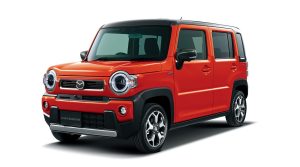
The Fit was last sold in this country six years ago (2020). Honda decided to stop selling it in this country because – six years ago – small, inexpensive cars weren’t selling very well because Americans were able to afford larger (and more expensive) cars. There was thus more money to be made selling less-affordable cars.
This is the main reason why there are almost no small, inexpensive cars available for sale anymore. Ford stopped selling the Fiesta in 2019 and no longer sells any cars at all, except the Mustang (which is small but hardly affordable). GM stopped selling the Cruze around the same time and now sells no cars at all, except the Corvette and a couple of Cadillacs (none of which are affordable). Dodge dropped the Dart ten years ago and also no longer sells anything affordable – a working definition of which is anything that costs less than $20,000.
But it is not 2020 and millions of Americans can’t afford the cars (which are almost all crossovers now) that are available.
There are probably millions of Americans who’d like to buy an affordable small car such as the Mazda Flair – or the Honda Fit – but they’re not allowed to because Mazda and Honda aren’t allowed to sell them in this country. The 2026 Fit that’s available in Japan and other parts of the world is basically the same as the 2020 Fit that was available in this country. But more compliance is required now than it was back then and making the Fit compliant would probably mean extensive and expensive updates that would make it too expensive to sell here, except at a loss.
This is the Catch 22 as regards “tiny cars.” In order for them to be affordable, they almost have to be tiny and that means they almost have to be light and that means it is almost impossible to make them compliant without making them larger (and heavier) and no longer affordable. Put another way, you can make a car tiny and affordable but you can’t make a tiny car that’s affordable. Integrating the structure needed to comply with federal roof crush/side-and-rear-impact requirements alone renders the “tiny car” concept oxymoronic, almost by default. (It is probably possible to build a compliant “tiny car” using high strength materials such as carbon fiber but then you have a “tiny car” with a big price and that defeats the purpose of the exercise).
People without much money to spend will generally put up with a small, sparsely equipped car precisely because they haven’t got much money to spend. If they did, most would probably spend more on something larger and better-equipped. First-time and younger buyers tend not to have the money to spend; there are also lots of people who just don’t have the money to spend – or don’t want to spend it. That’s why, for most of the history of cars, there were always economy cars, which were (generally speaking) synonymous with “tiny cars.” The old VW Beetle was certainly tiny. So was the original Honda Civic and the Chevy Chevette and the Geo Metro – to cite just a few of the many such cars that were once available for those who wanted to buy them.
Italics for an important reason that bears on the discussion about what’s not available – what’s not allowed – today. “Tiny cars” such as the Flair and the Fit ought to be available so that those who want to buy a small, basic – and inexpensive – car would be free to do so. As opposed to the government forcing everyone to buy only the kinds of cars the government allows to be sold. Why is choice so controversial? Imagine if the government only allowed people to buy stuff at expensive stores rather than the Dollar Store. The result would be lots of people who were priced out of buying anything. It’s functionally the same situation as regards the cars the government allows people to buy.
Why do we allow this?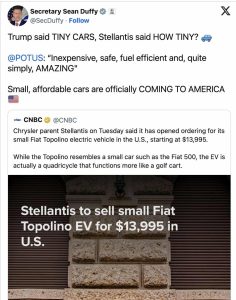
There was a time when Americans were free to buy just about any kind of car they wanted to buy – ranging from tiny cars like the VW Beetle and the early Honda Civic to Fleetwood Brougham Cadillacs. Choice is given a lot of lip service but the reality is it’s held in contempt by the government and – to be fair – a lot of Americans, too. Many of the latter support the government limiting what’s allowed because it assures only “safe” (that is, compliant) cars are allowed. It is not enough that people who want “safe” cars are free to buy “safe” cars; they insist everyone be made to buy only “safe” cars, too.
Before too much longer, they’ll have us all doing calisthenics every morning in front of the TeleScreen.
Meantime, Trump informs us we will be allowed to buy the Fiat Topolino, a “tiny car” that’s perfect for knocking around The Villages in. But if you want an actual tiny car – with more than a rope for a door (and a top speed higher than 25 MPH) you’ll have to go to Japan or Mexico or Europe, where people are allowed to buy and drive them.
. . .
If you like what you’ve found here please consider supporting EPautos.
We depend on you to keep the wheels turning!
Our donate button is here.
If you prefer not to use PayPal, our mailing address is:
EPautos
721 Hummingbird Lane SE
Copper Hill, VA 24079
PS: Get an EPautos magnet or sticker or coaster in return for a $25 or more one-time donation or a $10 or more monthly recurring donation. (Please be sure to tell us you want a magnet or sticker or coaster – and also, provide an address, so we know where to mail the thing!)
If you’d like a Baaaaa hat or other EPautos gear, see here!









Never mind tiny cars we can’t have. The Lügenpresse is moaning piteously over the EeeVees we can’t have — because bad, bad men cancelled them:
‘The E.V. revolution [sic] … was an opportunity for Detroit to rediscover its capacity for ingenuity and to re-establish credibility in an industry it helped to create.
‘Instead, whipsawed back and forth by shifting political headwinds and afflicted by all manner of self-enforced error, it appears to be in the process of sealing its own doom — at the precise moment interest in E.V.s is surging in the United States.
‘In April, 26 percent of prospective buyers were “very likely” to consider an E.V. for their next car. And that was before the chaos in the Strait of Hormuz helped push the price of unleaded gasoline to a four-year high.
‘In the worst case, [the US] retreats onto what the economist ‘Susan Helper’ calls a “shrinking island of ICE,” churning out outlandishly large trucks and not much else. At which point, the obsolescence of the mighty U.S. automobile industry would be all but guaranteed.’ — NYT
https://archive.ph/dyCKt#selection-8415.245-8415.586
‘A shrinking island of ICE’ — I LOVE IT! Vroom, vroom!
To anyone currently living in the Canadian wildfire smoke, it should be painfully obvious that every penny spent on emissions regulations equipment is a complete waste. It’s like a giant ‘Rube Goldberg’ machine of complexity that wastes tons of resources and has negative results.
For clarity – I don’t disagree with your premise that there ought to be a free market.
“There are probably millions of Americans who’d like to buy an affordable small car such as the Mazda Flair – or the Honda Fit – but they’re not allowed to because Mazda and Honda aren’t allowed to sell them in this country.”
However, you keep ignoring that the market has spoken. When the Fit, Fiesta, Geo Metro, etc were available they didn’t sell millions. Even when these cars were being made, they were not profitable.
As a libertarian supposedly in the Austrian tradition I would think you could admit your premise is wrong. Why it’s wrong could be debated for days. Monetary policy, regulations, American psychology all contribute. But the reality is the market has spoken and they don’t want what you keep pushing. Certainly not in the millions.
Hi Kim.
I specifically wrote that times have changed. It is not 2020. The market has changed. But we’re not allowed to have an actual market. Small, inexpensive cars like the Flair and Fit can’t be legally sold here. So there isn’t a market, in the Austrian tradition.
“Cars that only weigh about 2,000 pounds can get pushed out of their lane by the slipstream of a passing semi.”
Look in the mirror at who’s not promoting small cars.
What exactly is so different in 2026 vs 2021 when the Fit was last available? Why do you all of a sudden think a car like the Fit is going to sell in the millions or be profitable? Where’s the data? The data on small cars sales and profitability is directly at odds with your premise.
I’ve driven 2000 lb -2500 lb cars all my life. Have never been pushed out of my lane by a semi slipstream.
On the one hand you bemoan the lack of small cars but then turn around and basically try to scare people out of them.
So argumentative.
Kim –
Do you grasp that conditions have changed? In 2020, the average price paid for a new car was not $52k. It was about $38k. The cost of everything else was also at least 20-30 percent less in 2020, too. Average Americans are wanting more affordable everything. This is not my claim. It’s the expressed want of millions of Americans who are no longer able to afford basic necessities, including a basic car.
What I “bemoan” is the absence of choice imposed by the government and exploited by the major car companies. I would like to see a free market – which you seem to take issue with.
Avery interesting point. In 2017 I bought a significantly discounted, leftover ’16 Focus with a stick for about $12,500. Full list was just about $18,000. People were just not buying these cars in droves.
Personally, I LOVE it but I am not and never have been in step with everyone else.
And there is something else unmentioned here:
The top 10% of household incomes account for HALF of consumer spending:
https://www.newsnationnow.com/business/your-money/wealthy-consumer-spending/
Since the covid hoax the car companies have adopted the business model of taking orders for high-dollar, high-profit vehicles from the wealthy and selling lower volume. They’ve done away (as much as they can) with letting loss-leader stripped cars sit on the lot until the end of the model year and then offering rebates.
The manufacturers DGAF about selling cheap cars in large quantities to the poors, they have rejected Ford’s business model of a century ago.
Hi X,
Yes, this is true. But it also creates a huge potential market for low-cost cars. This market is legally shuttered by the regs. If there were an actual market, anyone would be free to try to sell any kind of car they thought would sell – and people would be free to buy it. That’s the way it was, once. I wish it could be that way again.
Fuel Mileage, Emissions & Safety, three things working at cross purposes…and GovCo ignores the Law of Diminishing Return.
The Ratchet of Control only clicks in one direction. And GovCo never sleeps.
It’s all part and parcel of the Empire of Idiocy we’re forced, at gunpoint if necessary, to fund and obey.
Like that old saying goes; “you can have it fast, cheap or good. Pick two”
The same should apply to cars again and maybe then we might wind up with some good enough cars at an affordable price.