


The boilerplate line is that a combination of ever-tightening emissions standards, fuel efficiency edicts and insurance costs put the kibosh on the muscle car.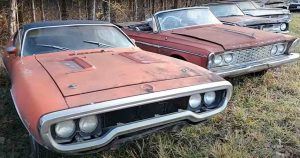
There is truth in this boilerplate. The V8s that powered the muscle cars were almost all much older than the muscle cars themselves; most dated back to the mid-1950s – years before the muscle car became a mass market car in the mid-late 1960s. They were simple, even crude engines – by today’s standards. Cast iron, heavy. They had a single flat tappet camshaft and two valves per cylinder and were fed fuel by carburetors. This was good because it made them relatively cheap to mass produce, which helped make muscle cars affordable. At the time, gas mileage and emissions were things almost no one cared about it.
The problem – by the early-mid 1970s, when the government began to care a lot about both – was they were 20-plus-year-old designs in most cases that were not designed with either low emissions or fuel economy in mind. Trying to make them fit into this new scene was something like trying to make a power lifter into a figure skating champion. The effort was doomed to fail.
It did.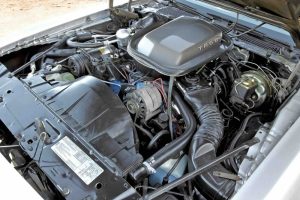
By 1979, the last of the old school muscle car V8s – Pontiac’s 400 – was on its way out. They’ve been sort-of replaced by performance engines – many of which make much more horsepower – but it is not the same creature. Without a big, carbureted V8, you haven’t got a muscle car – irrespective of how powerful it is. What you’ve got is a performance car. No slam on the latter. Just as it’s no slam to prefer vanilla ice cream.
The point is that vanilla isn’t chocolate.
By the mid-1970s, America’s involvement in Middle East politics had indeed caused the price of fuel to jump, too – just as it is jumping again, in our time. This further helped to put the kibosh on the muscle car, chiefly because the muscle car was a young man’s car and most young men could not afford to feed them, then or now. (It currently costs me almost $100 to fill up my ’76 Trans-Am, which means I can only afford to drive it occasionally – and I am no longer a young man.)
Insurance costs were another nail in the coffin – especially once it became a legally enforceable requirement to buy insurance. Back in the day – when muscle cars were new cars and for a few years afterward – it was easy to skip buying insurance (assuming you owned your car outright) because the insurance mafia hadn’t yet acquired the power to narc you out to the government for not having it – and the government hadn’t yet acquired the power to know, instantly, whether you had it. One of the main reason today’s performance cars are for the most part middle-aged guys’ cars is because only middle-aged guys can afford the insurance you can’t “get away” with not having.
But there is this one other factor that’s rarely talked about that effectively made the muscle car an impossibility. It was the extinction of the cheap, mass-produced rear-wheel-drive cars that served as the basis for the muscle cars and which made it feasible to make them inexpensively and so to sell them relatively cheaply.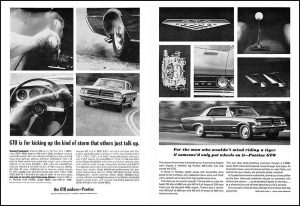
The first mass-market muscle car was the 1964 Pontiac GTO. It was basically a hotted-up Tempest, which was an economy car. But – as was true of most of the economy cars of the ’60s (at least, the American ones) – the Tempest was rear-drive and it was also body-on-frame which made it beefy. It was also designed to accommodate a V8, because – the youth will be amazed to hear this – it was very common back in the ’60s an even into the ’70s – for economy cars to at least offer a V8 option. It was not typically a high-powered option, but the point is that because the car was designed to accommodate a V8 it was a simple (and so cheap) trick to install a bigger, higher-powered V8 in the thing and – voila! – you had yourself a muscle car.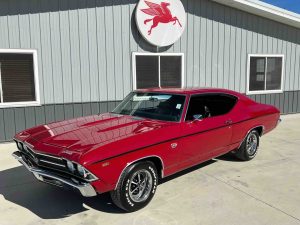
All of the muscle cars of the ’60s and ’70s had their grocery getter siblings. A ’69 SS 396 Chevelle was basically the same car as a run-of-the-mill Chevelle with a 307. The difference was the 396 – and the upgraded suspension and trim bits. Most Chargers didn’t have the 426 Hemi or the 440 Six Pack or even the 383. Most were just Chargers, sans the R/T and Scat Pack stuff. The mass-market, grocery getter versions of the muscle cars buoyed sales of the muscle cars. Put another way, Chevrolet was able to sell a few SS 396 Chevelles because Chevy sold a lot of 307 just-Chevelles.
It was also a snap to home-make your own muscle car.
A ’70s-era Chevy Nova was just a basic economy car – but it could be made into a muscle car by dropping a 350 (or even 396) into it, which was easy because it pretty much bolted right up. You could do the same with a Vega or a Pinto – or a Pacer, even. These economy cars were rear-drive, which is what you’ve got to have to easily orient a V8 in the thing.
Today, almost everything is front-wheel-drive and designed to accommodate a small four, mounted sideways. Sometimes, a V6. But not a V8 mounted front-to-back. It’d take re-engineering the entire car to make this work and while there are people who have the skills, tools and (most of all, the money) to do this sort of thing, most people do not. The handful of rear-drive cars that still exist are low volume, high-cost. There is no inexpensive, mass-market rear-drive platform that could serve as the basis for a modern muscle car, even assuming you could get a big V8 into compliance with the emissions and gas mileage rigamarole.
The last one such was probably the Ford Crown Vic’s “panther” platform – and it’s been out of production for 15 years.
Maybe in the distant future – after everything gets rebuilt from the wreckage of our time – there will be another muscle car.
But probably not until then.
. . .
If you like what you’ve found here please consider supporting EPautos.
We depend on you to keep the wheels turning!
Our donate button is here.
If you prefer not to use PayPal, our mailing address is: EPautos 721 Hummingbird Lane SE Copper Hill, VA 24079










Look what I started. All over a V-6 engine that happens to be a monster I personally built. By a bunch of people who own NOTHING.
Well, Daniel –
That doesn’t include me. I guess my 455 four speed Trans Am doesn’t count. Nor the half dozen other cars of that type I have owned. Again, no one here is shitting on your car. We are just correcting you over your erroneous characterization of it as a muscle car.
We never considered Pony cars to be muscle cars. We didn’t consider Pony cars to be cars at all. Only half a car laddie. Only half a car.
Who’s “we,”Daniel?
The thing about certain pony cars is there’s overlap with the muscle car. A 1974 GTO is a muscle car. It is based on the Ventura, which is basically a Chevy Nova. The same-era Camaro and Firebird are very closely related to the Nova (and Ventura). The ’74 GTO had a 350 Pontiac under its hood. You could get a 455 in a same-year Trans-Am (the standard engine was a 400).
Sounding more and more like cylinder-envy. He doth protest too much, methinks.
Hi T. McGee!
I don’t think he’s thinking at all. As I have been trying to get across to him, words and terms mean things. Specific things. If they do not, then they mean nothing. If you look up what “battleship” means, you will find an accepted definition; big guns/heavy armor. When people used the word “battleship” in conversation, it is understood they mean a ship with big guns and heavy armor. If someone says a ship without big guns and heavy armor is a “battleship” – and this is accepted – then the term no longer has any specificity. It means whatever anyone says it means. The conversation becomes unintelligible.
“Muscle car” is similar in that the term defines a particular kind of car – a mid-sized, rear-drive coupe with a big V8. These are the specific attributes that these cars uniquely possess. A vehicle that does not possess them is not a “muscle car.” Just as a horse that is not a draft horse cannot be a Clydesdale.
If we include different attributes, such as AWD and four doors and six cylinder engines – then the term “muscle car” no longer identifies a particular kind of car, since any car can be a “muscle car” once the definition is expanded to include cars that have more than two doors, fewer than eight cylinders and AWD.
Oh really? I’ve been attacked ever since I wrote the article.
Back in the day a muscle car was the car that could beat you. No other qualifications other than I can beat you and I’ll put money on it to prove it. THAT’S IT! Some people even put up pink slips. (that’s your title dummy) We used to laugh at Pony cars. If you put enough hp in them, they would actually twist themselves so the doors wouldn’t close. Even Trans Am put a C channel connecting the differential to the transmission to try to prevent it. Yeah, that’s what that was for.
Daniel,
You write: “Back in the day a muscle car was the car that could beat you.” Nonsense. A Ferrari 250 GTO easily beats a ’64 Pontiac GTO. Which of the two is the muscle car? A Ferrari is a supercar, a GT. A ’64 GTO is a muscle car. Oy vey!
A Subaru WRX STi beats pretty much every stock ’60s and ’70s muscle car. Is this AWD sedan a “muscle car,” too? How about a VW GTI? Why not a Bugatti Veyron? It’s much quicker than a ’69 SS 396 Chevelle, a Hemi GTX – or your car.
Give it up, man.
As far as the ’70-81 Trans-Am: Bullshit. I own one. I have owned three. One is in my garage, right now. I know these cars intimately, having taken them apart completely and put them back together. There is nothing connecting the differential to the transmission except the driveshaft.
One word government they suck the enjoyment out of everything.
Daniel’s an IDIOT. Sure, is his late-model Charger a “performance” ride? Sure. It’s also a FOUR-DOOR SEDAN. Ergo, what some pussywhipped geek gets cajoled into buying by the “little woman” because “Mother can’t easily get into the back seat of any 2-door coupe!
Both Ford with the Mustang and Dodge with the Charger, or Plymouth with the Roadrunner each toyed with the idea of four-door and/,or WAGON versions. Both were REJECTED for the same reason. Ford already had the Falcon/Maverick, Moat had the Coronet or Satellite. No need to CHEAPEN the brand!
If Daniel really wanted a latter-day version of the muscle car, he ought to have bought a Challenger.
Amen, Douglas!
I don’t get this guy. I wasn’t belittling him or his car. Just pointing out it makes no sense to refer to a V6/AWD sedan as a muscle car, because if the latter is one, then basically anything can be one. Ergo, the term has no meaning.
Muscle Car has a standard of identity. Even if it’s not written down. If it doesn’t have a bill and webbed feet it can’t be a duck.
Well, maybe not a duck with feathers that waddles, quacks, and is delicious roasted and with orange sauce poured all over it, but there IS this kind which any gear head ought to appreciate:
https://en.wikipedia.org/wiki/DUKW
And then, this “Duck” (Grumman J2F) certainly floated, and maybe with a misfiring cylinder (or two, or MORE) on that Wright-1820 Cyclone, it did “quack”, it certainly, in the era before helos were common, rescued many a downed Army Air Force pilot or Navy/Marine Aviator from a deserted isle (or maybe not SO “deserted”, i.e., “crawling” with Japs) or the “drink”.
https://en.wikipedia.org/wiki/Grumman_J2F_Duck
A “classic ” muscle car was possible because not only the V8 engines, but also the drive trains and car bodies could be readily adapted from staid, mass-produced vehicles.
The famous Ford Mustang is the perfect example. It was more or less a reconfigured Ford Falcon (same chassis), as tooling for an entirely new chassis for what was expected to have modest consumer appeal would have been too expensive. The same inline Six, introduced in 1960 as the “Falcon Six”, with 144 and 170 cubes available, was the base engine, now as a 200 CID, and many young women and men who just wanted “something sporty” but didn’t need a “romping, stomping” V8, thought them adequate and hood on gas, hence the “,pony” car, which the Mustang was NOT the first, as both the Chevy Corvair Monza and the Plumouth Barravuda preceded it by a hair. Even the first V8s, available towards the end of the 1964 model year, was a rather uninspiring 260 Windsor, intended as an option for the Falcon and the Fairlane, with a “wheezy” two-barrel and put out 155 ponies. It was in 1965, when the 289 was introduced, and one could get a high-performance version with a four-barrel and factory dual exhaust, cranking out 271 horsepower, that the cute “pony” car that the attractive “Bond Girl” drove through the Swiss mountains in “Goldfinger” became a muscle car in its own right!
“– after everything gets rebuilt from the wreckage of our time –”
Eric, do you really think there’s any chance for this?
Maybe I’m too pessimistic, but I don’t see it.
Hi Mark,
Yes, do see it. Just perhaps not in our time. Imagine being a Roam circa the height of imperial glory, during the reign of Augustus. Just a few hundred years later, it was all un ruins. Then for another 1,000 years the world went dark. But then the light came again. The Earth abides. And so do we, if we do not manage to kill ourselves off.
We came out of the last three 4th turnings in good shape although not everyone survived. Although from an Elliot Wave perspective, we may be at a higher order fractal than the previous two 4th turnings\fifth waves. I’m hoping people wake up soon and start using their heads. Seems unlikely.
Eric, there was indeed a “glory” that Ancient Rome HAD…but it also had squalor, despotism, high taxes, currency debasement, and an ever-strangling bureaucracy. Sound familiar? Also, more so in the West, including the area of central Italy from whence the “Romans” sprang, as outsiders, i.e., “Barbarians”, mostly immigrated PEACEFULLY, the character of Roman society changed over the centuries. By the fifth century, the majority of the “Roman” Army was GERMAN, high-ranking officers like Flavius Aeitus (who most historians agreed had a German officer that was also a high-ranking Roman officer), so the irony, for example, in the famous Battle of the Cantulian Plains (aka “Chalons-Sur-Marne”) against Attila the Hun in 451 AD, is that more Germans were DEFENDING Rome than attacking it! Also, the so-called “Fall of Rome” (the Eastern Romans in Constantinople probably had a good laugh about that!) was really more of a squabble between factions competing for nominal control of what remained of the once mighty Western Roman Empire (what the Franks and the Vandals hadn’t taken), with a relatively “dark horse” Roman general of vague origin, Odoacer, who likely was of mixed Germanic descent, killing off Orestes, once a general and ally of Attila, and the following year deposing Romulus Agustulus, the son of Orestes, and by all accounts pensioning the kid off and sending him to live out his days as a monk. Odoacer sent the accoutrements of the court of the Western Roman Emperor to the Eastern Roman Emperor, Flavius Zeno, proclaiming himself “King of Italy”, nominally subservient to the Eastern Emperor (in practically, only paying “lip service’), and said there was no need for a separate Emperor in the West anymore. Contemporary accounts indicate that most denizens of what had been the Roman Empire in the West, though they still considered themselves as “Romans” (indeed, the Roman Senate is documented as still meeting into the 7th century), were more concerned with local matters, especially the frequent plagues and famines that beset the former great empire, and many were glad to do without the tyranny that Rome had become. Odoacer was no less popular than the “Roman” emperors that he’d succeeded, but his own reign would be somewhat brief, as Zeno, rightly fearing that Odoacer would ally with either the Vandals and/or the Franks against Constantinople, took care of that “problem” and another one, an ambitious Orstrogoth general by the name of Flavius Theodoric. The man was a very capable army officer and politician, and Zeno also feared that Theodoric would revolt against him and put his own puppet emperor on the throne, so he had the Ostrogoth campaign against Odoacer. The two warred for a few years, then made peace, and at a banquet to celebrate that peace, Theodoric turned against Odoacer and killed him, legend being that he personally strangled him with his bare hands. Odoacer’s officers and men were forced to either join Theodoric or be sold into slavery or even executed, most joined. The Ostrogoths would rule Italy and Dalmatia for a further half century, and by all accounts, it was a relatively peaceful and prosperous time! That would come to an end in the mid-6th century as Justinian, ambitious to restore the old Roman Empire to its former boundaries, launched a terrible war against the Goths, this war, more than any other conflict, even the Punic Wars that had nearly seen Rome fall to the Carthaginians in the 3rd century BC, caused more destruction than the Italian peninsula would ever see, even the WWII Italian campaign of September 1943 to April 1945! Italy was hugely depopulated and ended up being a hodgepodge of duchies, some under control of the Byzantines, others various states that succeeded the Lombards that swept into Italy in the late 6th century. Rome itself would decline to just under 10K persons by then, and was on the verge of being abandoned altogether. One of the reasons the famous Coliseum ended up in ruins as it did was that its masonry was used to build or repair other Rome buildings, as the city was too poor to build afresh for centuries, and the once-great Roman roads and bridges that had facilitated commerce and the rapid movement of the once-mighty Roman Army had fallen into disrepair, and most of the quarries in the Appenines were abandoned or flooded anyway.
Regulation killed it certainly, just as regulations are killing recent engine options.
Maybe it’s cheaper not to make body on frame rear wheel drivers today, but what is not cheaper is what it takes to afford a modern car.
Vs 1965, it now takes on average an extra 562 hours of work to pay the purchase price.
Modern cars do have a lot of bells and whistles and can be expected to last longer, but that 50% premium puts most people into financing territory.
VS 1965, financing a vehicle pushes the gap to 800 extra work hours to pay it off.
Debt slavery is still slavery
The 60s – 70s also gave us muscle tractors which shared characteristics of muscle cars –big horsepower based on older tech, stylish, and just all around boss.
Take a look: https://www.youtube.com/watch?v=maGUqlF0t34
The same is true for the pony cars: The Mustang was built on the Falcon platform. The Camaro and Firebird were built on the Nova and Tempest platforms. The Challenger and Barracuda were built on the Dart and Valiant platforms. The Javelin and AMX were built on the Rambler platform.
These pony cars shared much with the economy cars they were based on, which made them inexpensive and easy to soup up. This was true into the 1980s with Ford’s Fox Body, which encompassed the Mustang and the LTD II.
The Falcon was later changed to the Maverick, and briefly, as the “Moose-Tang” era of the huge, by “pony car” standards, Ford rides with the broncing buck had grown to intermediate proportions, a “Grabber” version of the “steer-mobile” with a 302 4V didn’t do too badly. But that was VERY BRIEF. Novas and Tempests could be “muscly” in their own right, as could the Dart and briefly the Duster (Mopar never marketed any Valiant with anything other than a Slant Six or a 318 two-barrel, hell, they even introduced a Valiant BROUGHAM for those little old ladies that wanted economy with a modicum of comfort and a car easy to drive). Of course, the 1970 through 1974 Barracuda/Challengers were derived from the A-bodies but considered a platform in their own right, and the funny thing was, you COULD get one with a 198 Slant Six, what “Uncle Tony” derides as the “bean-counter” engine, and “three on the three”, I shite you not. Thankfully few of those abominations were ordered. Walt Kowalski could only drive a Chally with a 400 Magnum or Six-Pack! As for AMC…amazing what they accomplished on a shoestring budget with the AMX and Javelin and that 401 cube version of their Gen 3 V8.
Sadly, done in by the control freaks bleating “Safeteeee!”, their sponsors, the Insurance Mafia, and those twits who, IAW what HL Mencken wrote, got their knickers in a twist that someone had a GOOD TIME behind the wheel!
Sorry, forgot this little gem from late 1969 starring “Radar” (Gary Burghoff) and while I don’t recall the old lady portraying his nagging mother, she was in so many commercials and guest spots at the time.
https://www.youtube.com/shorts/F_vDYU1V5ss
“Banana-Cuda”, indeed!
Nothing killed the muscle car. I have a 2018 Dodge Charger with a Pentastar V-6 in it. I supercharged with a Vortech supercharger that puts out 22lbs of boost, via a Ripp kit. That tiny little 220 cubic inch engine puts out 608hp. More than any 60’s muscle car ever dreamed of. I’ve been trying to build such a car for over 40 years and finally did it. And I used nothing but off the shelf parts. And the Pentastar is built hardened with fuelly dragster tech. The only thing I had to add was hardened head bolts.
I also added ported intake manifolds, ported and polished 80mm Hellcat throttle body, oil catch cans, Borla S cat back exhaust, giant fuel injectors. New NGK Iridium spark plugs, new NGK coil packs and a 93 octane tune.
Incidentally, on the Interstate the car gets 41 mpg on the highway. It now has 22,000 miles on it without so much as a single check engine light.
I would’ve never guessed this project would’ve used a 6 cylinder engine.
I think I’ll keep it.
Hi Daniel,
No offense – your V6 Charger is an impressive performance car – but it is not a muscle car. If you say it is, then any powerful performance car is a muscle car.
Including most electric cars.
Muscle cars are a distinct species of car defined by the big (and carbureted) V8. They do not have electronic controls of any kind. They are simple, brutal things. Most don’t handle or stop well. But they all have that certain something that makes them different from any other kind of car.
How old are you?
What has my age got to do with anything, Daniel?
A goose is not a duck – and a V6-powered/AWD sedan is a performance car, not a muscle car.
Power/performance does not define what a muscle car is. Most muscle cars – even the hot ones – are only middling powerful compared with modern performance cars. A ’70 GTO RA III has 335 gross hp. It ran a high 13 second quarter. Your V6/AWD performance sedan totally outclasses it.
But no one questions its status as a muscle car.
So you’re claiming a Hellcat is not a muscle car? I’m sorry, but the entire would would disagree with you. They would laugh at you as well. So I’ll ask again? How old are you? I’ll bet my first muscle car, a 1967 Olds 442 would be older than you are. I’ll bet I was spinning wrenches before you were even born boy. And you want to lecture me?
A Hellcat has a big V8.
I’m not lecturing you – or insulting you. I am correcting you.
By the way, I have owned and driven several muscle cars. I still have a 455 four speed Trans-Am, which is technically a pony car but the big V8 qualifies it as a muscle car, too.
I’m not sure why you have your panties so wadded up obver this. Your Charger sounds impressive. It’s a cool car. But – sorry – it isn’t a muscle car.
“I still have a 455 four speed Trans-Am, which is technically a pony car but the big V8 qualifies it as a muscle car, too.”
So that makes it a non-binary car that can identify as whatever it chooses Hmmm. Well that’s a new one 😉
What would a Miata with a 455 be classified as? Curious.
Hi “Barney” –
You ask: “What would a Miata with a 455 be classified as? Curious.”
Nose heavy. Seriously so.
LoL
I’ve seen a couple LS swapped Miata’s. Those looked heavy enough but bigger is always better in America. So they say.
Hi “Barney”!
The LS block is light. I can (and have) carried them by hand. My cast iron 455? Forget about it! Also, the Pontiac V8 is wide. I doubt it’d even fit without major cutting welding (and bracing).
The Miata – being a sports car – is just fine with the four it comes with!
“Uncle Tony” once stuffed a Mopar 170 Slant Six, bone-stock with the original Carter BBS one-barrel carb, into a Miata. He built a rather large housing that protruded well into the passenger cab. The contraption actually ran fairly well, but, yeah, it too was nose-heavy.
Anyone can create some manner of Frankenstein vehicle. I’ve seen Dolcich and Freiburger stuff a Caddy 472 into an AMC Gremlin, for pity’s sake, and though the engine was otherwise stock, the beast went like a gorilla with a cattle prod shoved up it arse. But who’d want to DRIVE that stupid thing around town?
Amen!
I know a guy locally who put a Chevy LS into his Miata. The engineering is impressive. I’d still rather have a Lotus 7 or (if a V8 is wanted) a Sunbeam Alpine or AC Cobra.
Yeah? You can say anything you want, but it’ll blow off anything you’ve got.
Hi Daniel,
I don’t doubt it! But it is beside the point. A V6-powered AWD sedan is a performance car. It is not a muscle car.
Here’s a way to understand what I am trying to explain to you: A modern missile frigate can lay down far more destruction than a WW II battleship. But a missile frigate is not a battleship. A battleship is defined by its big guns and heavy armor. Without big guns and heavy armor, it is not a battleship – no matter how much firepower it has.
Is the battleship obsolete? Certainly. But it is still a battleship – and (to some) has appeal that a frigate will never have.
You’re just some kid, who thinks he knows everything, blowing wind.
Yeah, I’m “just some kid” … what a powerful argument!
I’ve probably got more experience with muscle cars – the real ones, such as my high school buddy’s ’71 GTX 440 – than you do. Have you ever actually owned a muscle car? I mean, something with a big V8, rear drive and no computer controls?
Again: I am not shitting on you or your Charger. It is not an insult to call it what it is – and is not. It is an impressive performance car. Why does it bother you to call it that? I’m not saying it’s inferior – far from it – just different.
Do you understand?
Let me try another way: A Tesla S is a brutally powerful performance car. It runs the quarter in 9 seconds. Is it a “muscle car”? According to you, it is – because it’s (like your Charger) a really quick and very powerful car.
Of course it isn’t a muscle car – even if had 1,500 horsepower and ran a 5 second quarter mile. Said another way, if it is, then any very powerful car – irrespective of what’s under the hood (even if there is nothing under the hood) is a “muscle car” and that’s just silly.
A Belgian draft horse is not a Frisian. A frigate is not a battleship.
Apples – and oranges.
The point being, a BB, or “wagon” in swabbie parlance, though magnificent to behold, is a relic of a bygone era. So, sad to say, is what WERE once known as “muscle” cars. Those who’ve paid a LOT of money for what’s an HOMAGE to them, like the Dodge Challenger, Chevy Camaro, or Ford Mustang, are generally well-off older guys reliving their “yute-hood”, or driving the vehicle that while “yutes” they WISHED they’d had, but never did, for whatever reason, and don’t necessarily want to twist wrenches, go to swap meets, rummage through salvage yards, etc. things necessary to keep that 50 to 60 y.o. Detroit iron going! They don’t want to learn the fine points of engine blueprinting or even rebuilding a four-barrel carburetor; these “posers” just want to throw MONEY, which they have or can BORROW (or inherited), and take their faux “hot rod” to the stealership everytime it quits on them. Apparently “Staggering Dan” is one of these PHONEY BALONIES.
100 percent, Douglas –
Battleships, though obsolete, are still regarded with awe. Several are preserved as museum ships. A missile frigate is – like a modern, computer controlled car – more “efficient” but also more soul-less. It does not summon the same awe. Just the same with muscle cars. Just seeing one. Daniel does not get this.
What’s funny is that America, of all the powers from “Dubya-Dubya Two, Da BIG One!”, actually kept its four (of six originally ordered) Iowa-class (BBs-61 through 64, Iowa, New Jersey, Missouri, and Wisconsin), the next class, the Montana vessels, were cancelled outright after initially proposed to redesign them as supercarriers (the angled deck refit of some of the 24 Essex-class CVs was deemed to be far more cost-effective than trying to make carriers out of the huge BBs).
It should be kept in mind that although nuclear propulsion had been advocated by Hyman Rickover as early as 1946, the Navy initially resisted going with it, figuring that basing their capital ships on unproven technology was too risky. Those CVs were also awesome in their own right, and that the Essex-class, of which 18 were reconfigured in the 1950s and early 1960s to the modern “angled deck”, served into the 1990s is testament to the design!
Our four BBs were brought back into service in the 1980s because they had awesome firepower with those guns, and with modern air-defense systems as well as attack sub escorts, it was figured they had as good a chance of survival as any other USN surface vessel. Although it was decidedly “old school” even then some forty yers ago, there was nothing like a broadside from those nine 16-inch guns, and they could lay a huge load of “FUCK YOU!” to the enemy at distances of up to 25 miles…i.e, usually OVER THE HORIZON.
And the transmission?
bulletproof ZF 8-speed AWD and it was the toughest part, it had to relearn how to be a transmission from scratch. It’s tune was blanked. Took it a year.
An A727 Torqueflite from the 1960s to mid-1970s didn’t have to learn JACK SHIT. It was a BULLETPROOF 3-speed automatic. Nice thing was you could take once from a wrecked ’76 Chrysler Newport with a 360 LA engine, sucking through a “wheezy” Carter BBD two-barrel, put it into a ’70 Cuda with a 440 four-barrel, stomp on it, and the auto gearbox, IF it could talk, would just sneer and say, “is that ALL you’ve GOT?”
Of course, that ZF is the culmination of not only transmission tech, but also computer controls, built by a fine German company that built, among MANY gearboxes and driveline products, several manual and automatic transmission for TANKS, including Germany’s own Leopard II. A fine gear box it is. But you won’t go out to Pick-and-Pull and yank one out of a junked ‘Benz (to be fair, you rarely seem ’em at PnP anyway) and have it replaced the blown box in your Charger. That’s but a small difference between the REAL “muscle” machines and you POSERS with more money, or at least a line of credit, than mechanical knowledge and/or COMMON SENSE.
Hi Douglas,
My buddy’s ’71 GTX 440 had the 727 – first car I ever drove that chirped the tires on the 1-2 upshift, stone stock. We worked that car like the proverbial rented mule and the 727 never faltered. I agree (and so do most people who know cars) that the 727 was among the best automatics ever made, if the standard is toughness and durability.
Why can’t I make corrections on this blog? That would be 41mpg on the Interstate, up from 28 stock. How? Simple, the car only uses 26hp to maintain 72 mph and has 608 on tap. I would HOPE the least it could do was be good on fuel.
Hi Daniel,
Spammers are why. It sucks. I wish I could just open everything up but if I did, the site would be flooded with crap from spammers. I’d like to have them all fed into a wood chipper and the slurry fed to the hogs!
PS: I fixed your typo!
Spammers are spammers. What does that have to do with fixing typos?
As I explained, Daniel – there are nets in place to prevent people (spammers and trolls) from screwing with the site. I could erect a paywall, but then only people who pay could participate – and I’m not Elon Musk!
That’s fine. But I’ll take Tavarish’s word of what a muscle car is. He’s a lot more relevant to the car world than you are. And he would certainly not agree with you. Most muscle car engines today a boat anchors. I’ll take the tech of my American made Pentastar a lot sooner than your antique Mexican V-8 Hemi’s, which are fuel injected; by the way. Had Chrysler been serious about performance and not pennies, they would’ve made the Pentastar into a V-8 and it still wouldn’t have cracked 300 cubic inches. Yet easily put out 800 hp with a blower. And I couldn’t even imagine the mpg it would’ve been capable of with those hp numbers.
Words matter, Dan – it’s how we understand what is being discussed. If we were discussing battleships and someone insisted that a frigate ought to be included in the discussion, it’d be obvious what the problem is. The Bismarck and Iowa and Yamato are battleships. Just as a ’70 GTO RA III is a muscle car. A missile frigate is not a battleship. And a V6-powered/AWD sedan isn’t a muscle car.
Yes, cast iron V8s are boat anchors. Your point? Or – rather – you miss the point. Again. A battleship is a heavy, inefficient colossus. But that is the charm of the thing – as well as the identity of the thing.
Your AWD/six-cylinder Charger sedan is a fine performance car. It is not a muscle car.
Neither is a Tesla S, which is a higher-performance car than your Charger. Or a Bugatti Veyron.
You realize that the Bismarck and the Yamato each went to “Davey Jones’ Locker”, right? It was said that on his flagship, when he received word of the Yamato’s sinking on April 7, 1945, as the men of the situation room broke out in applause upon hearing the news, Admiral “Bull” Halsey silenced them, then, with tears welling in his eyes, admonished the officers and men to observe a moment of silence to honor the officers and crew of the Yamato, who’s bravely but FOOLISHLY tried to make that suicide run to Okinawa, with barely enough fuel to get there, to be beached so that its huge guns could be used as an unsinkable artillery platform to desperately hold that Japanese island. Over 3,000 Japanese sailors and officers died trying to make use of an magnificent but woefully obsolete tub of iron!
I do, Douglas –
The men of Yamato and Bismarck died with honor. Another tale of great intrepidity involves the Scharnhorst, which some consider a battle cruiser because it only had 11 inch guns. But it displaced about 40,000 tons and was damned close to the standard. Anyhow, she fought magnificently against impossible odds before she sank. I’m sure you are familiar with the story but wanted to mention it in case others reading are not.
You’d think with 608 hp, it would get more than 41 mph on the interstate.
Just kidding — I know you meant to type ‘mpg.’ And yeah, that beats the living hell out of 11 mpg. Ask me how I know …
It’s not What , but (((who))) killed Muscle cars??
Once upon a time in the US, People could freely choose what they wanted, and car makers the market responded appropriately.
We were privileged to be blessed withsuch a plethora of affordable horsepower that it became taken for granted by the public at large.
We’ll never experience this again, unfortunately….
If the customer, and markets, could decide what cars, or anything, to buy based purely on their choices, desires and needs, not what the (((FEDGOV))) “says” you can have, because of safety & emissions & blah, blah, blah….well….
We’d actually have true freedom….
But roday, we just have Free-Dumb….
And its more expensive than anything else today….
YMMV….
Starting with “Landslide Lyndon”, aka LBJ, our politicians just couldn’t leave well enough ALONE. I’d say 1965 was the PEAK year of FREEDOM, which is “Yang Worship” word, which those that don’t fight for it should not dare speak!
“E Plebnista, Tukum Forum…”
And let’s not forget the superior interiors. Bench seats are now reviled but, if your car’s performance is based on straight line speed, who cares? Besides…that is “besides” you was your ultimate hormonal desire, snuggled up tight. And when that wasn’t enough the back seat awaits for Paradise by the Dashboard Lights. Heck, it was a veritable coming-of-age-mobile.
Miatas are great…but…
Front bench seats didn’t go with “muscle” cars, let’s be fair, you had to have BUCKET seats.
BUT, if you drove something a bit more, er…STAID, then the “SOB” seat (“Slide Over, Baby”) was PERFECT. How else would you and your g/f pleasure each other going 85 mph at 12:30 M on CA 152 between Los Banos and Chowchilla?
From Eric’s review of the 2026 Mercedes C-class:
‘Then there’s the C63. This used to mean a big V8 in a small sedan. Now it means a small four that’s much stronger than the big V8 you used to get. Paired with a plug-in hybrid, it produces 671 horsepower and 752 ft.-lbs. of torque. This thing can get to 60 in 2.9 seconds, making it just about the quickest new car you can buy – at any price.’
Obviously this lightning-quick acceleration does not make the C63 a muscle car, any more than its V8 predecessor. Nor does the bobtailed, vaguely bubble-shaped C63, with its nondescript appearance, remotely resemble the absolutely bad-ass Charger profile pictured in the lede photo — a legendary minge wagon that melted girls’ hearts.
Ultimately, as Eric asserts, muscle cars weren’t about performance, per se. They were about big, bad V8s — simple V8s, of 1950s origin. Having owned one — a 1968 GTO with a 400-cubic-inch V8 — my feelings are decidedly mixed. Even with cheap gas, getting 11 to 13 mpg and having to fill up frequently was annoying. Likewise frequent tune-ups (plugs, points, occasional carburetor cleaning and setting) and constant replacement of mild-steel exhaust pipes and mufflers. Did I mention its shitty, dangerous 9.5-inch drum brakes?
But finally, it’s down to the engine. If you had told me in the mid-1970s that the specific output of automotive combustion engines would triple in the next half century, I would have filed that claim on the science fiction shelf at the library.
Truly, the advances in engines and suspensions are thrilling. But they come with a poison pill: ubiquitous over-tech, including computer chips, telemetry and cell phones as a design motif. All of this is unacceptable — I won’t have it. But retrofitting outstanding modern engines into old platforms is hardly possible, owing to computer controls, CAN bus, and required sensors.
Auto makers have put us into a box. I won’t buy anything made outside the 1990-2010 ‘golden era’ (okay — maybe the 1971 Chevrolet pickup that’s been parked in a neighbor’s backyard for years now, acquiring a fine patina). To paraphrase a legendary quote from the Vietnam war, ‘We had to destroy the auto industry in order to save it.’ Let it bleed.
Morning Jim.
Decades ago tune port 350 swaps were common. Now LS swaps are common. I’m guessing that more than a few late model engine swaps have already been done with cut and spliced wiring harnesses although I’m guessing that the aftermarket offers a custom harness to run the modern engine and tranny in your 50s vintage F100. Just a matter of will, research and sadly money.
I put this question to AI:
‘Putting a modern engine into an older vehicle is a massive custom project (often Tier 4 or a “restomod”).
Electronics and Fuel Management
Standalone ECU: A 2026 engine talks to multiple factory modules (body control, transmission, ABS). You will need a standalone Engine Control Unit (ECU) or a programmable aftermarket management system (such as Holley, Megasquirt, or FuelTech) to run the engine independently.
Wiring harness: Strip out or adapt the old chassis wiring, and install a simplified standalone wiring harness for the modern fuel injection, ignition, and sensors.
Fuel system upgrade: 1990s fuel pumps and lines cannot supply the high pressure required by modern direct-injection or high-pressure port-injection systems. Install a high-pressure in-tank fuel pump and return/returnless lines rated for modern pressure.’
This commentary does not address sensors which may not be present in the 1990s vehicle … and need a CAN bus for communication.
Engine swapping — which I’d love to do in both my 1990s vehicles — sounds like a costly, nightmarish project, best tackled by restomod companies who have resolved all the issues and documented the procedures. But their price is astronomical, as in $250,000 restored Mustangs with modern engines and suspensions.
“ This commentary does not address sensors which may not be present in the 1990s vehicle … and need a CAN bus for communication.”
Unless your 90s cars are super high end German vehicles – CAN bus wasn’t in use in the 1990s.
Hot rodding was an American way of life from the beginning. In the 1700s you could add sails and cannons to your boat and make your own privateer. You could forge your own rifled barrels and make your own guns superior to what the old world’s expensive craftsmen were putting out. In the 1900s you could shave the head on your model T and shuck the body into a lightweight speedster which would run with and often ahead of European efforts. In the 1950s there was a ton of new, high compression, OHV V8s to swap into everything from model A’s to last year’s Ford sedan.
But after FDR and the trauma of WW2 and the Great Depression, something changed. Americans started accepting authority which had previously been their birthright. Once you allow a master to tell you what to do and what you can’t, you’re no longer free.
If they can call your god given right to travel and be well armed a privilege, if they fit first pick of your “income” and can tax your home after you’ve paid for it, you’re not free.
How is this relevant? The muscle car was one of the last gasps for American freedom. You could buy a new one off the earnings from any old job without sacrificing very much. Or you could swap the 454 into your Chevelle yourself without buying anything outside of junkyard parts.modern hot rodding is a very expensive endeavor. Bespoke electronics make custom Aftermarket controllers like Megasquirt a must, you will spend a couple thousand just getting it running. This is in contrast to going to the junkyard and picking up a 4 barrel carb and manifold for $25 and ordering a cam and lifters out of a catalog for another hundred, and hopping up your V8 for fun over a weekend.
Everything today is expensive, that cam and lifters is now 400 and up, the Megasquirt or Holley is going to set you back 2 grand before you’re running. But that inflated 2 grand is a much bigger bite of your $1000/week paycheck, with half of it taken in taxes and fees.
When you give up freedom for “security” or “prosperity”, you give up everything. And that’s where we are as a country.
Let’s not forget the confiscation of gold which was totally unconstitutional. The American public went along with it under threat of prosecution.
Actually, the big change started in 1913 with the creation of the federal reserve and the imposition of an income tax (which were both also unconstitutional).
To Ernie and Anarchyst. if this post sees the light of day…… ABSOLUTELY CORRECT!
—————————————————————–
“But after FDR and the trauma of WW2 and the Great Depression, something changed. Americans started accepting authority which had previously been their birthright. Once you allow a master to tell you what to do and what you can’t, you’re no longer free.
and
If they can call your god given right to travel and be well armed a privilege, if they fit first pick of your “income” and can tax your home after you’ve paid for it, you’re not free.”
This^. Post ww2 was a great era for America. Extra disposable income provided a great standard of living for Americans which allowed for hobbies that many cannot afford today. Going fast in cars was a new excitement for the masses. All forms of car racing had tremendous participation. Anyone could literally buy what they saw at the track (win on Sunday, sell on Monday). Inflation was just starting to accelerate as the muscle car era was peaking. Vietnam war. Culture was changing rapidly.
That was the main setback to my 40 year endeavor to build my ultimate muscle car. No engine could be swapped into the Charger that wouldn’t cost more than the car was worth. Even brand new ordered from the factory like mine was. I live in the north and wanted the AWD. You couldn’t have that with a V-8 at all from Dodge. So I concentrated on the Pentastar it already had. That meant I had to understand and know all it’s computer systems and know how they interplay with the entire car. It made me dizzy at first. I felt more like a computer programmer than a gear head. But I learned it all and walked away with 608 hp. Getting that kind of hp out of a V-6 seemed like a fantasy to me but there it is. And it’s rock solid reliable on top of it. That’s why I said I never imagined using a V-6 for this project. A muscle car in the 60’s was “I can beat you and I’ll put money on it to prove it.” It had NO OTHER qualifications. Not wide tires, not a four barrel carb, not a 6-pack carb setup, not V-8. NOTHING other than I can beat you. I know because I was there, and at Ohio Street every Friday night to prove it. Despite what Eric the great says.
My AWD V-6 with 608 hp won’t spin a tire in AWD. That’s why I smoked a Hellcat with it. And anyone who claims the Hellcat is not a muscle car because it has fuel injection is a damned fool. PERIOD.
Daniel,
Whether I am great is not the point. The point is your V6 AWD Charger is a powerful performance car – but it is not a muscle car. Have a look at this and you’ll see what defines a muscle car. Your engine makes more power. Mine’s better looking! https://rumble.com/v7bump4-pontiacing….html
I don’t think you read my last post on what a muscle car actually was in the day of them.
Daniel,
Muscle cars have always been what they are: Mid-sized, RWD coupes with big V8s. Not sedans with sixes and AWD. The ’64 GTO was the archetype; every other muscle car was an emulator of this concept.
Again, I am not slamming your car – far from it. I think it’s cool you got 600-plus hp put of your V6. But even if you got 1,000 horses out of it, it won’t ever be a V8 and your six cylinder/AWD sedan will never be a muscle car.
Be cool with what you have! There is nothing wrong with a stout performance sedan, which is what you’ve got.
But you’re only making yourself look silly arguing it’s a muscle car.
You’re shooting your mouth off without even reading the posts. Another thing kids like to do.
Daniel,
I’ve been methodically replying to all your comments. You reply with “arguments” such as “Another thing kids like to do.” Even if I were 15, it would be irrelevant as far as this discussion is concerned.
You have a performance sedan. You do not have a muscle car.
Daniel’s just being a POSER, acting as though his Charger makes him some “hot rodder”. It just made him a jerk that can throw money at something. Fuck him.
I agree, Douglas –
He comes across as a jerk. I never insulted his car; far from it. I just took issue with his absurd insistence that a V6/AWD sedan can be a “muscle car.” I ended up doing a whole lomng-form rant about it! https://www.ericpetersautos.com/2026/09/21/explaining-what-a-muscle-car-isnt/