

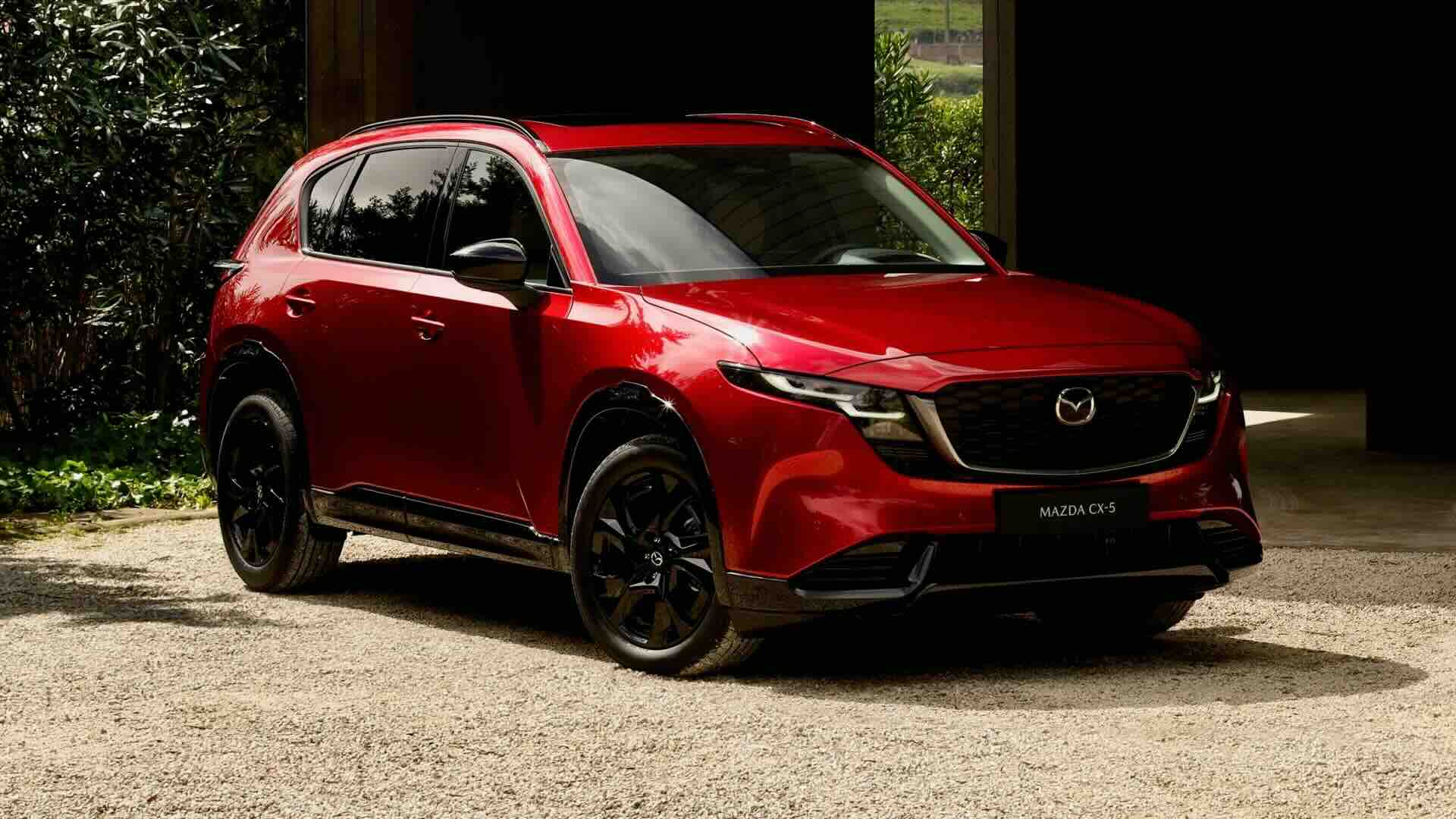

What’s the difference between a Mazda CX-5 and a Mazda CX-50?
Both are almost exactly the same size, come standard with exactly the same drivetrain and have base prices that are also exactly the same. So why does Mazda sell two of what could easily be seen as the same thing?
Chiefly, because they don’t look exactly the same, which renders one of them (the CX-5) more practical for carrying stuff – while the other can be more practical for driving in stuff.
What It is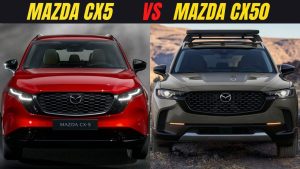
The CX-5 – like the CX50 – is a compact sized crossover.
The main differences between the two are how they look, which affects how much they can carry. The CX-5 is the more traditionally crossover-shaped vehicle and because it is, it has significantly more second row headroom and cargo-carrying capacity (66.5 cubic feet) than its same-sized but sleeker-looking sibling (which has 56.3 cubic feet of total cargo capacity). The CX-50 also offers some off-road-ish equipment in the Meridian trim, which comes with all-terrain tires and charcoal/blackout exterior graphics and an additional terrain mode for driving on unpaved roads. The CX-50 is also available with a turbocharged version of the 2.5 liter engine that’s standard in both of these small crossovers while the CX-5 comes only with the non-turbocharged version of that engine.
CX-5 prices start at $29,900 for the base 2.5 S trim – which is also the exact same base price as the CX-50. You get pretty much the same equipment – including the same drivetrain – in both, which consists of a 2.5 liter four (no turbo) paired with a six speed automatic and standard AWD. Also standard is a 10.25 inch LCD instrument cluster and a 12.9 inch secondary LCD that is the interface for the audio system and navigation, as well as the various apps.
The 2.5 S ($31,990) adds synthetic leather upholstery, a wireless phone charge pad, factory deep tint windows and heated/power-folding outside rearview mirrors.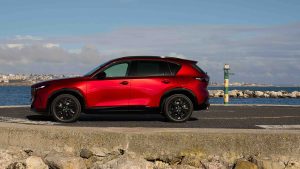
The 2.5 S Preferred ($34,250) adds a power rear liftgate, heated front seats and steering wheel, windshield electric de-icer, roof rails and a set of 19 inch wheels (two sizes up from the base S trim’s 17 inch wheels).
The 2.5 S Premium ($36,900) gets a panorama sunroof, a 12 speaker Bose premium audio system with built-in Sirius/XM, ambient interior lighting and real leather upholstery, plus gloss black trim and wheels.
The top-of-the-line Premium Plus ($38,900) adds a larger (15.6 inch) LCD touchscreen, hands-free power liftgate, adaptive headlights and paddle shifters, among other upgrades.
What’s New for 2026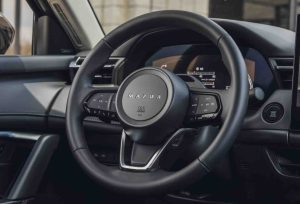
The CX-5 gets a major makeover; the new model is larger than the previous model and comes standard with the dual LCD displays that were not available last year.
What’s Good
Standard engine is a large four that doesn’t need a turbo to make up for being too small.
Standard transmission is a six speed automatic – and not a CVT.
More room for cargo than you get in the CX-50
What’s Not So Good
No optional engine (one’s available with the CX-50).
Not everyone is a fan of huge LCD touchscreens.
Isn’t available with the off-roady extras that you can get with the CX-50.
Under The Hood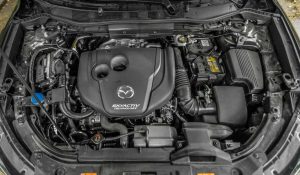
The CX-5 comes with the same drivetrain, regardless of trim. It consists of a 2.5 liter four cylinder engine that touts 187 horsepower, paired with a six speed automatic and standard AWD. The turbocharged version of the 2.5 liter four that’s optional in the CX-50 is not available with the CX-5, probably so as to give the CX-50 something different to help put some distance between it and the otherwise similar CX-5.
Regardless, the 2.5 liter four doesn’t need a turbocharger – because it’s big enough to make enough power without one. As a counterpoint, the Honda CR-V’s 1.5 liter four does need a turbo, because 1.5 liters by itself isn’t enough to make enough power to adequately propel a 3,500 lb. vehicle. Interestingly, even with the assistance of a turbo, the CR-V’s 1.5 liter four still only touts 190 horsepower – virtually the same output as the Mazda’s 2.5 liter four. The Honda’s touted gas mileage is a little higher, though: 28 city, 33 highway vs. 24 city, 30 highway for the CX-5. On the other hand, the Mazda hasn’t got a turbo that might need to be replaced one day, while the Honda does. And the smaller, turbocharged engine is also literally under more pressure, which often correlates with more post-warranty problems.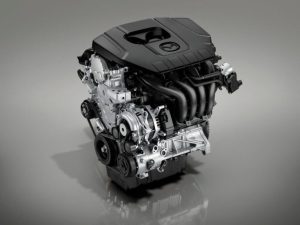
Another likely long-term advantage the Mazda can tout is its standard six speed automatic transmission, as opposed to the continuously variable (CVT) automatic that’s standard in the CR-V as well as other models in the class, such as the Subaru Forester. (The Forester does have a 2.5 liter four without a turbo that makes about the same horsepower as the CX-5’s 2.5 liter four.)
There are multiple driver-selectable terrain modes, including – curiously – an off-road mode. That’s curious because Mazda markets the CX-5 as the more off-roady iteration of these two CXs.
Zero to 60 takes about 8.3 seconds and Mazda says the CX-5 can pull a small trailer weighing up to 1,500 lbs.
The CX-50 has a standard 2,000 lb. max tow rating and that can be increased to 3,500 lbs. if the vehicle is ordered with the optional turbocharged engine.
On The Road
This Mazda is both fun to drive and exasperating to drive.
The fun is a function of the drivetrain, which isn’t what you’d call high-performance (see the 8.3 second to 60 time) but is pleasant in terms of how it feels and sounds. The six speed automatic doesn’t feel like it’s slipping – a common problem with CVTs, especially during wide open throttle driving and particularly when paired with an engine that doesn’t make a lot of power – and the 2.5 liter engines doesn’t sound whiny, as some too-small-for-the-vehicle engines do. The CX-5 also likes to corner. The steering is nicely weighted and the suspension keeps the car from under or oversteering unless you’re really moving. The ride is noticeably “bigger” feeling than before, probably because the wheelbase has been increased by 4.5 inches vs. previously.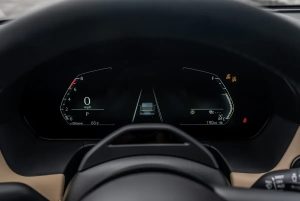
It’s both pleasant and fun, except for one thing.
Well, several – and they’re ll embedded in the new LCD touchscreen that’s off to your right. Within its various menus, you’ll find an array of new “assistance” and “safety” systems that take away from the drive by serially attempting to correct your driving. If you get too close to the shoulder for the car’s liking, you get a chime; if you drive faster than the speed limit, you get a ping. If you glance to the left or right – or at the touchscreen too long for the car’s liking, you get another ping/chime. There are still others, too – including the usual tugging of the steering wheel if the car thinks you’re wandering across the painted lines (i.e., Lane Keep Assist). The concatenation of pings and chimes is both annoying and distracting. The good news is most of these “assists” can be toned down. The bad news is that some – like the “drowsy/distracted driver” eye-movement monitor – can’t be turned off. This latter is extra-creepy and it will be a required standard next year (2027) in all new vehicles. per federal mandate.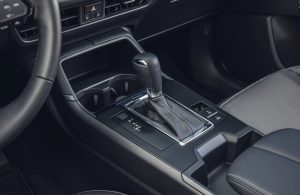
A piece of tape over the eye-movement monitor can, however, be used to blind the thing.
Another thing is that it’s difficult to do simple things such as change the radio station while driving. At least, it was for me. There is no obvious way to do this. No tuner knob, which is a control once commonplace and easily and immediately understood. Instead, there’s this new almost-13-inch tall (and wide) LCD screen (that’s the standard one; the optional is bigger) have to scroll through and then tap/swipe to get things changed. I found FM easily enough but using the < and > tap buttons changed nothing. I tapped the icon in between and that changed stations, but I couldn’t figure out how to stop them from changing.
I gave up and focused on driving instead.
You also have to tap/swipe to adjust the fan speed and AC/heat settings. This is not ideal. Dials and slides that can felt without having to look at them and that have physicality are functionally superior. Why fix what’s not broken? Apparently, to go-along with this mania to smartphone-ize everything, which is neither necessary nor helpful in a car. A smartphone is small and there is no place for buttons. A car has all this dashboard real estate to place buttons and switches, which not only work better they also look better than the big screens that are popping up in every new vehicle that are making them look like the same vehicle.
At The Curb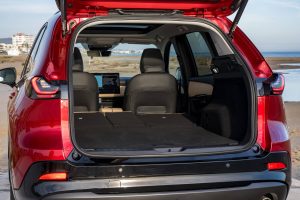
The CX-5 strikes a different pose vs. the CX-50. If you want a slightly more rugged look, the CX-50 is the one you’ll probably like more. If you prefer a more street-stylish look, the CX-5’s the one. Both have about the same footprint (184.6 and 185.8 inches long, respectively) but the CX-5 is noticeably taller (66.7 inches high vs. 63.5 for the CX-50) and that translates into noticeably more second row headroom (40.2 inches in the CX-5 vs. 38.6 in the CX-50) as well as more room for stuff behind the rear seats (33.7 cubic feet vs. 31.4 in the CX-50) as well as total space for stuff, with the second folded forward (66.5 cubic feet vs. 56.3 cubic feet in the CX-50).
In brief – and somewhat ironically – the more stylish CX-5 is the more practical of the two while the more adventuresome-looking CX-50 is a bit less practical, at least in terms of interior packaging. The CX-50 does offer more capability – and that does have a practical aspect, assuming you need the extra capability.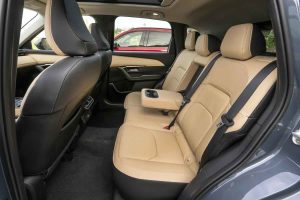
As mentioned earlier, every CX-5 comes standard with the new – and large – LCD touchscreen interface, as well as a digital instrument panel that replaces the previous analog-looking gauges. Some will like the new look while others may not. The standard eight speaker audio system is very good but the optional Bose system is much better (assuming you figure out how to change channels). However – and unfortunately – it is not available as an a la carte option with the lower trims. You have to buy the 2.5 S Premium to get it. Same goes for rear seat USB ports.
The Rest
It may – or may not – be in the CX-5’s favor that it is made in Japan while the CX-50 is made in the United States. Some believe that made-in-Japan build quality is better. On the other hand, the CX-50 didn’t get exposed to salt-laden sea air on a container ship during its trip from Japan to the United States.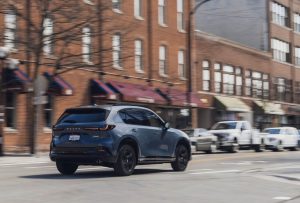
A hybrid drivetrain is also on-deck for the 2027 mode year.
The Bottom Line
How finely can you slice a pie and still have two distinct slices?
Mazda just did that.
. . .
If you like what you’ve found here please consider supporting EPautos.
We depend on you to keep the wheels turning!
Our donate button is here.
If you prefer not to use PayPal, our mailing address is: EPautos 721 Hummingbird Lane SE Copper Hill, VA 24079