



Some can remember when Coke tried to transition into New Coke – which was actually not Coke. And neither was Classic Coke, when it came out to placate people who rejected New Coke and wanted the old (real) Coke back. What they got instead was “Coke” sweetened with corn syrup rather than sugar. Most people still believe that Classic Coke is old Coke even though it isn’t.
This was one of the greatest and least understood swindles in the history of food.
Another that’s similar – and automotive – is the transition (to use that loathsome word) from measuring and identifying engines via their displacement in cubic inches to liters instead. This has served to homogenize engines by making them all seem the same, kind of like old Coke sweetened with cane sugar and Coke Classic with HFC.
Think of all the new cars – they are mostly crossovers now – that have 2.0 liter engines irrespective of them being different engines. The parts used to make a VW 2.0 liter four do not interchange with an Infiniti 2.0 liter four and yet both are “2.0 liter fours” and it sure sounds the same, doesn’t it?
It used to be that – in America – we didn’t use the metric system. Kind of like we didn’t play soccer – or call that “football.”
That was part of what made America different from Europe and Asia. The metric system is a relic of the French Revolution. The radical egalitarians – i.e., the Communists – who were its leaders imposed the metric system because it was uniform; that is, all the same. This is what Communists like. The metric system may be more mathematically sensible than inches and pounds and feet and yards and cubic inches but something gets lost in the translation.
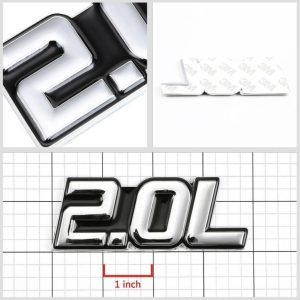
America, for instance.
It is now much more like the rest of the world because it uses the same androgynous metric system as the rest of the world. Not yet officially and not yet mandatory. But it’s been pushed on us nevertheless and nowhere else more so than under the hood. This began to happen sometime in the mid-1970s. That’s when American car companies began to denote the size of engines in liters rather than cubic inches. Previously, it was the rule to herald the size of engines – in particular, V8 engines – in cubic inches rather than liters. For example, the famous Dodge/Plymouth 426 Hemi V8. Just saying that summons emotions that don’t arise when one says 5.7 liters – the size of the modern Hemi (most of them). Chevy also makes a 5.7 liter V8 but it is not the same engine as the Dodge/Plymouth 5.7 V8.
The Metric denotations make them sound the same, though.
Chevy’s Camaro used to come with Chevy 305 and 350 V8s. Beginning in 1982, all of a sudden the 305 became the 5.0 and the same-year Mustang GT also came with a 5.0 V8 but it wasn’t a Chevy 305 V8; it was a Ford 302 V8.
Interestingly, the 1967-’69 Z28 also came with a 302 V8 but it was not a Ford V8.
What the metric system does is basically round off the difference between say a 302 and a 305 and make both seem as if they are the same (5.0 liter) thing. The current Mustang GT has a 5.0 liter V9 and it is not the same V8 as the old Mustang 5.0 V8 of the ’80s.
The same thing is always less interesting than a different thing.
Imagine what it would be like if every flavor of ice cream were the same “vanilla.” That’s essentially what you get with the metric system and it almost certainly has something to do with the general waning in interest in cars and what’s under the hood. It is rare to see the hoods of new cars raised at car dealerships because why bother? What’s too see? Another “2.0 liter” four? And you can’t even see that – because these engines are hidden under even more anonymity enhancing generic black plastic covers.
Imagine if dating were like this. Every woman (or man, if you’re a woman) the same height and build and hair and eye color, with the same (boring) personality. You might date one of them but dating the rest would be pointless since none would be any different. Dating would be a lot less interesting.
That’s what the metric system has done to engines and so to cars.
There are some signs of rebellion, however. Dodge began denoting variants of its modern Hemi using good old American cubic inches again; e.g. the 392 badges on the flanks of Chargers and Challengers equipped with the “6.4 liter” version of the Hemi V8. Alas, that brief resurgence was stilled when the Hemi V8 was removed from the Charger, which was turned into a device. The good news is this device has not sold well – an understatement on par with Emperor Hirohito’s comment that the war situation has evolved not necessarily to our (Japan’s) advantage.
Dodge is apparently going to bring back the Hemi V8 as an option in the Charger; whether it’ll be denoted in cubic inches or metric liters remains to be seen. Even so, it is likely to be the rule rather than the exception – because the metric system – like so many other pernicious things – is hard to beat back once it has taken root.
Thank the French. And Americans who are ok with everything being be the same.
. . .
If you like what you’ve found here please consider supporting EPautos.
We depend on you to keep the wheels turning!
Our donate button is here.
If you prefer not to use PayPal, our mailing address is:
EPautos
721 Hummingbird Lane SE
Copper Hill, VA 24079
PS: Get an EPautos magnet or sticker or coaster in return for a $25 or more one-time donation or a $10 or more monthly recurring donation. (Please be sure to tell us you want a magnet or sticker or coaster – and also, provide an address, so we know where to mail the thing!)
If you’d like a Baaaaa hat or other EPautos gear, see here!










I read an interesting point some time back about metric vs imperial (i think it was Dominic Frisby who has done a very interesting and comedic history of money and measures). The argument was that all modern design and art has been ruined and standardised by enforcing the metric system – reason being because the imperial measures were based on the human element (a foot being a foot and that) and therefore went better with the way humans thought and expressed themselves. The metric system is nothing to a human…. he proves the point by how all the magnificent designs of buildings in Europe were done under imperial system, and anything after metric became all dead and dystopian. I do believe the same can be said about cars….
Metric doesn’t bother me but I’m in America so imperial just feels normal. I don’t think it’s a topic worth ranting over but at the same time would prefer to use units that make sense for the subject at hand. When I’m working, I’m an electronics engineer, units based on tenths of meters, Celsius, etc work best. When I’m looking at a speedometer present it in MPH and my home’s thermometer in Fahrenheit.
In the metric system, the units are all scientific and neat and x10 tidy and easy to relate to each other. Works good for scientific endeavors. Whoopee.
In the imperial system the units tend to get a little messy, but they work fine nonetheless because they mostly came from and relate to the real world in which we live. I can just see a man a mile away; I can just feel .001″, etc.
I remember my father agonizing over what to get when he was buying a lathe – he correctly ended up with imperial. I remember my college cartography professor determined to use metric on a multi-map project – but reverting to imperial because the metric wouldn’t scale up and down on reasonable sized sheets of paper.
We end up confused. I can process metric engine displacements up to about 3 liters, above that I need to know the cubic inches.
In the imperial system, there actually is a measurement called “buttload”. The metric system’s got nothing on that!
Whats also disappeared, thanks to Feminazism and Political Correctness, is that unit of infinitesimal tininess, the “Cunt Hair”, and its derivative, the RED cunt hair. Back when Engineering was a “sausage fest”, we Engineering majors dated nursing majors, and the world hadn’t lost its sense of humor, nor tried in a futile effort to goad young women into “STEM”, which most of them are not temperamentally suited to pursue a career after graduation.
There are 61 cubic inches in one liter.
If there is one liter of displacement in a cylinder, times eight, 488 cubic inches, subtract 61 cubic inches, the displacement is 427 cubic inches. Those guys in the car manufacturing industry can do math, I think.
Divided by eight, 53.375 cubic inches of displacement in each cylinder. That will be 0,875 liter in each cylinder. I’ll do the European decimal point. har
They’ve been doing this with ammo for a while too, now. 6.5 Creedmoore, 6.8 Western, 8.6 Blackout, 6mm ARC, obviously 5.56 NATO and 7.62 NATO. I personally think the caliber designation sounds way cooler: .264 Creedmoore, .277 Western, .338 Blackout, .244 ARC, .223 Remington, .308 Winchester, etc.
Sowing, confusion. Is what they are doing.
…Spreading, dumbness.
I can just about picture some metric measurements, such as a liter, which is similar to a quart, and a meter, which just over a yard. I know that a kilogram is 2.2 pounds, and that to convert millimeters to caliber(s) you multiply by four. Thus, 9mm = .36 caliber, 10 mm = .40 caliber, and so on.
I do still have trouble visualizing a kilometer, except I *think* it’s about three-fifths of a mile.
Milligrams and grams defeat me, except , except I believe a gram is between a quarter and a third of an ounce.
What bothers me is having to do all this math to know what somebody is talking about.
I just instinctively know what an inch, a foot, and a yard is, and how it feels and how long it takes to walk or run a mile.
I can guesstimate pretty accurately whether an object I pick up weighs a pound or five pounds or ten pounds, without doing any mathematical calculations.
‘On 10 December 1799 the Revolutionary French adopted the metric system. It is as inhuman and inhumane as its inventors. Shucks!
The basic length is not the width of your thumb (an inch), the width of your hand (a span), the length of your arm from fingertip to elbow (a cubit), or even the length of your foot, all measuring sticks we carry with us daily.
Oh, no, it’s the logical, “scientific” 1/1,000,000th of the distance from the equator to the North Pole, a length well known from almost everybody’s experience.
To make it worse, 10 is only divisible by two factors, 2 & 5 (well, by 10, too, but that does no good), instead of four like twelve or sixteen.
I’ll tell you how I know the metric system is unnatural, inhuman, & depraved. When I was living in Berlin in 1972 & 1973, you NEVER heard anybody in the meat market ask for “500 grams” of bratwurst or anything else.
They always asked for a “Pfund” (500 g) or “ein halbes Pfund” (250 g). Not even the Germans would use metric.
And don’t even get me started on kilometers or liters. I can’t even figure out if it’s a KILL-o-meter or a kil-LOM-iter. Can’t trust any measurement I can’t pronounce.’
— Franklin Sanders, the Most Dangerous Man In the Mid-South
“KILL-o-meter or a kil-LOM-iter”
Interesting, that. Never thought about it before.
CLICK. There fixed it for you!
I use Cubic Inches in my writing, and I feel we’re gonna return to the proper days once more of CI vs Liters.
I hope so, Carmelo!
I loathe tje metric system. Jim nailed it when he said it lacks any human connection.
RE: “I loathe tje metric system.”
The dang sheet, when they taught us children that system back in the 1970’s in co-ed prison, ‘er public school,, the result was – most of us – didn’t learn either system.
Looking back, I imagine it was all by design.
Hi Helot,
There’s just something off – to me – about buying grams rather than ounces. Orwell had it right in 1984. Pint o’ wallop!
Hello Eric, some of us were brought up and bred in metric, and cannot visualise measurements any other way. I also used to ‘loathe’ imperial, what with all its disjointed and mis-matched units, unlike metric which transitions from smaller to larger units smoothly and gracefully, but came to the realization its like the way different languages use different words to express the same thing. Nowadays, when talking to an American, I strive to use imperial, just to make the interaction smoother, pleasant and an experience to remember.
If I’m “hangry” and have to settle on going through the Clown’s Drive-Thru (McDonald’s), I’ll order a QUARTER POUNDER WITH CHEESE, not a “Royale with cheese”. And the screen writers of Pulp Fiction got it wrong. While certainly using an Imperial unit of weight wouldn’t be meaningful in the country that invented the Metric System, being consistent with the “Frog” (French) nature to be utter pissants, the REAL reason for branding that sandwich of stale bread, goo masquerading as cheese, and a patty of cow fat and gristle as “beef”, is that when the Golden Arches started in France (about 1971, I believe), there was a big push by the French government, led then by George’s Pompidou, to get “Franglais” out of French culture. Of course Ray Kroc’s corporate bucks would come up with substitute brand names.
One Astronomical Unit is 1.496e+11 meters, the distance from the sun to the earth.
Makes no sense to anybody unless you are familiar with astronomical measurements.
149,600,000,000 meters
149,600,000 kilometers
93,000,000 miles
24 time zones, 15 degrees for each time zone, one hour, the sunrises at the leading edge and sets as the dark proceeds, the earth rotates one more time, takes 24 hours.
You have to work with base 12, completely necessary. Takes time to know how time works.
One day, circle the sun, count them, you’ll be back to where you started. March 21 to September 21, you’ll be on the other side of the sun.
A unit circle, D=1, will always have a circumference of 3.14159265359, doesn’t matter the system.
Big D…
Thank you for the information…..That “International Date Line” thing allows a Kool back door into weird (1 day) “twilight zone” Time Bizarro shit! To wit, I take off from St Louis on November 24th 1997 (afternoon) one way to Auckland NZ……The flight was 14 hrs total….
When we landed it was November 26th….Dang I waS ripped off for a day!!!!
Considering that light traverses from our Sun to us in eight minutes, astronomy-wise, an AU is just a “smidge”. Indeed, our closet known star, Proxima Centauri, is itself part of the Alpha Centauri system, being gravity bound to Alpha Centauri A and B. Those two stars, one a bit bigger and brighter than our Sun, the other somewhat smaller and dimmer, are separated from each other by about 80 AU, or roughly 7.5 billion miles. They both are 12,950 AU from Proxima, or about 0.22 LY. Please let that sink in. Light takes about 2.5 MONTHS to reach it from its primary stars that it orbits! The view from the exoplanet Proxima b if Alpha Centauri would at times be discernable to the naked eye as two distinct stars, but not always.
Space is VAST.
It seems to me that metric began creeping in back in the late 70’s when sodas were first offered in 2 liter plastic bottles (no idea why soda companies didn’t just offer soda in half gallons, like milk…). Then, car engines began switching to liters instead of cubic inches. Then 10K races became popular. I was never taught any metric in school (who knows that they teach now, if much of anything) but it gradually wormed its way into certain applications.
For some applications, I don’t mind metric, and actually it is easier (IMO) to use for very small linear measurements. Once the measurements get bigger, I get lost. I’m not keen on metric for weight, either. Having to multiply 2.2lbs to get weight in kilos is a pain and not so easily done in one’s head (at least not mine, as I suck at math). Meters work OK until again, the measurements get larger, as one must account for the extra three inches for each meter.
I can pretty well guess how far a mile is, but all I know about a kilometer is that it’s a bit less…and don’t get me started on temperature. As far as I’m concerned, if it’s 20 degrees outside I’m grabbing my heavy winter coat. If it’s 95 degrees, I’ll be in shorts and sandals. Celsius is totally unrelatable. The rest of the world can keep that one!
And yes, I do think that having a car’s engine listed by cubic inches does sound more formidable and impressive. By contrast, for someone to run a 10K race sounds far more impressive than if they ran a 6.2 mile race…
Screw all this new fangled sh*t!! Let’s go back to using the British Standard Whitworth for threads.
As an engineer, who does lots of physics math, I appreciate the metric system because it’s easy to work with at any scale due to the power of 10 prefixes. It’s also brilliant that different measures are related, eg, 1 cubic centimeter = 1 milliliter = 1 gram of water, and 1 calorie = the energy it takes to raise 1 ml of water 1 degree celsius. It’s all related and I can do conversions really easily.
I don’t care if an engine is 2.0L or 122 cubic inch, it’s the same thing. Everything now is 0.5L/cylinder, or 26.5 cubic inches per cylinder, because that’s the thermodynamic sweet spot for efficiency (and therefore power too).
There are lots of things to be upset about, but I can’t get worked up over this one. A porsche V8 is very different from a Ferrari V8 which is different from a GM V8, even if they’re measured in liters. My problem is that the V8 is being forced out by government, irrespective of how its capacity is measured.
Agreed completely. I have a PhD in physics and metric (or SI as we call it in science) is the language of science and engineering and it’s awesome. It’s very easy to convert from one prefix to another as opposed to the silly conversions in imperial. Moreover, the base units are all based on a physical property of the universe, such as the meter is based on the speed of light or the second is based on the vibrations of the caesium atom, etc. Also, our customary units are actually defined using the SI system so in a round about way we are using it already lol. I like Eric and regularly read his posts but I have to respectfully disagree with him here.
Don’t denigrate the foot as a measurement. 1ft X 360⁰ X 365.242 X 1000 yields the equatorial circumference of the Earth to 0.016%.
Dividing by 12 is another historical way of counting and measuring.
On a practical basis, a degree F is a smaller and hence more precise measurement than ⁰C the same way a 32nd of an inch is more granular and precise than a mm.
I find feet very useful when building stuff like decks or sheds since it’s really easy to divide a foot into equal halves, thirds, and fourths.
When it comes to interoperating with the world at large, which is metric, it’s less useful.
Don’t get me started on US gallons being different from UK gallons…
US gallons, are different from, UK gallons?
I did Not know this.
Seems like a Super cluster-fuck.
So is base 60 but you don’t see me advocating a return to that one (sure beats radians though)
Something I recently saw was that all those metric sockets are still turned by good ol’ SAE 1/2, 3/8, 1/4 inch handles…
The writing was on the wall (door panel).
As a kid, wondering what was up with the door panel emblem on my brothers 67 GTO
“6.5 LITRE”
Fast forward to 1985, replacing the power steering hose on Old Yeller my 79 Gran Prix, one end the nut was standard the other end metric. GM transition wasn’t complete!
Gm could fuck up a wet dream.
And, BTW the feet and inches, pints and quarts, miles per hour Americans beat the crap out of the metric Germanoids and Japanese.
Correctamundo! Try cutting that meter into thirds. Uh huh.
WWII Boeing B29 production, last full month they reached 375 completed.
https://nuclearcompanion.com/data/boeing-b-29-production/
That also means they had to build 1,500 engines to power the beast, imagine the effort/facilities required to build 50 of these IN A DAY.
https://www.flickriver.com/photos/sarge_schultz/14958832274/
I watched a B29 take off from Renton Field decades ago. Best engine sound you’ll ever hear, plus you could feel the rumble in your chest hundreds of feet away.
The “Rooskies” had a helluva time trying to reverse engineer from three B-29s that couldn’t make it to their airfields in China and thus landed at the Vladivostok Airport. They planes were interned; the crew “gradually” made it to where they could be repatriated to the USA, out of sight of the Japanese, to avoid infringing their then neutrality. As simple thing like different aluminum sheet metal thicknesses led to the Tu-4 “Bull” being about 7,000 pounds, or about 3,200 kg, heavier than the B-29D.
Hi Mr. Liberty ! Thermidor ! Crazy ass Frogs created metric time, 10-day weeks, 10-month calendar, they were crazier than pet coons. Which reminds me, the French aka Frogs, have a saying, “renvoyer au calendes grecques” place on the Greek calendar, which is like our sending an item to committee, because the Greeks didn’t have calendars, or something like that.
I too prefer the old school way of denoting engine displacement by cubic inches. 440 Magnum just sounds cooler than 7.2 Eurofag.
I am very much enjoying the month of Thermador right now. It’s my favorite..
Liberté, égalité, fraternité
Well Citizen, it beats the heck out of the month of Pluviôse.
Yes. Too dark, cold and rainy for me.
Old men shaking fist at clouds
The metric system is not the source of your problems. ROTFL
It’s not the source, but it’s a symptom, and a valid opinion and complaint. It sticks with the common theme of replacing perfectly functional systems with inferior, unnecessary new systems, pushed on us.
Yes. The commie idea of Year Zero and all. BID may need some education on this one.
100 meters by 100 meters is 10,000 meters squared or one hectare. (2.54 acres).
1000 m x 1000 m is 1,000,000 square meters or 100 hectares.
254 acres in one square kilometer.
16.5 feet is one rod, 160 rods equals 2640 feet.
One rod by 160 rods, 16.5 feet times 2640 equals 43560 square feet or one acre. 2640′ by 2640′ is one quarter of land.
Why? In the beginning, one chain equaled four rods or 66 feet, 80 chains times 66 feet equals 5260 feet or one mile. At 66 feet equal to one chain, you could level that distance or plumb it to the world, you had fairly accurate measuring tools that worked to lighten the load of measuring distances and land areas, the US Geological Survey statistical data emerged.
You had to level the transit for an accurate line of sight.
You surveyed landowners land to determine if the neighboring farmer was encroaching on the farmers land by maybe five acres. Farmers don’t like that.
You go out to the field and find a US Geological survey brass marker and go from there.
A carpenter’s square is 16 inches by 24 inches with a 1/100th of an inch scale on the face of the square, 50.8 mm for an inch.
The 1/100th scale is superior.
You’ll want to use the 1/100th of an inch scale for drafting.
100 kliks per hour or 62.5 mph, the metric system takes your farther. har
50.8 mm per inch is twice the number needed, 25.4 mm per inch. Have to scale it down, 0.254 mm will be 1/100th of an inch.
Oh well, 1/100th of an inch is 1/4th mm.
You see the superiority of the 1/199th inch scale.
Mistakes are inevitable.
Hey Metros ! Take your metrics and stuff them where the sun don’t shine !
Yeah! And be sure to get all 12 inches of it in there. That’s 12×25.4= 300 CM (oh dear!)
Yeah I know. Its a joke. Designed to make a point.
‘The metric system is a relic of the French Revolution.’ — eric
Tout à fait. In the late 18th century, the French Academy of Sciences defined the meter as one ten-millionth of the distance from the equator to the North Pole, along the meridian passing through Paris (bien sûr!).
What a colossal blunder! This definition was useful to no one. For physicists and astronomers, the speed of light and distance it travels in a given time are fundamental units.
For earthbound beings, the Romans (and even the bloody English) got it right: an inch corresponds to the distal phalanx of the thumb; a foot corresponds to the human foot (size 12); a yard to a tall man’s pace. And so forth. Human scaled, not based on a curve of the earth we can’t even perceive.
But exotic metric units caught on like wildfire in the groves of academe. Recently I read a consulting archaeologist’s report, studded with metric units. They surveyed a 15-meter corridor, not a 50-foot one. A thousand hectares were covered, not 2,471 acres. And so forth.
None of the people who use their reports in the field — including grubby, dust-covered pick swingers like my goodself — work in metric units. But these idle academicians, using alien Frenchified units, carry on thinking they are the cool kids. They’ll think different when we make them dig trail tread with their bare hands, as our German shepherd guard dogs bark and slobber inches from their pale white pencil necks.
The measurements are all divisible by 2, 3, 4, 12, 16 etc. Makes it much easier to proportion out, just change the denominator. At least if you were taught fractions in math class.
Decimalized measurement systems are nice for base-10 math for calculators but are more difficult to wrap your head around when you’re cutting lumber or cooking dinner.
Also, if you’re working in decimals it doesn’t actually matter what you call it.
What matters is that the numbers you get out are nice & easy to work with. Ideally your numbers should be 1-100 or better yet 1-10, because those are easy to estimate & do mental math with.
Hence the existence of mixed units like grams per cubic inch, and the persistence of the classic human-scaled customary measurement system.
One of my favorite graphics compares 0-100 in each system, in terms of weather.
0 Celsius = “cold outside”, 100 Celsius = “dead.”
Similarly 0 Kelvin = “dead,” and 100 Kelvin = “still dead.”
On the other hand 0 F = “very cold outside” and 100 F = “very hot outside.”
Thus proving that (at least for purposes of measuring the weather) Fahrenheit is the superior scale.
Also don’t forget there are 2 English systems, the U.S. one and the Imperial one. I believe the lengths are the same but the volumes are definitely different, the Imprrial sizes are a bit larger
1 imperial pint is approximately 20 U.S. ounces, not 16.
One time when I was in grad school I calculated out which has more alcohol, a U.S. pint or an Imperial pint…accounting for the additional fact that our beer is usually a bit stronger than theirs. Turned out it was very close to the same.
I’ve advocated a “metric time” system setup, as if the metric “second” is 1/100,000th of a sideral day, it’s about .864 of our current second. So when would “zero year” be? I say, make it 1830 hours, Central European Time, on April 20, 1889.
If you’re doing decimal time, the zero point is almost definitely July 14, 1789.
I stand corrected.
It was originally supposed to start on July 14 1789, and did according to the National Constituent Assembly (the O.G. Revolutionary government), but then on Jan 2 1792 the Legislative Assembly (the second Revolutionary government) voted that “year IV of liberty began yesterday (in so many words),” so the zero point was re-set again to Jan 1, 1789.
Then the zero point got re-set again to coincide with the establishment of the Republic so 1792 became Year 1.
Decimal time came in slightly later & only lasted a few years but never caught on & kind of slowly/piecemeal died out. mandatory 1794-1795 but a few places used it at least occasionally up to ~1801.
The calendar thing lasted until 1806 (2 years into Napoleon) & by then everyone was sick of it & it never really came back.
Jim –
A pace is two steps, a step is three feet.
Amen, Jim!
Acres is another. My deed says “plus or minus” – which isn’t exactly. Acres are human scaled.
It was considered the average size of a field that could be plowed in a twelve-hour day in the early spring by a typical farmer, using a plow pulled by a single mule.
All deeds in Nova Scotia are plus or minas. With most of the province being “private “ property this is to let the lawyers off the hook. If the property is a prefect rectangle or square you can be within a cunt hair of the actual area. If the property is a polygon it is plus or minas. An according, this all depends on the location of the corners on the ground.
Metric: another shitty relic of the French Revolution.
I can’t remember where I read it, maybe here, maybe Lew Rockwell, but no country ever voluntarily adopted metric. It was foisted on them by their government.
The French Revolution was a mixed bag.
Bringing some semblance of accountability to the ruling class was not entirely a bad thing. The way in which that was done left a bit to be desired, perhaps. But in terms of taxes and being left the hell alone on a day-to-day basis, as a relative nobody I’d take revolutionary France over 21st century USA any day of the week.
Pulleeeeaaase. The metric system is so superior to the US/SAE system that anyone whingeing about metric sounds like Saturday Night Live’s Middle Age Man or even Grumpy Old Man
If the US had remained a Confederation, which it was supposed to be until the Judeo-Masons took over, not only would the Civil War not have been necessary, but each state in the Confederacy would have had its own methods of raising taxes for things like roads.
Some states, perhaps a cluster, or a majority of them, would have come up with the idea of taxing automobiles to pay for roads based on engine displacement. Many European countries did this, and that is why most European cars have standard displacement levels to stay beneath the next step in tax rates and insurance class as well. 1599cc or 1597cc was called 1600 or 1.6 liter (try to do the displacement math between 302 cubic inches and cubic feet). 1995cc or 1997cc was called 2000cc or 2 liter because they were under the all important tax level of 2l.
One interesting side note to this is what happened to France. They set their tax step up to extraordinary levels for engines greater than 2 liter. Consequently Citroen and other luxury makers never bothered to make engines larger than 2 liters which is why the Citroen DS (aka the French Cadillac) were so underpowered and were unable to find a market in the US despite the low price of the French Franc.
The British nobility, who never willingly pay for anything, wanted to keep their large displacement Daimlers, Rolls and Bentleys, so they weren’t crippled with high taxes.
Hi Brosi!
The point i was trying to make is about the intangibles. An EV accelerates more efficiently and forcefully than a V8 muscle car. But it is a much less emotionally interesting experience than flooring the gas pedal of an old muscle car and hearing the engine/exhaust sounds. I am one of those odd ducks who does not think that “efficiency” is everything.
Here’s another: A modern missile frigate would sink a battleship. But a battleship firing its big guns is much more spectacular.
Eric, when the Reagan Administration, in building up Lehman’s “600 ship” Navy, brought the four Iowa-class battleships out of mothballs, they were refitted with Tomahawk missile systems, as well as the Phalanx anti-missile ship defensive system. But they would have retained their 16-inch guns along with those massive turrets, because otherwise the ships wouldn’t have been stable!
Not only was a broadside from an Iowa-class a sight to behold, it could still deliver almost ten tons of “whoop-ass”! in one salvo.
DS…
How about the Major League Fuckup of BB-61 when in April 1989…off Puerto Rico did a Firepower demonstration for the admiral…. The dude ordered them to stuff extra power bags , prior to the demo…
Middle turret 2 “cooked off” killing 47 sailors……The F..ink attending admiral was wisked away by chopper immediately after….
First hand “sitrep” from a Fireman on board ….After the compartments were flooded to prevent fire…..the dude heard sailors pounding on the door until they drowned…
And so it goes…..
The metric system is franco-communist garbage, but hey, if works for you knock yourself out with it.
Who are they going to pay taxes to, themselves?!
I beli ve that’s called a “savings account.”
OK, Eric, I’ll give you that cubic inches has more flair and style. However, when it comes to fasteners I far prefer metric to SAE. Maybe it’s because that’s what I learned first but, slicing bolt heads down to 64ths of an inch? Thread pitch that makes no sense?
Most Japanese cars can be worked on using only a half dozen wrenches/sockets. I can only imagine how bad German cars would be were it not for metric.
I agree, metric takes it hands down. I lived in the US until I turned 30 and was raised on SAE. It took a few years, but after learning the metric system I never looked back.
Most Americans are probably not aware that metric wrenches and sockets all work very well on SAE sized bolts and nuts. The sizes are close enough. I am not sure about allen wrenches but I’ll bet that holds too.
I don’t think there is such a thing as a SAE Torx size, which kind of proves that Americans silently accept the superiority of the European system on this issue.
Yes, many metrics can work with SAE, e.g. 3/4″ = 19mm, 9/16″ = 14mm. However, allen/hex does not translate. You’ll end up with a bunch of rounded internal socket heads. And, 12-point does not equate to triple-square.
Not one man in 1000 understands the triple square as proven by the number of stripped fasteners I’ve worked with over the years.
Not one in 100,000 understands Whitworth thread forms or wrench sizing.
And let’s not forget how easy it is to know what drill size you need for a given metric tap.
M16x1.5 tapped threads desired?
Drill size = 16mm-1.5=14.5 mm drill needed.
Now tell me off the top of your head what drill size is needed to tap a 4-40 thread.
SAE fasteners suck.
OK, BiD, leave it to you to bring in Whitworth. Try laying that on your average AdvanceZoneReilly counter monkey.
And, if you think the Germans lost WWII, you’ve never worked on a Porsche.
Fighting a BMW X5 with electrical gremlins as my current entertainment.
No love lost for BMW’s suppression of right to repair.
Aircooled Porsche’s are a weakness I can’t overcome.
No one does over the top complexity as well as the Germans. 😉
To your point, the rear brake assembly on some aircooled Porsches have 9, 10 & 11mm bolt heads.
Yet their most famous automotive product, der “Kraft durch Freude wagen” (“Strength Through Joy” car) aka “Der Kafer” (Beetle), was renowned for its mechanical simplicity. The idea was that even boys with just a semester of the German equipment auto shop could perform most routine maintenance and repairs, and for more complicated matters, like an engine rebuild, the air-cooled engine (picked in part to simplify the rear engine mounting and also to render use of antifreeze unnecessary) came out with fairly little effort.
It’s a shame that Volkswagen AG got away from that approach, but likely the same obsession with emissions and safety that eventually doomed the Beetle also made it unavoidable.
Let’s face it, nobody really likes Torx or triple square, well. . .except sitspinklers.
I’ll give you metric taps, but I do like the fine distinctions with motor displacement: 215 (Buick and later Rover V8), 250 (Chevy straight 6), 289 (Ford V8), 300 (Ford straight 6), 301 (Pontiac V8), 302 (Ford V8), 305 (Chevy V8), 307 (Olds V8), 318 (Dodge V8), 327 (Chevy V8), 340 (Dodge V8), 350, 351, 360, 383, 396, 400, 401, 426, 440, 454, 455, etc. I’m sure I’ve missed 100 others too.
I agree, as an engine identifier. It adds uniqueness into the mix. When it comes to fasteners the less variation the better.
Yes, metric is best for engineering. In the 2×4 world though Im better with feet and inch.
Though I own multiple sets of bits etc, every time I SEE any torx star crap I cringe to this day. Needless nonsense.
RE: “Yes, metric is best for engineering.”
Why do you say this?
…Do engineers only think in 10’s?
…Unable to think otherwise?
…Makes one wonder, how did The Empire State building go up, or the Panama Canal get dug?
…Did the Egyptians use The Metric system to build The Pyramids? Idk.
There’s nothing wrong with the “thou” (i.e. thousandth of an inch), inch, foot, gallon, cubic yard and acre for engineering.