

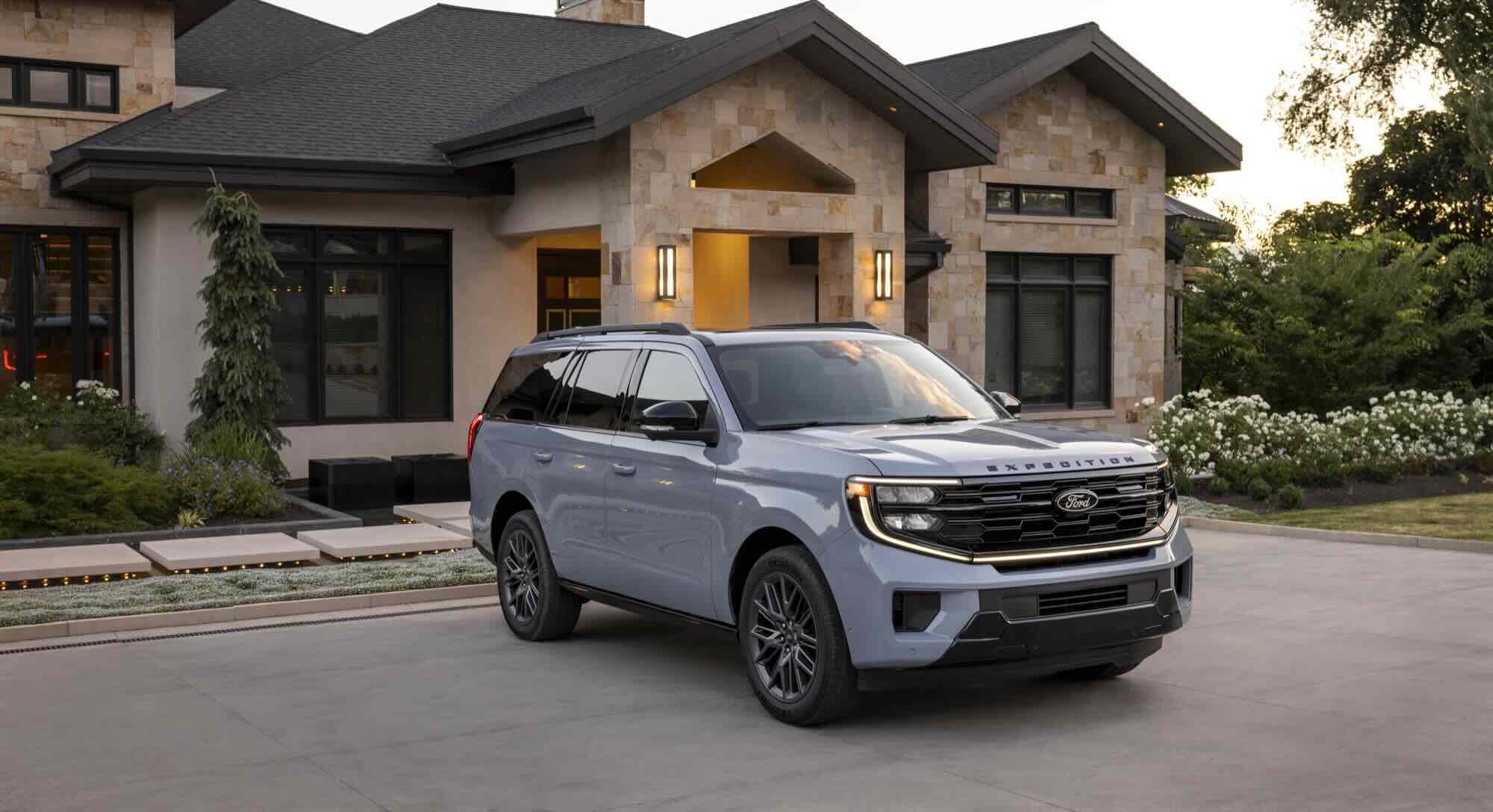

Big SUVs are bigger – and stronger – than they have ever been. The just-updated Ford Expedition, for instance is available with a 510 horsepower, twin-turbo V6 and comes standard with a 9,600 lb. tow rating. It weighs close to three tons yet is capable of getting to 60 in less than five seconds, which makes it quicker than just about every V8-powered muscle car of the ’60s.
It gets better gas mileage than most of them did, too.
What It Is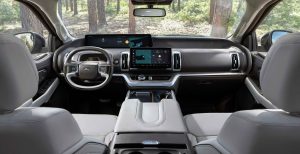
The Expedition is Ford’s full-size SUV; the Max version – focus of this review – is even fuller-sized, being about a foot longer than the standard Expedition. It competes chiefly with the Chevy Suburban, which is the fuller-sized version of the Chevy Tahoe.
Prices for the standard-length Expedition Active trim with a 400 horsepower version of the 3.5 liter twin turbo V6, standard dual LCD displays, eight passenger seating and rear-drive begin at $62,320; adding the optional 4WD system bumps that up to $65,320. The longer Active Max lists for $65,320 with RWD and $68,320 with 4WD.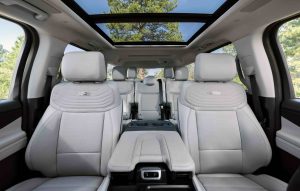
Next up are Platinum ($74,750 to start for the standard length; $77,750 for the Max) trims. The Platinum comes standard with 4WD as well as a 10 speaker Bang & Olufsen audio system and massaging front seats. The 510 horsepower high-performance version of the 3.5 liter V6 is available as part of an optional Ultimate package ($13,570) that also includes 24 inch wheels, a 22 speaker B&O audio system and an adaptive suspension, among other upgrades.
The $81,350 Tremor comes standard with the high-output engine, plus off-road equipment that includes 18 inch wheels with 33 inch General Grabber all-terrain tires, underbody skid plates and tow hooks, locking rear differential and a one-inch lift for additional ground clearance. The Tremor is not available with the extended-length Max configuration.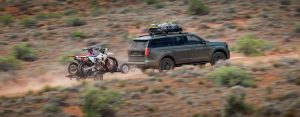
A top-of-the line King Ranch lists for $83,975 for the standard length version and $86,975 for the Max. These also come standard with the HO V6 and 4WD as well as a specific set of bronze-anodized 22 inch wheels, the 22 speaker B&O sound system, adaptive suspension and “King Ranch” embossed brown leather seat covers.
What’s New for 2025
In addition to a revamped interior with dual LCD displays (standard in all trims) every Expedition gets a new two-piece rear liftgate; the lower section can be folded out (and flat) and the upper section opens up and out. There are also slight exterior styling updates, including new head-and-tail-lights and revised grille.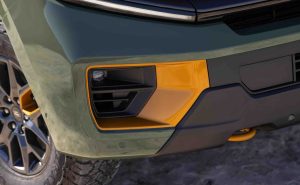
The Tremor replaces last year’s Timberline.
What’s Good
Much stronger standard engine (and much higher standard towing capacity) than Chevy Tahoe.
Big – and bigger – configurations.
Rides like the Titanic.
What’s Not So Good
Base price is thousands higher than Tahoe’s ($58,500).
No V8 or diesel engine option (available in Tahoe).
Is almost as big as the Titanic.
Under The Hood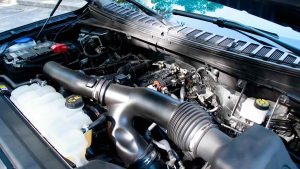
Ford led the way – in terms of replacing big V8s with small (and turbocharged) six cylinder engines in its big SUVs. If you don’t know why, the reason – fundamentally – is compliance. The car companies have to please both the government (first) and then customers (second). The government lays down regs having to do with such things as gas mileage and tailpipe exhaust emissions and it is up to the engineers to figure out how to comply while also maintaining the customer appeal of the vehicles they’re trying to sell.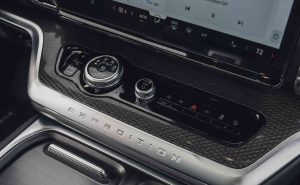
It is particularly difficult to make a V8 engine compliant – because big V8s by their design are big. This means they have big cylinders – eight of them – that are always pumping and that means moving air/fuel and creating more exhaust; the latter can be scrubbed of almost all the harmful-to-the-environment emissions. But not C02, which is now lumped in with the other (harmful) emissions. By replacing the big V8 with a smaller six, you have an easier time complying – because the smaller engine moves less air (at least, when it is not under turbo boost) and so there is less exhaust (and C02) being emitted. The smaller engine also has the potential to use less gas – thereby helping the company that makes it to comply with federal regs that demand ever-higher gas mileage “standards” be complied with.
But there is another reason – and even though it’s secondary, it is still important. It is that by turbocharging an engine, you can also offer customers an engine that makes more power, sooner. Specifically, more torque – which is the twisting force that makes a vehicle feel more powerful, sooner. Turbocharged engines make more torque at low RPM. In this case, the Ford’s 3.5 liter V6 generates more torque (480 ft.-lbs.) than the Chevy Tahoe’s much larger 5.3 liter V8 (383 ft.-lbs.) and more horsepower, too: 400 vs. 355.
That’s why the Ford can pull 9,600 lbs. (9,000 for the Max). The Tahoe’s standard tow rating is just 8,400 lbs.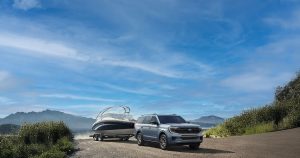
Even the Tahoe’s optional 6.2 liter V8 only makes 460 ft. lbs. of torque -and not until 4,100 RPM. The Ford’s turbo V6 produces its maximum torque at 3,300 RPM.
If you want more torque – and power – Ford offers a high output version of the turbocharged 3.5 liter V6 that touts 440 horsepower and 510 ft.-lbs. of torque. Both versions of the 3.5 liter V6 are paired with a ten speed automatic that is actually the same automatic used by Chevy in the Tahoe and Suburban. Ford and GM developed this transmission jointly, to reduce R&D costs.
One thing the Tahoe does have – offers – that the Expedition doesn’t is a turbo-diesel option, which is available with the Tahoe. The chief advantage of the Chevy’s available diesel engine is that it remains pretty fuel efficient even when you’re pulling a trailer. Gas engines tend to become gas hogs when you’re pulling a trailer.
Chevy makes this even more appealing by offering the diesel as an a la carte option with most trims for just $995.
On The Road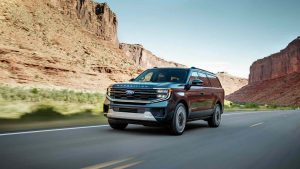
This is a big ship – which is why it’s kind of incongruous that it’s so quick. Equipped with the HO version of the 3.5 liter V6, this three ton (almost SUV) can move from a dead stop to 60MPH in just over 5 seconds.
That easily smokes the Tahoe, by the way.
(There are quicker big SUVs such as the electric iterations of the Cadillac Escalade and the Rivian device – but they can’t go nearly 600 miles on a full tank and when their charge runs low, you’ll have to stop and wait at least half an hour or so before you can get going again.)
The Ford’s four wheel independent suspension and body-on-frame construction provide both softness and heft.
The only thing the Chevy’s got on the Ford is that its V8 sounds better. More right for the rig. You don’t hear the Ford’s turbo six much at all. That’s considered desirable by many, of course. On the other hand, being able to hear the V6’s turbos spooling up – that whistle-turbine sound – might also add some emotionality to the experience. Regardless, you get authoritative forward movement with minimal pedal effort. The only complaint that’s fair to level at the Ford’s drivetrain is the standard automatic stop-start (ASS) system it’s saddled with – another compliance measure. ASS is used to help slightly decrease fuel consumption by shutting off the engine s often as feasible; this also serves to decrease the exhaust flow (and so, C02 “emissions”) to nil when the engine is off.
But when the engine is off, so is the AC – which is driven mechanically, by the engine. The vehicle’s systems will re-start the engine if the temperature in the cabin starts to rise more than a little but – but it’s enough of a little bit that you can feel it. Arguably, that is not something anyone who spends the $60k-plus minimum it takes to buy a vehicle such as this ought to be feeling.
But don’t blame Ford. It is only trying to comply.
There is one other thing – and it doesn’t have anything to do with how the Expedition drives or rides or handles, though it affects all of those things. It is the tap/swipe smartphone-emulating inputs for the climate controls and audio system controls. There’s no tune-by-dial knob, so you have to tune by tapping/swiping, which is clunkier to do even when the vehicle is stationary and much more so when you are trying to drive at the same time. There is a volume control knob on the lower shelf of the center stack and that’s a help. But a tune/station change knob would help as well.
Also steering wheel paddle shifters (the usual thing) to control shifting of the ten speed automatic manually when that’s wanted. Instead, Ford mounted the “+” (upshift) and “-” (downshift) buttons on the same center console shelf where the radio volume control knob is located.
The final thing that detracts from the driving experience is the suite of standard driver “assistance” nannies that cannot be turned off. You are only allowed to reduce the “intensity” of the nagging – and interference with your driving. For example, if you try to back up and get too close to a bush or some other thing that the system decides you’re getting too close to backing into, it will apply the brakes automatically and forcefully, which may result in spilled coffee on top of the annoyance of being preemptively parented by the vehicle. You may know exactly how close that bush is – because you back up in your driveway every day – and so know how much room to back up you have. It doesn’t matter; the system overrides you.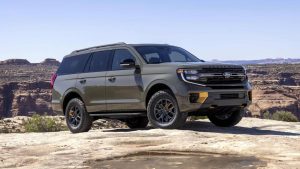
At The Curb
The Expedition is big – but it’s not quite as big as the Tahoe. The Ford is 209.9 inches long – in standard length configuration – vs. 211.3 for the Tahoe. But if size matters – or at least, length – the Max version extends out to 221.9 inches long. You can get an even bigger (longer) Suburban, which is basically the longer-length version of the Tahoe. It is 226.3 inches long. Chevy markets the Tahoe and Suburban as two separate models even though they’re basically the same SUV in different lengths. Ford sells the Expedition as one model in two different lengths.
The attraction of the regular length Expedition is that it’s a little less long than the Tahoe but not as long as the Suburban – plus the Ford’s stronger standard engine and much higher standard max tow rating.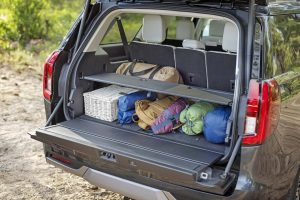
This year, the Expedition gets a two-piece liftgate that has a separate lower section that can be folded out, to create a table for tailgating that also makes it easier to load/unload stuff. Or leave it up to serve as a dam, to prevent stuff you’ve loaded from failling out the back with the upper part of the liftgate open. You can also leave it in one piece and just raise or lower the whole thing as usual.
Up front – in front of the driver – there’s a new 24 inch flatscreen display panel and to the right of that, a 13.2 inch center touchscreen. Most of the vehicle’s secondary controls are housed in the center touchscreen, as detailed above. It’s strange that Ford decided to keep a knob control for the audio system’s volume but decided not to include a similar knob to allow manual station tuning.
The steering wheel isn’t a wheel. It’s more like a rounded/smushed rectangle. This does give more leverage – less steering effort – in most normal driving situations but if you are someone who might drive fast (in the curves, especially) the smushed rectangular steering wheel feels weird when turned hard-over (think Titanic trying to steer around the iceberg).
All trims come standard with a power folding third row and both the second and third rows fold completely flat.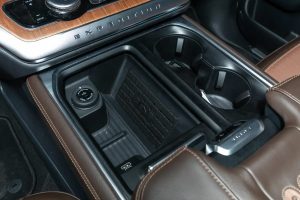
This Ford can be equipped such that it becomes a Lincoln in all but name. Among the Lincoln-esque features are the 22 speaker B&O ultra-premium audio system and the available driver and front seat passenger massaging seats that are bundled with the Touring package. An Expedition so equipped isn’t exactly inexpensive but it can be considered a bargain relative to the Navigator – which starts at $99,995 and doesn’t come standard with massaging seats (they’re available, but you’ll be spending well over $100k to get them). Also, the Lincoln isn’t available in longer-length form.
The Rest
Speaking of what it costs . . . .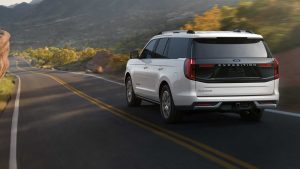
Would you believe (say it like Max from Get Smart) that just five years ago, the Expedition’s starting price was $48,990? That’s an increase of $13,330. This isn’t to pick on Ford – or the Expedition. It is to point out the alarming rise in prices generally. The ’25 Expedition does have some things the ’20 didn’t – such as a 24 inch flatscreen main gauge cluster and the two-piece tailgate. But it’s 90-plus percent the same big SUV. What’s very different is that this SUV – even if it’s a Ford – now costs as much as Lincolns used to. To put a finer point on it, the Expedition – which used to be a vehicle within reach of middle-income Americans – is much less so now than it was just five years ago.
The Bottom Line
The Expedition’s a wonderful big lug of a vehicle. If you can afford it.
. . .
If you like what you’ve found here please consider supporting EPautos.
We depend on you to keep the wheels turning!
Our donate button is here.
If you prefer not to use PayPal, our mailing address is:
EPautos
721 Hummingbird Lane SE
Copper Hill, VA 24079
PS: Get an EPautos magnet or sticker or coaster in return for a $25 or more one-time donation or a $10 or more monthly recurring donation. (Please be sure to tell us you want a magnet or sticker or coaster – and also, provide an address, so we know where to mail the thing!)
If you’d like a Baaaaa hat or other EPautos gear, see here!









I skimmed the article looking for the curb weight (didn’t see it). Probably weighs nearly as much as it’s towing capacity.
“Tremor” is an unfortunate name. This is a truck for Alcoholic or Parkinson’s disorders?
That’s hilarious, Matt – post o’ the day!
I was in one of these today. I was unimpressed.
The two screens caught me off guard.
My only question was when the screen dies will it run?
Whoever owns these in 7-10 yrs won’t be able to fix them
‘Every Expedition gets a new two-piece rear liftgate.’ — eric
Amazing! The wonders of 21st century technology. But station wagons of the 1950s all had two-piece liftgates:
https://tinyurl.com/494y9xyd
Who knows what automotive designers will discover next? V8s?
No Thanks. My Automotive IQ is over 50 and my Dick isn’t THAT small.
I see a lot of young MILFs driving big Expeditions or Tahoes nowadays. Hubby must work a buttload of hours to make the monthly payment.
Real estate people swarm to these.
Something tells me that a 440 horse power V6 and a 10 speed transmission won’t last as long as a V8 and a 4 or 5 speed transmission. It doesn’t look bad but the nanny tech will be a deal breaker for some.
Amen (and ditto) Landru –
What will this rig be like ten years from now – and out of warranty? I would not want to be the one to find out. Of course, it seems most buyers of these things lease or trade-in every five years or so and for that reason don’t care. I just wonder how many people there are who can afford that sort of serial debt?
Morning Eric:
Of course if you live in a state without emissions testing I could see someone swapping in a V8 and a AOD. A bit of fabrication will be needed but if they can do it in Cuba then gosh darn it so can we.
Right. The people who spend eighty grand on an SUV are going to get rid of it before the warranty expires. Or lease it. They really don’t give a shit if they have a transmission problem or a turbo problem, they are going to call the dealership and say “come and get it and drop me off a loaner, and shoot my secretary a text when it’s done,” and the dealer is going to take care of that customer far better than somebody driving a cheap shit Chevy Trax he can barely afford because the dealer knows he’s going to get a lot more of the rich guy’s business.
When the warranty is up in five years the rich guy will trade it in, the dealer will auction it, and it will be sold by a used car dealer for forty grand to some Mexican roofing contractor with five kids who’s bedazzled by all the bling on it. And when it needs expensive work he’ll charge an extra few grand on the next job, and/or pocket the taxes he isn’t paying to cover it.
This was my question as well: what does long term reliability look like? I’ve just about lost track of how many people I know with the Ford or Toyota 10spd trannys that got less than 60k out of them. Twin turbo V6 issues are not far behind. At this rate, there won’t be many companies making new cars, they will all be buried under an avalanche of warranty work relating to lithium batteries or failed ’emissions’ engineering. Pray that someone grows a pair sometime soon and puts a stop to this nonsense.