


As we descend into an America that increasingly has more in common with Cuba – particularly as regards the necessity of keeping older vehicles going as long as possible, on account of new vehicles being impossibly expensive for more and more people as well as increasingly unappealing, due to their unasked-for “tech” and “safety” systems – the subject of how best to keep the old stuff running well for as long as feasible is most au courant.
There are many things to consider, so let’s pick one for today.
If you own an older vehicle that was built with catalytic converters (most vehicles made since the late ’90s have two and some have more) and you have more than 150,000 miles on the clock, it is probable that your vehicle’s converters are at least partially blocked by now.
Here’s why:
Modern catalytic converters – this encompasses the monolith or honeycomb-lattice type that came into near-universal usage by the late 1980s (replacing the original “pellet” type that had little pellets within a case that were used for awhile in the mid-late ’70s) have exactly that inside their cases. A lattice that looks very much like a honeycomb. The exhaust gasses pass through tiny apertures – the open spaces in the lattice – and that is how the exhaust is scrubbed of the emissions that would otherwise escape into the air. They potentially polluting compounds are chemically converted into harmless (in terms of pollution) water vapor and C02. The latter has lately been reframed as a “pollutant” because the actual pollutants – the ones that actually cause or worse pollution – have been almost entirely eliminated from the exhaust stream of vehicles made since the late 1990s and the EPA dare not admit this else its justification for regulating “emissions” would be gone.
Anyhow, a byproduct of all those gasses flowing through those tiny spaces within the lattice is carbon build-up. Rub your finger inside the tip of your vehicle’s tailpipe and see for yourself. That same black sooty stuff you see on your finger is what you cannot see building up inside the “cat.” Over time, as it builds up, backpressure increases and that, in turn decreases both fuel economy and power/performance. Imagine a runner who is fit and can run five miles at a pretty fast pace without straining. Now imagine the same runner with a maaaaaaaaaask like the onese people were pressured to wear over his mouth and nose as he tries to run and you will have an idea what’s happening to your high-miles older vehicle with a partially clogged catalytic converter (or two).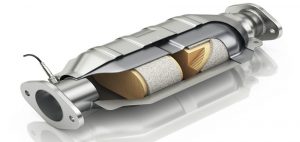
I noticed this happening – the decrease in gas mileage and performance – while driving my old truck (2002 Nissan Frontier). I keep the truck properly tuned – which doesn’t mean much with a modern old vehicle (one made since the late ’90s) beyond keeping the throttle body clean and once every 50,000 miles of so, checking/replacing plug wires, distributor cap and rotor – but even so, it felt like it was getting slower/more sluggish and it was definitely using more gas. The engine is still tight; i.e., it has good compression and vacuum at idle is within spec) so it’s not that. The transmission isn’t slipping, either.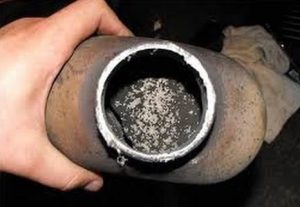
My attention turned to the cats. My truck has two of them. One is integrated with the exhaust manifold; the other is kind of like a muffler in that it is spliced into the exhaust, farther downstream. I decided to remove the latter to inspect it becaue it’s the easiest of the two to remove. One Sawzall does it all – in about five minutes.
Then I decided to replace it – with a section of pipe the same length, easily (and very inexpensively) spliced into its former place. Because once I had it off the truck and was able to look inside, I could see it was as blocked up as Dan Blocker’s arteries. (That’s Hoss from Bonanza; old-timey reference.)
I expected this to trigger the “throwing” of a “code.” That is, for the check engine light to come on. It didn’t – even though there is a second 02 (oxygen) sensor just ahead of the where the second cat used to be. That is probably why removal of the second cat did not trigger a “code.”
Even if it did, it wouldn’t matter – in any meaningful sense. All it means is that system has detected something in the emissions system is not exactly working per factory parameters; it does not necessarily mean the engine isn’t running well. The distinction is important – to you, the vehicle’s owner. It may also be important if you live in a state that requires regular passage of a “smog” check to renew your plates/registration.
If not, then who cares?
But what about the “environment!” some will screech. Well, what about it? Even without any cats, a modern vehicle with computer controlled fuel injection operates at the ideal air-fuel ratio all the time and that by itself addresses most of the meaningfully harmful emissions emanating from the tailpipe. And with one cat still in place (rather than two) the emissions are still next-to-nothing. (The second cat was added to fractionally decrease the remaining not-scrubbed stuff that passes through the first cat.)
By removing the second cat, I removed the blockage that second cat imparted; this makes up in no small way for however much the other cat – the one integrated with the exhaust manifold – is blocked. I plan to get rid of that one also, by replacing the heavy cast iron exhaust manifold with a tube header, which will further free up the flow. This will almost certainly cause a “code” to be “thrown.”
I don’t care.
I feel right about it, actually. Because the government-corporate combine has pushed me into this corner. It will not allow me to buy a new equivalent of my old truck – something like the Toyota Hi-Lux Champ, for instance. Not because it is “dirty” – in terms of its emissions – but because it is not compliant with every line-item of federal regulatory rigmarole.
This distinction ought to matter.
Also because it is affordable – just $13k – and affordable new vehicles are the last thing the government-corporate combine wants us to have access to.
So I will do what I need to – to keep what I have running and running well. I suspect millions of others tired of being screwed by the system which pretends it’s all Because The Environment (and Safety) will be doing the same.
. . .
If you like what you’ve found here please consider supporting EPautos.
We depend on you to keep the wheels turning!
Our donate button is here.
If you prefer not to use PayPal, our mailing address is:
EPautos
721 Hummingbird Lane SE
Copper Hill, VA 24079
PS: Get an EPautos magnet or sticker or coaster in return for a $25 or more one-time donation or a $10 or more monthly recurring donation. (Please be sure to tell us you want a magnet or sticker or coaster – and also, provide an address, so we know where to mail the thing!)
If you’d like a Baaaaa hat or other EPautos gear, see here!









my experience is the new-style, ceramic honeycomb cats just shatter.
with the remains rattling around on the bottom of the cat.
so no worries about blockage.
and adding a ‘spark plug anti-fouler’ takes care of any codes…
North Carolina has no emissions check, but they have annual inspections, and won’t pass a car throwing a P0420 code. Two perfectly decent cars: 2001 Ford F150 5.4L V8, 2004 Honda Civic 1.7L I4 … about 170,000 miles each … but how to fix?
Unless something dramatic has changed, NC still requires emissions testing, at least wake county, where Raleigh is, does. Some locations, like where I’m at, do not require emissions. The biggest benefit is when looking for another vehicle, nearby counties with emissions testing, residents will sell cheaply cars needing emissions repairs. Buy em while you can!!!
Hi Bill,
I have used this may times on VW and Audi and it works. Can’t see why it wouldn’t work on other makes. Plus it’s undetectable to the inspector. You will have to fabricate them yourself, he doesn’t sell them anymore.
https://cngvw.wordpress.com/2012/11/18/the-tom-thumb-is-the-first-catalytic-converter-test-kit-on-the-market-of-its-kind/
Ironically enough, in Cuba, many of the old American cars are now powered by soviet era diesels.
Israeli Guards Anally Gang Rape Palestinian Prisoner Until He Can’t Walk
https://www.aljazeera.com/news/2024/8/9/everything-is-legitimate-israeli-leaders-defend-soldiers-accused-of-rape
Keep sending us your tax dollars, goyim… we’re your “greatest ally”
And guess who resigns, gets arrested and will no doubt go to jail for causing the “worst pr disaster in Israel’s history?” Meanwhile the IDF rapists and war criminals (including entire government) skip off scot free.
https://www.ynetnews.com/article/syn8mt4y11e
https://www.jfeed.com/news/israel-military-prosecutors-arrested
Knesset member shouting that inserting a stick in a prisoner’s rectum is a-okay in the only democracy in the mideast — because Israel shares US values!
https://www.youtube.com/shorts/wUhdh8NLe0s
Removed both the cats in my Miata ND with headers and full exhaust. Got a tune that recognizes that fact and doesn’t throw code. Live in TN where they just got rid of emission checks state wide. I’m a happy camper.
High mileage…Sounds like something out of Up in Smoke.
I did replace the cat on the 91 Silverado, that was still the Era of the GM pellet cat. I got a “weld in place” for $160, a “exact fit” same brand, would be double. Couple sections of pipe adapters, stainless sleeve clamps, good to go, pufft no welding needed with a bit of pipe engineering. Removal was easier for me with a cutoff wheel on my cordless drill, Sawzall access was awkward.
Reason? Keep the back pressure near stock so the crude back pressure feedback EGR valve functions properly. Truck runs dandy on 87 octane as a result plus as you note pulling grades is back to normal.
The newer design honeycomb cats flow well. Harley forums this is a remove or leave it debate and actual dyno data shows near zero diff if it stays. On a scooter the extra heat can be a driver to gut it though.
‘As we descend into an America that has more in common with Cuba …’ — eric
APe News captures the banana republic zeitgeist of post-rule of law Amerika:
‘This week, the Supreme Court hears arguments on whether the president has overstepped federal law with many of his tariffs. Trump increasingly has expressed agitation and anxiety about the looming decision in a case he says is one of the most important in U.S. history.
‘He has said it would be a “disaster” for the United States if the justices fail to overturn lower court rulings that found he went too far in using an emergency powers law to put his tariffs in place. Trump has suggested he may take the highly unusual step of attending the arguments in person.’
https://apnews.com/article/trump-tariffs-supreme-court-foreign-policy-21337d2c11e629da3f187cdeb381d58b
HA HA HA! Donnie Fubar shows up in the august chambers of the Supreme Court to wave his tiny hands and emote at them with his 1,500-word vocabulary. I’d like a front-row seat in the gallery, please, so I can laff myself sick. Hope they don’t confiscate my bag of nitrous oxide!
*takes another big huff and falls off his chair*
If the Orange Douchebag does show up in person they should sell tickets on pay-per-view. I would definitely watch it; use the proceeds to pay down the deficit.
The question isnt whether he overstepped the constitutional limits of the executive branch, on the surface he has. However congress gave him that power (and it wasn’t theirs to give) and now I suspect the clowns in gowns will defer it back to the legislative branch (out of order for what, 37 days and counting?) to retake their powers.
What chaos there is now will be a hundred fold if they try to handcuff El Trumpo’s negotiations in the middle of them.
Last year a friend’s 1999 car (3000 lb 130hp good compression) would barely do 65 on the freeway, couldn’t accelerate as well as an original Prius, and mpg had dropped from 26 to 19.
Replace the 2nd cat with a pipe and all is well again. Still has “check engine” light, but who cares? D.C. NIFO
Excellent, JG!
Viva la revolucion!
A resistor and capacitor in place of an unused O2 sensor may smooth waveform enuf to stop say an 0420 code if car cant be “tuned” via OBDII.
Also a spark plug anti fouling extender will often defeat the o2 sensor, by moving it back out of the stream it is tricked into seeing conditions of a back pressure aka catalytic converter. Pick the right size, then screw it into the sensor bung and screw the sensor into it.
‘millions of others [are] tired of being screwed by the system’ — eric
It’s a freak show, really. A fedgov judge has ordered the Trump regime to keep paying for food stamps, even though the constitution says Congress (and no one else) appropriates all spending. Even the current partial shutdown has no basis in law — only two of twelve appropriations bills have passed the House. Not a single penny should leave the Treasury for the items covered in those ten overdue bills, while the House defiantly remains on strike.
Meanwhile, the Trump junta told Congress that it is not bound by the War Powers Resolution, which requires their approval for any military action that exceeds 60 days. And that’s setting aside the obvious fact that smugglers and soldiers are two totally different things. Bombing private boats on the ocean is no more a ‘war’ than Israel obliterating Gaza down to the last building.
We live under a degenerate reign of total, broad-daylight lawlessness, imposed on us by raging sociopaths. No one is under the slightest obligation to ‘comply’ with any law whatsoever, unless the consequences of getting caught are objectively too costly.
Smash the state.
Hey, said my name is called Disturbance
I’ll shout and scream
I’ll kill the king
I’ll rail at all his servants
— Rolling Stones, Street Fighting Man [1968]
I’ve seen the Hilux Champ up close in Thailand.
First thing is you quote an inaccurate price. The cost for the lowest cost one is 582,000 baht, which is about US$16,000. This is the cab-and-chassis version, no bed on it. It’s expected you’d finish the truck with a body of your own.
The cheapest version with a pickup box on it was 547,000 baht, which is around US$ 17,000. It has the flat bed with drop down sides.
The most expensive one, what they call the Super Attractive Package was 615,000 baht, about $19,000. This one had a 6 speed automatic, same engine. The only other differences I could tell were LED headlights instead of halogen and some trim differences like little orange accents in the dash, black insets on the doors. It was a short wheel base (rather than LWB like the other two) and the bed had sides and fenders that extended around the wheels. It’s the one that looks most like a pickup you’d recognize in America.
These had a 2.4L diesel engine, the 2GD-FTV if you’re familiar with Toyota. This is a nice engine, not super powerful, but is variable nozzle intercooled turbo with a 5 speed manual. I didn’t look to see if it had a catalytic converter. There were all 2 wheel drive.
There are dials for the air con, which seems to be standard. Cars in many ASEAN markets don’t have heat and these trucks didn’t appear to have plumbing for a heater core through the dash. Literally no way to get heat into the cab that I could see, but that may be unique to Thai versions.
You get plastic bucket seats (not a bench) and the material is PVC. The windows are electric, not manual. It has two air bags. The mirror was electrically adjustable, too. There is a speedo but no other gauges, just a lot of dum-dum lights for all the warnings. There’s no glove box and only the highest spec had a lid on the small center console.
You might be interested to note that all of them have Toyota Connect telematics, the system where you have an app on your phone to connect to the cloud and your vehicle. There is a small screen in the dash, not a traditional radio. It did have collision warning beepers and Toyota brake force distribution, which is their lowest stability control system. Tires are 14″ on steel wheels.
Back in the day I used to own a 1987 4Runner and these trucks feel even lighter and more spartan. The seats for sure are worse, the tilt about 20 degrees forward from their initial locking position and about 10 degrees back. But that’s only if you’re short, I couldn’t get the seat far enough back on the rails to tilt back at all and I’m only 5 foot 10 inches tall.
All said, it’s a very cheap truck, great for a fleet. I didn’t test drive one since I don’t have a Thai driver license. No way I’d want to drive one for more than an hour at a time, though. Very small, didn’t seem to have any sound deadening, very thin sheet metal. It seems like it would not be a quiet or comfortable interior.
Truth is it seemed priced about right.
The real Hilux I had in Australia was more like cars you’d get here. It was about twice as much as the Champ and I’d absolutely spent the extra money. A real deal Hilux starts at AU$32,000 or so, which is about $21,000. That’s for the regular cab and chassis 2WD, so about the same thing but the vehicle is so much nicer. If I could get them back in the States I go with a Double Cab SR 4×4 with the 2.8L 1GD diesel. I’d be in for about AU$50,000 or there about, so $33,000.
If you ever run into someone who is STILL screeching about cliiiiiiiiiiiiiiiiiiimate change, tell them that even Bill Gates now says it isn’t an existential threat to humanity, as he was probably one of the biggest purveyors of cliiiiiiiiiiiiiiiiiiimate change fear porn over the past few decades. Have too many people awakened to the ginormous scam that cliiiiiiiiiiiiiiiiiiimate change really is and Gates is hoping to make more money off of the other scam he and his ilk are pushing, “Global public health” and making MORE “vaccines”?
Here’s a clip from a recent Jimmy Dore interview with James Corbett on the new scam that Bill Gates is now hoping to make BIG MONEY on….
https://rumble.com/v712q22-bill-gates-gives-up-climate-scam-for-new-one-health-scam-w-james-corbett.html?e9s=src_v1_cmd%2Csrc_v1_ucp_a
Keeping your old vehicle going minus one or more of its cats is most likely reducing emissions more than buying a new one.
The greatest environmental impacts any vehicle has is when it’s built and when it’s junked.
By keeping our cars running as long as possible, we reduce emissions of all kinds.
After all, we can’t save the environment by buying new stuff because buying new stuff is a big part of the problem!
A section of 2′ x 3/8″ rebar from Lowe’s is about $6. Works like a charm.
Oh, catalytic converter, hollowed be thy name…
If you live in a place that requires visual inspection of the cat, remove it and hollow it out. A couple of clamps and it looks pretty stock.
Had that with my 1970’s Chevelle back in the day. Straight pipe with the old cat put around it. Worked like a charm, inspector put the mirror under, and it looked good to him, passed!!
Car ran so much better without it, better mileage and power.
I seem to recall that with the older pellet type catastrophic preverters a person could cut them off, ram a rod through it in order to hollow it out, then reinstall it using muffler clamps.
Is there any way to do so with newer catastrophic preverters?
Skip the purchase of a tube header that way, maybe?
Yup, cut off the convertor and use a hammer and chisel to remove the honeycomb weave, then reinstall with clamps. Don’t breathe in the dust and crud that comes out of the convertor, it’s carcinogenicity.
One thing you should add to your oil if your car has a flat tappet cam is a bottle of STP Oil Treatment as it contains ZDDP which is found in a lot lower concentration than oil used to contain. The Junkyard Digs YouTube channel says you need two bottles to get that ZDDP level back to what it used to be in the early 1980’s.
Rust proofing your car before it’s rusted out is a lot easier than repairing the rust damage.
If you drive a car with the check engine light on don’t forget to check regularly if any other issues have crept up as you won’t know it as the light is already on.
Everything I own is over 20 years old and if I can keep them running so can you!!!!!!!!!!!!
An interesting consideration, Eric. I wonder about the cats on my old trucks. Is your Frontier running noticeably better?
Morning, BaDnOn!
Yes, very noticeably. Specific example: There’s a hill I climb on the way home; before I nixed the cat, I needed to downshift to 4th to prevent the engine from lugging. Now I can leave it in 5th and it ascends the grade easily, without lugging. Gas mileage is up, too.
Hmm, definitely something I should look into.
One tiny advantage in Oregon is no smog checks when a vehicle is 21 years from manufactured date.
Rip em off, throw em out and smile again legally. Lotsa nice Cali hotrods find thier way up here when smog gladys sees and tells.