

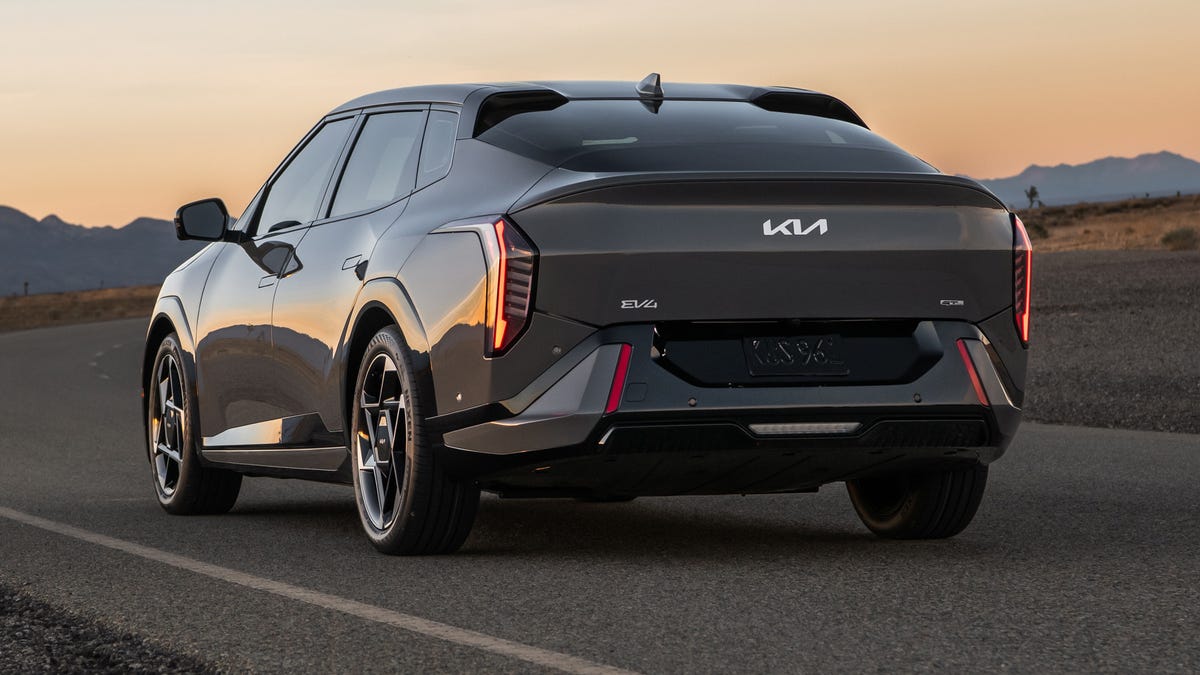

Hyundai has just announced it will not be bringing forth the EV4, which was teased as being Hyundai’s first “affordable” battery-powered car. It was to be offered for “only” $35,000 to start. Like most EVs, that price likely did not include a battery capable of absorbing charge enough to give the thing a driving range of more than 250 miles, best case. That’s about as far as you can drive something like a supercharged V8 Hellcat Charger with the difference being, of course, that the Charger can be fully refueled in about five minutes while the device requires being plugged in for at least 20-30 minutes to recover a partial charge.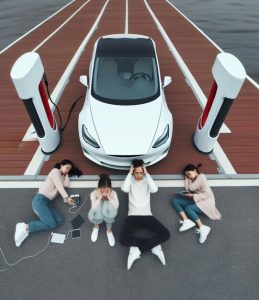
Hyundai teased the EV4 would be able to recharge from 10 to 80 percent in only 30 minutes! By which time you could have driven home, probably, if you were driving a gas-powered car.
But it’s the “affordable” part that sticks in the craw. When did a starting price of $35k become “affordable”? Perhaps it seems so in a relative way given a Chevy Tahoes start close to $60k now.
$35k was certainly more “affordable” when the government was kicking back $7,500 to affluent people who bought the things (you have to be affluent to qualify for the tax rebate; i.e., you have to have paid enough in taxes to qualify for the rebate). But Trump nixed the rebate and that means $35k is no longer $27,500 – the latter figure being kinda-sorta “affordable” – if you try not to remember that people used to be able to buy brand-new cars for less than $20,000 and that was within the past five years, not back in 1990.
It was also more “affordable” – as regards EVs – when it cost less to charge them than it costs to fuel a vehicle with an engine. That advantage is gone with the wind also. Especially if you – the EV driver – plug your device into a not-so-fast charger, where electricity costs a premium because there ain’t no such thing as a free lunch – or high voltage electricity – and the infrastructure needed to provide it. Even plugging in at home has become just about as expensive as filling up the gas tank of a typical 35 MPG crossover. So there’s little, if any, financial advantage to be gained by purchasing an EV – especially at full price; i.e., without the $7,500 off provided by the tax rebate, if you qualified for it.
That brings up an interesting thing. Most Americans don’t pay enough in taxes to qualify for getting back $7,500 (for buying an EV). You have to be making pretty good money to get some of that money back. Consider the implications of this.
It is precisely the people who most need an affordable vehicle – whether it’s an EV or otherwise – who did not qualify for the tax rebate dangled as an inducement to buy an EV. Yet it is precisely those people who must be persuaded to buy an EV – if EVs are ever to be other than indulgences for a relative handful of affluent buyers.
The bulk of the people who were able to take advantage of the tax rebate didn’t really need it. They just took advantage of it. The EV “market” was largely supported by affluent people who got a hug tax break that was not available to working and even middle income people.
Holy regressive tax policy, Batman!
But there are not enough affluent people to support more than a small “market” for even a $35k EV, irrespective of the rebate. The latter inarguably attracted some of them to buy an EV because it’s always nice to get some money back from the government. But people who don’t earn enough – and pay high enough taxes – didn’t get any money back. 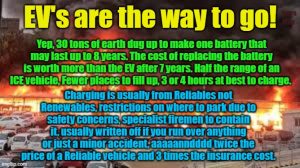
Now that affluent people won’t be able to get $7,500 of their own money back, few will want to pay full price for a device that inconveniences them on top of that.
Meanwhile, everyone else is tapped out.
Hyundai recognizes this. More bluntly, Hyundai isn’t run by stupid people. The company’s deciders know that if the “affordable” $35k EV4 were to be offloaded onto Hyundai dealers, the things would sit embarrassingly on the lot for most of the model year, until it became essential to fire-sale the inventory around the end of the year. Ford, Dodge, GM, Mercedes, VW – the lot of them – know all about it already. All of the latter have lost Brinks truck loads of money and also prestige. It looks bad when your dealers’ lots are full of dust-collecting devices that no one wants.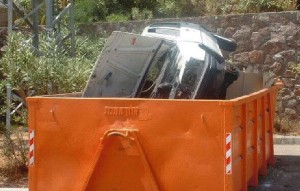
Hence, “delayed until further notice” – as regards the EV4.
This is smart – because it’s the apotheosis of stupid to keep on doing the same thing (that isn’t working) over and over and over, hoping that – maybe this time! – it’ll finally work.
. . .
If you like what you’ve found here please consider supporting EPautos.
We depend on you to keep the wheels turning!
Our donate button is here.
If you prefer not to use PayPal, our mailing address is:
EPautos
721 Hummingbird Lane SE
Copper Hill, VA 24079
PS: Get an EPautos magnet or sticker or coaster in return for a $25 or more one-time donation or a $10 or more monthly recurring donation. (Please be sure to tell us you want a magnet or sticker or coaster – and also, provide an address, so we know where to mail the thing!)
If you’d like a Baaaaa hat or other EPautos gear, see here!









[…] in America. There being little point in manufacturing what’s not going to sell. See the implosion of the EV “market” as a case of for-instance. Car manufacturers invested – if you want to […]
If EVs are to be truly effective at reducing emissions, EVs need to be adopted on a significant scale such that they constitute the majority of vehicles on the road.
Trouble is, EVs’ expense and hassle means that they can’t be adopted on any significant scale.
For one thing, they’re outrageously expensive. As a matter of fact, a lot of people can’t even afford $35,000 for a vehicle. That alone is a huge problem.
I won’t get into the hassles of charging, range, and catastrophic battery failures, but just based on price alone, EVs aren’t the solution.
What really gets under my skin is that there are vehicles like the Toyota Hilux, VW Rabbit TDI, Toyota Prius, and Ford Maverick that cost much less than $35,000 and actually pollute less because they Burn Less Fuel—the only really workable way to reduce emissions. And because they’re cheap, a lot of people will buy them.
I say this not as an environmentalist, but as a conservationist—I don’t like waste and pollution. EVs are utterly wasteful, and contrary to popular belief, they pollute like mad.
The EV4 was to be made for the US in Korea. Tariffs may have made it even less affordable.
So, score 1 for tariffs?
Hi Dan,
Yes, I think tariffs were a factor – but not the decisive one. $35k for a small EV – with all the hassles that attend owning an EV – is both too expensive and too much hassle. One could buy something otherwise comparable for thousands less and not have to deal with the hassles. QED, as they say!
Of course that model won’t be sold here but how much do you want to bet it will be sold in countries that think evs are great and what are odds that when the demonrats are in the majority the evs will be forced upon people again.
The entire push toward EVs only makes any sense if we accept that its purpose is not to ‘save the planet’, but instead to get the vast majority of ‘ordinary people’ out of private vehicles and into public transport, walking within the borders of one’s 15-minute city, or just staying in one’s government-allocated one-bedroom apartment and watching Big Brother on TV, while waiting for the next Universal Basic Income payment.
Assuming one has sufficient social credit score, of course.
Yep…They’re not trying to control the climate or control emissions…they’re trying to control YOU.
When I was in Korea in the 80s, Hyundai, Daewoo, and Samsung were still considered second tier quality. I remember buying a Samsung TV that literally lasted a lifetime. The people in Korea were like Japanese, proud of what they produced and not stupid.
Hyundai, last I checked is still a Korean company. One which has competence, and quality as core principles, just like across much of Asia. What they don’t have, DEI management and HR run amok Just like here in America. As evidenced by GM and Fords, ‘let’s sell at a loss, we’ll make it up in volume, then insult the hell out of our customers with commercials full of woke garbage.’ Or, ‘Lets make annoying products few people want or can afford so as to please our good friends in the government,’ philosophy.
I kind of liken EV’s to cordless drills. When re-chargeable drills arrived on the scene 25 plus years ago, they were awful, had no power and last about 15 minutes. Eventually, the batteries and motors were improved and today they are quite good, however, you need extra batteries and you still need and “corded” drill for tougher jobs and when they are called for.
One EV for the family would be OK for commuting and running errands, however, I still need a V8 truck or SUV for hauling/trailers and long trips. The desire for our government to promote EV’s as the only car you will ever need was as stupid as the fluorescent light bulb replacement program.
“One EV for the family would be OK for commuting and running errands…”
Sure, until you take into account the higher up-front cost, the massive depreciation, the good chance of burning your house down while charging in the garage and the ever-increasing cost of electricity.
Then you realize that zero EVs is the only right number for just about any sensible family.
Will AI even compile an image of an EV at home in the dumpster?
‘Holy regressive tax policy,
BatmanJoe Manchin!’ — ericThe former senator from West Virginia was so wrapped up in EeeVee Fever and ‘saving the climate’ that he thought it appropriate to lavishly subsidize battery-powered devices.
He was grossly mistaken — forever disqualifying him from grifting the American people again in any form of so-called public service, one would think.
But no. People with no skills — but with the connections of a former senator — live on as beltway bandits:
‘The former West Virginia House member, state senator, U.S. senator, secretary of state and governor is now working as an
energy consultantfixer for companies who invest, generate power and build infrastructure.’https://www.wowktv.com/news/west-virginia/former-senator-joe-manchin-transitions-to-energy/
No wonder America is $38 trillion in debt, with grasping grifters like Joe Manchin looting it bare. Let’s all chip in to buy Joe a dirty bag of coal for Christmas.
“Hyundai isn’t run by stupid people.”
Mary Barra & Jim Farley could stand to pop by Hyundai for a cup of common sense.
The establishment, which ironically has many of the same elderly people who protested that same establishment when they were kids in the 1960s, sure wants to make everything so expensive that only Uber wealthy elitists can afford it. Things such as REAL FOOD, REAL health care, electricity, coffee, automobiles, owning a home, owning a gun, etc. And the establishment successfully manipulated many people into thinking that the problems of the past few years are because of their neighbor who voted for Trump, didn’t take an experimental “vaccine”, etc.