

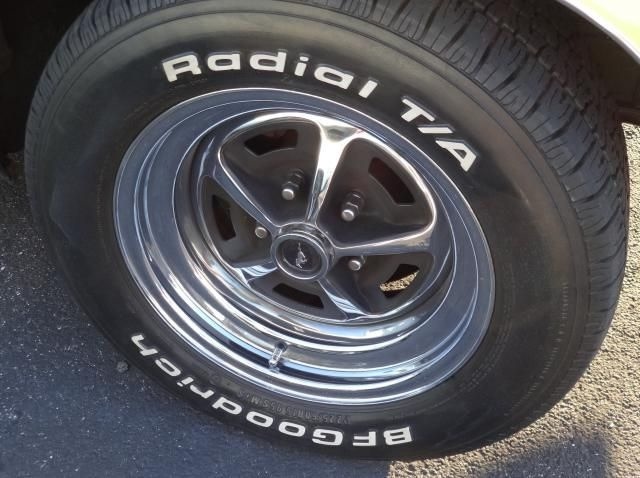

One of the things that made owning a classic-era (1960s-1970s) era muscle car fun was that it was easy to – as we used to say – get rubber. Meaning spin the tires. Juvenile? Maybe. But it was – and still is – fun.
It is a kind of fun that has been largely taken out of the equation by electronic countermeasures such as traction control (which in many modern performance cars can’t be turned entirely off and which in any event you have to remember to turn off every time you want to get a little rubber) as well all-wheel-drive (which pretty much precludes getting rubber altogether, unless the thing has more than 1,000 horsepower like a Bugatti) as well as tires that are typically 3-4 inches wider than the tires typically fitted to the old muscle cars.
Of course, these improvements – along with much-improved power – make modern performance car perform much better than class-era muscle cars, most of which were only about as quick to 60 and through the quarter mile as a late-model V6-equipped Toyota Camry or Accord. Many weren’t even that quick. But they were – and still are – are great deal more fun. No offense meant. The V6 Camry and Accord are both great cars that perform impressively. So in fact does almost every new vehicle, as a matter of fact – if you go by the performance standards of the ’60s and ’70s. A new Prius gets to 60 in about 6 seconds, which means it is about as quick as about two-thirds of the as-they-made-’em muscle cars of the ’60s and ’70s.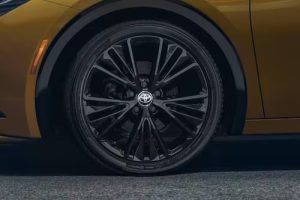
It is almost Ferrari-quick by the standards of the ’80s (Magnum, PI’s 308 needed about 7 seconds to get to 60 and had trouble getting rubber on dry pavement, which is why they filmed it taking off from the grass, which allowed it to get a little loose in the tail).
Part of the reason why the Prius is quick is because it has more grip and so it does not slip. It comes standard with 17×6.5 inch wheels, which offer a much larger contact patch than the 15×7 inch wheels (and tires) that most ’60s and ’70s muscle cars were fitted with. But which is more fun to drive – a new Prius or an old muscle car that can get rubber? Arguably, the same is true when comparing apples to apples; i.e., when comparing modern performance cars to old muscle cars. There’s no contest, if you go by the numbers – which is exactly why much of the fun has been dialed out of modern performance cars. They do not get rubber. Not easily, at any rate. You usually have to countermand the countermeasures. Turn off the traction control (if you’re allowed to) and then – because it’s probably got an automatic – hold the brake pedal to the floor while at the same time applying downward pressure on the accelerator pedal until the rear tires (if it’s a RWD performance car) begin to slip.
Most will not get rubber if you just floor it from a dead stop and even those that do will safety net you with stability control, which dials back the tail-wagging fun that was a big part of the fun of owning a muscle car. The fixation on stats – how quickly does it get to 60? – is why there’s arguably more performance but less fun to be had today.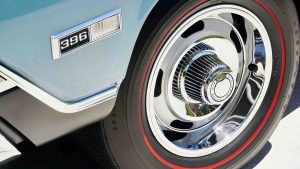
As well as more expense.
When the muscle cars of the ’60s and ’70s were new and also for many years thereafter, when they were just old cars, there was an abundance of new tires available for them that were in expensive because fifteen-inch tires were pretty much the standard-size tires for pretty much everything. You didn’t have to buy a performance tire because any 15 inch tire would fit your muscle car’s 15 inch wheels. The performance tires also were not hugely expensive because they weren’t huge. A 225/70-15 tire is a lot less tire than a 255/45R-18 tire (which is the standard-size tire you get if you buy a new Mustang GT).
They were also less vulnerable to ruinous damage because they had much taller sidewalls, which cushioned the impact of hitting a deep pothole or running up over a curb.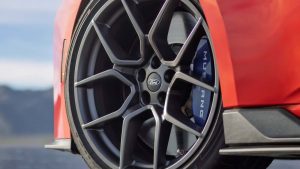
Yes, of course – the 255/45R-18 tire gives you much more grip – laterally as well as straight-line-acceleration-wise. Also shorter braking distances, on account of the larger contact patch. Quicker steering response, too. All of this is great if you’re on a track or driving on the street as if you were driving on a track. The thing is, the grip threshold is so high now that it almost forces you to drive the modern performance car really fast just to experience any real fun. For it to to get a little squirrely, which is part of the fun. Otherwise, you’re driving so far below the car’s capabilities that it’s almost boring (or becomes that, after the initial experience wears off).
Getting rubber in an old muscle car never is.
. . .
If you like what you’ve found here please consider supporting EPautos.
We depend on you to keep the wheels turning!
Our donate button is here.
If you prefer not to use PayPal, our mailing address is: EPautos 721 Hummingbird Lane SE Copper Hill, VA 24079







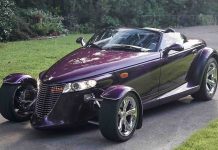

 era muscle car fun was that it was easy to - as we used to say - get rubber.)