

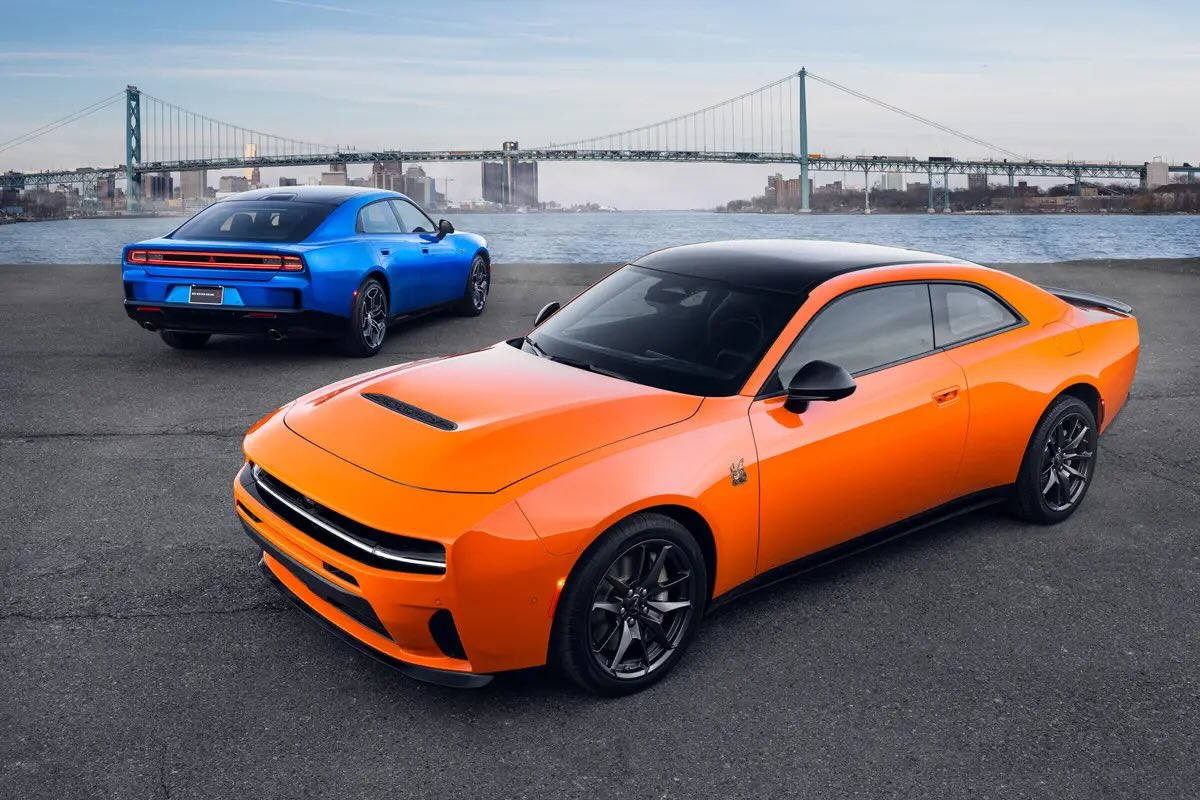

Dodge – the people in charge of Dodge, to be precise – made a huge mistake when they decided to replace engine power in the Charger with battery power two (going on three) years ago. The “electrified” Charger has been a disaster on par with the Edsel and perhaps worse because Ford could afford to lose money on the Edsel – the rest of Ford being perfectly healthy at the time.
But Dodge is not healthy – because the Charger (and Challenger) were Dodge. Past tense emphasis. By gutting the Charger – and killing off the Challenger – Dodge effectively gutted itself. All that was left in the lineup after 2023 was the Hornet, a small crossover – and the Durango, a mid-sized SUV. The Hornet hasn’t done well, not because it’s a bad crossover but because there were already so many others on the market. People generally go to a Toyota or a Honda or a Subaru or a Mazda store if they want a crossover. Those brands specializing in such things. People went (again, past tense) to Dodge stores precisely because Dodge didn’t specialize in crossovers – or SUVs, for that matter. The Durango is not a bad SUV; there’s a lot to like about it, in fact – such as the fact it it’s the last Dodge available with a V8 engine.
Which brings us to the next mistake Dodge just made.
In order to correct their first mistake – removing the engine from the Charger – they are going to put one back in. But it won’t be a V8 and that is arguably a huge mistake. One that will be compounded by two other mistakes. The first being that these re-engined Chargers will be automatic-only (apparently) and also all-wheel-drive-only.
But why is that a mistake – and more than just the one?
Well, the big one is the small engine. The 2026 Charger won’t be powered by a V8 engine. It will be powered by a 3.0 liter twin-turbo inline six, an iteration of the same engine found in some other Stellantis models, such as the Jeep Wagoneer.
The mistake Dodge is making is thinking horsepower matters more than size (and type). More finely, Dodge is essentially repeating the same mistake it made before, that being a failure to understand that a performance car is not the same thing as a muscle car.
The battery-powered Charger that failed to entice buyers to Dodge stores was very much a performance car. It was quicker than the V8-powered Chargers that came before. Dodge focused on this stat and by doing so, lost sight of the fact that most if not almost all the people who want a Charger want to hear the sound of a V8 (not the soundtrack of one) and want to feel the rumble of one, too. Put another way, it does not matter to such people how quick a vehicle is if it is not a muscle car. Dressing a Tesla up to look like a Dodge didn’t do it for them – and it never will.
That is why the six pack iteration of the Charger is likely to have trouble, too. Dodge resurrected that term, which long ago referred to the three two-barrel carburetor option that was available with some of Dodge’s most beloved muscle cars of the classic era, back in the late ’60s and into the early ’70s.
It now refers to a 2026 Charger powered by the 3.0 liter Hurricane six, which is a fine engine as well as a very powerful one. It is arguably too fine. Six cylinders are very smooth, very quiet engines; BMW and Mercedes use them in their high-end models for just this reason. But a smooth-idling muscle car is like a quiet (and smooth-idling) Harley. Do they really not get it? People who buy Harleys want that shake – and that potato-potato-potato idle. So do people who like muscle cars. That is why a six cylinder powered performance car cannot ever be a muscle car, no matter how high-performance it may be.
To make the point clearer: A Porsche 911 has a high-powered six cylinder engine but no one in his right mind would ever think to call it a “muscle car.”
In addition to the tangibles that will be absent – the rumble and shake, the deep bass tone that only a big V8 can make – there is the intangible of smallness. Once again, no disrespect is meant. The Hurricane six is not the problem. The problem is what it’s going into. People who buy muscle cars like big engines – even if they aren’t particularly powerful. The 1964 GTO’s V8 only made 345 horsepower (and that was according to the old “gross” method of measurement that overstated at-the-wheels power by about 20 percent). That is far less power than the ’26 SixPack Charger’s 420 horsepower six makes. But the ’64 GTO’s 389 V8 (6.5 liters) was twice-plus the size of the Hurricane six.
Ask a muscle car fan whether that matters.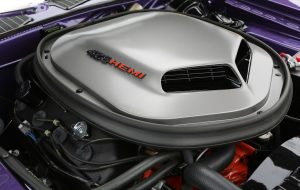
Dodge product planners appear not to have asked. Or maybe they have – and that’s why the ’26 Charger with the six does not have “3.0 liter” badges on its quarter panels. All the old muscle cars bragged about how big they were under the hood.
But the real deal-killer for many is probably going to be the AWD and no manual things. Especially the AWD thing. All-wheel-drive is a fun-killer. It means no burnouts. Ask a muscle car fan whether that matters. Dodge seems to think traction matters – because a burnout means the tires are spinning rather than biting and that generally means you lose a few tenths running the quarter mile. That is a sacrifice muscle car enthusiasts do not mind making.
Ask a few of them.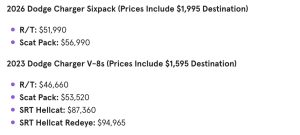
Now factor in the automatic-only mistake and what you end up with is a fantastic performance car that is the antithesis of everything a muscle car is supposed to be and what people who buy them want and expect them to be.
A six-cylinder-powered, AWD/automatic-only Charger will have to sell itself chiefly on its looks as opposed to its goods – and that is likely to be a hard sell. Especially in view of the fourth (and also compounding) mistake.
The 2026 Charger with a six is gong to be significantly more expensive than the 2023 Charger with a V8 was: $51,990 to start for the ’26 R/T with a six vs. $46,660 for the ’23 R/T with the V8. The higher performance 2026 Scat Pack lists for $56,990 (vs. $53,520 for the previous version with a V8).
That’s a $5,330 uptick for the least expensive new Charger with a smaller engine and two fewer cylinders – and that’s probably going to prove to be just too expensive for most people who might want one to buy one.
Ford is having trouble selling Mustangs for similar reasons. Middle and working income Americans under 40 – who are the people who like such cars – cannot afford such expensive cars, especially when they are impractical (both are coupes) and very thirsty, too. These are affluent older guys’ cars – and there just aren’t that many of them to float cars such as these.
Adding a big V8 to fix the shrinkage problem under the hood would make the ’26 Charger a muscle car again. But it would then probably cost $60k-plus and who can afford that?
It’s a shame. It’s weird, actually. Because the 2026 Charger is a great looking car – unlike the Edsel or the Aztek. But looks truly aren’t everything.
At least, I don’t think they are going to be enough.
. . .
If you like what you’ve found here please consider supporting EPautos.
We depend on you to keep the wheels turning!
Our donate button is here.
If you prefer not to use PayPal, our mailing address is:
EPautos
721 Hummingbird Lane SE
Copper Hill, VA 24079
PS: Get an EPautos magnet or sticker or coaster in return for a $25 or more one-time donation or a $10 or more monthly recurring donation. (Please be sure to tell us you want a magnet or sticker or coaster – and also, provide an address, so we know where to mail the thing!)
If you’d like a Baaaaa hat or other EPautos gear, see here!









You have 2 guys (engines) ones big and heavy has a broken leg (old v8), the other is a skinny short guy thats been shot up with adrenaline (turbo). They each have to get a ton up a hill, the big guy will crawl his way up the hill no issue, the small guy gets a running start gets half way up the hill and has a heart attack and dies
I just wouldn’t buy anything past like 2017, they’re all set up to fail around 100k, they all now require an internet connection and a subscription with either snap-on or the dealer to use functions and run tests (ex. doing rear brakes in your 2021 Ford pickup), take a look at how cheap the lower control arms are on the cheveys, and Chrysler using plastic upper control arms
You can get short term subscriptions to the software.
Toyota does a 2-day access to Techstream. It’s $80 for the 2-day Professional access. The only thing it won’t do is immobilizer work and making new keys. Toyota requires you to jump through NASTF certification to get access to the Professional Security versions.
In the case of Ford you can use FORscan, which is a very good aftermarket option.
Grab a Tactrix cable for $170 and you can talk to most things. Mine has worked with Subaru (SSM), Toyota (Techstream), Ford (FORscan) and Nissan (NERS) so far.
Re: awd
Maybe the think they’re going to get back some of the cop car market they once had?
I don’t think so though, as ford and gm have evolved the explorer and Tahoe into popular cop cars. We’ll see.
BTW, older chargers and 300s were available w v8 and awd. I think prior to 2015. They lost sales when it was discontinued.
The all-new 2026 Dodge Charger SIXPACK models feature standard all-wheel drive (AWD) but include a selectable drive mode that switches the vehicle to rear-wheel-drive (RWD) only, enabling features like burnouts and drifting. This is essentially the vehicle’s “drift mode..
The system uses a wet multi-disc clutch that can selectively send all power to the rear wheels, effectively disengaging the front axle. This allows drivers to break traction and initiate drifts or perform burnouts.
In addition to the RWD mode, the car comes with a standard Line Lock system, which freezes the front brakes to allow the rear tires to spin freely for warming them up before a race or simply creating smoke.
This functionality is standard on both the 2026 Charger Scat Pack (550 horsepower) and the R/T (420 horsepower) models, both powered by the twin-turbo Hurricane inline-six engine.
Dodge specifically designed this feature to offer the best of both worlds: the stability and grip of AWD for everyday driving and launching, with the “hooligan” fun and performance characteristics of a traditional RWD muscle car when desired.
Doesn’t matter to all the old guys shaking their fist at the clouds 😉
I am an old guy myself. The first muscle car I helped buy (for an older brother) was a 1969 Chevy Chevelle. I found it (this was in 1980) and we paid $475.00 for it with 57,000 miles on it with no accidents. Two problems were rust around the passenger rear wheel and different color hood (original hood) from body. We fixed the rust spot and painted the car gray. That car lasted my brother almost ten years. Those really were the good old days.
The bigger issue is customer choices. Dodge only give us 2, a 400 or 500HP model, with $53K and up prices!!!
A stripper model, just an engine, manual transmission, and RWD, has to be less to make, and more affordable. If you want all the bells & whistles, fine, you get them, but you’ll pay for it. Dodge & many other car companies seem to have lost that customer driven model, and are unfortunately killing themselves slowly.
YMMV….
Amen, Saxons –
I think Dodge (Stellantis) was in a hurry-up/desperate rush to get an engine in this thing – any engine. They intended for it to be electric only. But that failed, extremely. So they pressed the drivetrain they have into service and – voila! But – as you say – it is much too expensive and it’s not really a muscle car, either – much as it looks the part.
That is probably why American consumers are not “allowed” to purchase such vehicles, Saxon. #1 because they would be more affordable. #2, because we want them, and could work on them ourselves, and #3, TPTB cannot control us with safety crap when you are going old school.
Well if they don’t put the hemi or hurricane 3.0 in the Grand Cherokee (hemi was avail prior), then I would be interested in this new charger next time I need something (2-4yrs).
I need AWD/4wd to just get up my very icy steep driveway but want only RWD 95% of the time. I’m not sure which one I would get, old hemi or new I6T? I would have to drive them both for sure. I would lean hemi though, but absolutely not if it’s with the e-torque like the trucks, don’t want that. It’s like pick your poison, mild hydrid or turbo.
Thx
I don’t believe people are automotively astute enough to differentiate between performance and muscle (Especially anyone who’d be clueless enough to buy a Stellantis product). Go fast…horsepower, without the expense and limitations of an EV? If they’re not scared-off by the Dodge nameplate, and if it’s not too expensive, they’ll buy it. Just like very few are complaining about the lack of manual transmissions in other models. You can’t even buy a new C-8 Corvette with a stick. It’s all over…. Automotive culture is being bred out of people. I’m actually impressed that Dodge would even use a straight-six- as I was reading your article, I was bracing for “a twin turbo four”.This’un may just keep Dodge nominally breathing for another year or two.
I suppose I am one of the few still complaining about the lack of manual transmission vehicles. This vehicle I am driving now is my first automatic, and after 3 years use, I am STILL looking for the clutch pedal. I prefer a manual. Good luck finding one, though. Never mind being more familiar with the ins and outs of a manual trans, I find I have better control in the Winter on these icy, snowy, slippery roads. Oh, I have a “Manual Mode” in this car, but please. It is akin to drinking decaff coffee in the morning, and believing it will wake you up for the day.
Ditto! I freakin’ HATE automatics. Sticks are so much more robust; last forever; and give ME control over MY vehicle….. What’s not to love?
How very true, Arthur. And really, a sports car is just not the same without a manual transmission. Really….for those who know how to operate them, it is a helluva lot more fun with a manual. Much like the “vroom vroom” noises the EV’s make….an automatic just does not cut it.
Call me crazy but inine six engines are way more cool than V8s, I never understood the v8 obsession.
Hi SCW,
You’re not crazy – and neither am I. Well, maybe a little! I like inline sixes a lot. But they are not muscle car engines. Their smoothness and smallness are virtues in every other type of car. But not in a muscle car.
The current Charger’s chassis was based on a Mercedes S with many shared components and even diesel engines and Mercedes automatic transmissions in the beginning.
This platform is simply too big to remain a “pony car”. If globohomo-compliant Stellantis wanted to create an “American” “Muscle Car” for today’s youth it would have to be suitable for its target audience which would have to be a much younger age dynamic then “boomer”.
One key issue here is that it has to be RWD or it is fake. Mazda could bring out a nice 3.0 straight six RWD sports/muscle car in various levels of hybridity to compete with a Mustang or a BMW 3 series very easily but they would try to harvest the upper price segments. Stellantis is very unlikely to bet on a new ICE platform targeted at the declining US market with something like a small, light front engine rear drive coupe with a non-turbo direct injection 3.0 six, of about 250HP, and 6 speed manual for $30K or less than $40k anyway.
Many PHEV’s matched with a 4cyl turbo have levels of performance approaching super cars from a decade ago.
Mitsubishi Lancer revo evo II. FAIL.
This Dodge crapshoot is so obviously intentional suicide its now boring.
Edsels were ugly but still practical. The Challenger looks sexy but lacks the soul –kind like a blow-up doll.
Conceivably the 3-liter Hurricane Six could serve in the 2026 Charger, IF it were tuned to have a mellow, rumbling exhaust note. After owning a V8 muscle car, I got permanent brain damage from blasting down Hazel Street in a Jaguar E-type with a bad-ass six-cylinder engine that sounded the part. I just never got over it.
But automatic-only is a deal killer, as is AWD, all the time. Unless it’s your daily driver in the snow belt, AWD is superfluous, adding weight and complication.
Dodge is owned by eurotard lemmings who are committing civilizational suicide. They are unfit for purpose as humans, and so are the shitty vehicles they make. DIE, DODGE, DIE.
If I am going to buy a muscle car, I do not want AWD. I DO, however, want that manual transmission. Hell, I drove rear-wheel drive vehicles for many years back in the day. I had a slant six in one vehicle (a Volare?), and did it have rumble!!! Also, nothing was more gratifying than opening up the hood and drooling at the engine (8-cylinders, too!), and tinkering around under that hood. What in the world is that cover thing over the engine? It reminds me of the Jaguar ad, where everyone is smooth and woke, but not a single vehicle shown that they were supposed to be advertising. Also, your comment, Eric, reminds me of a much-younger Burt Reynolds in “Smoky and the Bandit”, or Bo and Luke in “The Dukes of Hazard”. It is tragic to think that one day such beauties would come to an end.
When you let the bean counters and HR harridans run a car company this is what you get.
It’s the same cluelessness that shows up in advertising. You’ll be watching the Daytona 24 Hours with the prototype Cadillac fighting for the win and the Cadillac ad pops up showing four black chicks cruising in an Escalade in some urban core.
Clueless.
Exactamundo! We started going downhill as a country when they started indoctrinating tens of thousands of MBAs and PHDs, shoving them into management ahead of people who had worked their way up and knew their business.
I’m a little confused why Dodge doesn’t offer multiple engine and drive train options. Make a 6 cylinder version available with a 2 wheel drive or with AWD and an 8 cylinder version available with a 2 wheel drive or with AWD.
For that matter I fail to grasp why everyone needs AWD nowadays. I’ve driven in some pretty hellacious winter weather with just two wheel drive cars and trucks (FWD or RWD) perfectly well using snow tires. What’s even funnier is that all my hot rods have limited slip but the cars I drive in the winter don’t have it.
Either way I suspect sales will be a lot lower than what their hoping for but I doubt they will understand why. Which begs the question of what do the people designing this car actually own and drive themselves?
Hi Landru,
I agree re AWD. It is almost a fetish object. It used to be a feature specific to a few brands, such as Subaru and Audi. Now it is a ubiquitous feature and that has made it annoying in that it is very difficult to find an interesting vehicle without AWD. I am considering converting my automatic muscle car to manual because a manual is more fun. It will likely be less quick – due to me not shifting as precisely as an automatic – but who cares? I certainly don’t. And I would not want to keep my TA if it were AWD because driving it would be boring. I like being able to spin the tires and catch rubber on the upshift!
Also, since you’re handy with a wrench, with a shop manual you could rebuild that manual transmission on a workbench. I’m not so sure any of us would dive into a home rebuild on a 8 speed automatic.
I worked with a guy in aerospace, prior career a Ford mechanic specialist in auto trans rebuilds. A goofball but extremely intelligent. He described what went into just a three speed automatic trans rebuild. You better get it all perfect or good luck sorting it out. “Now just where did this check ball go in that valve body?”
I agree, Sparkey!
Also, provided one doesn’t abuse it, a good manual box can easily last 50 years-plus. Automatics not so much.
The A343 I mentioned is a 1996 so 29 years old and just turned 200,000 on the clock. I had one bad solenoid but otherwise it was just seals and gaskets. Eventually the clutches do wear out in them but mine wasn’t slipping so I didn’t tear it completely apart.
The W56 I did needed new synchros and a couple of bearings, but it was a 1990 and has more miles. It’s not turning them over faster anymore since I’ve turned the truck into a crawler, so it spends it’s life going walking speed and is abused badly.
Everything wears out eventually, the difference to me is whether it’s designed to be serviced and parts are available or not. That’s what I worry about more in modern transmissions of any type, that they’re not made to be repaired so are throw-away.
The old NP420 in my 79 F150 is nearly 47 and shifts just fine! Automatics in trucks, muscle cars, and sports cars are for broads.
I’ve rebuilt the A343 in my 4Runner. Automatics aren’t magic, they’re just mechanical things. Toyota sells all the parts to rebuild it and just follow the service manual to do it. I’ve also rebuilt a W56 5-speed from a Toyota pickup I previously owned. There’s plenty of springs, thrust washers, snap rings, balls, roll pins in a synchomesh manual. It really doesn’t matter which type you’re working on, you have be organized and pay attention to the details.
Yes the auto trans is mechanical but its complex. Ive rebuilt many dozens of engines, but only a few transmissions. They’re just messy and not fun. From dropping the tranny pan and inevitably getting fluid up my arms or all over the floor outside my huge catch pan, they just aren’t fun. Manuals are better in my book as they seldom fail in normal use, there are no passages to plug up.
I do like the modern automatics with their many gears and deep overdrives, but I don’t want to ever work on one and I don’t trust a junkyard one.