

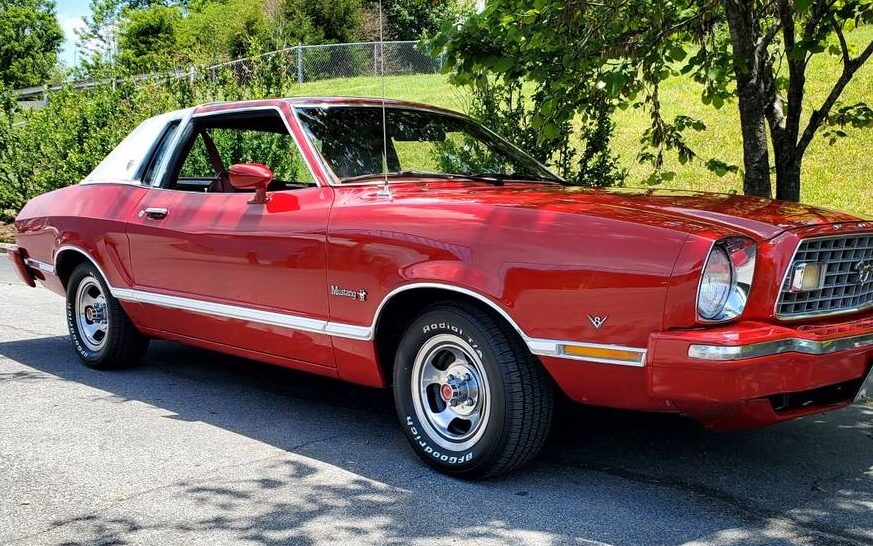

There was a period of roughly 10 years – from about 1972 through about 1982 – when American V8s made about the same (and sometimes, less) horsepower than a current four cylinder engine. Two of the most infamous examples are the V8s that were available in Ford’s Mustang II – the downsized Mustang Ford brought out in 1974 to save the Mustang – and the biggest, weakest one that was ever put into a Pontiac Trans Am in 1975-’76.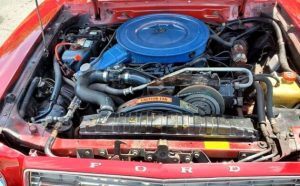
The ’74 Mustang was a very different kind of Mustang than the 1973 Mustang. It was a lot like the original ’64 Mustang in that it was small and light. By ’73, the Mustang had become huge (for a Mustang) and heavy. It was also very thirsty by dint of that and at just the wrong moment for that. The early ’70s were the era of gas shortages – caused by political tit-for-tatting over what was going on in the Middle East. It had become hard to sell big-engined cars and the ’73 Mustang needed them because it was too big and heavy for a small one.
So Ford redesigned it to be a smaller, lighter car for the ’74 model year and it came standard with a four cylinder engine; a small V6 was optional. Initially, there was no V8 option. The car sold well but something was missing. This was still a Mustang, after all. The original ’64 and every other Mustang that came after – until 1974 – had always been available with a V8. Soon, the new Mustang II was as well. It just wasn’t a very potent one. The first generation Mustang had a 289 Hi-Po option, which meant a small V8 with a hot cam, high compression pistons. four barrel carb and cylinder heads designed to make power. The little V8 did. This engine touted 271 horsepower and probably made more than that.
In 1975, Ford decided a V8 option was needed to maintain the Mustang’s reputation. By then, the Ford 289 had grown in size to 302 cubic inches but it touted just 140 horsepower. The V8 was initially available only with an automatic, compounding the problem – but Mustang IIs so equipped did get the chrome V8 badges on their fenders.
Pontiac’s Trans-Am – the high performance version of the Firebird, which (along with the Chevy Camaro) was born to compete with the Mustang – was still basically the same car in 1975 (and 1976) that it had been in 1970, when the “second generation” versions of these GM Mustang-fighters made their debut. The mid-1970s Trans-Am still came with big engines, too – just like they did in the early 1970s. A 400 cubic inch (6.6 liter) V8 was standard and – for 1975 – the Trans-Am was once again available with the even bigger 455 V8 (7.5 liters) that had been the strongest engine available in a Trans-Am a few years before.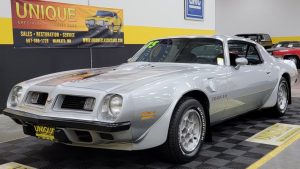
But those few years made all the difference. In 1974, the Trans-Am was available with a Super Duty 455 that was basically a toned-down race car engine that still touted 290 horsepower (and probably made a lot more than that). By 1975, the best you could get was the “455 HO” – which touted just 200 horsepower. Comparatively speaking – compared with the 140 horsepower V8 you could get in the Mustang II – this was a lot of power. But by previous standards – and today’s – 200 horsepower out of 7.5 liters is pretty weak.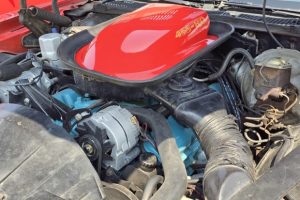
But both the small Ford V8 and the big Pontiac V8 could easily be fixed. They both were weak because they were choked out, basically. 1975 was the first year for catalytic converters in all Ford and GM vehicles and that ended factory dual exhaust systems for a long time because dual cats were too expensive at the time, so these V8s had to try to breathe – to exhale – through restrictive single exhaust systems. The poor Ford V8 also had difficulty inhaling through its restrictive two barrel carburetor. The Pontiac V8 at least still came with a four barrel carb. Both these engines were also timed and tuned for compliance with emissions regs, which in those days meant soft ignition timing and leaned-out carburetor jetting.
The beauty of these engines was they were still basically the same engines as the much-higher-horsepower versions that had been available just a few years prior. All it took to make them similar was to replace the awful factory exhaust system (and cat) with a proper system without a cat and then tune the engine for power rather than compliance. The Ford needed a four barrel to really sing, but that was easy to arrange as a four barrel intake and carburetor from an older 302 bolted easily in place. The Pontiac’s four barrel just needed some jetting and other adjustments. Without even opening it up – as to replace the soft factory camshaft – the ’75-76 455 Pontiac V8’s output could be goosed from the stock 200 to 230 in a weekend and the Mustang’s little 302 could be made to make 200. In the much lighter Mustang II, that was enough power to rival the performance of the early-mid ’60s first generation Mustangs equipped with the 289 Hi-Po V8.
This was the glory of those mid-late ’70s Mustangs, Firebirds and Camaros. It shall not pass this way again – because the government got smarter. More vicious, actually. It became progressively harder for the car companies to make their old engines compliant. They were retired – and new engines designed for compliance replaced them. These had integrated controls that couldn’t just be chucked because the computer would “throw a code.” It was still possible to do things such as “chip” these engines – for awhile. And then it was “flash” them – their ECUs – for awhile. But it got harder to do things with just a socket set and wrenches. Also a lot more expensive.
Today’s engines admittedly make great power – often from not much engine. And that’s objectively good but it’s also not everything because numbers aren’t everything.
Try putting a number on a smile, for instance.
. . .
If you like what you’ve found here please consider supporting EPautos.
We depend on you to keep the wheels turning!
Our donate button is here.
If you prefer not to use PayPal, our mailing address is:
EPautos
721 Hummingbird Lane SE
Copper Hill, VA 24079
PS: Get an EPautos magnet or sticker or coaster in return for a $25 or more one-time donation or a $10 or more monthly recurring donation. (Please be sure to tell us you want a magnet or sticker or coaster – and also, provide an address, so we know where to mail the thing!)
If you’d like a Baaaaa hat or other EPautos gear, see here!








My younger brother had one of these, the “Cobra” model. De-fanged it wasn’t super fast but it made a lot of noise and I still enjoyed driving it.
In 1975, my Dad bought my Mom a brand-new Mustang II on his Ford Z-plan discount. It was their first brand-new car purchase, custom-ordered from the dealership.
When it arrived, it looked kinda cool … front air dam, mag wheels, raised-white-letter radials, the “sport” suspension, the top-of-the-line interior. They even opted for A/C and power windows. I couldn’t believe my frugal parents doing this!
As a teen-ager at the time, I mused that a 302 V8 stuffed into a Pinto could be kinda-sorta exciting. But my hopes were dashed after my first ride in it. Utterly gutless. I remember the air-injection pump made more noise than the engine.
My folks dumped it 3 years later, once the Michigan road cancer first appeared. What a total P.O.S.! And American cars progressively got worse in the decade that followed.
Perhaps the biggest dog of all for detuned V8s was the ’81-82 Ford 255. 115 hp, LOL. What a turd.
I have a 4.0 V6 that makes 200 hp…
‘Try putting a number on a smile, for instance.’ — eric
I smile at the near tripling of specific output in half a century. High power, light weight, and high fuel economy are a killer combination that wasn’t available in the engines of 1975. What’s tragic is all the baggage that came with better engines, starting with computer-integrated systems that vastly complicate engine swaps and tuning. Then there’s the weight bloat, the over-tech obsession, the cell phone style user interface, and the like.
Today a 3-liter straight six is capable of delivering close to 600 horsepower. With an acoustically-tuned exhaust to let it rumble, such an engine transplanted (if that were possible) into the relatively lightweight vehicles of the 1960s and 1970s would be awe inspiring — that is, if their braking and suspension were also upgraded to handle the power.
No point of speaking about new vehicles meeting this description, since Big Gov regulations don’t allow it, and auto makers are still captured by the cult of cell phone envy and high tech obsession. If they really want to emulate Steve Jobs, they need to do what he did — totally rethink what a phone [or car] could be, and launch a totally new, better, lighter, sexier, cheaper and more capable product that pre-empts everything that went before.
To some extent, this is what Elon did with Teslas, though there is so much to object to. Every auto maker who tried to copy Tesla failed miserably. Now someone needs to rethink the IC-engined automobile — which the market clearly prefers — and throw out the dead-end direction of the past 15 years, other than than the high-output new engines. It starts with rejecting baaaatteries as a propulsion system. Jim’s First Law: batteries suck.
Hi Jim.
My first gen Camaro has a late 80’s tune port 350 in it that was initially installed around 1990. A bit of creative work was done to the wiring harness to make it all work but companies today make wiring harnesses that allow the fuel injection and computerized tranny’s to function properly in an older car, probably not cheap but definitely cheaper than having a mechanic figure out which wires aren’t needed anymore.
“such an engine transplanted (if that were possible) into the relatively lightweight vehicles of the 1960s and 1970s would be awe inspiring”
Toyota for the 2025 SEMA show did just this. They put the twin turbo 3.4L V6 from the current Tundra into a 1985 FJ60. Kept the stick shift, too. Supposedly gauging interest in making it a kit. People for decades swapped small blocks into old Land Cruisers. To this day they do LS swaps, ECU and all, from a donor Tahoe or whatever. It’s not really that hard. You can even get the original dash gauges to work fine with the GM harness.
https://www.hagerty.com/media/news/toyotas-sema-blitz-continues-with-tundra-swapped-fj60-land-cruiser/
Don’t pan the 302 2barrel too much, that Autolite 2100 is a danged fine, well designed carb which will run really hard. They made small ones and big ones, it was really simple to bolt on the big one from a 390 onto a 302 and have it run better than a Autolite 4100.
A street 302 only needs about 450 CFM, until you wind it way up. Also if you’re inclined a GM TBI (2 bores) will go on and run really well if you want to go EFI.
I remember the late 70s Trans Ams and Z28s. They were much larger and heavier than the 71-73 Mustangs that I thought were big. The underpowered v8s had to contend with all that extra weight.
The malaise era (1977-81), brought to you by Jimmy Carter. Little if anything could be done about the fuel crisis. Crippled V8s were made for emissions, not gas mileage. I remember when it was common to smell raw gas in car exhaust, and prior to 1975 there was lead in gasoline. That didn’t really go away until fuel injection systems replaced carburetors.
My father despised all of the “pollution crap” on his car, back in the mid 1970s. In retrospect, a lot of it was necessary until we had more efficient engines that could burn fuel without sending so much of it out the tailpipe.
restored a 4cyl mustang ii. Put in a 5.0 and a 5 speed from an 88 mustang. Carb instead of fuel injection. Scavaged a 3.40 rear from a 74 6cy mustang, posi trac unit. Used Stumpy’s frame connectors, put in a monte carlo bar I made because the car had T tops. I run mid to low 13 second quarter miles with it. I also own a 78 firebird that I modified the 400 with higher compression and a proper cam, aluminum intake and holly fuel injection unit. runs very strong. the thing I like about these cars, especially the mustang ii, is that they were abandoned and or cut up for suspensions. When I take the mustang ii to a car show, I get snickers, until they see the quarter mile times with very minor modifications.
I should complete the thought. These cars are often overlooked, even now, because they basically sucked in almost every way. So when I take a mustang ii to a car show, it’s often the only mustang ii there. I get a lot of attention and questions. And snickers of course. But then, that is the life of a gen xer. Handed crap leftovers by baby boomers and too capable and rough for millennials.
Hi Steve,
I’m going to admit something almost as embarrassing as being in the Epstein Files: I like the Mustang II. I’d love to have a Cobra II or King Cobra. I know… I’m a freak!
They were such a nice change from the tugboat styling and the massive bloat of the 72/3 mustangs. I like em too, at least the fastback/hatchback.
Another kinda cool car from that era in addition to a V8 Mustang II was the V8 Chevy Monza…
My daughter spotted a Mustang II in the parking lot of Hobby Lobby over the weekend and sent me a pic. She thought it was cool (she’s 19). I told her, nah… not really too cool. Although I do like the King Cobra only because I had the Hot Wheel as a kid.
I like the 71-73 Mustangs due to the movie “Marked for Death”. Steven Seagal drove one and it was nice, until it got destroyed… I was a teen in 1990 when Steven Seagal movies were AWESOME. lol
Those ‘Stang IIs looked great and handled great. They just needed a powerplant worthy of the Mustang badge. To be fair, other makes had the same problem, that’s why we’ve labeled that period as the “Malaise” Era.
RE: “I like the Mustang II.”
You’re, sick! Man. Totally, sick!
…Pinto lover.
Might as well say, you love Yougo’s!
[It’s just a machine, I don’t care how much you like a machine.] Ha!
Singer.
There were some cool Pinto V-8 conversions…
There was a guy in my high school days who had a hot rod Pinto. It was pretty bad ass.
Hi Philo,
Yup! The great thing about the Pinto and the Chevette was they were rear wheel drive, which made it much easier to put a V8 drivetrain in them.
Possible, certainly. Feasible…well, certainly a lot more feasible than converting a FWD platform to RWD, which virtually all just weren’t worth the bother, BUT…the effort to drop a V8 into a subcompact like the Pinto was a LOT more than most folks realized. Never mind that the engine bay could barely take that Ford Windsor block with stock exhaust manifolds, and if you wanted your “Hooker” (headers), you were getting out the Saw-All or the cutting torch and butchering the inner fenders. As for the transmission, you had to pound in the “hump” to get it to clear a C6 or a four-speed, and there was also the matter of the rear axle…the stock Pinto one had to go if you had a V8 build worthy of the effort; a narrowed “ten bolt” was essential, not only to survive the much stronger engine, but also to keep that rig from going sideways!
There was a humorous bit in “Hot Rod” cartoons which I can’t find where someone with a hot rod Pinto keeps winning the “Super Stocker” at the drag races, but the engine keeps failing. After the penultimate race, the crew chief looks at the blown motor and tells the driver/owner, “It’s ‘lunched’, chief”. The owner just bellows, “Get a replacement block, and I don’t care from WHERE!” and the crew does their “magic” in record time. An enthused fan of Fords watches this, and after the Pinto wins the final race, he congratulates the winner, then walks out to the parking lot, where his FORD Country Squire Wagon with a ‘351’ badge has its hood up…
No way, X.
A Couchette …(spell check, wtf is a Couchette?) … A Chevette could only be cool according to who was driving it & a passenger in it & how well a bunny hop was done.
A Pinto, while I no way ascribe to the N.B.C. news fakeism attributed to it, … it just wasn’t a cool car. No matter WHAT engine a person finangled into it.
Of course, your mileage & opinion may vary.
…Beauty is, in the eye of the beholder.
Hab a nice day.
My brother had the Cobra II back in the day. Hey, for the time it was fun.
Good stuff, Bill!
Those care were fun because they could be easily “awakened.” I once had a Ford Maverick, which was similar to the Mustang II. It came with a 302 2 barrel and it was about as quick as I could run. But that 302 livened up with just a four barrel, headers and some tuning work. With a shift kit in the transmission, it could (and did) chirp the tires on the 1-2 upshift. I never got around to putting a cam in it, but if I had…
I learned to drive in the “stripper” ’70 Maverick my Dad got just for that purpose. The only option that car had was an AM radio. No carpet, 3-on-the-tree, straight six. It was so light in the rear, you could easily chirp the (crappy bias-ply) tires on the 1-2 upshift.
Doesn’t need to be some tough to live with race cam either. Lope-d-lope, no thanks. A pre smog years factory cam works just dandy, goal is to get back to presmog valve timing so the poor thing can breathe. My aerospace work buddy, former Ford dealer mechanic, put a Police Interceptor cam in his Mark IV, wowser! What fun carpooling in that rig! Rush of power right up thru 90.
Morning, Sparkey!
Yup! As regards Pontiacs of the mid-late ’70s, the big two things are the low compression and terribly restrictive factory exhaust. In ’76, for instance, the 455 had 7.6:1 CR. Just increasing that by two points (which with Pontiacs is just a matter of swapping heads) will really wake the engine up. Get rid of the factory exhaust (single with one cat) and even with the stock limp-dick cam, a smog-era 455 or 400 will run pretty strong.
300 HP is perfect. Whether it’s the L48 350-300hp Chevy of late 60s, or an LS engine.
The ’71-’73 Mustang was large due to being able to fit a 429 cubic inch motor into it with requiring modifications as for the previous cars. That cost a bit of money, so Ford wanted a larger, and stock, engine bay. Even so, the Mustang was stripped of its original purpose of being a fun, 2+2 car for the youth market. Far as I’m concerned, Ford never recovered the same appeal; today’s Mustang is too big and complicated, with no chance whatsoever of anyone being able to ride in back. There’s less room in it than in the ’68 Fastback I had. As for making later V8s faster, I heard the procedure was to remove the smog stuff, keep it aside, put on performance parts, then take all that off and put on the smog stuff when inspection time came. My grandfather took the smog stuff off his ’74 Impala. He said it gave it “a lot more pep” but didn’t help to raise the fuel mileage.
…429 cubic inch motor into it *withOUT requiring modifications…
Ford changed the Mustang from budget pony car to a personal luxury barge. Those 71-73s had the performance potential, but they were like racing a four-year old at the Preakness.
My buddy has an original ‘73 as a collectible. Fun to tool around in, the 351 has a nice burble rolling thru town.
The lost art of the long, aircraft carrier long, hood! See also 73-77 Monte Carlo. Nice that anything bad happens it’s a long ways from you, the driver!
Keep those hood hinges oiled, bound up hinges = buckled hood real quick.
Damn right, Sparkey. My 2nd car in high school was a 1970 Monte Carlo, 2 barrel 400ci. It was really easy to spring that hood if you weren’t careful. Still, a nice car I wish I had been able to keep but the Ohio road cancer took it early.
I still think that first generation Monte was the best looking. Also early 70s GM still used nice gauge steel for the body panels, solid cars. The Commanders ‘71 Nova was solid, doors clicked shut no shudder no rattles. ‘75 and on, meh.
One of the most pitiful examples was the Cadillac 472/500 V8. Introduced in 1968 with 472 cubic inches, it produced 375 horses at the crank. Two years later in 1970, a 500 cubic inch variant pushing out 400 horses and 550 pound feet of torque in the “8.1 liter” Eldorado—the largest engine ever put in a passenger car.
Six years later, the 500 produced an anemic 190 horsepower in the 1976 Eldorado.
In 1977, the 500 shrunk to 425 cubes and later on to 368 cubes before being replaced by the dreadful V8-6-4 and the HT4100.
Yeah, that’s pretty sad.
remember, in 1972, horsepower rating methods were changed. So the drop wasn’t as drastic as it seems. But, the difference in performance was very noticeable. The other changes were positive including standard disc brakes (at least on the front) and suspension mods that made the car more stable. I was just a kid in the 70’s, but remember riding in muscle cars that were both awesome and unsafe. when I came of age to drive, gas had jumped from .25 a gallon to as much as 1.40 in my area. I couldn’t afford to drive the gas guzzling boats like the Cadillac, but they are still cool. I’m a shade tree builder and tuner. Sometimes I look for low compression engines to boost, easier and cheaper, and many (not very many) had hardened valve seats installed (instead of just a hardened face). I took a turbo 301 pontiac trans am, 79, and really made it run hard just by a decent cam change and some intake/head porting.
Cadillac 472/500s have become increasingly popular among hot rodders because they’re relatively cheap and can be made to make a lot of power without a lot of modifications. They’re actually lighter than Chevy big block Rat motors if I recall.