

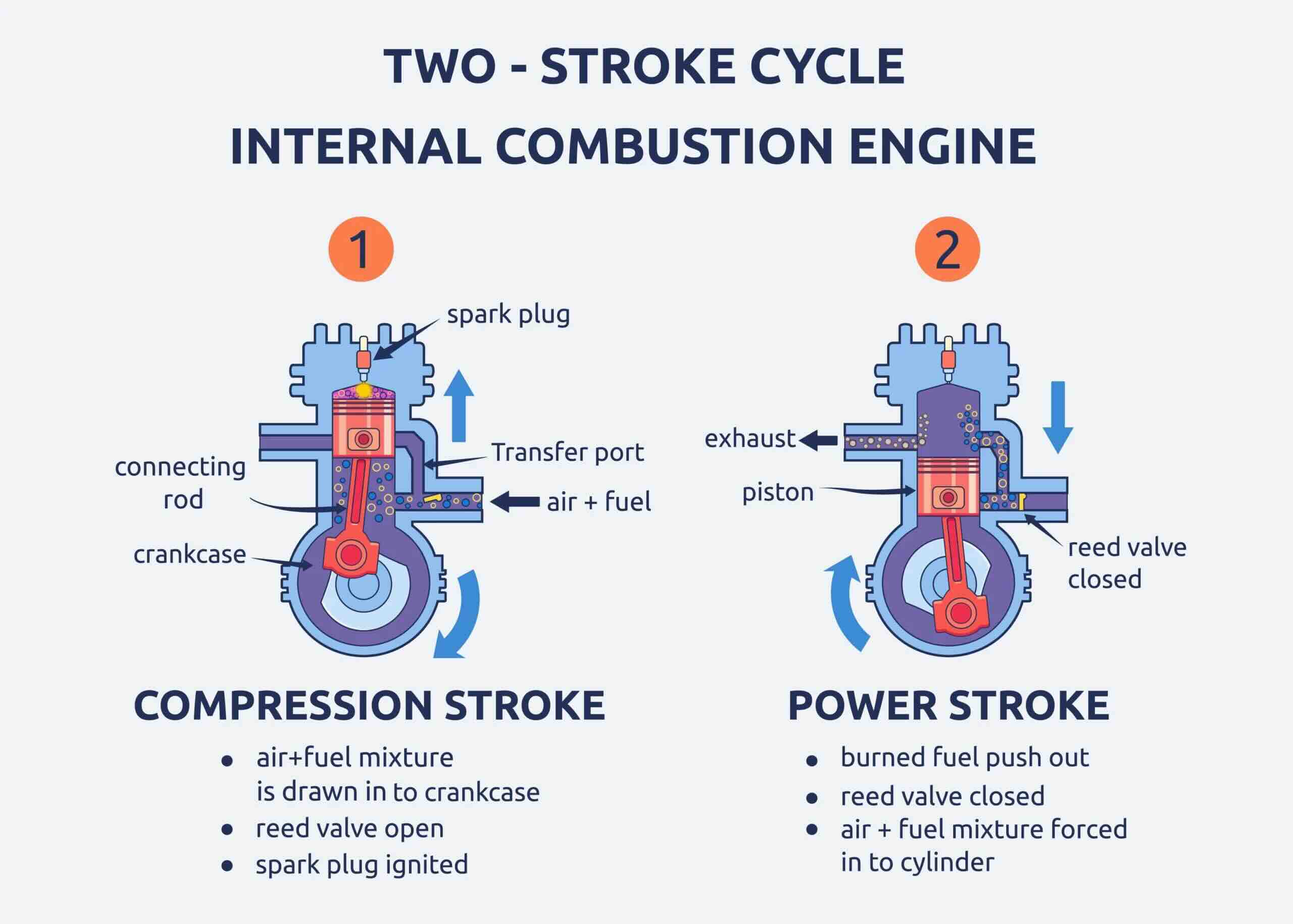

There are rumors afoot that GM is developing a two stroke engine, which is a type of engine not seen in cars (outside of the old Soviet Union) since before JFK was elected president.
Two strokes have many virtues, including simplicity – because they have no valvetrain – and low cost (because they have fewer moving parts) and high output for their displacement, relative to a four stroke engine of the same displacement, because two stroke engines make power every time a piston ascends to top dead center within the cylinder. A four stroke engine has four strokes – intake, compression, combustion, exhaust – but only one of those strokes (combustion) results in power.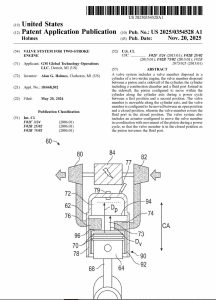
Two strokes also have some strikes against them. The main one being they are very difficult to make compliant – with emissions standards – because for one thing they burn oil on purpose (it is mixed with the gas, to provide engine lubrication) and for another because the nature of the design allows for contamination of the intake charge with exhaust gasses. which is a function of using ports that are covered and uncovered by the pistons as they go up and down in the cylinders. Four strokes also have ports but they are opened and closed by intake and exhaust valves that seal when closed.
There is also the related problem of piston ring wear caused by the piston going up and down in cylinders that have holes (those ports) in their sides. In a four stroke engine, the piston is surrounded completely by the cylinder wall, which compresses the piston and oil control rings evenly. In a two stroke engine, the open port on the side of the cylinder creates a spot where the rings are not compressed evenly, leading to faster wear and more blow-by (higher emissions). And that is why the only vehicles with two stroke engines that can still be legally sold are for use off-road only.
These being off-road dirt bikes.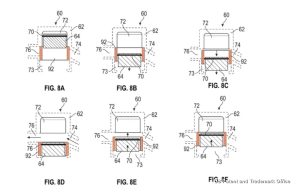
But a two stroke may be coming back on-road. The may be part is suggested by a new GM patent for a new-design two stroke engine that appears to have a sleeve-valve or linear system that creates a hole-less cylinder wall when the piston passes by the port, thereby improving sealing and reducing premature piston ring wear – which will (or ought to) help reduce emissions and make the engine compliant.
Maybe.
But don’t expect to see this engine powering a GM vehicle anytime soon – though it may be buried somewhere deep inside inside a future GM EV as a power source. More finely, as a generator, to produce the electricity you’d otherwise have to plug in (and wait) to get. This would eliminate not just the Range Anxiety you have heard people talk about but the arguably more serious problem – Wait Annoyance – that is much less-talked-about. Few people would give a flip about range if it were easy to get more. Have you ever heard of someone complaining about the range of a Hellcat Charger? It has a range of maybe 200 miles, if you are easy on the accelerator pedal. If you aren’t, you might burn up the contents of its tank in 150 miles or even less.
But it’s not a problem because it’s not a hassle to refill the tank. A five minute stop and you’re ready to go. With an EV, the wait is best-case at least 15-20 minutes for a partial charge and that’s just too much hassle for most people.
Hence the idea of what’s being marketed as a range extender by some purveyors of EVs. The range extender being a gas-burning engine. You never run low on charge because the engine is there to generate more as you drive – so long as you have some gas in the tank. That is the role GM’s new two-stroke is likely to play, if it ever sees the light of day – which it just might because there are certain advantages, as detailed earlier. A two-stroke range extender would be cheaper and so help reduce the cost of the EV. It also takes up less space and it’s simpler, all of that is good given it would likely be buried somewhere deep inside the EV’s guts and for that reason not easy to service.
Best to make it so that it needs service less often.
This isn’t a new concept, by the way. GM was first to market a range-extender equipped EV. It was called the Volt (old review of one is here). It could be driven about 50 miles on battery power but when that was exhausted you did not have to stop for a charge because it could charge itself. Some people, at the time, confused the Volt with a hybrid – which it technically was. But it was very different from other hybrids because unlike them, the Volt was primarily an electric car that happened to have a gas engine on board. In conventional hybrids, the gas engine provides both charge and propulsion; i.e., it powers electrically powered accessories and the wheels that move the car. In the Volt, the gas engine was there chiefly to generate the electricity that powered the electric motors that turned the wheels.
It was a fine idea with bad timing. The Volt came out in 2011, when there wasn’t much market for such a vehicle and no mandated “market” for EVs. That came too late to save the Volt, which got cancelled after 2019 – just as the “market” for EVs began to pick up. To borrow a line from On the Waterfront, it coulda been a contender.
The Volt wasn’t obnoxiously expensive – as the EVs that came later were (and are) and it was practical. More so, arguably, than an engine-only car because it could run for 50 miles entirely on battery power. This gave it dual fuel capability – as well as very long legs. Some owners had to get into the habit of using fuel stabilizer because it took months to burn through a tank.
It’s ironic to reflect that the one EV that maybe made some sense got cancelled at just the moment when everything else began to make no sense at all.
. . .
If you like what you’ve found here please consider supporting EPautos.
We depend on you to keep the wheels turning!
Our donate button is here.
If you prefer not to use PayPal, our mailing address is:
EPautos
721 Hummingbird Lane SE
Copper Hill, VA 24079
PS: Get an EPautos magnet or sticker or coaster in return for a $25 or more one-time donation or a $10 or more monthly recurring donation. (Please be sure to tell us you want a magnet or sticker or coaster – and also, provide an address, so we know where to mail the thing!)
If you’d like a Baaaaa hat or other EPautos gear, see here!








The majority of off-road motorcycle enthusiasts (not beginners), run 2-strokes.
Around 10 years ago, the EU started regulating them as follows from AI:
“Progressive Standards: Standards like Euro IV (2016), Euro V (2020), and Euro V+ (2024) drastically lowered HC limits for motorcycles, making traditional 2-strokes difficult to comply with”
The largest Manuf. of these is/was KTM, which came out with their 1st gen injected 2-strokes around 2018. They had some hickups, but did OK. Their 2nd gen came out around 2023, and are pretty good. For the most part, they do not smoke like carb’d 2-strokes.
Most of my riding friends run 2-strokes.
It’s interesting to me that the big 4 japanese brands did not try to compete with the EU 2-stroke brands (KTM, Beta, etc…). They might be trying soon, we’ll see.
[…] Cætera. . . Other Analysis, Punditry, and News:Is GM Bringing Back the Two Stroke Engine? – Eric at Eric Peters AutosChina’s Underpopulation & Overproduction Will Lead to Ruin […]
Anyone remember the 2 stroke Suzuki jeep?
1977 Suzuki JL50 2 stroke 539cc
https://www.youtube.com/watch?v=N5mVyrfbgkc
“:The Suzuki FB engine is a series of two- and three-cylinder two-stroke engines that was produced by the Suzuki Motor Corporation from October 1961 until November 1987. They were used in a number of Kei-class automobiles and light trucks. From the original air-cooled 359 cc (21.9 cu in) straight-twin version the FB series developed through a number of different models having different names, ending with the water-cooled, three-cylinder LJ50. The names used for various versions of this engine often refer to the chassis code of the cars in which they were introduced, until Suzuki changed their engine naming system sometime in the first half of the 1970s.
Hi Jack!
I’d forgotten about that one – thanks for the reminder!
You could do a 2 stroke with a normal oil pump and filter and oil you change, if it was supercharged then the intake wouldn’t have to go through the crankcase
Some of the greatest ‘rides’ ever made were 2 stroke powered. If you have never driven a Yamaha rz350/banshee, a Honda cr500, a Kawasaki kx500, an Arctic Cat thundercat 1000(Suzuki), and many others, you’ve missed out. Diehard 2 & 4 stroke engine fan here.
Small 2-stroke engines (think chainsaws, leafblowers, and off-road bikes) burn an oil and gas mixture to provide power and lubrication. But they’re also notoriously bad for emissions – oily smoke being the main culprit, especially when cold and when under load. But larger 2-stroke engines (think large outboards, sleds, and power generators) are designed with an oil sump to deliver lubrication. This means they can burn just plain fuel and are no worse in emissions than a 4 stroke engine. Also it’s not a design requirement that 2-stroke engines have cylinder ports instead of valves; that’s usually done for reasons like small space, low weight, and simpler mechanics reasons. Valved 2-stroke engines are quite common in marine and power applications.
So, the GM 2-stroke charging engine will LIKELY be a 2-stroke, sump lubricated, and valved engine. Negating any of the worries/concerns of excess ring wear, higher emissions, and the like, that this story brought up.
Great info! I just learned a couple of things. Thanks.
‘Valved 2-stroke engines are quite common.’ — Recognizing Truth
A conversation about this subject on Reddit quickly turned to gas turbines, which don’t need valves:
https://www.reddit.com/r/engineering/comments/lxoeto/could_a_fully_valved_meaning_both_intake_and/
The sketch at the top of the thread illustrates the basic problem with 2-strokes: the need to evacuate exhaust gases and replace them with air (or air-fuel mixture) in only about 120 degrees of crank rotation — versus a full 360 degrees (exhaust stroke + intake stroke) in a 4-cycle engine.
‘Sir, a two-stroke’s cylinder evacuation is like a dog’s walking on his hind legs. It is not done well; but you are surprised to find it done at all.’ — Dr Samuel Johnson
I would giggle every mile if my car sounded like my chain saw
If you’re going to go Soviet, go full Soviet I guess.
The only reasons I would ever buy a Trabant, GM or original, would be either as a hobby/curiosity, or because I had literally no other option.
Supposedly it was called the Martin Luther car. “Here I stand. God help me, I cannot do otherwise.”
A friend of mine owned ed one of these:
https://www.oldcarsweekly.com/features/quirky-is-better-the-saab-sonett-ii
Snowmobiles are mostly powered by two-stroke engines. They do have to meet emission requirements but those are not as rigorous as automobiles need to comply to. Still there are interesting ways they have used to clean up the exhaust, such as timing the fuel injection appropriately. And two strokes are just better for nitrous oxide emissions because of differences in the combustion pressure/temperature cycle.
Indeed, Rolfe –
I own an old two-stroke bike and it smokes prodigiously. No reed valves, even. My buddy has a KTM dirt bike with a two stroke and it hardly smokes at all. The only way to tell it’s a two-stroke is by ear.
If GM has to account for over 400 thousand engines in it’s latest recall? I’m guess at least 10 billion dollars to fix them all. If so, GM won’t be around long enough to worry about 2-stroke engines.
I’ll just stick with my AMG V8’s… thanks.
They’ll make it so environmentally friendly that it won’t be useful for much except a lawnmower.
Now I’m old, but I question your statement that two-strokes have been gone since before JFK. I seem to recall Saab producing a three cylinder two-stroke at least into the mid-sixties. As I also recall, it had only seven moving parts. I coveted one owned by a friend. It was as reliable as an anvil and economical as well.
Hi Michael,
You’re right; one of the readers pointed out there were a couple of two-stroke powered cars available in this country in the early ’70s. Still, that’s 50-plus years ago – and these were not common, even then. That said, two stroke powered bikes are a lot of fun. I have owned them (and still own one) and while they can be a handful, they are also saturated with personality and a lot of fun!
Being someone not thoroughly knowledgeable in the history of engines, I had to check out an idea:
The 2-cycle diesel.
It would seem a great solution to having to add oil to the fuel which causes the blue-smoke emissions characteristic of 2-strokes. Diesel fuel is lubricious, so the addition of oil might not be necessary.
Turns out they’ve been around since 1899. I wonder if the innovations of this new engine could be applied to a diesel variety. They are said to be less fuel-efficient, but have incredible longevity and the simplicity is remarkable. It’s said there is no injector pump (instead “unit injectors”, which seems appealing since I have yet to rebuild the failing pump on my backhoe.
My dad had a tiny Isuzu diesel called the”I-Mark” back in the 80’s. It was a great little car that could go 600 miles on a tank.
Detroit diesels are 2-stroke and are the junkiest engines ever made.
Detroit diesels most certainly aren’t junk. They are pretty heavy (because they are built like tanks) and pollute more than a modern diesel, but they are insanely powerful and rock solid reliable.
Plus the sound is a much finer, sweeter addiction than any opiate.
Whatever the displacement, simply double it for the equivalent 4 stroke diesel, the 6BT Cummins and its 24 valve updates are 360 CI, a 4-53 Detroit displaces 214 CI but makes power on every revolution so is equivalent to 428 CI.
The famous buzzin dozen is a 12V72 Detroit. That’s 72 CI*12 cylinders for 864CI swept displacement or the equivalent of 1728 CI. I covet one.
Sorry, but I don’t agree, when I think of Detroit’s I think of a high whinny engine like on a seriously smoking city bus or Garbage Truck. Just cheap thrown together garbage like every GM. You won’t find them in trains any longer.
Morning, Daniel!
Yeah, but those old diesels smelled great! As a kid I used to savor the flavor.
Geebus ,
Every time I smell diesel …..I Deja Vu all over again and flash back to my first one way ticket to (Euroland) Brussels Belgium back in 86…..
yeah. I hear that. I also miss leaded gasoline, although the maintennace intervals on those engines were hideous. But I digress. There are winners and losers in the ongoing automotive wars
I defy anyone to call this whiny!
https://youtu.be/Pts5iiExFRA?si=BxPoQrBaxzrZ2hSK
That’s a pretty amazing demonstration, Ernie.
Also, this compilation, with 453T sounding the best to me. More like a high-end sports car than a diesel. Also, a hilarious appearance from Greta:
https://www.youtube.com/watch?v=9zvz3L6WwTQ
Yes, the 4-53 does have a special and unique sound. But for my purposes if I’m going to swap one into something a 6v92 at 2500 lbs is not a lot heavier than a 4-53 at 1900. I am slowly putting together a hot rod medium truck, so lots of options to consider…
Intriguing, Ernie. Keep us posted!
As an owner of a 2017 Volt, I can say that is the best car that I have owned (including 2 Lexus). It has 83,000 miles. About 85% of the miles have been on battery only. I plug it in at home and it is always charged when I leave. I go months at a time without visiting a gas station. And I have no range worries. It is the best of both worlds.
Good stuff, Jim –
The Volt deserved better than it got. A regular here owns one and – like you – has nothing bad to say about it.
What kind of gas mileage do you get on it? What percent city and highway (above 70) do you do?
4 bangers are proven technology
After GM shafted us in 2008 on our GM Bonds, they can pound sand on anything they produce for sale.
Ditto
You can have a 2 cycle without the ports in the cylinder, just using a normal valve train.
GM built two stroke diesel engines that way for a very long time. Search Detroit Diesel 71 series.
The Volt was a remarkable vehicle, but per GM, it lost several thousands per each car sold. And to think that Government Morons are actually serious about production 2 strokes for today’s market??? Yeah, and I bet they’ve got some beachfront property for sale with each 2 steoke powered car….in North Dakota!!!
I don’t GM ever expected the Volt to be a commercial success, it was as much a test as anything. It was actually a pretty neat vehicle, just ahead of its time (and I am not a proponent of EV’s unless 1) you increase the battery capacity by a factor of 4 (half the size and twice the current power) and 2) figure out how they can be charged (meaning increasing generating infrastructure and transmission or get higher efficiency solar + batteries for storage).
Which has nothing to do with 2 cycle technology except that a very compact generator can be built utilizing a modern two stroke.
I’ll be glad to sell them some of that beach front, I just hasn’t had much water since Lake Agassiz went away. No matter, I’ll be glad to sell it to ‘em.
Most if not all of NATO countries have been overrun with a people who hate the West and the United states in particular. We are in the process of being overrun now and some of our states have given over to it and are exporting our wealth.
I find no reason to be a part of NATO anymore for just that reason. Do you think any Muslims in Great Briton will fight to save it? Not a chance. France? Sweden? Nope.
This was supposed to be a reply to https://www.ericpetersautos.com/2025/12/13/is-gm-bringing-back-the-two-stroke/#comment-1180976 but apparently I haven’t mastered this comment section
Was interesting until it took the turn on the EV road….
Until auto makers develop a 4 stroke engine, nothing else will be practical. ~Felix Wankel~ 😂
I had a two stroke Yamaha motorcycle that was fast and good on gas in the early 70s until it was stolen in late 70s at college. The motor would need to be gone through more often then four stroke motors.
GM should produce the 1 stroke engine, like the Bourke:
http://projectbourke.com/hotrod.htm
bourke engine animation
https://www.youtube.com/watch?v=CvuSMjPFYzs
The Subaru 360:
https://en.wikipedia.org/wiki/Subaru_360#:~:text=EK31%20engine%20of%20Subaru%20360,the%20clutch%20via%20an%20electromagnet.
produced from 1958-1971, also had a two stoke engine. I do not recall if these were ever imported to the U.S. Oh, wait.
>From 1968, approximately 10,000 were exported to the US, with an original price of $1,297 ($11,728 in 2024 dollars [12]). The 360 was imported to the United States by Malcolm Bricklin before he later manufactured his own cars.
Was just about to post something about this…. I have one!
>There are rumors afoot that GM is developing a two stroke engine, which is a type of engine not seen in cars (outside of the old Soviet Union) since before JFK was elected president.
Not true.
The Saab 96:
https://en.wikipedia.org/wiki/Saab_96
existed in the U.S at least into the early 1970s.
I knew someone who owned one in ~1972.
I distinctly recall him adding oil to fuel, and the exhaust was oily smoke, so it was definitely a 2 stroke. I do not recall the model year of his auto, only the weirdness of a 3 cylinder engine.
Speculation, but chances are that EPA regs killed it off for U.S. sale.
The link at the top led me to an ‘unauthorized’ page. Here’s another link that may work:
https://tinyurl.com/y5cd9arr
A sleeve valve is the key feature, as Eric mentions. The patent also speaks of using an Atkinson cycle and fuel injection.
These would be very interesting modifications to a two-stroke engine, squeezing even more power out of it. The unknown, of course, is how emissions will be affected. Only the physical mechanisms are disclosed in the patent — not any test bench work.
Maybe the old internal combustion engine isn’t dead yet, despite the best efforts of EeeVee Mary to kill it off.
The Otto cycle came about in the 1860s while the Atkinson cycle’s origin was in the 1880s.
Here’s a neat 101 on the cycles: https://www.youtube.com/watch?v=NvtcTXey0U8
Thanks, Jim – and sorry the original link went dead end. I have replaced that with the new one!
If you believe the people that say WW3 is coming, what makes you think most of these environmental regulations will still be around if they hinder the war effort? Afterwards some of the regulations but probably not all of them will return.
That said, most people realistically can’t afford to buy a new car and it’s even worse for EVs or hybrids. A Trabant in US dollars was affordable but in East Germany it took many years of saving to buy one. It doesn’t matter how good a product is if no one can afford to buy it.
Unless GovCo here goes all Euro Nazi and bans all earlier cars people will just continue to fix and drive what they already own.
WW3 seems closer every day. A liberal acquaintance of mine, when asked what he’d do about the Russia/Ukraine situation, said, “Assemble all the forces of NATO, the USA, Ukraine and ask Israel to help out, just once. Maybe give Putin 2 hours to surrender but maybe not. And turn them loose like they are attacking a 40 foot Venezuelan possible drug or fishing boat.”
I asked him how he planned to survive the nuclear exchange. He has yet to reply.
But, that’s the mentality of so many these days, WAR, WAR AND MORE WAR. It makes me think the Deagle dot com post from a few years ago will come true. That is, the U.S. population will decrease by 2/3. Not a very cheery prospect to say the least.
Morning, Mark –
Wow. Your liberal acquaintance is both insane – and evil. How casually he speaks of the deaths of hundreds of thousands – if not tens of millions. Does this imbecile not know that the Russians possess an estimated 5,000 nuclear warheads?
Interestingly I got to know him from racing. He has a vintage Formula Ford and does his own engine building. He also has some new Mustang that he’s added many go-fast upgrades and he runs that at track days. You’d think someone that is so connected to the physical world in such an engineering sense would think a bit more logically. Alas, tis not the case when it comes to politics and war.
It doesn’t help that in BC, the ‘news’ and propaganda is anti-capitalism.
We visited interior BC this past summer, and even got ‘lectures’ from shuttle bus hosts, etc… about how bad capitalism is, and those bad americans are the threat. Un-educated idiots.
I was about to engage with the guy, but my wife put a stop to it.
Hi Eric,
Although my friend didn’t respond to my question about surviving a nuclear exchange, one of his fellow travelers did.
“Russia’s nuclear delivery systems are non-functional. They’ve had 4 tests in the last 4 years. Most didn’t make it out of the silo before self-destructing. One made it out of the silo, and exploded immediately after. Russia is not a nuclear threat any more. The massive Soviet nuclear deterrence is rotten. Have you not been paying attention?”
The level of insanity is strong among those with Putin Derangement Syndrome.
Rep Thomas Massie has introduced a bill to pull the US out of NATO. Its chances are dim. His typical Chamber of Commerce Repugniclown colleagues are all rah-rah for NATO — a fig leaf for the US not demobilizing from WW II for eighty (80) years.
A lot of them are just dimwits who don’t question existing institutions, however dysfunctional. But pervasive military grift, with defense contractors located in each and every Congressional district, probably is the best explanation. The weapons may not work worth a shit. But everyone involved gets their palms greased.
America’s empire is drowning in debt. But Congress Clowns won’t reverse course until the checks bounce. Conventional thinking will be our ruin.
Sadly, providing historical context for the war will sway his opinion either. No pointing out the US meddling, no reminding of the Clinton-era deal of not moving NATO one inch closer than united Germany, no discussion of what the US has to do with anything in Eastern Europe anyway. Nothing will bring him to the truth.
This is the new reality. The old media that was such a uniting force is gone, but the remnants remain. Those who still consume the old broadcast media are so connected they cannot see past it.
I love how all these warmongering chickenhawks think a war with Russia will be a walk in the park and they’ll just go about their business when it’s over. Maybe Clowngress and the elites can ride it out in their Fuehrerbunkers but I happened to survive a nuclear attack I would make it my life’s work to track down and kill every s.o.b. I could find that caused it.
IF I survived.
I feel the exact same way. Yes, if we survived I would expect to see all the professions involved to be open season on.
Sane people have a hard time worrying about CO2 emissions any time. Once you start spewing plutonium, uranium, etc into the atmosphere an a large scale I doubt it will occasionally any interest.