

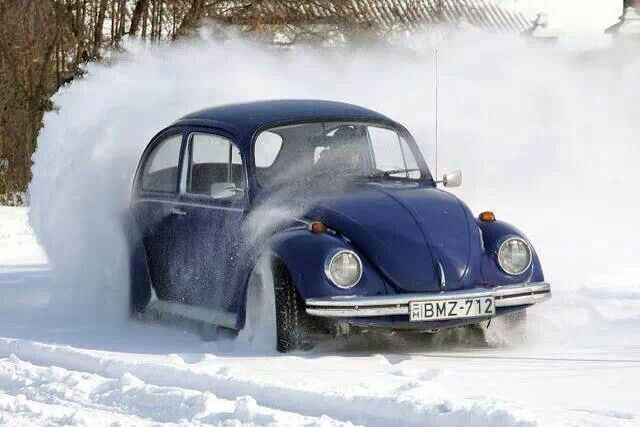

I have long admired the original VW Beetle (and owned several over the years) on account of its no-nonsense design ethic. It outdid the Model T Ford in many ways, insofar as being simple, inexpensive personal transportation for the masses.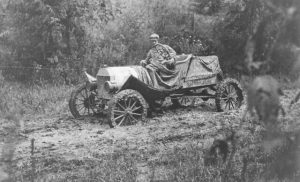
It had heat, for instance – which the T lacked. Lots of jokes have been made about the Beetle’s heating system, which relied upon a network of ducts and tinwork encasing the engine. The same fan that cooled the air-cooled engine also pushed air warmed by the running engine into the passenger compartment. It was actually quite ingenious and if the tinwork and the engine was tight the heater worked pretty well. The “engine” is italicized because – infamously – if the cases leaked, the hot oil that seeped would cook off and the vapors would be part of the warm air ducted into the Beetle’s passenger compartment.
But it did warm you up. Or at least, it kept you from freezing. One up on the Model T.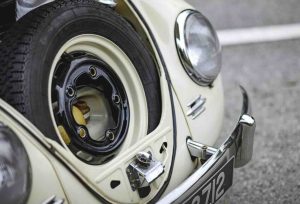
But the Beetle and the T – though very different in many respects – had one thing in common. They both had tall/skinny wheels (and tires). There’s a reason why. One that has been forgotten that maybe ought to be remembered.
When the T came out, roads were generally made of dirt not asphalt. When it rains, dirt becomes mud. It can become deep mud if it rains a lot and good luck trying to slog your way through that in a car – unless it has tall/skinny wheels (and tires). The same goes for snow, which they get a lot of in Germany. The Beetle’s pizza-pie plate wheels (like the T’s similar wagon wheels) cut through the snow (and mud) down to where there was solid ground and traction. The T was adept at fording through the unpaved dirt roads of rural, early 20th century America, just as the Beetle was adroit in the snow.
Not may people still driving today have ever driven a Model T but there are millions who have driven a Beetle and know, firsthand, how remarkably unstoppable they were in snow – despite not having all-wheel-drive (or even front-wheel drive) and no “drive modes” to fine-tune the little boxer engine’s “tip in” response and the transmission’s shift points. You fine-tuned the throttle response with your right foot and shifted for yourself (VW did offer an automatic as an option, but most Beetles came equipped with four speed manual transmissions).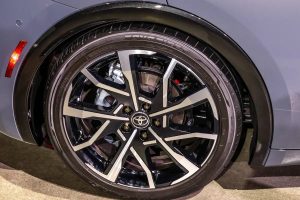
Tall/skinny wheels (and tires) offer another advantage that has interestingly been forgotten. They are a boon to fuel economy. The Beetle was capable of approaching 30 MPG if driven gently, which is remarkable given its engine was not fuel injected (later, Mexican-made Beetles got that upgrade) and its transmission lacked overdrive gearing. The car was also a flyweight – just 1,600 lbs. The lightest new cars weigh well over 2,000 lbs.
But those skinny, pizza-pie plate wheels helped, too. It took less energy to roll a Beetle. – as anyone who has pushed one down the road already knows. It takes more energy – burns more fuel – to roll a big fat wheel with a steamroller tire. These big fat wheels (and steamroller tires) are also heavy. The Beetle’s 15×4 (mark the 4) steel wheels were so light a man can easily pick one up with one hand.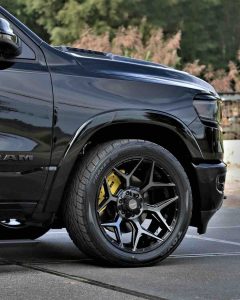
Try picking up a 20×8 inch “rim” with one hand.
It’s be interesting to find out just how much a difference it would make to swap out say a set of 18 inch “rims” on a car such as a Prius hybrid with a set of fifteens that were also just 4 inches wide. Without actually performing a side-by-side test, it is hard to say for certain but it is absolutely for-certain the increase would be in the whole numbers – as opposed to fractions of them, as achieved by such “technologies” as automatic stop-start (ASS) and cylinder deactivation.
Gnomesayin’?
. . .
If you like what you’ve found here please consider supporting EPautos.
We depend on you to keep the wheels turning!
Our donate button is here.
If you prefer not to use PayPal, our mailing address is:
EPautos
721 Hummingbird Lane SE
Copper Hill, VA 24079
PS: Get an EPautos magnet or sticker or coaster in return for a $25 or more one-time donation or a $10 or more monthly recurring donation. (Please be sure to tell us you want a magnet or sticker or coaster – and also, provide an address, so we know where to mail the thing!)
If you’d like a Baaaaa hat or other EPautos gear, see here!






In the 80’s I drove a 1954 Pre-A 356 with 165/70 15 inch ZX Michelins. You had to accept the limitation of the cars. I even has two chrome wheels a two painted silver. The 54 pre-A is so much more crude than the 356A 57. The skinny Michelins set the limits perfectly for both cars. I thought I was in high cotton with those fancy tires. Tom
“But those skinny, pizza-pie plate wheels helped, too. It took less energy to roll a Beetle.”
So that means the skinny tires had less traction (less rolling resistance).
Therefore, that would make skinny tires WORSE in the snow. Because you want the most traction you can get in snow or ice. So WIDER tires would be better for snow/ice.
That’s what makes sense to me, IDK maybe I’m wrong?
Hi Harry,
The skinny wheels/tires cut down through the snow – and that’s the main reason why a Beetle was so good in the snow!
I hear you, but you’re cutting down to what? More snow/ice? If it cuts down to tar or dirt then yeah that makes sense, otherwise it doesn’t make sense to me.
Those skinny tires, do the trick.
I’m double posting a great video from below:
https://www.youtube.com/watch?v=WGGGCVtpnoQ
I once purchasd a sand rail(68 beetle based) as a winter car, because the wheels were soo tall and wide (hoosier circle dirt tires rear – think front wheels of batmobile) that it would go on top of the snow. Front tractor tires got decent traction like a rudder on a boat, and it was light enough to go on top of the snow. Open differential but steering brakes allowed me to lock whatever side power was wasting on, sort of like manual traction/stability control.
As soon as it got down to 40 degrees the 009 distributor fell flat on it’s face with no advance curve you had to shake the trottle pedal like you had parkinsons. Swapped for an 034 vacuum advance and changed heat range plugs with the seasons.
How does rim diameter decrease miles per gallon? Shouldn’t it be just final tire circumference and sprung weight?
What comes into play is if the circumference of two options is exactly the same the smaller rim has taller sidewalls so that the mass of the tire is closer to the axle.
But the flip of this is the rim mass itself. If they can build a lighter wheel using aluminum than would be if it was rubber then it might negate. Also the weight necessary to make the sidewalls themselves strong enough factors in.
For example, the Rivian that gets the best range is the one with 21″ wheels with the 20″ and 22″ being options. The reason they offer a 20″ is that’s the better offroad option where you need the sidewall for flex whilst aired down and have slightly less risk of damaging the rim lips.
Offroad vehicles have a balancing act between too little and too much sidewall. Ideally you want a lot of sidewall to allow flex and keep the wheels safe from rocks.
But too much and the tire is unstable on pavement without very thick sidewalls, which defeats the purpose of having flexy sidewall in the first place and makes the tires very heavy.
They have a tire circumference that best matches the gearing to put the engine in it’s most efficient power point. Then there’s best combinations of rim and tire sidewall to achieve the best efficiency. It’s not always the smallest rim. It’s usually not the tallest rim either.
Rotational inertia is a big enemy here. The higher rotational inertia will constantly take more energy to accelerate and to decelerate a wheel and tire combo.
Little s#!t boxes like the Ford Festiva, older Geo metros, etc have tiny wheels and tires not just to be cheap, but to give better performance, as well as being an easy way to lower the roll center of the vehicle.
Aside from being funny looking and not working great on off road/rough terrain, small skinny wheels and tires have lots of advantages.
I had a 72 model. Two winters in upstate NY, one in Idaho Falls, two more in Seattle. It never failed me in any way. One day after an ice storm the drivers side was encased in 3/4 ” solid ice. I couldn’t open the drivers door but managed to climb in the passenger side.
By the time I got to the toll booth over the Hudson to Poughkeepsie the car was warm enough to crank the window down. The ice was still solid over the window opening. I punched half of it out to give the toll attendant the till ticket.
Around 130k miles the clutch cable broke. Guess what, with a little practice you could drive fine without it. I drove it that way for weeks before I had the opportunity to replace it.
Dead battery? No problem push it yourself get it going pop the clutch on you are on your way.
In the winter it gave up nothing to a snowmobile.
My uncle used to tell me stories of him driving a captured Kubelwagen around France near the end of the war. They loved it because it would never get stuck.
Saw a good video awhile back about Beetles in snow. Guy was out west in negative temps. It was pretty impressive. Heater did struggle quite a bit though!!
https://www.youtube.com/watch?v=WGGGCVtpnoQ&pp=ygURdncgYmVldGxlIGluIHNub3c%3D
Love this video, Klink!
Brought back memories of me in the ’90s. Some advice for the guy: An old credit card works better as a windshield scraper than that rag he was using!
Yeah! That rag didn’t do much that’s for sure. That car would probably be a beast with snow tires on it though the skill to drive a car like that in those conditions is missing from most drivers today.
Or music cassette case
Hitlers car the vw funny how he at least said he was concerned about the people needing a cheap car to get around and how the dictators in the ussa don’t want you to have a cheap car to get around.
And on tiny lighter weight cars my favorite is probably the amc gremlin seen one with a v8 swap really cool
My second car was a 1981 Toyota Starlet. It came with 145/80/13 tires. It was great in the snow and wet weather. On the highway at 65 to 70 it got 40 and sometimes 45 mpg. I changed to 175 70s and the mileage dropped by 4 mpg minimum. The advantage to me was improved cornering and maybe braking. I think I could have compensated woth a stiffer sway bar front and rear.
I miss that car to this day. It would make a great commuter. And… it was rwd. If that car had an 100 hp engine, it would tear up the road. It weighed 1800 lbs. It was a sad day when Toyota stopped building rwd models in 1984.
Swamprat… I see how my day is starting.
Hi Swamp!
Well, I’m in a decent mood today because – as you already know – I got the old brake pedal assembly out of the TA. It took my mule-like determination to get it done – and that did it! The new pedals go in today and then the getting-ready to cut the hole for the Hurst shifter!
Nice- I envy you right now. No garage for me to work on anything. Add in, no time. Always people calling and asking for this and that. Best of luck on that cutting. Make sure you don’t cut any extra.
Yea! Glad to see “Hurst shifter” made it into your swap! Click click baby!
145/80R13 compared to a 175/70R13 is a 2.5% increase in circumference. That has to be included in the mileage comparison since the odometer will turn over 2.3% fewer miles with the larger tires.
That of course doesn’t account for the full 10% drop in MPG. The extra 20% width and weight has a definite impact. But if you have not corrected for the circumference then that’s some of it.
Wow, I’d never heard of a 1981 Toyota Starlet.
…It’s a f-ing Rabbit! ?
https://www.motortrend.com/features/1812-1981-toyota-starlet-kp61-the-angry-duckling
I would love to own one today. Both the Rabbit, & the Starlet. Too bad, our Overlords won’t allow it.
I should add, I drove a couple of Rabbits back in the day. Fun cars. They do a mean 360 and bounce well.
Instead of replacing V6 and V8 engines with turbocharged 2.0L 4-bangers, why not replace steamroller wheels with 15-inch wheels with actual sidewalks? Methinks you’d save more gas that way.
That’s what our putative masters want us on- sidewalks. (Yes, I know you meant sidewalls…)
Curse you autocorrect!
I wonder if the pendulum will swing back to smaller/skinnier tires/rims?
They certainly are way better for the large majority of people.
Trends in the aftermarket get copied by auto makers, much later. Monkey see, monkey do.
Mag wheels were an aftermarket item in the 1960s. Most cars came with steel wheels and hubcaps. Now ALL cars have custom aluminum wheels.
Big, wide tires were copied from race cars. They work great for high-speed traction, where fuel economy is unimportant. But on highway vehicles, they add to unsprung weight and guzzle gas — all for a stylish look. Me drive fast! Me Dale Earnhardt!
Monkey auto makers suck. I hope they all go out of business soon.
Indeed, now cool for a lot of enthusiasts are steelies with hubcaps, and often stuff like GM rallye wheels with their caps. Even old cop car wheels with dog dish caps are different and cool now.
It doesn’t help that proper high quality triple chrome plating has been driven out of the country and made obscenely expensive by the earth worshippers.
I’ve never driven small cars, but I’ve always so admired the engineering and simplicity of the Bug. I’m fascinated by it. I’ve even considered getting one, even though I wouldn’t drive it on the road. Maybe even restoring one, just for the immersive experience.
Re the tall skinny tires: Lesson learned. When I was young, my first pick’em-up truck had wide 32″ tires with an aggressive tread. Looking at it, ya’d think that truck would have great traction (Well…if you were young and ignorant). In reality, that truck had the worst traction of any vehicle I’ve ever owned over the last 40 years. If there was a cloud in the sky, those tires were a-spinnin’ and the truck wasn’t going anywhere. I mean, it was so bad, it was embarrassing! Between those wide tires, and not having any weight over the drive wheels, old ladies in Corollas could easily go where I wouldn’t dare!
Maybe Trump will decree that a “people’s car” be built here, today- just as his German counterpart, Hitler, did for Deutschland. (Well of course, it such were to happen, the thing would weigh 6,000 lbs and have 15 air bags and 57 computer modules, and get 8MPG…and have a sensor that would prevent you from starting it on anything but a perfectly sunny dry day…).
Indeed, Arthur!
I’ve owned several old VWs and – like you – I was (and remain) impressed by the brilliant, functional simplicity of the things. You could have the engine out of a Bug in a hour with basic hand tools. Changing the oil could be done with a crescent wrench and no jack stands. Just undo the on big bolt on the underside of the crankcase and let’ er drain. Oil filter? What oil filter! You cleaned a screen. The single barrel Solex carb could be serviced by anyone. Four plugs, one fan belt – and that’s about it. Just be sure to check/adjust the valves every 10,000 miles or so!
Eric, can you imagine what we could have if it weren’t for Govco being intimately involved in vehicle design? If it weren’t for the disingenuous manufacturers? If it weren’t for the masses being willing to finance $80K rolling piles of crap?
Pretty sad: Hitler gave us the VW Bug.
Our government took it away, and along with it, any hope of ever having new, simple, cheap, durable vehicles. AT least the Nazis didn’t hate their own country and their own people. Our government does!
Absolutely, Arthur!
Today, a modern Beetle analog could be built and sold at a profit for $10k if the government were not in the way. No air bags or “safety” add-ons. Just a sound-to-drive little car with a TBI-injected four cylinder engine and a five speed manual. Nothing “electronic” beyond the stand-alone computer to run the TBI. The drivetrain would not be “dirty” and whatever slight differences there were in terms of “emissions” of meaningfully harmful gasses would be countered by the car’s very high fuel efficiency. A car that averages 50-60 MPG “emitting” far less in the aggregate than a drivetrain that touts fractionally lower emissions but only manages 35 MPG due to the vehicle’s grotesque curb weight and rolling resistance… because “safety.”
A big part of why air cooled went away was the difficulty of precisely controlling the combustion temperature. Which is critical in controlling what kind of gases exit the tailpipe.
I wonder if it would be effective to do with a fan which varied speed electronically and thermostatic louvers which could be adjusted to control temperature better? This would add complexity, but air cooling has enough advantages in weight, repairability (sustainability) and reliability I wonder if it might be worth doing.
I drove a VW for several years when I was in college in the 60’s, was great fun but the “heater” was pretty useless in weather like we’re having now; needed an ice scraper to clear off the INSIDE of the windshield 😆. Was good in the snow as you said though, think having the weight of the engine over the drive wheels had a lot to do with that as well.
Tire cost, my 03 Ford Escape $115 each, Hankook 225/70-15 weight 23 lbs
Similar Hankook for the 18 Jeep GC, $215 each, 265/60-18 weight 36 lbs
Hit the way back machine: stock tires for my 79 Pontiac Grand Prix (miss you Old Yeller) 195/75-14 again a Hankook tire, $90 and weigh only 18 lbs. Car rode and handled just fine on those stock size tires.
The Jeep eats tires, but I can’t stand noise so I spring for the Pirellis at over $250 each so with mount balance tax it’s north of $1200 and 35k miles is getting down past the wear bars. Progress Comrades!
PS: That Pontiac had disk brakes up front even with 14” rims. Set up with Bendix Titanium pads it stopped the best with excellent pedal feel, than anything I’ve owned since my 69 Alfa Romeo.
The last couple old V dubs (type 3 squareback and a type 3 notchback) I flipped included replacing the completely rotted tires. Interestingly enough, 165/80R15 tires are STILL cheap, 2 years ago they were $160 for all 4 with free shipping, I see they’re about $200/set now. They have to be ordered though. Also, they are so easy to handle and mount.
My friend who is driving a 1989 Geo Metro (made in Japan, no EGR system) went shopping for 12″ new tires, could not find a one in Medford, Or – so he had to order them online and Les Schwab put them on. He got them from giga-tires dot com – impressive online tire seller. Check it out, you can buy 12″ tires for around $25 each plus shipping.
(older Geo Metro have 155/80R12 tires)
To measure the effect of tires and pressure, find a paved road on a hill that rolls out to a flat. Mark the starting spot and roll down with engine off in neutral. Measure the distance for different tire pressures. Higher pressure will get more distance, proving the drag is lowered with increase tire pressure. Darin at geometro and ecomodder websites has done this, and here is the chart:
https://www.metrompg.com/posts/photos/chart-s-firefly.gif
Note: at 50psi, increasing pressure does not change resistance
lots of charts:
https://www.metrompg.com/posts/tire-pressure-rolling-resistance.htm
Go too high and you’ll wear out the center tread and lose traction though. And of course ride and noise get worse-still a worthwhile experiment.
I finally figured out that it’s worth the money to buy really good 10 ply trailer tires for my car haulers for this reason- they’re designed to run 90psi and it just tows lighter and is much less damage prone.
Eric: “It’s be interesting to find out just how much a difference it would make to swap out say a set of 18 inch “rims” on a car such as a Prius hybrid with a set of fifteens that were also just 4 inches wide.”
If I recall correctly Eric you mentioned many years ago that when the Prius’s wheel and tire size were increased from the previous year the fuel economy went down about 3 or 4 mpg due to an increase in rolling mass. Of course monster size brake rotors also factor into this.
Even if there was no difference in fuel economy just the price difference between a set of 205/75R15 tires/ wheels VS 325/40R24 wheels/ tires would leave you gasping for breath.
325/40R24 tires are only $502 each vs. 205/70R15 $56 each.
Price based on cheapest/ first result. YMMV.
I’m sure most people don’t care about what tires and wheels cost because they’ll just finance it………
That’s why I have 235×16 on my pickups. The kids on my job sites can’t believe how I can
get around. Remember the old skinny, Ford tall boy/Bias tires? They would go all over the place.
Many moons ago, when I wanted to put big rims and low profile tires on my cars because they looked “cool & hip”, the physics & numbers stopped me cold. Not only were the new wheels insanely expensive, they actually made the car slower and harder to drive!!! The skinniest wheels and tires helped the most, as the decreased unsprung weight improved fuel mileage, and i found high rubber sidewalls is a lot lighter and cheaper than tall metal wheels. Guess dragsters, with skinny tall front wheels/tires and huge rear fat tires, with little metal wheels, really do know how to get going fast the most effective way possible! Who knew???
YMMV, but save your fedbux, and buy more old cars, instead of fancy rims and racer boy tires…you’ll thank Eric & me later!!!
“It’s be interesting to find out just how much a difference it would make to swap out say a set of 18 inch “rims” on a car such as a Prius hybrid with a set of fifteens that were also just 4 inches wide. ” – Eric
Indeed it would. The biggest problem you might have would be those skinny tires handling all that 3200+ pounds of weight. That’s two Beetles if your numbers are correct.
Mounting them would be difficult since the Beetle has drum brakes and most all new cars have large discs.
18×4 wheel could be a new “look”. Still, you might have to go to a 10 ply tire to handle the weight per sq”. Speaking of brakes, the abs would be going off all the time.
I also recall Eric testing a vehicle that the manufacturer specs had the base model with better mileage because it didn’t have the “upgraded” rims.
At least ABS could be useful at that point. I still wouldn’t use ABS.