


It is probably true that EVs sales are in freefall on account of the realities of EV ownership becoming common knowledge – rather than the end of the federal tax rebate that used to be available, if you were affluent enough to qualify for it. Kind of like “safe and effective” with regard to vaccine uptake. In both cases, the truth was not told.
More finely half-truths were told.
For example, about “fast” charging EVs. The “fast” is bracketed within air fingers quotation marks to point out the dishonest etymology. It is true that it takes less time to charge up an EV at a commercial/high-voltage “fast” charger vs. charging an EV at home (which is essentially trick-charging the EV since it takes many hours, best case) and so it can be said to be “fast” relative to that. But it is still slow, relative to how quickly one can fill up a non-electric vehicle. The italics bring up the next half-truth.
Or suppressed truth, if you prefer.
It is that you can only partially charge an EV at a “fast” charger. And even that takes comparatively forever (viz, it took me 30 minutes to instill 100 miles of driving range in the last EV I was sent to test drive).
The kiosks (and the EVs) are set up to deliver – and accept – “fast” (that is, high voltage) charge up to 80 percent of battery capacity, after which the charging reverts to slow. This is a safeguard to reduce the chances of damaging the battery or triggering a fire from the heat that can be generated during high-voltage DC “fast” charging. The truth is that while you can get a partial charge “fast,” the full charge takes a lot longer – as in an hour or more. The consequences of this truth include having to stop for your next charge sooner – assuming you don’t wait the hour or longer it takes to get a full charge – because you’ll be leaving the charging kiosk with just a partial charge. That means less driving range, which means you’ll be running out of range sooner.
The next suppressed truth is that you’d better have a credit/debit card to pay for your charge – because you can’t pay cash for it, as you can for gas. Some “fast” charger kiosks demand you have a phone – with an app loaded on it. Either way, it’s another unwanted nudge toward a cashless payment system. You are are effectively required to surrender your anonymity; the kiosk knows it’s you charging up – and also where and when. More ominously, it sets up the possibility of metering how much electricity you – specifically you – are allowed to access in real time, because the “fast” chargers are “smart,” meaning they can be used to control you by restricting what you are allowed to do.
Speaking of charge . . .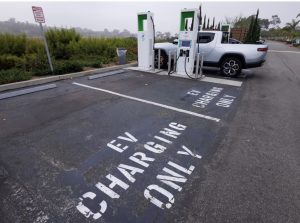
There has been almost no “mainstream” coverage of the fact that the charge to “fast” charge is on par with what it costs to gas up a vehicle with a tank rather than a battery. Why? Because you’re being charged for the . . . convenience of not having to spend hours at home waiting for your EV to charge. High voltage DC chargers cost money – even with generous federal and state subsidies, which you are charged for via the taxes you’re compelled to pay – and someone’s going to have to pay for that.
It isn’t cheap to charge at home, either. An EV is a high-draw appliance, like an electric stove. Keep one of those on for 6-8 hours (the typical time it takes to recharge an EV using a “Level II” 240V outlet) every night and see what it does to your utility bill.
Speaking of charging . . .
Another suppressed truth about EVs and charging that’s new is that some manufacturers of these devices are eliminating the possibility of using ordinary household electricity – a standard 120V household outlet – to charge them.
Plugging in to 120V outlet isn’t “fast,” but it does allow you to charge up an EV anywhere there is electricity. Interestingly, that option is being quietly eliminated. I recently got sent a 2026 Ioniq 9 – Hyundai’s newest EV – to test drive for a week. The first thing I do when I get an EV to test drive is plug the thing in, because by the time it arrives at my house, it is already partially discharged – because I live in the country, where there are no “fast” chargers. I looked for the usually supplied charge cord apparatus but there was none. I then discovered that this new EV could only be charged using a dedicated 240V circuit – which requires a brand-specific outlet, by the way, in addition to the dedicated 240V circuit itself, which entails running wire from the electrical panel to some accessible point in your garage (which assumes you have a garage). It was either that or drive to the “fast” charger for a charge.
In other words, it seems the possibility of charging at home is being gradually eliminated – making it so that only people who have a home (and a garage) can charge there, assuming they don’t mind the additional expense of upgrading their electrical panel to be able to do that.
Everyone else is being quietly herded toward “fast” charging only. Consider the implications.
Several other manufacturers of EVs are nudging people along the same lines, by charging extra for a home-charge cord. In some cases, a lot extra. When VW sent me an ID Buzz to test drive, it did not come with the home charge cord (and the electronic box that modulates the current) needed to just plug the thing into a household 120V outlet. It was a $700 option. In other words, even if the device could be charged at hone, you’d have to spend that much extra to be able to do so.
Perhaps the last nail in the EV coffin is the truth about depreciation getting out.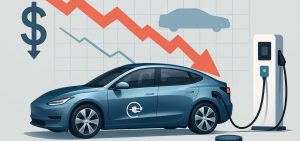
EVs lose value to the tune of about 30 percent more over a five year period because the truth about EV battery packs has gotten out. That truth being that like any battery, over time, EV battery packs gradually lose their capacity to hold a charge – just like the battery in your phone of laptop. Unlike the battery in your phone or laptop, though, EV battery packs are staggeringly expensive to replace, which – along with the depreciated value of the EV itself – renders the EV both functionally as well as economically a throw-away much sooner than would be the case with any other vehicle. Instead of a 15-20 year viable service life, half that life. Given that EVs also cost thousands more than otherwise similar non-EVs, buying an EV is something like buying into a time-share apartment in a really bad neighborhood.
John Adams was right about facts – which is to say, he was right about the truth.
Both are stubborn things.
. . .
If you like what you’ve found here please consider supporting EPautos.
We depend on you to keep the wheels turning!
Our donate button is here.
If you prefer not to use PayPal, our mailing address is:
EPautos
721 Hummingbird Lane SE
Copper Hill, VA 24079
PS: Get an EPautos magnet or sticker or coaster in return for a $25 or more one-time donation or a $10 or more monthly recurring donation. (Please be sure to tell us you want a magnet or sticker or coaster – and also, provide an address, so we know where to mail the thing!)
If you’d like a Baaaaa hat or other EPautos gear, see here!










Off topic, but this article on biofuel quotas made me do a double take. Just what we don’t need, more ethanol! Thanks, Trumpy – NOT!
https://finance.yahoo.com/sectors/energy/articles/refiners-us-biofuel-quotas-may-192312868.html
And, let’s not forget the record setting Porsche, the Taycan. No other Porsche can claim such phenomenal depreciation numbers…
https://www.kbb.com/porsche/taycan/2022/depreciation/
My Telsa loving neighbor, after two of them, gave up the ghost. She just got a Lincoln Navigator with an ICE engine. Why? IDK, other than it now has a huge ‘screen’ that she likes.
And I would chastise her constantly. We don’t have cell on our road, so I would see her stopped before the dead zone as many do, and I would pull up next to her “ya need me to bring a generator?!” I did this often, and she would get pissed at me, haha.
And if she ever came over to pick my wife up, I would demand that she not use the ‘auto drive bs’ thing.
My wife reported often that she would get a headache in the thing.
I’ve been reading this new conspiracy theory that Trump is causing people to buy EVs as gasoline disappears. The law of unintended consequences.
There is one silver lining in Trump’s Iran war madness, a sustained increase in gasoline prices will drive more ultra fuel efficient vehicles to be offered.
Yes, but that will most likely result in more hybridization of the fleet instead of smaller/lighter cars with smaller engines. Better than an EV but still adds complexity. And you can forget about diesels. They are dead for passenger cars here. No way to make them meet current/future regs without costly and fragile systems.
Can’t imagine what it would be like driving an EV for a long trip. Back when my parents still lived in NJ we could drive down for the holidays on one tank of gas nonstop in about five hours (our bladders were in better shape back then). My sister and brother in law would drive up from Florida nonstop also, only stopping to pee, gas up, and switch drivers. Took them about eighteen hours or so. Good luck with making that time in an EV.
More evidence Israel can be charged w/engineering 10/7:
3.10.26 YNET. “Executed over spying for Israel? Iran’s Quds Force chief vanishes. Speculation surrounding Esmail Qaani intensified after he reportedly survived the assassination of Iran’s Supreme Leader Ayatollah Ali Khamenei at the start of the war, along with several of the leader’s top aides” (Also survived assassinations of Nasrallah and leadership during 12 Day War)
Video I saw on Sonar 21 didn’t mention any connection to 10/7, but in reading this article from a Quds Iranian “defector”/Israeli spy (?) it seems Qanni (thus Israel) might have ordered Hamas to attack on 10/7:
5.1.24 “Qaani’s Growing Leadership Struggles in a Post-Soleimani World … The exception to this model is Lebanese Hezbollah (LH), where all its leaders are members of the Qods Force—in some cases with military ranks and Iranian names. Due to this connection with the Qods Force, LH leadership has supported Qaani, tried to strengthen his position, and made his relations with Palestinian groups stronger than before. There are some insiders who believe that this relationship has had an impact on Hamas’s decision to attack Israel on October 7. After the start of the war, sources affiliated with the so-called Axis of Resistance, whose identities are protected for security reasons, stated to the author that Qaani had directly planned this operation with the Palestinians. They understood the attack as having been implemented based off of a plan developed by Imad Mughniyeh years ago and updated with the help of Lebanese Hezbollah. However, these sources believe that Qaani had informed both Hezbollah and the Qods Force leadership council that the planned attack would not happen in the near future and that the measures being taken were simply preparatory in nature.
“These sources described a conflict in the Qods Force leadership after October 7, questioning Qaani why the decision to attack had bypassed the leadership council—and whereby Qaani tried to exonerate himself in emphasizing that Mohammed Deif, Sinwar, and Al-Gharidi had carried out the attack outside of his command. That this is the understanding of at least some Axis of Resistance affiliates of how October 7 unfolded—a disconnect between Qaani and other elements of Qods Force leadership in the lead-up and aftermath of a major operation of an Iranian proxy—underscores the perception of turmoil within the IRGC leadership post-Soleimani, and their views of what this tension can lead to or allow in terms of Iran’s broader control over its proxy groups. Moreover, there is the perception that the attack has sparked a good deal of criticism of Qaani from within the organization and among some proxy groups. The sources likewise believed that Qods Force leadership had reprimanded Qaani in a meeting held on October 14 and attended by the Chief of Staff of the Iranian Armed Forces Major General Bagheri, commander of the central headquarters of Khatam al-Anbiya Gholam Ali Rashid, Shirazi, head of the military office of Mohsen Qomi, and a number of government members.
“Each potential suggests a failure of leadership: if Qaani was indeed directly involved but did not inform IRGC leadership, this suggests that failed to inform the broader leadership beforehand that an attack would take place in order to ensure that the political, military, and economic infrastructure for it could be provided. Or else, if the operation took place without his knowledge, it is a significant failure for a leader held responsible for the behavior of groups that receive monthly salaries from Iran and where Iran bears the political responsibility resulting from these actions. … Soleimani apparently tried to avoid interfering in Iran’s internal political affairs and to maintain an equal distance from the political factions within the framework of the Islamic Republic of Iran, while Qaani maintains close relations with Ibrahim Raisi and is seeking to establish closer cooperation with the Ministry of Intelligence—thereby distancing himself from the intelligence wing of the IRGC. Specifically, he is coordinating closely with the Ministry of Intelligence to liquidate political activists abroad, while in Soleimani’s time these activities were done through the intelligence of the Islamic Revolutionary Guard Corps. …Right now, Qaani’s future is unclear. After the end of the war between Israel and Hamas, it is likely that Qaani will be dismissed if he is indeed considered the main architect of October 7 among Iranian leadership.”
https://www.washingtoninstitute.org/policy-analysis/qaanis-growing-leadership-struggles-post-soleimani-world
h/t Sonar 21 Larry Johnson 3.15.26 “Trump is Trapped, But Doesn’t Know It” video is embedded in blog
“Was the Commander of Iran’s Most Dangerous Military Unit a Mossad Spy? — The Full Investigation”
https://www.youtube.com/watch?v=t0_i_Pot1BQ
‘Half truths were told …’ — eric
… and mistakes were made! But we’ll name no names, to protect the guilty … *cough* ‘Joe Manchin’ *cough*.
Eric speaks darkly of EeeVees’ accelerated depreciation, reminiscent of a nine-year-old boy featured in Ripley’s Believe it or Not, who had the wrinkled features, white hair and piping voice of an ancient Boomer.
But in the bizarre alt-world of the Lügenpresse, senescent EeeVee clunkers are presented as screaming bargains. It’s like being offered a carton of a dozen cracked eggs, leaking and runny, for only two dollahs. Such a deal!
When life hands you broken eggs, make eggnog, counsels the wise and all-knowing Lügenpresse.
M is for the mud flaps she gave me for muh pickup truck
O is for the oil I put in my pickup truck, drain it out, and dip my sheep in it
T is for Dolly Parton
H is for Haggard
E is for
EggsEeeVeesR is for … REDNECK!!
— Ray Wylie Hubbard, Redneck Mother
Did y’all get the ‘T’ bit? As in tatas … knockeroos.
My solar inverter is installed in my garage, and it has an EV port. It’s physically a very simple installation, just run a few feet of 10/2 cable to the charging cable. But then the installation company has to turn up the port and set up the charging parameters. They’re going to push back on me DIYing a cable because of the warranty and their own liability issues, so that’s going to be a few hours of work+materials+provisioning.
Once installed it can be set up to charge the EV on solar, utility power or some mix of the two. Fact is, an EV used for commuting will likely be out of the garage when the sun is shining and parked at night, so that means I’ll be using utility power. That’s OK in theory because I would have provided about 30 kW to the grid during the day so it will be “net zero” right? Except that’s in addition to the electricity I normally use so now it’s either use electricity at home or use it to charge the car. Another option would be to install a battery to store electricity during the day and discharge the battery at night. Except that’s another major capital outlay, and I’ll still end up using much more electricity on net and therefore paying more to the utility.
All for a vehicle that will drastically lose range in 3-5 years.
“If it weren’t for those darn batteries!” says the EV evangelist. Well, sure. And if it weren’t for my looks I’d be a model! The battery pack is the heart of the EV. Without it, the thing is worse than useless. I’d even consider an EV as a commuter car if I could get “free” solar charging, but as I showed, that’s just trading Capex for operating costs. If the battery would last 10 years without major performance declines I’d even consider the added cost to my home’s electrical system, if only because I like to front-load paying for something that will reduce costs over time.
Morning, RK!
You made my day with this one:
“If it weren’t for those darn batteries!” says the EV evangelist. Well, sure. And if it weren’t for my looks I’d be a model!
And if my aunt had balls, she’d be my uncle. 🙂
🤣🤣Good one🤣🤣
“Balls!” said the Queen.
“If I had two, I’d be King.”
“That’s OK in theory because I would have provided about 30 kW to the grid during the day so it will be “net zero” right?”
The problem with that is that EVERYONE with solar on the roof will ‘provide to the grid’ while the sun is shining, just as that same EVERYONE will be wanting to use power after dark.
The mistiming of such supply and demand is the Achilles’ heel of such government-promoted, weather-reliant approach.
The grid soon gets to the point where there’s too much power at midday, which then has to be ‘curtailed’, and too little after dark, which will eventually lead to rationing.
Several utilities in sunny places like Australia are now starting to charge, rather than pay, for ‘feed-in’ solar trickle current.
Or to remotely draining one’s home (if you have one) or EV’s batteries in times of need via ‘smart meters’. Which is also already happening.
Last but not least, the cost of stabilizing the grid for all these highly variable sources is also not cheap and is largely borne by those WITHOUT solar panels, in the form of higher overall prices.
It’s called the “duck curve” because the production/use graph resembles the profile of a duck. California’s ISO fixed the problem by changing the net metering laws to wholesale/retail pricing, where instead of requiring the power company to buy residential solar at retail prices (net metering), they could buy at the spot/wholesale price and charge retail consumption prices. While that’s much more fair (people without solar are no longer subsidizing people with solar), it also breaks contracts that were signed in good faith. It also has led to a surge in home batteries, which just remove potential power (and consumption) from the grid. More good news for Tesla, with their cheap and inefficient Power Walls, but it basically makes new residential solar unaffordable, even with tax breaks.
My co-op tried the same thing back in 2023, and promptly got sued by the state of Colorado (all the rich folks up in Aspen and Vail have solar and paid for Gov Polis’ (s)election). So now they’ve implemented a peak demand charge and offer a discount if you avoid running high loads during peak times like between 4-8 PM. The answer is to require solar suppliers to pay for battery systems that can level out demand, but again, that makes solar completely unaffordable. And the greens still have too much sway in government to let that happen.
When it comes to depreciation, I don’t sweat depreciation too much because I keep my cars for 10 years or more.
What I do sweat is not being able to keep an EV for 10 years or more. You see, EV batteries, as you mention, start to degrade as soon as you start using them. And the more you use a “fast” charger; in fact, the more you charge them, the faster they degrade. This can happen in as soon as seven years—which happens to be how long a lot of car loans last nowadays.
On top of that, you have the issue of your EV no longer being “supported” by its manufacturer after a certain period of time. This support not only involves the availability of replacement batteries (which by the way are not standardized such that aftermarket batteries are readily available) but also the over-the-air firmware updates for the EV. Either those updates are no longer available, or they end up bricking the device.
I’ve had to discard otherwise serviceable electronic devices because their batteries were no longer able to take a charge and replacement batteries were no longer available. Thankfully, those devices cost me no more than a few hundred dollars. But $50,000 is a bridge too far—for myself and many others.
Sooooooooo, one cannot buy an EV and keep it for 10 years. In fact, with EVs, the entire business model is not predicated on owning them, but renting them—either by leasing them or by transportation-as-a-service.
I would never underestimate the effort someone will go through to save money. EV’s battery replacement is going to be $9,000? “The hell you say. Here, hold my beer.” as guy in wife beater and CAT Power hat sparks a torch.
A couple other things to consider:
An EV generally costs at least 50% more compared to an equivalent sized ICE vehicle which means a higher insurance bill and depending on where you live, higher property taxes and let’s not forget that if you have to pay sales taxes a whole bunch more when you bought it.
Whoever insures your house may want more money because EVs just want to catch fire so the insurance company will want more money because of it.
The sad thing is that I’ve seen little EVs with lead acid batteries on the internet that would work as a cheap runabout to go a few miles if you lived in the city that might be perfect for that task but of course we aren’t allowed to drive them on GovCo’s roads. Speaking of that where are all those tiny cars President Trump promised us?
Not anymore, unfortunately, given post-COVID prices on any vehicle.
Right now you can get an Equinox EV for ~$35k.
Which is certainly not “50% more” than a comparable ICE SUV.
What makes the Hyundai example so egregious is that it is a lower priced brand. It’s not some exotic but, a far more accessible purchase for those not in the top 1% income bracket. Ergo, they don’t have the disposable cash to install a 240 charging station in the garage they can’t afford.
Just another tile in the mosaic, The Decline and Fall of a Once Great Civilization.
I suspect Mark the reason they are not supporting 120V charging is that it doesn’t transfer enough power to accomplish much. Although it might keep the battery from losing it’s entire charge in a cold winter might be a reason to keep it.
That’s a fact, Landru –
About the time it takes to recover charge using a 120V outlet. Even so, I can testify (from experience) that you can get about 30-40 miles of range via 120V if the EV is left plugged in late afternoon and not used until the next day. Obviously, that’s not a lot of range. But – in the first place – it’s probably enough to allow you to drive to a “fast” charger and (in the second) it’s enough to add enough additional range as a reserve, which is important when you have an EV. Finally, it’s enough, probably, for people who do not need to use an EV every day or who only drive short distances.
So why take that option away?
Like the electric equivalent of a jerry can. Slow, yes, but if your EV is flat dead you could have someone grab a generator and extension cord. Might be cheaper than a tow and you’re probably waiting around for an hour or two for one to show up anyway.
“Ergo, they don’t have the disposable cash to install a 240 charging station in the garage they can’t afford.”
Don’t worry, I’ve no doubt there’s already an auto loan provider out there that will be prepared to finance the new 240-V outlet for the lucky new EV owner as part of the overall 7-year lending package!
What’s a few hundred extra dollars if you’re borrowing $60K already?
Its actually Outright Lies coming from (((authority))).
EV’s are expensive, dangerous and boutique, like Ferrari, Lambos, and other exotic cars.
Truth is as brutal as it’s refreshing.
Buy older mechanically based vehicles, and you can drive for decades….like the cubans…
We’re all Cubans now….
With some parts companies going bankrupt, we will be repairing cars like the Cubans; scavaging parts off other cars or making the parts ourselves.
Hold my brew while I pencil out an AWD differential for yr 21 Audi. Youll be drivin an smilin in a couple uears.