

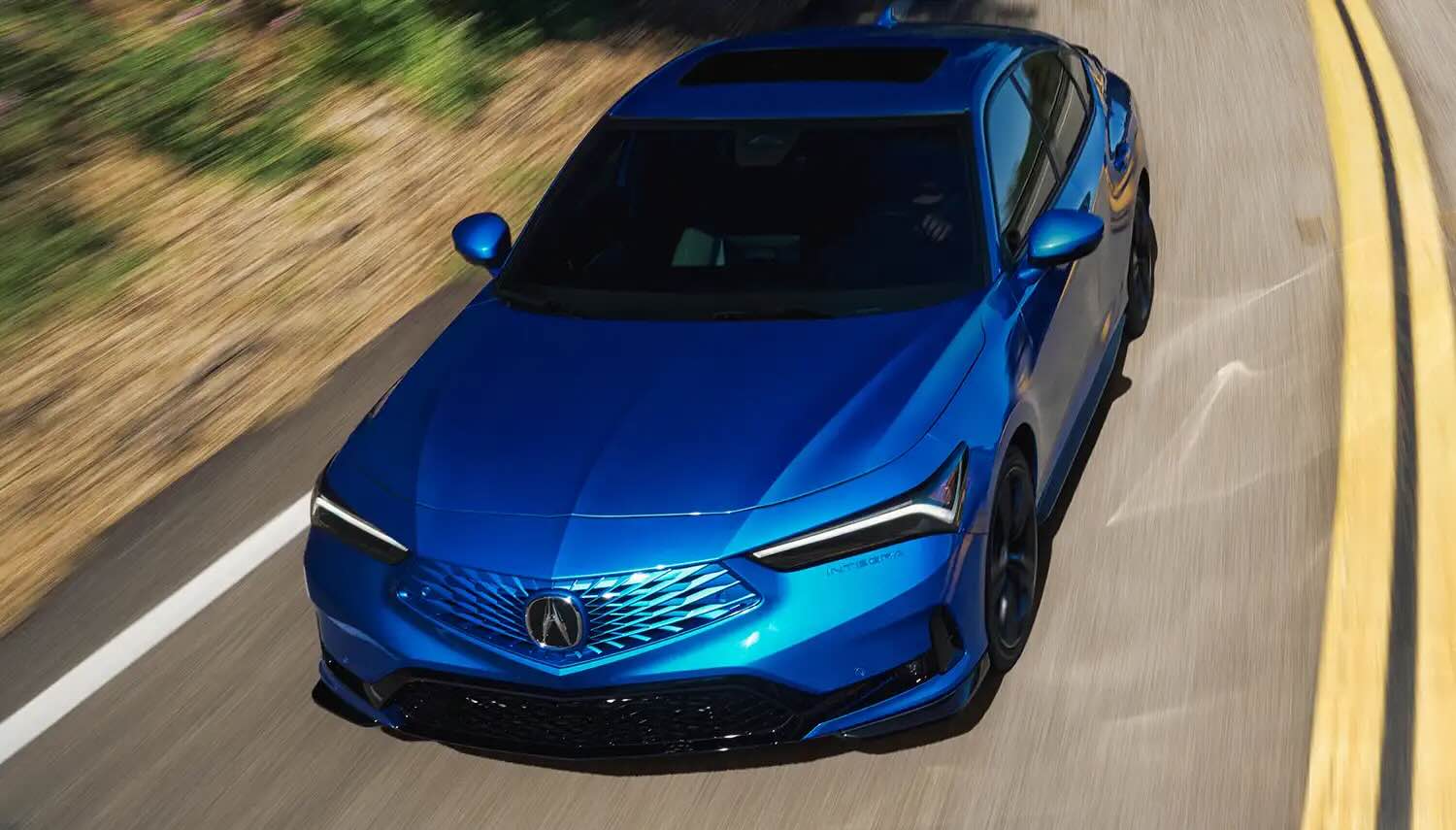

What is the difference between an Acura Integra and a Honda Civic? More finely, is there any difference between an Acura Integra and a Honda Civic – other than the price?
What It Is
The Integra is a sporty small sedan sold under the Acura label that is closely related to the less expensive Honda Civic. There are a number of differences that go beyond price – and styling.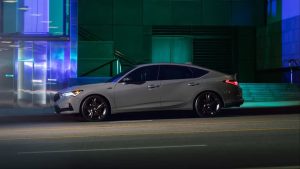
For one, the Acura is sold only as a hatchback while the Civic is available as a sedan or a hatchback.
For another, the Acura comes standard with the the more powerful 1.5 liter turbocharged engine that is optional in the Honda (which comes standard with an economy-minded 2.0 liter four without a turbo).
The Integra’s base price is $33,400 and for that you basically get an Acura-ized iteration of the Honda Civic Si, which lists for $31,495. Both come standard with the same 1.5 liter, turbocharged four cylinder engine but the Honda comes standard with a six speed manual transmission while the Acura comes standard with a CVT automatic. You can get a six speed manual with the Acura, but you’ll have to step up to the $39,200 A-Spec with the Technology Package, which includes larger 18 inch wheels as well as a limited slip front differential, an adaptive suspension, upgraded synthetic suede upholstery and a 16 speaker premium audio system.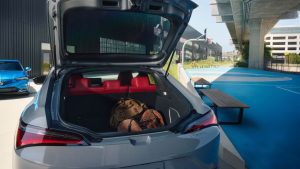
But the really big news – as Ed Sullivan used to say – is the Type-S, which centers on a 2.0 liter turbocharged engine that touts 320 horsepower (five more than the similar Civic Type-S).
This version of the Integra comes only with the six speed manual and also gets upgraded brakes and 19 inch wheels with more aggressive “summer” tires, an adaptive exhaust, wider track and aggressive-looking bodywork to match its capabilities.
Its base price is $53,900
What’s New For 2026
The base trim gets a new 9 inch LCD touchscreen and wireless connectivity. The Type-S gets the more aggressive-looking bodywork.
What’s Good
More luxurious/prestigious Integra is only slightly less expensive – to start – than a Civic Si.
Manual transmission is available.
Hatchback’s cargo capacity makes this small car a practical car.
What’s Not So Good
You can get a Civic Si with a standard manual for $7,705 less than the least expensive manual-equipped Integra.
Standard CVT (a transmission designed primarily for economy) is arguably out of place in an Acura.
Pop Tart LCD screen looks cheap.
Under The Hood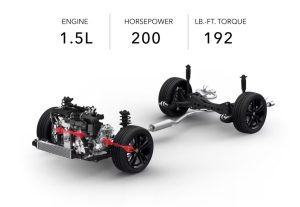
Unlike the Civic – which comes standard with a 2.0 liter (no turbo) four that makes 150 horsepower – the Integra come standard with the Civic Si’s 1.5 liter turbo four that makes 200 horsepower. However, this engine – in the Integra – is paired with a standard CVT automatic while the Civic Si comes with a six speed manual. This is an interesting incongruity given the Integra is supposed to be (like the Civic Si) an car fir driving enthusiasts and most driving enthusiasts dislike CVTs – and not just because they are automatics.
Their chief virtue is an efficiency gain vs. an automatic (or manual) with fixed forward speeds.
The 0-60 times tell part of the tale.
A Civic Si with the 1.5 liter engine and the six speed manual can make the run in just over six seconds while the Integra with the same engine and the standard CVT automatic takes closer to 7 seconds to get there. The upside is the higher gas mileage: 29 city, 37 highway with the CVT vs. 26 city 36 highway with the optional six sped manual. It’s not a huge difference, obviously – but it does make the point about CVT automatics being primarily designed for economy rather than acceleration.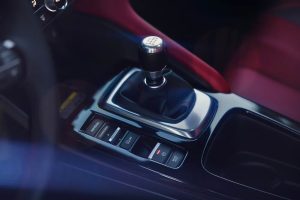
The good news is you can get the six speed manual; the bad news is that you to move up to the much more expensive A-Spec with the Technology Package. You do get the additional enhancements described earlier but it is probably the case that many potential Integra buyers would just like to be able to buy the six speed and not all the other things bundled with it.
So why does Acura (effectively) push so many would-be buyers into a CVT-equipped Integra? It probably has to to do with Corporate Average Fuel Economy (CAFE) math; the fewer manual-equipped Integras Acura sells, the higher Acura’s overall CAFE “fleet average” MPG number and that helps Acura avoid being fined for selling too many “gas guzzlers” while still being able to advertise the availability of a manual-equipped Integra.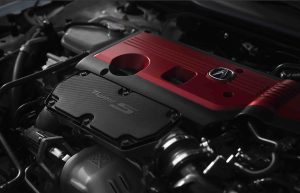
This is common practice in the car business. It is why manuals are both rare and when available, they are generally only available optionally and only in higher-trim iterations of the vehicle.
This isn’t an issue with the Type-S, which comes standard with a turbocharged 2.0 liter four that makes 320 horsepower (and 310 ft.-lbs. of torque) and comes only with a six speed manual. It’s not a problem – insofar as CAFE “fleet averages” go – because the Type-S’s price – which is about $20k higher than the base Integra – assures Acura won’t sell very many of them. Not because the car isn’t desirable but because it’s not exactly affordable (unless you compare it with something like a BMW M3, which costs about $20k more to start; about which more follows below).
It’s sounds perverse because it is. It is also why all the really fun cars have become such expensive cars.
All Integras are front-wheel-drive and both engines want premium unleaded. You can fill ‘er up with regular and it won’t hurt anything – other than power/performance. Sensors will detect the lower octane fuel and dial back the turbo boost (and the power).
On The Road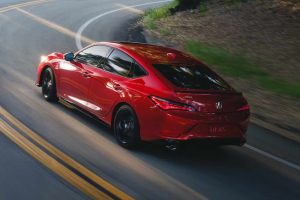
The Integra to get is the one with a manual because it’s the one that’s most fun to drive – and the whole point of owning a car like the Integra is to have fun while you drive. An automatic – CVT or otherwise – detracts from that. There’s less to do, for one – beyond stomping on the accelerator pedal – and that is inherently less fun than letting out the clutch while you stomp on the accelerator pedal, then push the clutch in (and let it out again) out as you shift through the gears. Also, you can hold each gear as long as you like; the CVT holds the range as long as it likes. With the manual, the Integra not only is quicker, it feels quicker. It feels more alive, because you’re more involved.
The CVT works well; but that is not the point. A CVT-equipped performance car is something like a three-wheeler vs. a motorcycle. Both are fun – but one is much more fun.
Even with the CVT, the Integra’s reflexes are cat-quick; the steering is surgical precise. The grip well beyond the threshold of most driver’s abilities. Translated, that means it is very easy to drive this car very fast – including in the corners. Just remember that there are limits to any car’s grip and if you exceed them – and your own abilities – physics will not forgive you.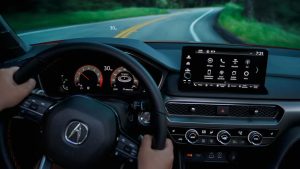
The ride is firm but not so firm you’ll want another car for daily driving. Acura has always done a god job balancing that just-right tautness with just-right give. The seats help out here. They keep you in place but it’s a place that’s nice to be, on account of the well-bolstered cushioning.
Yin – and yang.
The Type-S amps it all up considerably. The zero-to-sixty time drops to 5 seconds and the lateral road-holding ability increase to more than 1.02 g’s on the skidpad. The standard – and only – six speed has short-throw action and that intangible but-all-important quality – feel – that makes a performance car more than its horsepower or 0-60 numbers can convey. You have to drive the car to get it.
Once you, you will want to keep driving it.
At The Curb
The Integra comes only as a hatchback, as mentioned previously.
This is probably sensible because it makes this compact-sized Acura much more practical than the Honda sedan it’s related to. Though just 185.8 inches long, the Integra has 24.3 cubic feet of cargo capacity (almost twice as much as the Civic sedan) and the space is more useable because of the hatchback layout, which doesn’t separate the cargo area from the passenger area. You can fold the rear seats forward and basically use almost all of the interior space (excepting the driver’s seat) to carry whatever you need to carry and that definitely comes in handy.
Regular Integras don’t look different enough from Civics, though.
That can be a problem – or a plus – depending on how you look at it. On the plus side, if you like the looks of the Civic and are wanting an Acura – to get the additional standard features and, of course, prestige – then you can, for not much more than the Civic (Si) costs. At least when stacking up the base Integra against the base Civic Si, since both cost nearly the same. 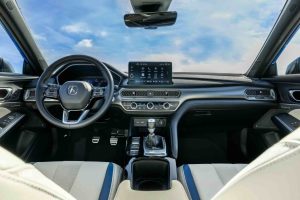
Also, the Civic Si is for the kids. Not in an insulting way. Just as it is not insulting to bar hop when you’re in you’re in your 20s. The Integra is for when you’ve grown out of that scene – but still like to have fun.
On the other hand, if you want that six-speed manual – in the Acura – you’ll have to spend thousands more than it would cost to get the same thing in a Civic Si that looks pretty much the same.
The wild card is the Type-S, which does look different and – more importantly – is different. It is also a bargain, relative to something like a BMW M3, which lists for $79,300. Yes, of course – the BMW is much more powerful, has a six cylinder engine and is rear-drive. Even so, it’s still about $20k more expensive than the Integra and you’d be higher-profile. The Type-S does look different – more menacing – than a regular Integra – but it is also not a Known Offender (as far as cops are concerned) while the M3 is the OJ of that type.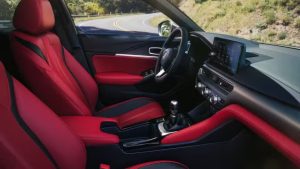
The interior’s layout is crisp and functional, though the Integra’s standard LCD touchscreen is of the Pop Tart erupting from the top of the dashboard variety. There are, however, still rotary knobs and push-buttons for everyday-use functions such as adjusting the temperature, airflow and fan speed.
The A-Spec’s standard adaptive suspension and the excellent 16 speaker premium audio system are almost as desirable as the six speed manual (assuming you like to drive). It’s unfortunate, though, that Acura decided to bundle all of those things together, since the six speed is kind of an essential in a car such as this – like the cheese on a cheeseburger – while the adaptive suspension and excellent 16 speaker audio system are nice to have but not essential to have.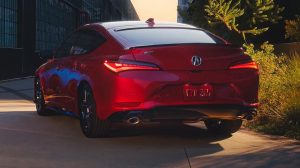
It’d be interesting to see how many more Integras would sell if they (like the Civic Si) came standard with the manual rather than a CVT.
The Rest
Front-drive performance cars – especially powerful ones, like the Type-S – are fairly hard to find, probably in part because of the near-hysteria that has been fomented about the necessity of AWD. Okay, maybe if you live in Minnesota. If you don’t, you might actually need AWD a few days out of the year and the rest of the year, you’ll be lugging around the extra equipment (and paying more for it, too). Certainly, AWD increases cornering grip – but the truth is you need to be driving really fast for that to become a meaningful factor. Also, it can be argued that driving a FWD (or RWD) performance car faster is more fun, precisely because of that wheelslip factor. It gets boring when you never break traction.
That’s never a problem with the Integra.
The Bottom Line
The Integra as Civic Si (and Type-S) in mufti is not an unsound concept. Why make an issue of what you’ve got – especially if you’re not a kid anymore?
. . .
If you like what you’ve found here please consider supporting EPautos.
We depend on you to keep the wheels turning!
Our donate button is here.
If you prefer not to use PayPal, our mailing address is:
EPautos
721 Hummingbird Lane SE
Copper Hill, VA 24079
PS: Get an EPautos magnet or sticker or coaster in return for a $25 or more one-time donation or a $10 or more monthly recurring donation. (Please be sure to tell us you want a magnet or sticker or coaster – and also, provide an address, so we know where to mail the thing!)
If you’d like a Baaaaa hat or other EPautos gear, see here!









‘This 1.5-liter engine– in the Integra – is paired with a standard CVT automatic while the Civic Si comes with a six-speed manual.’ — eric
This is completely upside down and backwards. The raging incompetence of automotive brand managers is stunning to behold.
They are doing for Acura what Alissa Heinerscheid did for Bud Light with the Dylan Mulvaney tranny ads. Goofballs!
p.s. Reckon young Dylan can drive a six-speed with a couple of Bud Lights under
hisher belt, a hinomaru headband restraining her brunette mop, and bellowing Banzai!?! Let’s give it a go, Acura! #YOLO #MADBITCHESWhy can’t manuals be short shifted for the fuel economy tests?
Hi Mark,
The problem is the variability. An automatic can be programmed for uniform operating characteristics. A manual is a variable – and variables are what’s not wanted.
That’s why I asked about short shifting, something totally under the control of the driver. It would seem to me that, if a driver wants to economize his fuel use, there are steps he can take to do that. Short shifting is an option. Another option is accelerating gradually vs. rapidly. And so on. Even with an automatic tranny, whether conventional or CVT, you’ll have variability; how a driver accelerates will determine fuel use.
That’s an interesting question. I wonder if the EPA tests have to use some sort of “trained” driver. Where I live cars have to do emissions tests (I know, it sucks) and my old truck has to follow a profile, called the I/M240 standard. It gets put on rollers with a tailpipe sniffer and the testing drone drives so the truck follows a speed curve. Being a stick there’s usually only one old guy in the building who can even drive it and half the time he can’t follow the speed profile, which is a series of accelerations, coasting and holding RPM that I presume mimics some pencilneck bureaucrat’s idea of a “typical” use. To the point, if the test drone fails to hit accelerations, which requires upshifts, well enough the test fails by default and they have to do it again. I wonder if the EPA tests are the same, which adds a whole bunch of variability to the results.
For real. I’ve never purchased a car for myself that wasn’t a manual. When I am driving in efficiency mode, I can always beat the EPA mileage on any vehicle I’ve ever owned, and I do better at this than in any of the automatic cars I’ve owned (either for my wife, who has a bum left knee, or cars we were given for free). I guess the fact that they don’t allow optimized testing is further proof that the government really just hates those of us who prefer to do anything at all for ourselves. They’d really rather we all rent self-driving EV appliances than own real cars.
Bottom line: 26 totally useful Civic with manual transmission is $55k.
Honda, you sure nuf know what people really want dontcha.