


When you can’t have coffee but want coffee, they serve you decaf. It is simulated coffee. It is a substitute – considered by most people who have to drink it when there’s no coffee to be had a poor substitute. But it is better than nothing, so the saying goes.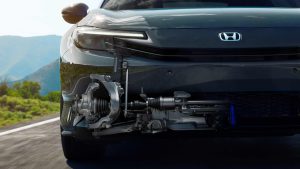
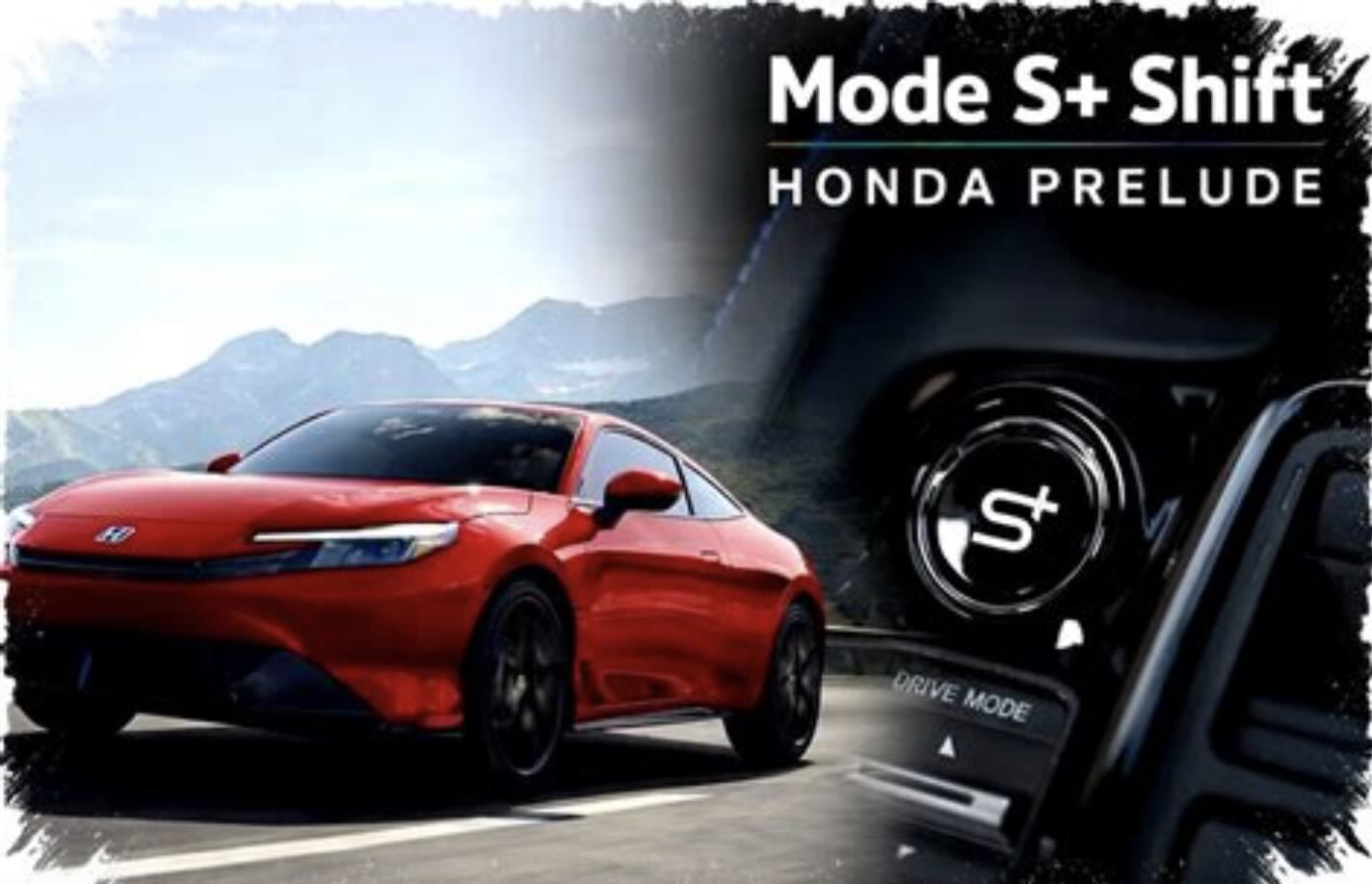
The same can be said about Honda’s S+Shift system, which simulates shifts in the Prelude hybrid. That’s not all that’s simulated. You may need a cup of coffee – with caffeine – for this.
The Prelude hybrid is a serial hybrid, meaning the engine is there chiefly to generate electricity to charge up the battery which powers the electric motors that actually move the vehicle. Generators run at a steady speed; they do not rev up and down, which creates a kind of disconnect in a serial hybrid. When the driver pushes down on the accelerator pedal, it does not cause the engine to speed up – as it would in a car that had an engine connected to a transmission that connects to the wheels that turn to make the car go. So Honda developed a simulation for the Prelude hybrid designed to “align the engine noise such that it sounds like it’s revving” in tandem with your right foot’s inputs. Another simulation – Linear Shift Control – conjures the illusion that the transmission which isn’t there (the Prelude hybrid’s electric motors turn the wheels directly) is “shifting” in tandem with the engine “revving.” 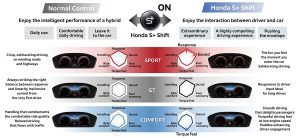
As a recent article in Road & Track puts it, “Enter the S+ Shift world” and “you step into Honda’s Narnia of simulated shifting.”
The article isn’t critical, which is remarkable – given it appeared in a publication that, at one time, would have mocked simulated “revving” and “shifting.”
Instead, there’s this:
“The secret sauce of what makes the new Prelude’s powertrain engaging is all in the fine-tuning and calibration of the electric motor and internal combustion engine,” the writer explains. “While Honda tells me it’s not trying to simulate the sound of any specific engine from its history, it does admit the torque curve and acceleration are meant to mimic a 2.4-liter naturally aspirated four-cylinder. That seems perfectly reasonable considering the electric motor doing the real accelerating is a mildly torquey little beast.”
Italics added. Simulation and mimicry. The writer apparently does not see the sad confession implicit in this. Why simulate or mimic what’s not there if what is there is better? When CD players came out, did they mimic and simulate tape decks? Do synchronized manual transmissions mimic the non-synchronized manual transmissions of the past?
Put another way – as regards the Prelude hybrid – something that was good is missing. Well, why not just put it back? That would be the obvious thing to do. Dodge has done just that. It put the engine back in the Charger – so no more need for simulated and mimicked sounds, as were made to emanate from the sound system of the battery-powered Charger.
To be fair, the Prelude hybrid is not a Charger; i.e., it is not the kind of vehicle that has to have an engine that revs and a transmission that shifts (assuming you want people to buy Chargers). Put another way, it’s not a muscle car or even a performance car. It’s a hybrid – and a serial hybrid at that, which is arguably the most sensible kind of hybrid if the object of the exercise is to maximize fuel economy. Using the engine as a generator running steady-state at the “sweet spot” in its power band is better (for gas mileage) than using the engine to propel the vehicle via a transmission. So why not be proud of the serial hybrid powertrain?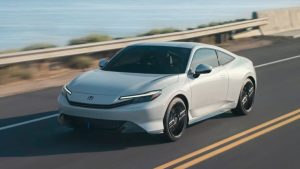
Why try to simulate and mimic what has been replaced?
“Honda S+ Shift was developed not only to create the enjoyment of behaving like a (dual-clutch transmission) but also as a technology that enhances the fundamental powertrain values of responsiveness and linearity,” says the hybrid Prelud’s powertrain project leader, Yoshiharu Saito.
How about the value of reality – as opposed to simulations and mimicry?
“The response and linearity to even slight accelerator input changes during acceleration and deceleration, such as on uphill roads or freeways, are capabilities not previously achieved in conventional hybrids, and we believe this allows drivers to enjoy a true dialogue with the vehicle.” 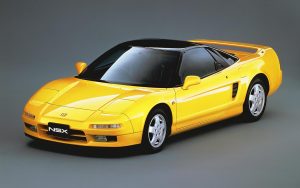
Italics added.
A “true dialogue with the vehicle”? How about genuine interaction with the vehicle? Honda once worked hard to engineer such interaction between driver and car, as for example via superbly engaging manual transmission shift linkage that controlled driver-shifted manual transmissions. And via screaming 9,000-plus RPM VTEC engines, as in the S2000 roadster and NSX supercar. How does one even have a “dialogue” with a vehicle? I supposed by asking the AI voice assistant to turn up the stereo, to drown out the fake and gay simulations and mimicry.
“Shifting via the steering wheel-mounted shift paddles,” says the R&T writer, “is where the fun really begins. When you pull a paddle for an upshift in S+, Honda says it briefly puts the motor into regeneration mode. This instantly drops the revs of the internal combustion engine and obviously drops the output of the electric motor, simulating the interruption in acceleration you’d expect from upshifting with a traditional transmission. Even the sound is trying to be faithful to the sensation, as Honda uses its Active Sound Control system to play the noises you’d expect to be hearing over the Prelude’s four speakers.”
And they ask me why I drink.
. . .
If you like what you’ve found here please consider supporting EPautos.
We depend on you to keep the wheels turning!
Our donate button is here.
If you prefer not to use PayPal, our mailing address is: EPautos 721 Hummingbird Lane SE Copper Hill, VA 24079








This is all so dumb.
When CVT’s came out, the manufacturers simulated gear changes because people are used to it. This simulated gear change actually makes the CVT less efficient, and less performant, albeit, less boring.
Same for simulated shifts in an EV. An electric motor can stay at 100% torque until it reaches 100% battery wattage, then it stays at 100% horsepower the whole time, as you accelerate (torque drops as RPM increases). By messing with this curve with simulated gear changes, you are also losing performance.
Why not let each technology be the best that it can be.
Oh, right… because people aren’t free to choose anymore, and you want to get ahead of those customer complaints.
‘Why not let each technology be the best it can be?’ — OppositeLock
This is axiomatically true from an efficiency standpoint, as you point out. But not necessarily so, when filtered through the biases of human perception, expectations and living memory.
My first air flight, at age 6, was on a Lockheed Constellation powered by four Wright Duplex Cyclone 18-cylinder radial engines. It was already two years out of production, its fate sealed by jet-engined aircraft. But I never really got over the awe and wonder of those gigantic, reassuring propellers slicing through wispy cloud tops. The impersonal, concealed turbine hum of big jets was never the same.
Nor, as a skinny lad, did I have an inkling of the Connie’s human connection: ‘On April 17, 1944, the second production C-69 [the Connie’s military variant], piloted by Howard Hughes and TWA president Jack Frye, flew from Burbank, California, to Washington, DC.
‘On the return trip, the aircraft stopped at Wright Field in Ohio to give Orville Wright his last flight, more than 40 years after his historic first flight near Kitty Hawk, North Carolina. He commented that the Constellation’s wingspan was longer than the distance of his first flight.’
What is that rich historical resonance worth — that respectful wing tip to the first air pilot, by the designers of the first pressurized-cabin civilian airliner with a ceiling of 24,000 ft? I can’t tell you. But it still means something to me.
Morning, Jim!
The Connie was also beautiful. It still is. Beautiful things have their own merit. I despise the Bauhaus austerity of function over form. Of bleakness and gigantism for its own sake (e.g., the Airbus). The Concorde was anothe beautiful thing and while I never got to fly in one I did get to see numerous take-offs and landings at Dulles, when I was a kid, back in the ’70s and ’80s.
What a craptacular joke they’re playing on us with all of this.
I’ll admit, I drove an EV for the first time recently. The sensation was a bit like driving a CVT, but without much in the way of genuine feedback sounds—maybe just an irritating inverter whine.
I’m used to driving a proper manual, so even automatics can throw me off since they rarely shift when I expect them to. I haven’t personally owned an automatic in quite a while, although I’ve had a handful of traditional automatics over the years. They’re just not my cup of tea.
Back to the EV: honestly, like with a CVT, not having any audible or tactile sense of the engine revving is distracting for me. I’m not getting the feedback I’ve come to expect, which makes me focus on that absence instead of external cues like traffic.
When habits are deeply ingrained, your brain doesn’t have to spend much processing power on them—they fade into the subconscious. Don’t some CVT systems deliberately mimic gear changes for that reason? They don’t technically need to vary the RPM to work, but they do it so the driver can sense acceleration.
The video game generation is in charge now. Things are catered to them, like it or not. The enjoyment I get from utilizing mechanical things are not shared by a seeming majority of youngsters. I’ll just keep on enjoying my mechanical things and teaching my kids about them. What else can I do?
I found this guy on YouTube who shows how the old mechanical machinery works. Amazing stuff. The inventors of these machines were geniuses.
https://www.youtube.com/@YesterdaysMachinery/videos
That sorta garbage fits its intended market perfectly. Honda jail is punishment for little girls whose driving gets outa hand expensive.
I’ve got old cars that happily rev through the gears, not fast but enough to let you know it’s not a sports car but will do it’s best :). A serial hybrid that fakes it doesn’t work for me.
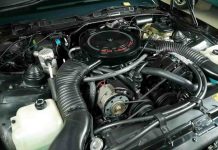
On the upside I had my Camaro out for an hour yesterday. Nice test drive and good times with it’s M20. A few issues like it’s check engine light is on, paint touch ups, general cleaning, possible oil leak on the exhaust, a speedometer that reads low and “wiggles”. Minor stuff at this point. But fun all the same.
What year Camaro?
67 with a newer fi setup.
Ever notice how most of the things that cause us problems are fake? From money to politicians, to sex, and beyond
“So why not be proud of the serial hybrid powertrain? – Eric
Because 100 years of marketing cars has been about the physical movements required creating an emotional bond between the car and the driver. The car doesn’t just get you from point A to point B, it responds to your commands. It does your bidding. A drive-by-wire linear acceleration curve drivetrain isn’t going to have the direct connection between brain, arms and legs and machine. Doesn’t mean there aren’t benefits to a serial hybrid, and at some level, if done properly, drivers might get used to the new system.
If I were Honda’s marketing team, I’d make sure that the fake shift points, fake gear fake gear selector and busy-box vroom vroom noises were all easy to disable. And make sure the owners see the option to disable all that on an easy to find button or switch. Better to let the drivetrain be the drivetrain it is, not what car enthusiasts want.
Besides, we used to pay a premium for ultra smooth acceleration. Cadillac sold millions of luxury land yachts with slush box three speeds and massive torque because they shifted so well you couldn’t feel it.
And add a robotic voice saying “grind em till ya find em” or “fuck an a double clutch”
It is exasperating to watch as the car companies present these silly gizmos. Everything they make now is trash to me.
Must everything be faggotized. It’s all for the greater good I’ve already depleted my victory gin quota for the week.
Keeping my cache of ‘victory fentanyl’ safe, to celebrate when we win the War on Drugs! 🙂
Again, Contrived Complexity to simulate a simple engine/manual trans drivetrain. Just make the dang original that’s cheaper and easier.
And another thing, didn’t Rolls Royce become known for its quiet interior? So quiet in fact that you could hear the jeweled clock ticking over the road noise. The serial hybrid seems to be approaching that level in ITS basic form so go for it.
Bizarro World, indeed.
Pffft. A Rolls Royce is no Royal Deluxe II
https://www.tiktok.com/@thealmanac77/video/7349628101665557766
The real commercial
https://www.youtube.com/watch?v=8It6KFhlsBo
In fact I remember an old motor trend article on the 69? Chevy Impala, where they were astonished that you could hear that clock. So it wasn’t just high end stuff, there was and is a market for quiet, comfortable cars. MT speculated that Chevy marketing had made the clock louder…
Yes, even the middle class got to enjoy a quiet smooth car before the unibody/four cylinder/rack&pinion/MacPherson strut/Roman chariot diameter wheels craze took over.
Body on frame, A arms up front, recirc ball steering box with an isolator in the steering shaft, a V8 engine. 14 or 15 inch wheels with 75 series tires. 70 series tires, gas shocks and a rear sway bar if you want to get frisky-er. A eight hour drive in my ‘79 Pontiac was bliss. Our friends pitched their VW Rabbit for a Buick Regal his first comment to me “I get out after a six hour drive my ears aren’t ringing and my hands aren’t numb!”
Peasant cars have their place just not for road trips.
‘When CD players came out, did they mimic and simulate tape decks?’ — eric
Not that I know of. But an unfortunate feature in video editing apps allows simulating a split frame with vertical jitter — what used to occur in balky film projectors. Just saw an example last week in a documentary. The editor couldn’t resist inserting fake jitter into an 8 mm film clip from 1982, thus communicating to twenty-somethings that ‘this archival footage is like, REALLY OLD, dude!’
Failing to simulate what works can be lethal. After the human heart transplant era began in 1967, someone had a brainwave: why not implant a centrifugal pump to replace a failed heart? After all, centrifugal pumps produce steady state flow, without the thumping pressure waves of a reciprocating pump such as the human heart — or a piston engine.
But despite steady, reliable blood flow, all the recipients of centrifugal pumps died. Turns out the pulse of a real heart — its systole and diastole — is indispensable for life, harking back all the way to the maternal heartbeat in the womb. No pulse soon results in death, though blood be still circulating.
Honda is trying to reinstill a pulse in an EeeVee that never had one. This totally misses the point. An IC engine is the heart of a car. An EeeVee without a heart can never inspire a person born with one. EeeVee engineers just don’t understand.
Oh, every drop that runs through the vein
Always makes its way back to the heart again
And by the way you look fantastic
In your boots of Chinese plastic
— Pretenders, Boots of Chinese Plastic