

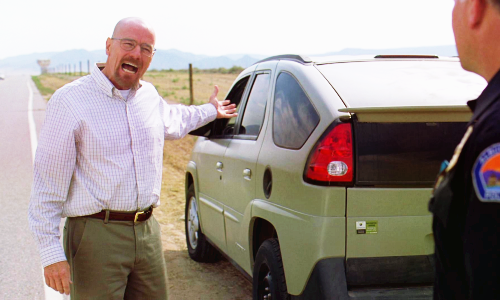

Remember the Pontiac Aztek? It was made for four short years, from 2001-2005. That was twenty years ago, which means no one who is under 25 today has any memory of the Aztek when it was new. Maybe they ought to be reminded – so they can understand what they never got to experience in a new car.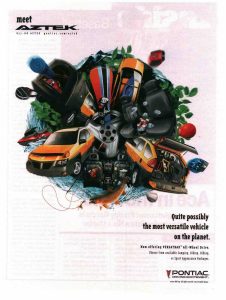
Back in 2001, the Aztek was mocked because of is looks. It did look strange. It was designed to look “Xtreme” and it was marketed at then-still-young GenX’ers, such as myself. It was however basically a minivan that looked like it had been badly beaten in a back alley. It had corrugated plastic body cladding and a dumpster-looking rear end. The functionality was superb – it included a dual/split tailgate and a removable center console that could be used as a portable beverage cooler. There were rear stereo controls, a sliding cargo floor with hidden storage cubbies and an available camping package with an attachable tent and air mattress – but the appearance was polarizing. That’s why it lasted just four years – and became a co-start in Breaking Bad, the series about high school teacher-nebbish Walter White who becomes a drug kingpin. He drove an Aztek because he was a loser (and wanted to look like one, so as to avoid attention).
But the Aztek was – arguably – a winner. The kind that (like Walter White, before he becomes Heisenberg) is under-appreciated by everyone who takes them for granted.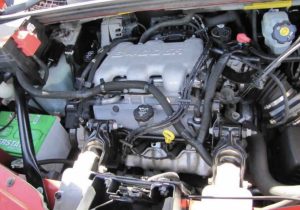
Consider what you got back in 2001 for your $21,995 – which was the base price back then of a brand-new Aztek.
Superficially, what you got was a compact crossover SUV dimensionally similar to a current/2026 Toyota RAV4, which stickers for $33,495. Back in ’01, when you spent $21,995 you got a standard 3.4 liter V6 engine and a four speed automatic transmission. This was what we used to call “boilerplate” in the news business – meaning, nothing remarkable. Because it wasn’t.
Today, if you buy a new RAV4, you get a hybrid-augmented four cylinder engine and a CVT automatic. The new RAV4 does get much better gas mileage. But the Aztek came with a V6 – something that was totally unremarkable in the early 2000s. Four cylinder engines were – at that time – still found almost exclusively in small, economy cars. There was a kind of congruence between engine size and vehicle size, as there is with suit sizes. A big man doesn’t wear a shirt made to fit a small man – at least, not outside the circus.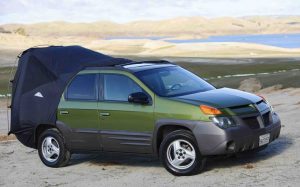
The Aztek’s V6 was also an overhead valve V6; i.e., it had just one cam operating two valves per cylinder via pushrods. The OHV layout has many practical advantages, including compactness (the engine takes up less room in the engine compartment, making it easier to service) and fewer parts, which correlates with fewer failure points. The GM 3.4 V6 was one of those Walter White engines that was steady and reliable that almost everyone took for granted. Now they’re all gone. Unless you’re able to spend about twice as much on a new crossover. If you have about $40k, you could buy a new Mazda CX70 or Hyundai Palisade. They have sixes, but with turbos (Mazda) and overhead cams and four valves per cylinder (Hyundai) and direct injection, too. 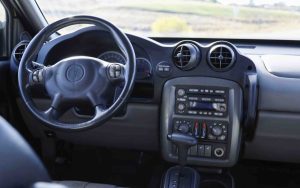
That 3.4 V6 is like that girl you didn’t appreciate all those years ago. You maybe think about her when you think about what you’re married to now.
Four speed automatics were also unremarkable back in the early 2000s. They had one overdrive – which served the purpose of greatly reducing steady-state cruise RPM, which greatly increased gas mileage at highway speeds. The four speed automatic has been supplanted by automatics with multiple overdrives that serve no meaningful purpose but do add greatly to the cost and complexity of the transmission. Slight increases in fuel efficiency are achieved at the cost of a transmission that’s more failure prone and much more expensive to replace. Many. of these compliance transmissions shift weirdly, too. They “hunt” for the right gear; the downshifts and upshifts are sluggish. Nothing meaningful has been gained – but a lot has been lost. 
The 2026 RAV4 and most of the other vehicles in its class no longer come standard with traditional automatics of any type; these have largely been supplanted by CVT automatic, which use a system of pulleys and drive belts to continuously vary the range (rather than the gear) your in. Instead of clean transitions between first and second and third and fourth, you get a kind of slippery feeling forward surging sensation, often attended by a lot of noise. CVTs have also proved to be less reliable than the simple, durable four speed overdrives we took for granted that are now long gone.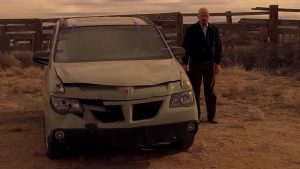
Perhaps the most under-appreciated aspect of the Aztek is that it accepted you controlled it – and not the other way around. Laugh at its looks all you like; the Aztek had no cameras looking at you. It did not try to “assist” your steering or braking. There was traction control, but there was also an off button – and when you turned it off, it was off until you turned it back on. It did not come on again once your speed had increased beyond a crawl. You could pretty much do what you wanted with the Aztek and whatever you did was between you and the Aztek. No one was watching or listening in.
No wonder Walter White liked it.
. . .
If you like what you’ve found here please consider supporting EPautos.
We depend on you to keep the wheels turning!
Our donate button is here.
If you prefer not to use PayPal, our mailing address is: EPautos 721 Hummingbird Lane SE Copper Hill, VA 24079









[…] https://www.ericpetersautos.com/2026/09/01/the-aztek-was-brilliant/ […]
The Buick Rendezvous was the cousin to the Aztek. That one did not have the hideous looks of the Aztek. Maybe the Rendezvous is a diamond in the rough?
The Aztec might’ve been brillant and practical, but it was completely ruined by price, for its day.
I found it interesting in 2001, but the astronomical $22K price tag, to start, for the time, left me absolutely flabbergasted and mystified by GM’s moronic decision to price it so high.
Had it been priced at $14K or $16K, to start, with options & packages going to the moon, it would have been a surefire success….but….Greedy Morons in action!!!
It’s overall lack of uniqueness, as compared to similar les expensive J-body offerings available, both from within other GM lines, and competition from dodge/Chrysler minivans and foreign makers, and burdened by a mediocre engine(for its time), and lack of an actually rugged 4WD, doomed itself.
Sure, I remember the kinda cool tent/camping package, but for $22,000 fedbux, to start, in 2001???
An absolute non-starter, making it dead on arrival, killed by GM’s indifference to learning it’s lesson from 20 years prior, in badge engineering, and overpricing similar platforms, a la, the Cadillac Cimmaron and Chevy Cavalier. The J platform wasn’t bad, but wasn’t, or shouldn’t have been the basis for any Cadillac.
But a terrific review like this only exemplifies how much we’ve lost, and how quickly we’ve lost it, and why the (((USFEDGOV))) is the 800lb bad gorilla crushing the market, for car makers and buyers everywhere, with DOT & EPA safety and MPG and emissions requirements limiting selections, rather than letting customers and the market sort it all out.
Oy Vey!!!…..
YMMV….
The eCVT that is used in Toyota hybrids is not your average CVT. It is an entirely different kind of beast. It has no belts or pulleys. Mechanically, it is much closer to an open planetary differential than it is to any transmission. It’s simple and durable.
It’s biggest drawbacks are that it needs two motor/generators, it can only be used in a hybrid system, and it doesn’t give the same driving experience as a geared transmission. Other than that, it is actually simpler and more durable than all belt-based CVTS and most geared automatic transmissions.
It’s biggest advantage over manual transmissions is that it doesn’t have a clutch that fails. On the other hand, the clutchless design is also the eCVT’s biggest disadvantage vs a manual (i.e. it’s not as fun to drive).
Hi Shoal,
Yup! In defense of manual transmissions, the clutch is a normal wear item and – if you can wrench – it is not expensive to replace. Also, if you can drive competently, it is not difficult to get 150,000-plus miles out of a clutch.
“…like that girl you didn’t appreciate all those years ago. You maybe think about her when you think about what you’re married to now.”
Haha! Then you think about looking up that “cute young thing” and see what she looks like now-a-days… Yikes!
The Aztec is your high school sweetheart with a PhD and a ton of money, but she looks like John Merrick and Rocky Dennis had a baby that they liked to beat a lot. And not like, blowing off a little steam baby-beating. Talking full-on psychotic rage-beating that baby like a drunk Joker angry at losing to Batman once again.
Yes. I’m a proud Aztec-basher. Have been since it came out. Mocked them throughout their production run, and celebrated its demise when it was dead. I also proudly mocked the “Mustang II”, the “Mustang Mach E”, and Chrysler in general for trying to base their entire lineup on the K-chassis.
That having been said, I can’t deny the oddly utilitarian design and feature set (such as your aforementioned camping package) which came close to making it something worth buying. But…those looks. I just can’t get past those looks. I can imagine being stared at waiting for a red light, and me screaming out “I AM NOT AN ANIMAL!” No. Just no.
My high school sweetheart is a Toyota Highlander — she was fun 25 years ago when she was practical and lean, lacking an ounce of body fat, but now she is a scold who is barely recognizable as the same model.
My favorite GM engines were the 3.8 V6 supercharged and the 6.0 V8.
Had lots of them.
The best GM engines were measured in cubic inches.
Did you know that ‘Colonel’ ‘Tom Parker’ was in fact an “illegal alien”?:
“Colonel Thomas Andrew Parker (born Andreas Cornelis van Kuijk; June 26, 1909 – January 21, 1997) was a Dutch talent manager and concert promoter, best known as the manager of Elvis Presley. Parker was born in the Netherlands and entered the United States illegally when he was 20 years old. He adopted a new name and claimed to have been born in the United States. With a background working in carnivals…. He also assisted Jimmie Davis’ campaign to become governor of Louisiana, for which he was awarded the honorary rank of “colonel” in the Louisiana State Guard.”
https://en.wikipedia.org/wiki/Colonel_Tom_Parker
That was why Elvis never toured outside the US, as the ‘Colonel’ would not let his subject out of his control, and the ‘Colonel’ would not be able to re-enter the US. A vile control freak, much in the same spirit of the Orange Douche himself.
I have no doubt that being unable to escape the clutches of such a creature contributed to Elvis’ premature death.
This was in reply to Jim H below.
The Army contributed to Elvis premature death by introducing him to amphetamines during his time in Germany.
BTW, unlike Tim Walz, Elvis was a serious car enthusiast.
The last known photograph of Elvis alive was of him behind the wheel of this product of a bygone auto era.
https://www.drive.com.au/caradvice/the-last-car-elvis-ever-drove-the-stutz-blackhawk/
Morning, Roscoe!
I’m a big Elvis fan and – back in the ’90s – I visited Graceland to do an article on Elvis’ cars. I was allowed to sit in that Stutz that Elvis drove the last night of his life.
Remember the King!
Built on the same platform as their minivan platform.
But had less space than the minivan and was more expensive, IIRC.
My fully loaded 2004 DGC cost only $25k out-the-door, drove it for over 20 years.
That $21,995 back in 2001 would be well over 40,000 Gutenburgdollaren today.
A common theme is price of cars back in the day. I still have the window sticker from my only new vehicle ever, a 1998 Tacoma 4×4 XtraCab 3.4L V6, 4 speed auto, TRD Offroad package. Price was $26,454 purchased from Bergstrom Toyota in Oshkosh, WI. That’s $54,193 in 2026 shekels.
Morning, Tim –
It’s not just the decreased buying power of dollars – what they call “inflation.” It is that most us the Deplorables, the non-401k/stock market peddler-shyster people – have not seen our incomes increase in tandem. Most of us are earning less, so things cost much more in real terms. Back in ’98 you could afford a new Taco. Can you afford a new one today as comfortably as you did back then? How long was the loan you took out back in ’98? Was it six years?
i always thought that the car was pretty functional and not that ugly. I think the ugliest mass production car in North America was the 1975-79 AMC Pacer. The second was GM’s space looking minivans. Looked like a dirt buster.
Proto-Vanlife vehicle. A “Westfailia” version of the Aztec might have been a hit. Especially if it had a little more ground clearance and AWD. I imagine that could have been the plan but got shot down in committee.
The Pontiac Aztek, AMC Gremlin and Pacer, and Edsel were vehicles that indeed looked like they had been beaten hard with an ugly stick—but they were downright good compared to what’s offered today.
All of them came with simple, reliable engines—OHV sixes and V8s. All of them were fairly roomy inside. All of them were easy to maintain and repair.
None of them were outrageously expensive.
None of them would nanny you, peddle to you, or rat you out.
Sure the Azteck was ugly but at least it was practical and it’s engineering would allow it to run for decades.
Today’s cars are mostly uglier and will be dead in under 15 years due to being uneconomical
to repair.
… or neglected. The biggest factor in whether a car can go 200+ thousand miles is the frequency of maintenance, particularly transmission fluid and coolant. Engine oil should be changed at 5k miles..
New life can be given by refreshing the suspension over time. It’s amazing what a new set of control arms, bushings and struts do to a car.
All true Swamprat. Ask a mechanic how many cars are brought in seriously low on engine oil, cars with 4 bald tires or burnt out headlights.
The number would probably stun you.
The Aztec has been out-uglied by the cyber truck.
My thoughts exactly, MH.
The rear of the Aztec looks just like the cybertruck.
“That 3.4 V6 is like that girl you didn’t appreciate all those years ago. You maybe think about her when you think about what you’re married to now.”
LOL. What a classic line, bro…
Thanks, X!
I aims to please!
The late bloomers were a treat! A girl from high school, in band with me. Moderately tall, not fat (most were not fat in 1973), black rim glasses, meh hair, no makeup. Pleasant enough. Fast forward 4 years, she was a cousin of my buddy’s fiancé. We both ended up in the wedding party and she was at the pre wedding dinner, oh my what four years had done! A 22 yo jaw dropping stunner! Full length stylish hair, no more glasses, just the right amount of makeup, wowser. I got to walk this doll down the aisle at the wedding.
I have a similar analogy.
I call cars like this “My chubby girlfriend that can cook. She doesn’t make your heart go pitter patter but you end up loving her over time”
Thank You.
Although I said that about a ’94 4 cyl Camry. and 2012 4 cyl Rav4.
‘Perhaps the most under-appreciated aspect is that it accepted you controlled it.’ — eric
As every powerful person — whether a politician, an artist, or an author — intuitively understands, control is non-negotiable. We are all powerful within our sphere of control, however large or small.
When Elvis Presley wanted to record Dolly Parton’s song I Will Always Love You, his slimy manager ‘Colonel’ Tom Parker casually informed Dolly that it was ‘customary’ for songwriters to sign over half their publishing rights, to humbly thank the King for boosting their song.
Dolly told ‘Colonel’ Parker to pound sand. Then fifteen years later, she banked ten million dollars of royalties when Whitney Houston covered the song in the 1990s.
Uppity cars with a mind of their own were foreseen decades in advance by Stanley Kubrick’s AI antagonist HAL 9000 in 1968: “I’m sorry, Dave, I’m afraid I can’t do that.”
This is categorically unacceptable. I am permanently withdrawn from the ‘new car’ market. I don’t do ‘over-tech.’ I don’t do ‘connected.’ I don’t do ‘assistance technologies.’ And I don’t leave my greasy fingerprints on stinking douchescreens.
Burn it down — all of it! 🙂