


Jeep is touting the 37 miles-per-gallon of the 2026 Cherokee hybrid – for only $36,995. Does it not make your teeth ache?
If you’re sweating the cost of $3 per gallon gasoline, how are you supposed to be able to not sweat the cost of a $37k vehicle? Put another way, if you can afford to buy a $37k vehicle, do you really care – in other than the abstract sense – that it gets 37 miles-per-gallon? Pella triple pane casement windows are nice. They are also sold as “energy saving.” But their cost to buy negates these “savings.” Financially speaking, you’d be better off buying a set of decent, builder-grade double pane windows because that way you’d actually save money. The same goes for solar panels. It takes decades to see any “savings” – and by then, the panels or the storage batteries are probably reaching the end of their lives and it’ll cost you thousands (again) to start all over again.
Everything about Green is a grift.
The push to hybridize everything that moves is marketed as being about saving people money but the truth is that it’s about imposing the costs of compliance on people by getting them to think they’re saving money. The only thing “green” about is the money and everything else is red. 
The Cherokee – which has been off the market for a couple of years now – used to come standard with a non-hybrid drivetrain and a base price under $30,000. The now-hybrid-only 2026 Cherokee lists for $7k more to start. Let’s do the math that almost no one ever seems to want to do when it comes to “saving money” by purchasing a hybrid. At current roughly $3 per gallon prices, seven grand buys about 2,333 gallons of regular unleaded. The previous-generation, non-hybrid Cherokee’s gas tank held 16 gallons. So, seven grand would purchase roughly 146 full tanks of gas. Most people fill their tanks about once a week or four times a month and so about 48 times per year. Call it 50 to round it out. This means one could drive a last-generation Cherokee about three years on the $7k one didn’t spend to buy the next-generation/hybrid-only Cherokee.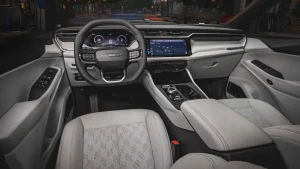
The math is actually worse than that – because while the last-generation Cherokee only averaged 25 MPG, it did not average zero MPG. Meaning that the difference in gas mileage between the last-generation, non-hybrid Cherokee and the ’26 hybrid only Cherokee is 12 MPG. That does mean a ’26 hybrid Cherokee can go about 590 miles on a full (16 gallon) tank vs. the last-generation non-hybrid could only make it about 400 miles. In other words, a difference of 190 miles per tank in favor of the hybrid. That sounds good but it’s necessary to take into account the 400 miles per tank the previous Cherokee goes before the putative “savings” (driving the hybrid) begin.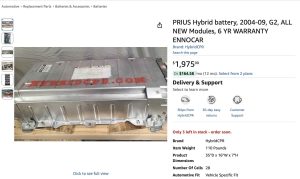
There is also the increased cost – of insuring a $37k vehicle vs. a $30k vehicle – to take into account, as well as the increased cost of annual property taxes (in states that impose this tax on vehicle owners) and the hidden cost of having to replace the hybrid’s battery pack at some point. This latter currently costs about $1,500 on average and while the original purchaser may not end up paying it, someone inevitably will.
Plus the intangible costs of what might be styled the Ongoing Diminishment. The last-generation Jeep came standard with a 2.4 liter engine; the ’26 comes standard with about half the engine – a 1.6 liter four, augmented by a pair of electric motors and a 1.08 kWh battery pack.
You get less for more, in other words. Well, except for the curb weight – which swells to an outrageous, almost surreal 4,300 lbs. Remember, the Cherokee is a compact crossover that competes with modes such as the Toyota RAV4, which more or less created the genre. And here’s an interesting signpost along the road: The original (1996) RAV4’s curb weight was 2,778 lbs. The bloat is an iteration of the cost of compliance, too. And we’re supposed to believe – rather, we are expected to ignore – that adding more than 1,000 pound of steel, plastic, glue and so on plus the costs of extracting the materials from the Earth (much of which will get landfilled back into the Earth) is “green.”
Circling back to where we began, if the vehicle manufacturers that are hybridizing everything were motivated by a desire to save people money, they’d manufacture the economical cars that were once available. Instead, they manufacturer entry level cars that are as expensive to buy as luxury cars used to be (and luxury cars are now as expensive to buy as exotic cars used to be).
Here’s an example of a vehicle that’s similar in general layout to the Cherokee that actually does save people money: The ’25 VW Taos. It lists for $25,495 so right off the bat, you’ve effectively pocketed $11,500 – enough to keep the tank full for the next 5-6 years.
If VW were able to offer the Taos with TDI diesel engine this small crossover would average better than 37 MPG – and for a lot less than $37k.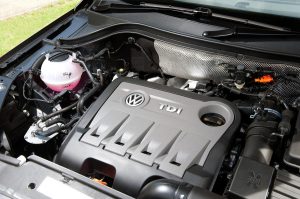
When VW was last allowed to offer TDI diesels, you could buy something like a Jetta – which is a compact sedan – so equipped for about $23k. A hypothetical 2025 Taos TDI could probably be sold for thousands less than what it will cost to buy the ’26 hybrid-only Cherokee, in which case you’d actually be saving money – immediately – as well as down the road.
Chiefly because you wouldn’t be paying compliance costs sold to the suckers as money-saving features.
. . .
If you like what you’ve found here please consider supporting EPautos.
We depend on you to keep the wheels turning!
Our donate button is here.
If you prefer not to use PayPal, our mailing address is:
EPautos
721 Hummingbird Lane SE
Copper Hill, VA 24079
PS: Get an EPautos magnet or sticker or coaster in return for a $25 or more one-time donation or a $10 or more monthly recurring donation. (Please be sure to tell us you want a magnet or sticker or coaster – and also, provide an address, so we know where to mail the thing!)
If you’d like a Baaaaa hat or other EPautos gear, see here!










They need to make hybrids interesting. Like the F-150 hybrid that has the 220 split phase panel in the bed. That’s interesting. Instead of keeping cans of pure gas or extra propane to run a fussy little generator just plug the trailer into the 30A socket in the bed. If you’re worried about using up travel fuel, just bring along a jerry can of plain old 10% ethanol, the truck runs fine on it. Get a critical load panel installed in the house and a transfer switch so you can keep the lights on during a power outage. Might not be the ideal solution if there’s an extended outage (or you aren’t home at the time the power goes out), but for a good number of power outages it will work just great.
All Jeeps should be solid front and rear axles, for all of the whaling and gnashing of teeth auto makers make about sharing platforms to reduce costs Jeep sure sh*ts the bed when it comes to that area, the Grand Wagonner should be built on the Wrangler platform, the Grand Cherokee should be built on the Wrangler platform the new Cherokee should have been built on the Wrangler platform.
Jeeps motto should be we are not for pansies, or panty waists, they can buy Range Rovers or Toyotas
Hybrids actually get worse mileage on the hiway and freeway because they are heavier due to the electric motors and battery. They only do better in the city. Most people who own SUV’s live in the suburbs, not in the city, and likely do a minority of their driving in stop and go traffic. City drivers would prefer a smaller car or even an EV. So the 37mpg figure would be mitigated by better mileage with a lighter vehicle when travelling distances.
These 37mpg figures are fake and gay and typical of the talmudic world of deception we live in where dishonesty and deceit are treated as virtuous. Thank you AG for the way you and your tribe have crushed our civilization and replaced it with your warmongering-talmudic-pedo-usury system of rape the goyim.
“The same goes for solar panels. It takes decades to see any “savings” – and by then, the panels or the storage batteries are probably reaching the end of their lives and it’ll cost you thousands (again) to start all over again.”
This just isn’t true anymore, at least necessarily. Most people get grifted by the solar installers, and in most of those cases, there aren’t even any batteries involved. Solar panels are actually pretty cheap these days.
When I lived in Phoenix, electricity costed about $0.15/kWh, plus a monthly fee of about $20. From my calculations, with the electricity I can produce and use here, my solar setup will pay for itself in about 6 years.
My LiFePO4 batteries have a 10-year warranty, so that basically gives me about 4 years of free electricity, and that’s if those batteries only last that long. Could be longer. And batteries are getting cheaper as well, that is, barring the effects of Darth Tangelo’s tariffs. We’ll see where that goes…
The solar panels will probably last ~25 years. The chargers and inverter could last indefinitely. This means it will cost less when it’s time to “re-up”.
There is a lot of anti-solar BS out there, especially in “conservative” circles. People are very tribal. When they see the “other side” liking or doing something, they automatically hate it, whether or not if it makes sense.
If you have the sunlight, solar kicks ass.
Yeah, but now do the math again using the grid price that would still be available today, should we be spared the mandated ‘green technologies’, like wind & industrial solar, and with the utilities being allowed to use the cheapest forms of generation (coal & gas & 4th generation nuclear).
Solar without a battery obviously does not work at night or when the weather is poor, and you are still reliant on the grid, even if you don’t happen to live in a cloudy place far from the equator, where winter output often is almost zero.
Solar feed-in tariffs are pure grift and once there are enough households with those on their roofs, it leads to grid instability and in some countries the utilities are now CHARGING for the feed-in, or disconnect the customer altogether.
Solar with a battery costs thousands more, the battery lasts for maybe ten years, if you’re lucky, and even in sunny places like Australia and the South Pacific, the average actual household production is barely above 10% of name plate (theoretical maximum output with optimal conditions over 24 hours per day).
In other words, if you want to live entirely off solar, you’ll be forced to either significantly curtail your power use, or overbuild the name plate capacity by at least 5-8 times of what you need. Which ain’t cheap.
There is a reason why grids with centralized, large base load power generators, were what was built before the ‘green’ BS took over. They are by far the most efficient, cheapest and simplest solution, especially in comparison to the ‘everyone generates his own’ nonsense that we see today.
And let’s not forget the inevitable hundreds of thousands of toxic mercury-leaking discarded non-recyclable old solar panels in landfills.
Solar deserves all the scorn it gets.
John,
I happen to like decentralization. I’m all about that “everyone generates his own” “nonsense”. Any time I can produce something myself, like my own power or food, I will. Self-reliance is the true path toward freedom, not being shackled to a ‘grid’.
Secondly, solar panels do not contain mercury or other heavy metals. That’s some a part of some BS smear campaign. Coal does, however. Maybe it’s not in levels high enough to be too dangerous as some might claim, but coal sure does contain heavy metals and solar panels do not.
I live entirely off solar (and a little wind) and I haven’t had to curtail my energy use significantly. It’ll be even better when I can live in a house with better insulation and a more efficient refrigerator. Even as it is, and even with somewhat cloudy days, I’m able to run the AC, television and computer all day as necessary. Sometimes I actually have to switch off panel input because the batteries are full. (When LiFePO4 batteries are full, they just quit accepting current.)
I’m not sure what you’re talking about with this “name plate” claim. My panels put out every bit the wattage that they are rated for, provided the Sun is directly overhead. Even more on a cold day. To get a maximum input available per day, you have to get a solar tracker setup, but panels these days are cheap enough that if you want more power, you just buy a few more. It’s more cost effective than the $2,000+ tracking system.
I don’t know how much cheaper electricity would be without government interference, but Phoenix has the Palo Verde nuclear power plant, and I got the feeling that the power companies there will charge as much as people would pay.
I’ve heard other anti-solar propaganda, such as solar panels need to be frequently cleaned to keep functioning. Poppycock. There is a shitload of dust blowing around here constantly, and I don’t but give my panels a spray with the hose every few months. Usually, if there’s rain, you don’t even have to do that.
So no, I don’t want a ‘grid’ anywhere near me. I like being off-grid. You know what takes a lot of maintenance and up-keep? Power lines. And I’m glad I don’t have ugly telephone poles and wires crisscrossing the country here. I hope it always remains this way.
Solar, and wind, will never be a source of 24/7/365 electrical generation.
Yes, under ideal conditions they can be shown, on paper, to be a superior source of power. However, we don’t live in a static ideal world.
What does have potential is nuclear using thorium. The Chinese are making great strides in this area as we speak. Imagine a unit the size of a typical heat pump providing uninterruptable electricity for decades. This also eliminates the power lines and natural disaster interruptions.
It’s mindboggling that we still get electricity by pounding sticks into the ground and hanging wires to every building. But, it’s like “education”. With all the technological advances in the last 100 years power generation and education haven’t changed a bit. Interestingly, they are both GovCo protected monopolies. Gee, I wonder if there’s a connection…
Hey Mark,
I’m all for personal nuclear power! I see that China has recently created a functioning thorium molten-salt reactor. We pioneered the technology 60 years ago. Not sure why the hell it was shelved, except, as you stated, GovCo held the keys.
Then there was the thorium-powered car:
https://www.drive.com.au/news/the-thorium-powered-car-eight-grams-one-million-miles/
I’m all for nuclear in general, especially for industrial applications. Hopefully a new nuclear renaissance is on the way as has been rumored, but I’m not dwelling on it.
I just want Mr. Fusion to power my car and house.😆
Hi BaDnOn!
That’s interesting (and glad to hear it). My power bill is generally around $120/month lately. Last time I estimated the cost of a solar system adequate to power the house it was something like $15k. That was several years ago, so maybe the cost is less now (though it seems the cost of everything is more). In any event, that’s a lot of coin to spend to save the $120/month, though there is big value in having your own source of power and not being at the mercy of the people who control the grid and the cost of power. I wish I had more time to look into this in detail…
Hey Eric!
From the quick math, ($15k/$120/month = 125 months ~ 10.4 years), even your calculation means you essentially break even for first decade, though you would save on the panels and other components for the second, only theoretically having to replace the batteries. This is if $120/month is your average bill, which is actually pretty cheap these days in many places.
To illustrate what I mean about solar equipment being cheaper these days, here are 12.8V, 300 AH LiFePO4 batteries selling for $300. That means you can have a 21.6 kWh pack for $1,800. That’s considerably less than what I paid just a couple years ago for a 15kWh pack.
https://www.ebay.com/itm/357050082972
Also, if you’re like many people and your primary energy draw is your AC, you could consider a solar heat-pump:
https://www.santansolar.com/product/airspool-solar-hybrid-minisplit-kit-2kw-used-panels/
That one comes with solar panels and will run directly from sunlight if there is any, no batteries required.
Also, SanTan solar (local Az company) has great prices on panels and other equipment. And no, I don’t work for them or have any connection to them other than having purchased panels from ’em.
Finally, you’re damned right to be suspicious of those who control ‘the grid’. How long until your power “allowance” is throttled because you didn’t do what you were told or your social credit score is too low?
Hi BaDnOn!
I actually don’t use the heat pumps; the main power draw is the hot water heater, well pump and the dryer. I think a system that would keep the lights and ‘fridge and well pump/water heater running would suffice. Two years ago I was thinking about buying some of those modular panels that can be easily wires in series plus storage batteries for back-up power, to handle all but the well pump during power outages. But I can’t afford to even think about that sort of thing now. Not when two plastic bags of groceries cost $110.
I hear ya, Eric. Things are absurdly expensive right now. We’re in a bit of limbo right now as well until I can pay-down some things/save up a little.
If you’re even thinking you’re ready to take a solar plunge, however, let me know and I’ll help with any input I can.
Won’t work in VA Eric, not enough sun. Yes, they can work in the SW.
If your desire is self power, you’d be better off with a built-in generator, but make sure you get a non-proprietary unit, most are not, and design the size with auto-load shedding so you can run a smaller one more efficiently.
We just did an addition to our W house and it is electric heat primary, so we added a 22Kw high-end genset w/auto load shedding. Was about 10K installed, not too bad considering the benefits it offers.
I looked at my solar installation as “prepaying” my electric bill for the next 8 years. That locked in my rate at 2020 prices. But it never would have happened without the subsidies and tax breaks. Otherwise the payback would have run out past 10 years. Note I have gas heat and hot water (and a swamp cooler) so my electricity needs are fairly light. Some of my neighbors with AC/heat pumps have about double the panels I have, and I still probably pay less for heat in the winter than they do.
I get it, there’s no way I should accept the incentives because I’m stealing from poor taxpayers, or whatever. Fine, then call me Ragnar Danneskjöld, simply recouping what was stolen from me to begin with.
But like all things too good to be true that subsidy and tax break program was too successful. So the co-op tried to drop net metering, like what California Edison did in southern California. But in CO net metering is the law, so the governor got involved and put the kibosh to the plan. The window on the “too good to be true” incentives has shut tight. Pretty soon the tax breaks will expire too. Maybe solar will continue to be a cheap way to augment power, maybe not. There’s a bunch of capacity in factories all over China that says it might stick around for a while. It’s just sand and metal.
When you consider all costs, a lot of things people do regularly would not be done. But math is hard I suppose….
When I was unemployed, so many people said, drive uber!
But when you add up all the costs of driving for uber, you aren’t making money, and in many cases losing money. You need a fairly new car, you need added insurance, you going to put thousands of miles on a car you otherwise wouldn’t have. So increased repair costs that wouldn’t have happened etc. It just doesn’t make any sense to do it.
But thousands do it, I just don’t get it. People just ignore some of the costs no matter what. Same thing goes for like delivering pizza or amazon etc. You are working hard to subsidize some billion dollar business that is too cheap to pay you enough.
“There’s one born every minute “ PT Barnum
As in sucker
My $19,995 Maverick hybrid was just the ticket. 45-50 MPG around town.
But… the Maverick is now $28k…
We’re gonna save a buck on gas no matter what it costs!
If the old Cherokee was $30,000 and got 25 MPG and the new one is $37,00 and gets 37 MPG the break even point is 179,750 miles. At this point higher MPG is a benefit.
That assumes same gas price, same maintenance, same insurance for both. Making another assumption will of course change this but the number would have to be arbitrary.
For example, assuming a 10% insurance premium for the hybrid move the break even point to 260,000 miles.
If you assume large difference, say maintenance cost is twice as much over it’s life then there’s no break even point.
Thus it’s hard to predict other than build in the price of an battery change over an assumed life. If that costs $2500 then the break even point is 242,500 miles. If a battery is $7000 then the break even is roughly 350,000 miles.
Will that be just one? Couldn’t say, in a hybrid the battery lasts longer than in an EV and being smaller is considerably cheaper. Using 2025 money $2500 is probably reasonable so there is a break even point theoretically and based on history of like the Prius 242,500 miles is not unreasonable. Some fail much earlier, some go slightly longer. That number is a safe assumption that the vast majority of hybrids with real world data we know will need a new battery. It’s also hard to know exactly what happens if you don’t replace the battery. The hybrid will still run but the lower MPG changes the calculus. Will that be 1 MPG or 10 MPG?
At some point you have to consider ICE stuff, too. Especially with a Jeep it’s doubtful you can expect greater than 200,000 miles of trouble free ownership.
So all you can really do is do the upfront math. What happens down the road is too variable.
The FINKS at the WEF (How fitting that the name of the new head of the WEF is Fink) now wish to BAN private ownership of an automobile in addition to eliminating single family homes. The excuse given for such insane ideas will likely be CLIIIIIIIIIMATE CHANGE.
Cars and motorcycle has long been PERFECTED.
I can buy a 250cc on/off road lo-tech carbureted bike brand new mind you, for around $1700 in today’s valueless currency. How much is that in 1980 dollars?
Remove the ad-on gooberment smog crap, do a little service and quality control- add side and tail box’s and the wife and I can ride across the country on an adventure of a life-time.
$1700 new @ our local Chinese shop.
The cost of a brand new 4×4 wagon loaded with everything you want and ‘nothing’ you don’t.. could easily be available around $10k today. Maybe less.
And just like the five modern but basic motorcycles we have in our garage.. the wagon would be ultra dependable.
It is hard to understand how we are willing to be ‘raped’ so to speak at this level?
That turd or a car weighs a couple hundos less than my 25-year-old GMC Sierra with 4WD and 8-cylinder. Good grief.
Ditto my 1991 Silverado standard cab 8’ bed V8 2WD. All that steel and cast iron in our rigs near par weight with the “modern age” half the size rig, amazing (amazingly ridiculous).
When I talk to private sector clients regarding energy or cost saving features to be added to their construction projects, I always bring another aspect to compare to: future value of money. Whatever they want to add be it: solar panels to heat recovery chillers, the payback period must be *5-years or less*. Otherwise, you can take your $ you were going to invest in this enhancement and compare it against putting that money in a low-risk annuity at 5% which is a conservative return (most will pay 8% or more). If the payback is beyond 5-years, at the end of 10 years you will have more money in your pocket plus continued earnings going into the future and without the burden of a device that needs future maintenance and eventual replacement.
When talking to large institutional or public/government types, I will quote Thomas Sowell:
“You will never understand bureaucracies until you understand that for bureaucrats procedure is everything and outcomes are nothing.” —Thomas
Sowell
Hi Hans,
We have an old Victorian house with 12 foot ceilings and 7 foot windows. Years ago I looked into replacing the windows with double pane inserts but the expense would be way more than I would ever save in heating costs.
Hi Mike,
Yea, some sales-kid came by my house selling new High E windows. I asked for the R/U Value and solar reduction factors which he reference their website. I did the calcs myself…sure, I would have saved 30% of my heating/cooling energy from the windows. But my windows don’t account for all that much to the total loss to speak of and with their high-cost payback was over 20 years. No thanks.
Who, in their right mind, would buy a $37k Jeep overly expensive high-maintenance disaster POS at all? Oh, right, women.
Women?
Don’t you mean Butch van Dyke?
Wanna be gurl bosses is jeeps new demographic. 1.6 liter four cylinder sounds pretty puny, even if its boosted on steroids. And 37K, sheesh, you could buy a nice classic jeep with that and still have money left over for maintenance and fuel.
As shown in the lede photo above, the 2026 Cherokee has acquired new ‘mean eyes’ LED makeup, to scare the driver in front of you. That ought to be worth $5K right there, as others move aside in fear and respect. /sarc
Next year: color-changing LEDs to turn them mean eyes blood red.
And bleed all over the Milky Way
The stars in your eyes look red today
— John Hiatt, Cry Love
The trick is to look at only one side of the P&L ledger. This has been going on for a long, long time.
Roughly 30 years ago when the textile industry was packing up and moving to Mexico and China you’d have a plant that employed 4-5 THOUSAND people in a community close its doors. At the same time the local politicians and bureaucrats would tout the fact that they “recruited” (finger quotes to denote that it’s the same as “recruiting” a woman to be your wife for the evening) that would bring 65 jobs to the community. Much praise and backslapping would ensue.
You can now see signs in the windows of vacant store fronts that proclaim, “This Space Isn’t Empty, It’s Full of Opportunity”. I’m not making this up.
So this is what the collapse of an Empire looks like, eh?
If the 1.6 L 4-cyl. turbo is the same Fiat technology Stellantis is using in the other Jeep hybrids, you shouldn’t worry about the battery pack longevity because the engine will be long gone by that point.
A 1.6-liter four to propel a 4,300-lb vehicle! Reminds one of those Roman statues, with a little-boy male member attached to a hulking, muscle-bound man.
A quarter century ago I bought a 2000 Grand Cherokee with a 4.7-liter V8. It weighed several hundred pounds less than the 2026 hybrid. Mind you, the V8 ran rough as a cob from Day One. That, and numerous electrical glitches, put me off of Jeeps for good.
But this new 1.6-liter Cherokee represents a new frontier in car-cuck ridiculosity, if I may coin a neologism to underscore my mockery. Stellantis, please just kill yourselves!