

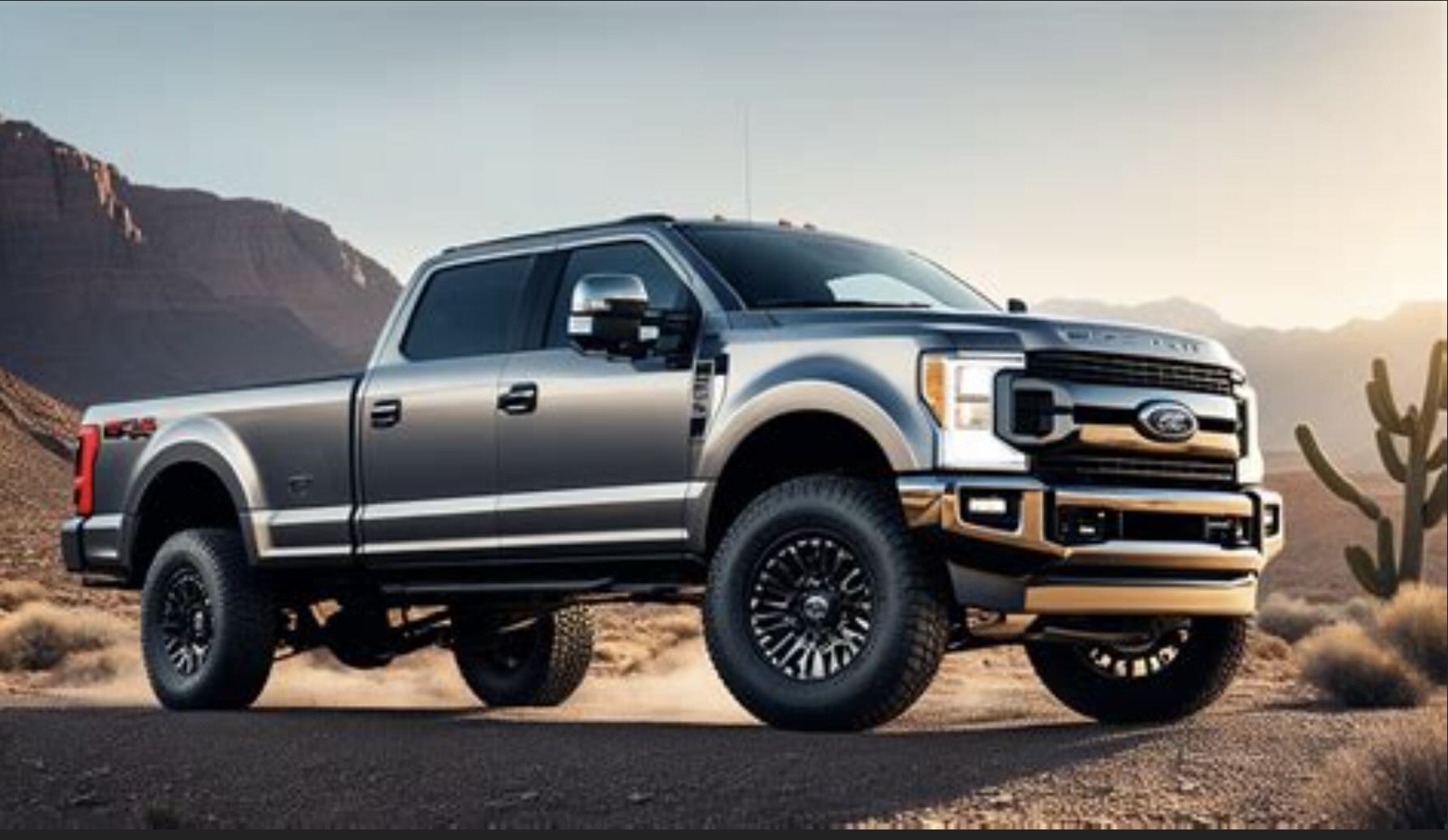

Do you want a big truck with just two doors, an eight foot bed and a big V8 rather than a small six with a turbo?
It’ hard to get all those things together in a half-ton truck and some half-ton trucks no longer offer those things anymore (the current Ram 1500, for instance, comes only with four doors, a six or five-foot bed and a turbo six).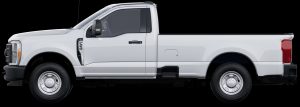
If you want the things that used to be commonly available in half-ton trucks, you can still find them standard in three-quarter-ton trucks like the Ford F-250.
The why-you-still-can is due to a combination of factors, including the fact that 2500-and-up trucks are subject to less onerous federal regulations (as regards fuel economy and “emissions”) and because 1500 pickups have become popular among people who don’t especially need a work truck anymore and are fine with a truck that’s better suited to carrying people than a stack of 4×8 sheets of plywood.
The really good news is that the F-250 doesn’t cost that much more than an F-150, but it’s a lot more truck for not much more money.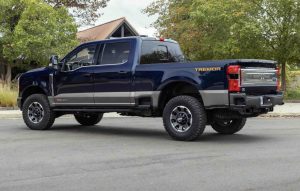
What It Is
The F-250 is Ford’s 2500 series pickup. Like others in the class such as the Ram 2500 and Chevy Silverado 2500, it is a more rugged and powerful truck than lighter-duty 1500 series pickups.
The base XL trim ($45,300) comes standard with a regular cab (two doors) and an eight foot bed, as well as a 6.8 liter V8. As a point of comparison, the base XL trim F-150 comes standard with a 2.7 liter turbocharged six cylinder engine and stickers for $37,450.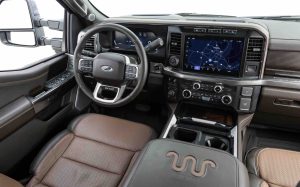
The Chevy Silverado 1500 comes standard with a turbocharged four.
If you want an even bigger engine than 6.8 liters, Ford offers a 7.3 liter V8 as a stand alone option for $1,000 extra. In addition, there’s a turbodiesel 6.7 liter V8 that is available in two output levels.
If you’d like four doors and an eight-foot bed to go with it, the F-250 is available configured that way as well.
A top-of-the-line Platinum trim with Crew Cab and an eight foot bed stickers for $78,065. If you do not need an eight foot bed and want to save a few bucks, Ford offers the Platinum Crew Cab with a 6.75 foot bed for $77,865.
All trims except the base XL come standard with 4WD.
What’s New For 2025
The main new thing is Ford’s Pro Vehicle Integration System 2.0 – designed to ease installation of aftermarket accessories.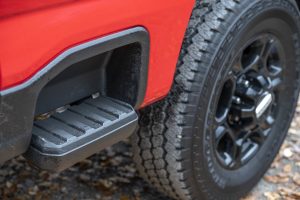
What’s Good
Everything (and more) that a half ton truck used to be for not much more than a current half-ton truck costs.
Multiple V8s to choose from – gas and diesel.
Even the base XL comes standard with what would have been considered luxury features in a half ton truck made in the early 2000s and before – including power everything, power-locking tailgate, heated outside mirrors, AC and trailer sway control.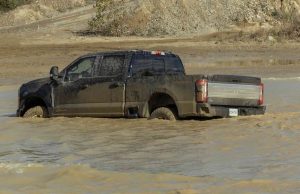
What’s Not So Good
It’s a climb up to get in – and to get cargo in and out of the bed, due to it being high off the ground and having high bedwalls. (Ford does provide scallops to use as foot-holds).
Does not offer the extra-roomy MegaCab configuration available with the Ram 2500.
Diesel V8 adds more than $10k to the price.
Under The Hood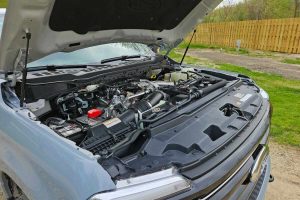
The F-250 comes standard with what’s only available optionally in current half-ton trucks – and no longer available at all in several of them, including the current Ram 1500 and Toyota Tundra.
That being a V8 engine.
A big one, too. It’s a 6.8 liter V8 that touts 405 horsepower and 445 ft.-lbs. of torque, sufficient to allow for a tow rating of 18,200 lbs. – which is thousands of pounds higher than maximum tow-rating of any half-ton truck. (Part of the reason for this is also that trucks in the 2500 class have heavier frames than the 1500s and so can handle the torsional stresses of pulling that kind of weight.)
A ten speed (heavy duty) automatic is paired with this V8 – as well as the optional (and even bigger) 7.3 liter V8 that touts 430 horsepower and 450 ft.-lbs. of torque. Equipped with this huge V8 – it displaces more than 440 cubic inches in Before (metric) Times measuring methods – the standard tow rating goes up nearly 4,000 lbs. to a maximum of 22,000 lbs.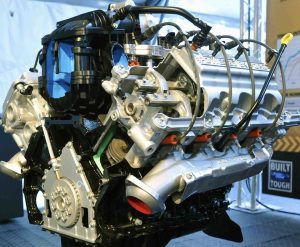
Also, the 0-60 time goes down from about 8 seconds to 7.5 seconds.
An interesting about this V8 is that it is also a Before Times pushrod, overhead valve V8 – meaning it doesn’t have multiple camshafts operating a plethora of intake and exhaust valves. Fewer parts and a physically smaller V8 – in terms of its exterior size – are among the benefits of this layout vs. overhead cam engines with four valves per cylinder (rather than just two).
It would be a fine thing if Ford could offer either of these V8s in the F-150 but it can’t because of compliance pressure; they use “too much gas” – not in the eyes of buyers but in the eyes of government bureaucrats, who somehow get to decide for us how much gas we’re allowed to use as well as the types of vehicles and engines we’re allowed to buy.
There’s a third engine option; technically, two. Ford offers a 6.7 liter Powerstroke turbodiesel V8 in two outputs. The first touts 475 horses and 1,050 ft.-lbs. of torque; the higher-output iteration touts 500 horsepower and 1,200 ft.-lbs. of torque. The max tow rating – with a gooseneck – tops out at 23,000 lbs. 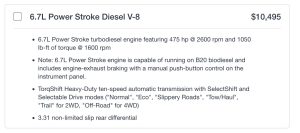
With the HO 6.7 V8, this huge and heavy (nearly three ton) truck can get to 60 in 6.3 seconds.
Either way, going diesel isn’t inexpensive. The standard output iteration adds $10,495 to the price; the higher-output version adds $12,995 to the price of a new F-250.
The main sell here isn’t so much the increased tow rating but the increased distance you can drive an F-250 so equipped. The diesel doesn’t have to work as hard – and so does not burn as much fuel-per mile – as either of the gas V8s.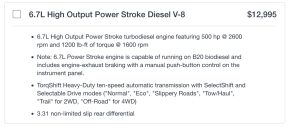
The government does not publish mileage stats for trucks in this class, but with 34 gallons of diesel in the tank the dashboard indicator says about 600 miles of driving range. That’s right there with a Prius hybrid – but the Prius can’t tow 23,000 lbs.
Dual 68 amp batteries can be specified for $210.
On The Road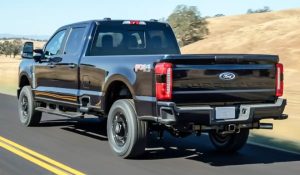
Once you’re pointed straight ahead, the F-250 is both easy to drive and pleasant to drive. The background burble of the big V8 – gas or diesel – conveys strength to match the beefy feel of everything else. If you choose the diesel, you’ll get an exhaust brake like the Big Rigs have; it uses exhaust back pressure provide a deceleration effect without using the brakes as much or as heavily. Just lift off the accelerator instead.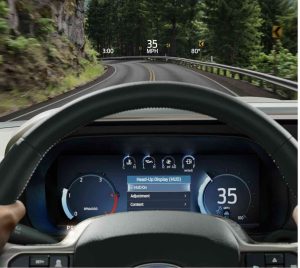
The house-pulling torque of the diesel is worth the cost, if you can afford it. Twelve hundred ft.-lbs. of torque is enough to almost get air under the front wheels if you launch the thing hard from a dead stop. It’s also enough to make pulling a 10,000 lb. trailer feel like you’re not pulling anything, which is one of the objective reasons for buying a 2500 over a 1500. The F-150 is rated to pull up to 13,500 lbs. So you could pull 10,000 lbs. and be well within the safe zone. But you will definitely feel the load of 10,000 lbs. hanging off the F-150’s rear bumper. On the other hand, a 10,000 lb. RV hanging off the rear end of an F-250 is kind of like Arnold (in his prime) benching 225 pounds.
Arnold’s one-rep max was reportedly around 500. Thus, 225 was a warm-up.
Being able to pull more also means the drivetrain isn’t being worked as hard when not pulling as much as it could. It’s nice to have the capability to hitch up to 23,000 lbs. to the rear end. But it’s comforting to know that pulling 10,0000 or even 15,000 lbs. – which is a big (and heavy) RV – is probably not going to lead to the early demise of a very expensive transmission or engine that was worked too hard, too often.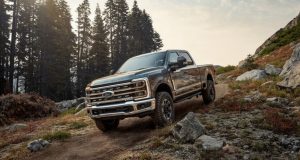
Three can comfortably sit up front, which is something three could do in the big land yacht sedans that are no longer made – which helps account for the popularity of the big trucks (and SUVs) that have taken their place. Another commonality with those dreadnoughts of yore is a very wide turning circle (51.1 feet for the Super Crew with the 6.75 foot bed) and this can make it a handful to maneuver in some parking lots and also when trying to get straightened out again exiting from a side street. But once you are straightened out, the feel of the F-250 can be likened to how it feels when you’re sitting in the plush first-class seat of a 747 cruising at 400 MPH. The speed is almost unnoticeable – as is the fact that you’re sitting inside something so big.
And that’s a fine feeling.
At The Curb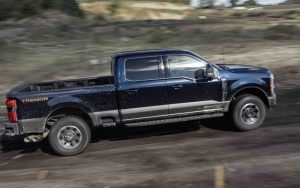
The F-250 comes almost any way you might want it to – or need it too – which sets it apart from the current crop of half-tons that increasingly come in fewer ways than many truck buyers want and need and that probably explains why truck buyers are gravitating toward the three-quarter-ton segment now. The half-ton segment is popular with buyers who want a big car – but since those aren’t sold anymore, they go for half-ton trucks (and big SUVs based on those trucks) instead. The big cab/small bed layout works for them because they typically haul the family dog in the bed rather than a stack of 4×8 plywood.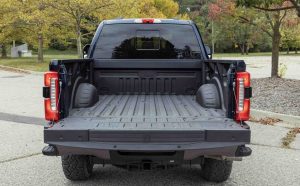
The regular cab/eight foot bed configuration is the most obvious way. Another way is that the eight foot bed is available with the Super Cab and the Crew Cab. You aren’t forced to pick one over the other – as is often the case in the half-ton segment.
The “base” XL trim is described as a “work truck” – which is true and false. It can do a lot of work, without breaking a sweat. But “work truck” used to mean metal floors, roll up windows and a heater. It now means standard AC, power pretty much everything (including the tailgate) plus electrical trailer sway control, 5G hotspot, heated outside mirrors, remote start and an 8 inch touchscreen. If that constitutes a “work truck” then the nature of “work” has become a lot cushier than it used to be.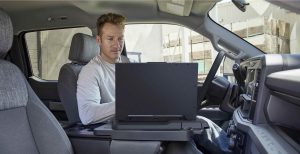
You can upgrade from there to the higher trims if you want such luxuries as heated seats (both rows) rain-sensing wipers, power adjustable pedals and a larger (12 inch) LCD touchscreen and a B&O eight speaker premium audio system. The range-topping King Ranch and Platinum trims up that ante with massaging front seats, power deploying running boards, a 14 speaker B&O audio system and a powered tailgate. The Platinum – which gets unique-to-that-trim premium smoked truffle leather seats with French stitching, a dual-pane sunroof and satin-chrome trim – requires buying the HO version of the 6.7 liter diesel. This version of the F-250 also gets the new pre-wired auxiliary switches for accessories built into a headliner-mounted control console.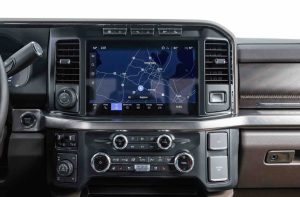
As mentioned earlier, the front seats can be configured to seat two or three across via the flip-up/down center section that serves as either the middle seat or a center console/work space with an adjustable “desk” for laptops and so on.
There’s also a Tremor package that can be ordered with most F-250 trims. It bundles a locking rear diff, limited slip front diff, skid plates for the transfer case and fuel tanks, 35 inch tires, revised front and rear ends for increased angles of approach/departure plus a factory lift that increases ground clearance from the standard 9.7 inches to 10.8 inches. The ten speed automatic also gets a driver-selectable Rock Crawl mode.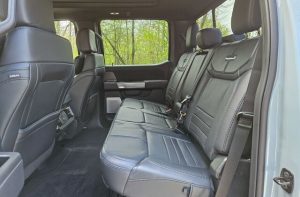
It’s been said elsewhere that the F-250’s main rivals – the Chevy Silverado 2500 and the Ram 2500 are a little “nicer” – meaning they are a bit less big-trucky. That’s a plus – or a minus – depending on what kind of truck you’re looking for.
The Rest
Perhaps the most intriguing thing about the F-250 is how little it costs relative to the F-150. The latter’s base price – $37,450 – is only $7,850 lower than the base F-250’s price and you could probably haggle that down closer to parity. You’ll certainly get a lot more capability (and engine) for your money when you buy the F-250.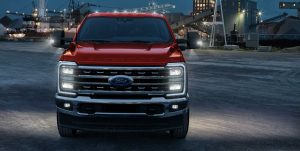
The thing that may be most daunting – to some – is the height of the F-250 vs. the F-150. The latter stands 75.4 inches tall; the former stands 79.3 inches, so it’s more of a climb to get in the F-250. The latter’s bed is also higher up and so there’s a climb up to get at what’s in the bed, too.
The Bottom Line
If you’re wanting – and more to the point, needing – a truck that doesn’t shy away from being just that, this one will likely fill the bill.
. . .
If you like what you’ve found here please consider supporting EPautos.
We depend on you to keep the wheels turning!
Our donate button is here.
If you prefer not to use PayPal, our mailing address is:
EPautos
721 Hummingbird Lane SE
Copper Hill, VA 24079
PS: Get an EPautos magnet or sticker or coaster in return for a $25 or more one-time donation or a $10 or more monthly recurring donation. (Please be sure to tell us you want a magnet or sticker or coaster – and also, provide an address, so we know where to mail the thing!)
If you’d like a Baaaaa hat or other EPautos gear, see here!










Wow. My 2002 F250 Crew 2WD 5.4l Gas XLT was $27K in July 2001.
Extra features were limited-slip diff and self-cancelling turn signals!
285K miles with a few parts and sparkplugs invested. Still gets 14MPG.
The gov’t vehicles all have their EGRs exempted/bypassed. Only the plebes have to deal with that shit, so it was a win/win for domestics to root for EPA to make the rules tougher. Drives more vehicles into the service bays after warranty. I miss the days when Detroit fought Washington.
Hi Dr. Otto –
I’m not surprised. Just the same (of a piece) is the fact that our Leader Class gets to be driven around in 5 MPG V8-powered armored limos and 15 MPG V8 powered SUVs.
Anyone know if the gas engines offered in the F250 the same as Ford’s “Godzilla” crate motor (that seems to have an excellent reputation for power & durability)?
Anyone have any insights as to how that 10-speed computerized slushbox will hold up after a couple hundred thousand miles?
I’d hate to drop 80 grand into one of these and have a serious drivetrain issue at 50,000 miles.
Eliminate the EPA, NHTSA, we should be able to drive what we want in a free country.
“The Chevy Silverado 1500 comes standard with a turbocharged four.”
Mary Barra, CEO of GM, a dyke masquerading as a man who loves cars, likes it that way. Its just like the feminists who like to force men to wear skinny legged Jeans, that way they know that they have the men by their balls. That is the equivalence to putting a 4 cyl turbo in a full sized pickup.
Like everything else that is going wrong in the US, if the Jews did not want it that way it wouldn’t be so.
It makes sense to buy the base model F250 if what you’re after is an actual work truck—greater payload and towing capacity, more powerful engines, fewer bells and whistles to break.
I wonder if 4 wheel drive is available on the XL trim level—or if you have to upgrade to XLT to get that.
The only new tech that I’d happily pay for (if sought a new truck) is the integrated trailer brake controller. Otherwise, all the other standard amenities are expensive to buy and repair. I routinely tow an 18′ equipment trailer or a 16′ utility.
The wiring harnesses are all there for the aftermarket trailer brake systems on the 150, I’d be shocked if the 250 and up isn’t already plumbed for a trailer brake as well.
I am unequivocally NOT a truck person. They look like refrigerators on wheels, they handle like puke, but somehow, this is the best truck I’ve heard about in ages, at least since that Chevy SS454 pickup I saw. If you’re going to buy a truck, go all the way. If I am ever going to own one of these beasts, it has to be able to do a bunch of work. With a base towing capacity of 18k lbs, this is the ticket. I don’t want to spend more on a truck than I have to. Good job Ford.
Not a goddamn real transmission in sight, though.
Just a bunch of fuckin slushboxes.
I had to move up to the 2500 class after breaking a 1500 by towing below its limit too often I guess.
Never drove a Ford, but the last one I did (an Excursion rental) felt cheap. Maybe that’s not the case with the F150.
If you are going to haul anything of significance, heavy duty is the only way to go. It’s the only way to get a useful bed.
And I love my real V8 without gimmicks like fuel saving that trashes those engines.
Here in the people’s Republic of Canada, our 2026 EV mandate will add $20k to any light car or truck unless the manufacturer has more than 20% EV sales. Since the F250 is medium duty and only 10k (Canadian) more then the F150, guess what the dealerships are going to be pushing! Brilliant move from the progressive crowd as usual.
We’re I looking for a new vehicle at this point, I’d almost be tempted to just get a Kenworth.
‘The latter’s [F-150] base price — $37,450 — is only $7,850
higherlower than the base F-250’s price.’Who knew that Ford made these big V8s? They used to install them in, you know, cars and hardtops and convertibles and such. Galaxie 500, Torino, Ranchero … whatevah!
Now unless you’re a buyer of a great hulking F-250 truck, you wouldn’t know they exist.
Lighting Jim Farley thinks EeeVee trucks are the future. He’s the one who doesn’t have a future.
Hi Jim,
Thanks for the catch; just fixed!
I like this truck – because its a truck; no apologies for it. More, please.
Jim H, chevy, ram, ford all make a big v8 for the last 5+ or so years in their 2500’s. Their fleet buyers got disgusted at how much tier4 diesels cost to operate and demanded simpler.
Basically, a contractor that buys 5-10 a year for his biz, pays 100K more for the diesel, but they were expected them to go 200-300K miles before they would get a new one. Not anymore, they go 100K and need a $20K new EGR system, etc…..
Most of the mid-sized contractors I know buy these large v8’s now.
It’s kind of a rare situation where the auto maker sort of listened to the market.
Sort of because the market is distorted by EPA forcing diesel compliance so a simple diesel engine can’t be made anymore. That’s Ford’s fault, but it isn’t. I mean, they have influence but don’t actually write the laws and regulations.
In any case, in the world where Ford is coerced to play ball they find a workaround to give the market the closest thing they can without getting VWicided. They also supply lots of government vehicles so they can doubly perverse incentives.
The big 3 were absolutely involved in changing the regs to Tier4.
Asian diesels we coming that were a 1/3 of the price (already were) that met the current regs. The regs had to be changed, which just cost us more, and more, and it will never end. Well it will, IDK how.