


It used to be that a luxury-brand’s least expensive model was smaller and for that reason less practical than the more expensive models. It also usually looked like the least expensive model.
The upside was the lower price.
BMW’s 2 Series Gran Coupe has different upside. It doesn’t look like BMW’s second-least expensive sedan, the 3 series – even though it also has four doors.
It’s also less expensive than it was last year.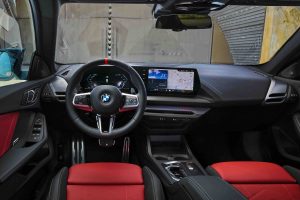
Imagine that.
What It Is
The 2 Series Gran Coupe is actually a four-door sedan made to look sleeker – more coupe-like – via a lower roofline and a “faster” (more swept back) windshield. It’s technically a subcompact but by the yardstick, it’s only about six inches shorter overall than a 3 Series sedan and has comparable interior room, except for backseat headroom – of which there’s about two inches less vs. the 3 Series sedan. That – plus a smaller trunk – is the price you pay for the coupe-like good looks.
But you’ll pay less – in terms of what it costs. Not just vs. the only slighter larger – but much more expensive 3 Series sedan, which stickers for $47,500 to start. But also vs. last year’s 2 Series Gran Coupe, which stickered for $41,600 to start.
Prices for the ’26 2 Series Gran Coupe start at $39,600 for the 228i; it comes standard with a turbocharged 2.0 liter engine that makes 241 horsepower, paired with a seven speed automatic and front-wheel-drive. The $41,600 228 xDrive is basically the same but comes standard with all-wheel-drive. The high-performance M235xDrive has a much more powerful (312 horsepower) version of the 2.0 liter engine, plus handling, braking and cosmetic upgrades. It lists for $49,500.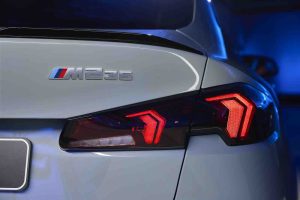
The BMW’s main rivals are the Mercedes CLA, which also has coupe-like styling but a higher MSRP ($44,400 to start) and much tighter back seats – and the $40,100-to-start Audi A3, which is the bargain of the bunch (especially when you take into account that it comes standard with AWD) but which also has a trunk that’s got less space than some women’s purses.
What’s New for 2026
BMW has added a new – less expensive base trim (the 228i) to make this model more affordable than it was.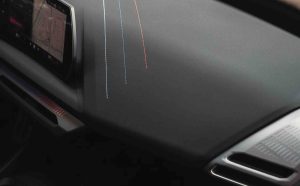
What’s Good
Doesn’t look inexpensive (for a BMW).
Much stronger standard engine than its two main rivals.
Exceptional high speed handling chops.
What’s Not So Good
Automatic-only (but then so are the others).
Rearseat headroom is significantly less than up front (that’s the price you pay for the low, swept-back roofline).
Small car trunk (but not as small as either the Benz CLA’s or the Audi A3’s).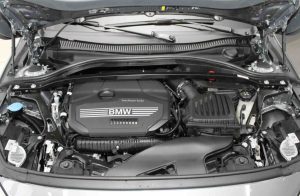
Under The Hood
Like its rivals, the BMW comes standard with a turbocharged, 2.0 liter four cylinder engine – but it differs in two key respects. First, it is more powerful than the 2.0 liter fours in the Mercedes CLA and the Audi A3. The BMW’s turbocharged 2.0 liter four touts 241 horsepower – vs. 221 for the Mercedes CLA and just 201 for the Audi A3.
Unsurprisingly, the BMW is the quickest-accelerating of the three. It can get to 60 in about 5.8 seconds.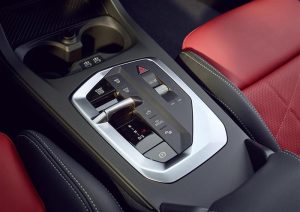
The other thing that’s different is that the BMW is the only of the three that isn’t a so-called “mild hybrid,” meaning it doesn’t have a 48 volt electrical system/lithium-ion battery pack and some iteration of flywheel/belt-start to quickly restart the engine, which is turned off as often as possible by the hybrid system to increase gas mileage (and reduce emissions of the dread gas that feeds plants, CO2). It just has automatic stop-start, which uses a conventional starter – the same one that starts the engine the first time you go for a drive – and that can be turned off, if you dislike the engine automatically cutting off at every red light.
You can’t turn off the mild hybrid stuff.
Also, not having the mild hybrid stuff means there’s less stuff to wear out or just quit on you – costing you more money to have repaired/replaced. It also costs more to buy – as for example the $44,400-to-start Benz CLA250.
The mild hybrid stuff doesn’t even save you much in the way of gas money. The 228i touts 26 city, 38 highway, which is close to economy car mileage – and this is a luxury-sport sedan (er, “coupe”). The Benz CLA250 touts lower mileage – 26 city, 36 highway – and the Benz costs more and is less powerful. The A3 touts even lower mileage – 24 city, 34 highway – and it is also much less powerful than the BMW.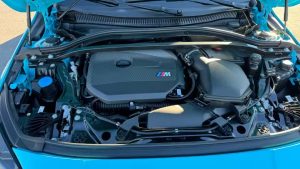
The m235i – which is the high performance variant of the 2 Series Gran Coupe – also comes standard with a 2.0 liter engine, but it has been goosed to produce 312 horsepower and 295 ft.-lbs. of torque, output comparable to that of a small V8. Even so, it still manages 24 city, 33 highway – while also managing a 0-60 run of 4.2 seconds.
Both variants of the 2.0 liter four are paired with a seven speed, dual clutch automatic. The base 228i is front-wheel-drive; both the 228i xDrive and the M235i xDrive come standard with all-wheel-drive. AWD is optional with the Benz CLA and standard with the Audi A3.
On The Road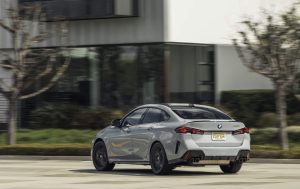
Entry level doesn’t have to mean it drives that way. The 2 Series doesn’t feel that way, at least.
It feels better, in some ways, than a 3 Series.
It’s lighter, for openers – 3,534 lbs. vs. 3,644 lbs. – and it rides on a much shorter wheelbase – 105.1 inches vs. 112.2 for the 3 Series. The two differences combine to make the 2 Series feel more agile – and it’s more than just a feeling. The 2 Series is more agile for essentially the same reason that Bruce Lee was more agile than Chuck Norris. Smaller and lighter generally translates as quicker and snappier. This is especially interesting because of the other big difference between these two BMWs, which is that the 2 Series Gran Coupe is built on a front-wheel-drive layout (with AWD optional) while the 3 Series is built on a rear-drive layout (with AWD available).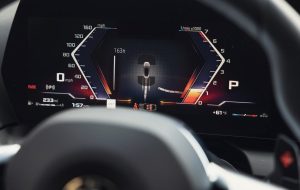
It is interesting because – usually – FWD cars feel nose-heavy (because they are nose heavy, because most of the weight of the drivetrain is over the front wheels) and are inclined to understeer early when pressed. Not this FWD-based car. It feels like a rear-drive car, tracking with admirable neutrality – neither tail out oversteering or understeering unless track-day pressed and then it’s a kind of get-out-of-trouble-free card that is more forgiving than the sudden tail-coming-around (and you’d better know how to throttle steer clear of trouble).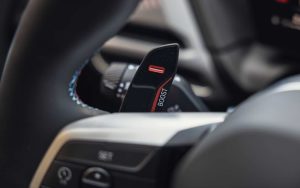
The 3 is the better track tool, if you’re actually going to drive like that. But if you’re going to drive on the street, the 2 Series can be more real-world enjoyable because it can be driven very fast in the curves without the kind of drama that needs a driver with track-day skills to keep in check.
Speaking of enjoyable:
There’s a “boost” button – a paddle, actually – on the left side of the steering column that works a little like the nitrous oxide button some hot rods have – in that when you pull it back toward you, the computer allows a momentary surge of extra turbo-boost to give you maximum thrust. The LCD dashboard goes angry red when this happens and the seven speed dual clutch automatic goes into its most aggressive shift programming.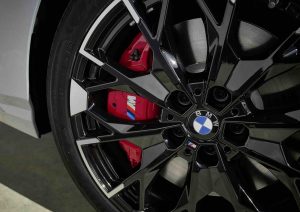
The standard adaptive suspension delivers firmness without harshness. The optional M Sport package includes upgraded brakes with powder coated calipers; they bite like a bulldog.
It’s just a shame you can’t shift for yourself, there being no manual transmission option. BMW sedans were once prized for being four door sports cars precisely because they were available with manuals. The automatic shifts more precisely, of course – and it never misses a shift. But something important is missing here. It’d be wonderful if BMW decided to put it back.
At The Curb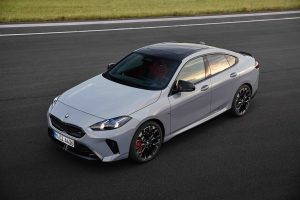
Though it is classified as a subcompact, the 2 Series Gran Coupe – which is 179.2 inches long – isn’t much smaller in terms of its overall footprint than the 3 Series sedan, which is 185.9 inches long. The 3 does ride on a much longer wheelbase – as outlined earlier – and this makes it look like a larger-than-it-is car when viewed from the side. But inside, there’s much less difference – in terms of room for the passengers.
In the 2 Series Gran Coupe, the driver and front seat passenger have 41.4 inches of legroom and the backseat occupants have 34.4 inches. In the 3 Series, there’s 42 inches of legroom up front and 35.2 inches of legroom in back – virtually the same, in other words.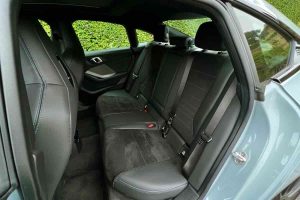
The main space difference is backseat headroom, of which the Gran Coupe has about two inches less (35.7 inches vs. 37.6 inches) than the 3 Series sedan has. But there is enough headroom back there for people under six feet tall and that’s probably 85 percent of people. The 3 Series’ main advantage is that it has a much larger (16.9 cubic foot) trunk vs. the Gran Coupe’s 12 cubic footer. However, the Gran Coupe’s trunk isn’t so small as to make this sedan as useless as a coupe – like the Audi A3’s purse-sized 8.3 cubic foot trunk. The Mercedes CLA’s 11.6 cubic foot trunk is about the same size as the BMW’s – but you’re paying nearly 3 Series money – $44,400 to start – for the CLA250.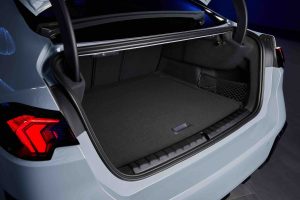
The main attribute you’re getting for your money when you buy the 2 Series Gran Coupe is more distinctive looks – for less money – than you’d pay for a 3 Series. The latter is not an unattractive car. It’s just not as sexy-looking a car as the Gran Coupe – and that may be worth less to you.
The Rest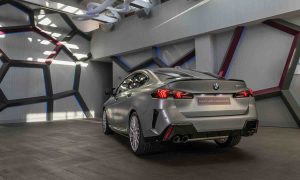
The 2 Series GC is a BMW – that is to say, a luxury-brand car – but its price (to start) isn’t that much higher than what you’d pay to get into a loaded non-luxury-brand sedan of about the same overall size, such as Honda Civic – which can easily sticker out for $35,000-ish. Which makes it awfully tempting to reach just a little higher to get into the BMW. Not that there’s anything wrong with the Civic. The point is it’s not a BMW – and even when loaded with all the options available, it’s still not a BMW. The highest-performance Civic Si trim only offers 200 horsepower – and it doesn’t offer an adaptive suspension (although it is available with a manual transmission).
The Bottom Line
It’s nice to find an entry-level vehicle that (arguably) looks more expensive than the next-up-in-the-lineup vehicle. It’s even nicer to find that’s it costs less this year than it did last year.
. . .
If you like what you’ve found here please consider supporting EPautos.
We depend on you to keep the wheels turning!
Our donate button is here.
If you prefer not to use PayPal, our mailing address is:
EPautos
721 Hummingbird Lane SE
Copper Hill, VA 24079
PS: Get an EPautos magnet or sticker or coaster in return for a $25 or more one-time donation or a $10 or more monthly recurring donation. (Please be sure to tell us you want a magnet or sticker or coaster – and also, provide an address, so we know where to mail the thing!)
If you’d like a Baaaaa hat or other EPautos gear, see here!









Four Door Automatic with an Electric Hand Brake. Just as boring as every other vehicle out there. I’ll stick with my 2016 Audi S1 – forever.
‘BMW’s 2 Series Gran Coupe has different upside. It doesn’t look like BMW’s second-least expensive sedan, the 3 series – even though it also has four doors.’
Looks like the last gen Kia Forte. And this obsession with ‘coupe like styling’ will finish destroying sedans the way bloat and weight killed the pony car market
BMW’s 2 Series Gran Coupe has different upside. It doesn’t look like BMW’s second-least expensive sedan, the 3 series – even though it also has four doors.
Just as the MINI ‘hardtop’ is not a hardtop, this BMW is not a ‘coupe’.
And 37″ of rear headroom is the bare minimum for passenger comfort.
The more utility that is destroyed with these efforts, the fewer sedans will be sold.
If that ‘fast’back design included a hatch instead of a pathetic 12 sq ft trunk, the compromises made in the interior dimensions would be livable.
Otherwise, a money grab for the lease market.
Wow! A ‘new’ non-hydrid. Maybe they’re waking up?
I’d still go with the Caddy CT4, which starts at 35K, and is RWD. Of course it would be difficult to find a 35K CT4 on the lot. But options all the way up to a fire breathing CT4 V Blackwing which is super fun and a very good deal compared to it’s EU competition.
After our experience with EU sedans, the cost of parts and service was off the charts compared to our caddy.
Reminds me of an updated Taurus.
Plus side, a Beemer available for under $40k is a surprise to me.
Arrggghh — BMW’s square-headed designers’ fetish with a butt-ugly, lozenge-shaped driver display (further degraded with vulgar digital numbers and letters) soldiers on.
It’s of a piece with the krauts’ Flachspüler (‘shallow flush’) toilets with a ‘poop shelf’ at the back, so you can poke around in your feces if you’ve got time on your hands and an inquisitive (or coprophagic) nature.
https://tinyurl.com/yk3rvdsw
Sheesh, why can’t BMW just farm out the aesthetics to the neighboring Italians, as they used to do?
What do automakers have against building two door cars and coupes in particular lately?
Hi Rich,
I don’t they have anything against coupes; the problem is coupes aren’t practical – and the problem now is that vehicles are so expensive that fewer can afford to have an impractical car plus a practical car. So they buy the practical car. Even the Miata – which used to be very affordable – is now a nearly $30k-to-start car.
Coupes, like wagons, have been on the decline for quite some time. I don’t really blame the automakers. They kept trying with both styles for years, but sales kept going down. When I was growing up in the ’80s coupes were everywhere. Some of the bestselling models were coupes like the Regal/Cutlass Supreme/Monte Carlo. It’s unfortunate but too many people just don’t want them anymore.
And its become a bit too challenging to squeeze a 250 lb kid into a coupe behind a folded front seat.
This thing is FWD, not a RWD “coupe.” therefore it’s no different from any other appliance on the road.
Although I don’t current have any rwd cars, this thing is unworthy of a BMW badge