

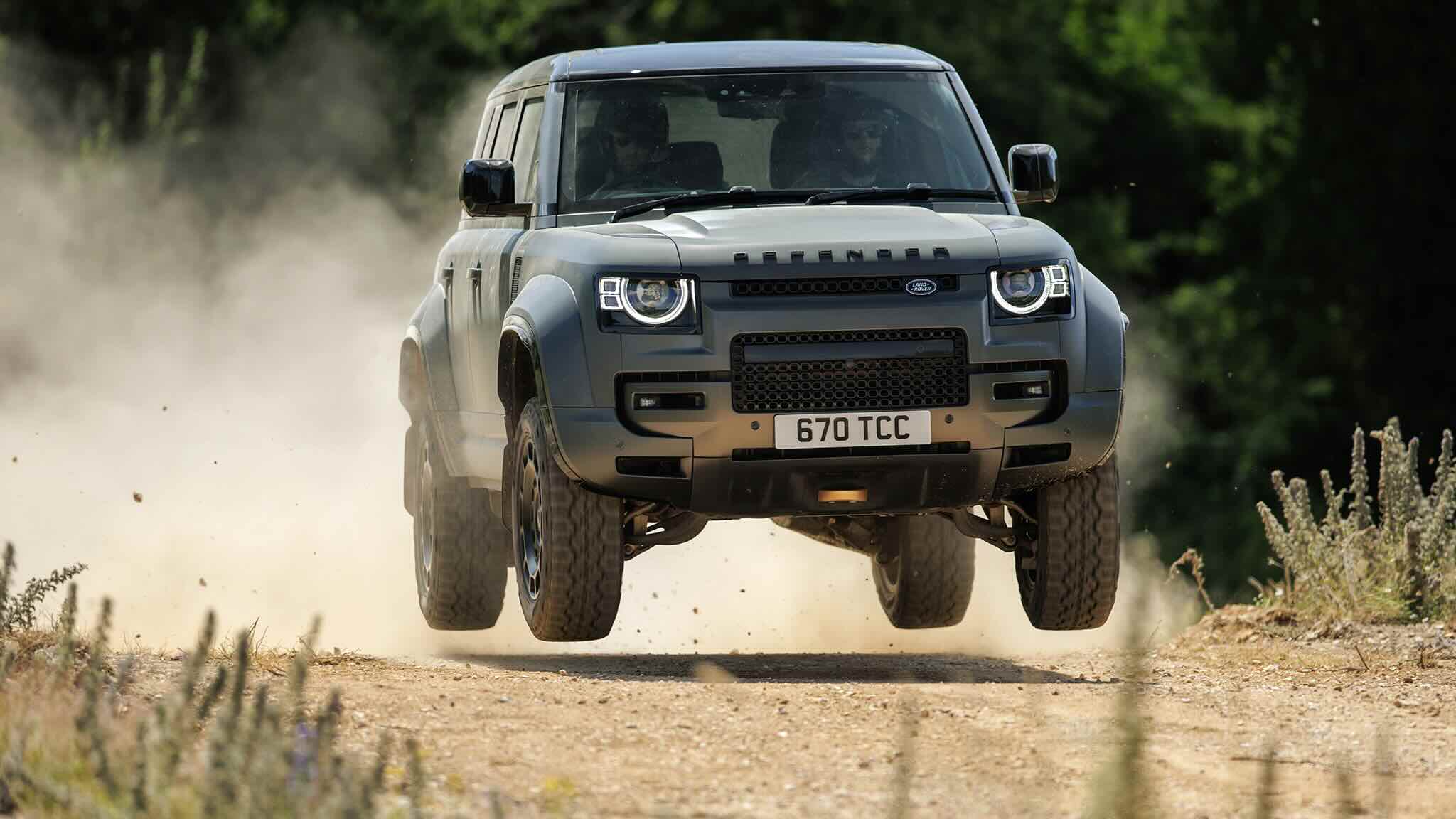

There are several things that are unusual about the 2026 Land Rover Defender. The first is that it’s available in different wheelbase lengths and two and four-door bodystyles – with seats for as few as five and as many as seven. The second is that its available with four different engines, including two different V8s (as well as a turbo four and a turbo’d inline six).
Such variety was once pretty common.
Now, it’s almost extraordinary.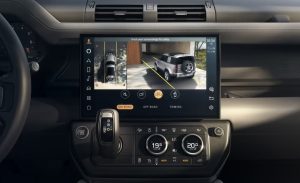
What It Is
The Defender, which ranges from compact to full-sized, is one of the OG 4x4s, along with the first Ford Bronco. You have probably seen them in TV nature/exploration shows because they can get to places very few vehicles can go that haven’t got treads, like a tank. Today’s Defender is also rugged but also ultra-luxurious as well as something the classic/OG Defenders never were.
That being as quick as a Ferrari – if ordered with its available 626 horsepower turbocharged V8.
Prices start at $63,500 for the four-door, two-row Defender 110 P300 S, which comes with a turbocharged, 2.0 liter four cylinder engine paired with an eight speed automatic and full-time 4WD with locking axles and Low range gearing. The $73,000 Defender 130 P300 S is basically the same thing and similarly equipped but rides on a longer wheelbase and comes standard with a two-passenger third row (you can get a third row with the 110, but there’s less room back there due to there being less length overall).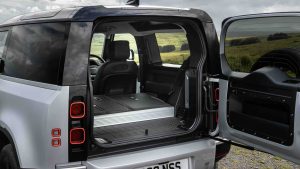
Both the 110 and the 130 are eligible for underhood upgrades.
The 110 P400 Trophy Edition ($87,400) comes with a turbocharged, 3.0 liter inline six plus all-terrain tires, a height-adjustable adaptive suspension, raised air intake (to keep water from getting sucked into the engine) plus a roof rack and unique yellow or green paint.
The same 3.0 six is also available with the 130 in the $84,400 P400 X-Dynamic SE and the $86,700 Outbound as well as the $105,000 130 P400 X – which also gets 22 inch wheels, upgraded Drive modes, recovery hooks and upgraded brakes as well as heaters for the second and third rows.
You can also get a two-door/short wheelbase Defender 90 P525 – which comes standard with a 5.0 liter supercharged V8. This engine is also optionally available with the 110 and 130.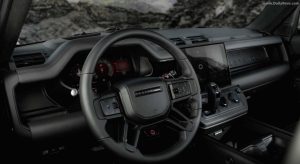
If you prefer a turbocharged V8, it’s standard in the 110 P635 OCTA ($158,300) and the top-of-the-line 110 P635 OCTA Black ($168,700). Both come with a turbo’d 4.4 V8 and wide body fender flares, an upgraded air suspension and special front seats. The Black adds black-themed styling accents and special 20 inch wheels unique to this trim.
What’s New For 2026
There’s a new Adaptive Off Road Cruise Controls system that automatically modulates throttle input over rough terrain and the 130 can be ordered with a built-in air compressor.
Octa Black and Trophy editions are new and all trims get a larger (13.1 inch) touchscreen.
What’s Good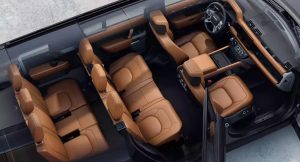
Multiple body and engine choices.
Heroic off-road capability.
Available third row (Ford Bronco and Jeep Wrangler do not offer this useful feature).
What’s Not So Good
Huge price uptick to go from a four to a six – and from a six to an eight.
Cost to fill ‘er up is in the triple digits.
Similar – and similarly capable – Ford Bronco (base price $40,495) costs tens of thousands less.
Under The Hood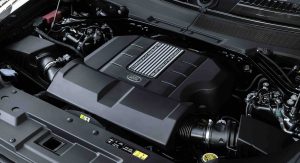
The Defender is available with a plethora of engines, beginning with the standard turbocharged 2.0 liter four. It touts 296 horsepower and 295 ft.-lbs, of torque and – like all of the Defender’s engines – it is paired with an eight speed automatic and a full-time 4WD system with driver-selectable terrain modes and Low range. Equipped with this engine, the Defender is rated to tow up to 7,716 lbs., which is very impressive given how small this engine is and how heavy the Defender is (5,125 lbs with the four). This combo also manages 18 city, 22 highway – which (again) is impressive given how heavy the Defender is.
A larger, 3.0 liter in-line turbocharged six (augmented with a “mild hybrid” system that cycles the engine off as often as possible, to decrease fuel consumption) is available for those who want more power – and have more cash. This engine touts 395 horsepower and 406 ft.-lbs, of torque. Impressively, advertised gas mileage remains the same as with the standard four cylinder engine and in real-world driving, it’s actually a little better, because the size doesn’t have to work as hard to haul the Defender’s weight. The maximum tow rating goes up to 8,200 lbs. with this engine, too – and it’s probably the one you want anyhow, if you intend to tow more than 5,000 lbs. with this vehicle. The four is rated for a ton more than that – but it’s going to be working hard doing that.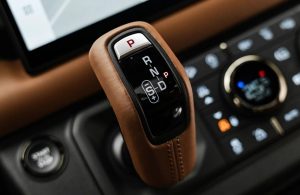
Next up – if you can afford them – are two available V8s.
The first is a 5.0 liter supercharged V8 that touts either 493 horsepower (P500) and 450 ft.-lbs. of torque or 518 horsepower (P525) and the other is a turbocharged 4.4 liter V8 that touts 626 horsepower and 553 ft.-lbs. of torque. Equipped with the latter V8, a nearly three-ton Defender is capable of accelerating to 60 MPH in about 3.7 seconds.
It’s also capable of 15 city, 19 highway – which is only slightly less than the mileage touted by the little four that’s standard in the lower trims. Not that gas mileage matters much to people who can afford a Defender with a V8. What they probably do care about is driving range – and mileage matters in that respect. So does having a gas tank that holds just shy of 24 gallons, which is enough to allow the V8 Defender to go about 450 miles on the highway and 357 miles around town. That beats any EV – and you can refill to full in just a few minutes, too.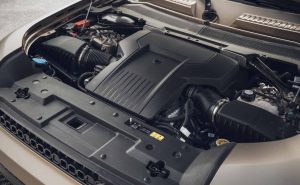
The Defender’s main rival – the Ford Bronco – comes standard with a slightly larger (2.3 liter) slightly stronger (300 horsepower) turbocharged four, for a lot less money. But it is a Ford, after all – and while the Bronco is just as capable as the Defender, it is also more common. This does not mean it is inferior. Only that it isn’t as exclusive.
It is also not available with a V8. The stoutest engine it offers – in the Raptor – is a 3.0 liter turbo’d V6 that touts 418 horsepower.
On The Road
Do you know what a gentleman is?
It isn’t a guy who is well-bred, well educated, well-dressed and polite – though those are elements of being a gentleman. He is also a guy who can take out an adversary if it becomes necessary while wearing his dinner jacket and without mussing his hair.
The Defender is a gentleman’s 4×4.
You don’t see them often because they are expensive and that precludes their being common. The Ford Bronco is a lot of fun and very capable. It is also just over $40k to start and that is why it is more common. Not – as Seinfeld used to say – that there is anything wrong with that. But there is something special about the uncommon. It is why special things are esteemed more than common things. A bottle of top-shelf whiskey.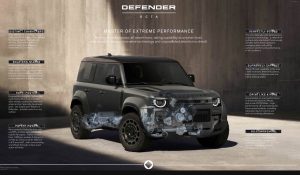
Or something like this.
The four is fine – and the six more-than-fine – but what makes this 4×4 something special is the available V8s. If you have the means.
Especially – arguably – the supercharged 5.0 liter V8. It is not the Defender’s top engine. But it is a supercharged engine and that is truly special because turbocharged engines are so common. They are so for several reasons, including the fact that turbos are more efficient. A mechanically driven supercharger takes a considerable amount of power to make power – whereas a turbo generates power almost for free, in the sense that using exhaust gassed to turn the turbo’s impeller wheel doesn’t cost power. But nothing sounds like a supercharger. That fabulous whirring sound of mechanical things happening you hear as the blower compresses the incoming air. Also the absolutely immediate response. There is no lag with a supercharger. It hits like Mike Tyson in his prime – fast and hard.
To maximize the experience, pop the hood and get rid of the black plastic acoustic cover that Land Rover puts on top of the engine to quiet the sound – which is something like turning down the volume when your favorite song comes on the superb Meridian audio system radio. This engine sings beautifully, especially if you put your right foot down about a third of the way and keep it there. That mechanical wail is music to the ears of anyone not deaf to the emotion of motion.
Of course, the main reason for buying a Defender is its indefatigable ability to keep going – on roads (and trails) and in conditions that would stop most anything else. Normally, that’s a boots and jeans kind of experience. In a Defender, it’s more gentlemanly experience. The fully independent suspension allows each wheel to articulate with dips and bumps and if you get the Octa, you’ll get to experience Land Rover’s “6D Dynamics” hydraulically linked suspension that does away with sway bars that are normally there to tie the suspension down but at the cost of an almost uncouth rigidity.
With almost a foot (11.5 inches) of clearance, you feel you could almost drive through the English Channel to France from London.
At The Curb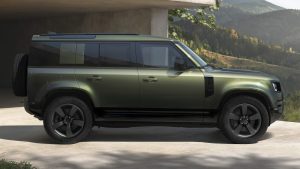
Like a tailored suit, you can buy a Defender that suits.
The two-door 90 is rides on a 101.9 inch wheelbase and is 180.5 inches long overall, so about 14 inches longer than the smaller Jeep Wrangler two door (166.8 inches) and about eight inches longer than the also-smaller two-door Bronco (173.7 inches).
The four-door 110 rides on a longer (119 inch) wheelbase and is 197.5 inches long – significantly longer than the still-compact-sized four-door Bronco (189.4 inches) and the four-door Wrangler (188.4 inches). The 110 can also be had with a third row, which you can’t get in the Bronco or the Wrangler. You can also get a third row with more legroom for the people back there in the 130, which at 211.7 inches long qualifies it to be rated full-size.
A fun available feature is a flip-up center console up front that converts into a jumpseat, allowing three people to ride in the first row.
Regardless, the Defender looks like what it is – no easy thing given it’s 2026 and every vehicle manufacturer must conform to the template laid down by federal regs demanding compliance with various “standards” that have had the general effect of homogenizing the looks of just about everything else. Somehow, the Defender is both compliant and recognizable because it does not look like everything else.
Add a snorkel, roof racks and some Jerry cans strapped to the side.
The full-size (and so, fully useful) spare mounts to the rear gate, so you won’t have to crawl under the vehicle to get it if you need it.The roof has the two fixed-in-place panes of glass on the rear sides as well as a panorama sunroof.
Inside, it’s both posh and uncluttered. The main instrument panel is analog-looking but it’s LCD and configurable. The new, larger (13.1 inch) LCD screen has a 4×4 display that shows elevation, incline/decline and which axles are locked or not. There are deep storage shelfs built into the dash that are also LED backlit at night. A magnesium bar runs the width of the dash and adds a rugged look as well as hand-holds
The Rest
You might think the least expensive Defender would be the two-door 90 since it’s the smallest Defender. But it’s also the only Defender that comes standard with and only with the supercharged V8 – which is why its one of the most expensive Defenders.
Contrariwise, the least expensive Ford Bronco (and Jeep Wrangler) is the two-door version.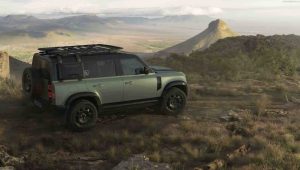
Also, it’d be nice to be able to get a diesel engine in a Defender – which is the ideal kind of engine for a 4×4, on account of the superior low-end torque and also the increased driving range you get with a diesel (there are fewer places to fuel up in the jungle/desert and so on). And you can get a diesel powered Defender – just not in the United States, on account of the regulatory regime that has made it very challenging to get a diesel engine “certified” for sale in the United States.
The Bottom Line
There are other 4x4s that are as capable as the Defender, but few – if any – as gentlemanly as a Defender.
. . .
If you like what you’ve found here please consider supporting EPautos.
We depend on you to keep the wheels turning!
Our donate button is here.
If you prefer not to use PayPal, our mailing address is:
EPautos
721 Hummingbird Lane SE
Copper Hill, VA 24079
PS: Get an EPautos magnet or sticker or coaster in return for a $25 or more one-time donation or a $10 or more monthly recurring donation. (Please be sure to tell us you want a magnet or sticker or coaster – and also, provide an address, so we know where to mail the thing!)
If you’d like a Baaaaa hat or other EPautos gear, see here!









[…] https://www.ericpetersautos.com/2026/05/11/2026-land-rover-defender/ […]
It would be interesting to see your take on this VS the EOS Grenadier, which apparently the founder wanted to purchase the old defender tooling but was told no by Land Rover. So he decided to make his own defender.
Itz difficult to find information on the Rovers. I am primarily interested in engine size, HP Torque and gas mileage. l also want to know about the car length, wheelbase, weight, capacities. I looked on the Range Rover site and could not find that information. A lot of pictures and words describing “A RELENTLESS PRESENCE” and “Sporting luxury with attitude”. Maybe the writers are all English majors.
It seems that these days many people are not interested in these technicalities. Most people just want to start the car and drive. They don’t even know about what engine the car has. Cars these days for most people are just appliances.
A rich peoples car or someone who wants to appear rich.
Yes, exactly. I’m that guy who wants to know if it has an interference engine, a timing chain or belt, among other things like you mentioned, as well as approach/departure angles. I take one look at the tires on a LR and immediately think they need to be replaced to do what their commercials show
On the rare occasions when I visit auto makers’ websites, the fancy graphics take a long time to load on my tin-can-and-string connection. But the specs I’m interested in are either buried several clicks deep under the marketing hype and color choices, or not present at all.
Auto makers — who needs ’em?
No discussion of the Defender is complete without talking about Wranglers and Land Cruisers.
The United States gets such a small number of options of the global options, only the highest specification Defenders and Land Cruisers, that I think you miss much of what the manufacturers are trying to do. In Australia and New Zealand, all over Europe, Asia and Africa the comparison would be Land Rover and Toyota.
I’d say the Bronco and Wrangler are the direct competition with each other since they overlap in the few markets that get them. The Jeep by most accounts is credited as the birth of a consumer 4×4 after WWII, although the Land Rover and Land Cruiser were created in Britain and Japan to fill the same need and post war came to the market as competition to them.
Ford was late to the game having built Jeeps (GPWs) under contract so later they had to develop a new vehicle rather than adapt the Jeep that was then a Willys brand. The Bronco is cool and a very legitimate 2nd generation 4×4 that absolutely handled very itself well against the Series I (later Defender) Rovers, FJ25 and FJ40 Land Cruisers, Jeep CJ-2 and CJ-5 of the time.
In that thread of thought the Defender isn’t nearly as unique from the Land Cruisers. Both were once global vehicles often seen in one-stage plain white, cloth interiors, rattling down some poor road in Africa with U.N. painted on the side. Now it’s only Toyota who really still builds this vehicle, in the 70 series Land Cruisers. The Rovers and 250 and 300 series Land Cruisers are rugged but not really the same simple vehicles they once were.
Active hydraulic dampers in place of sway bars are a great example of thinking outside the box. They do what a sway bar does — but much more besides.
Second to the revolution in specific output of IC engines — which has nearly tripled in the past sixty years — active suspension is one of the more impressive technological advances.
Eric notes how unusual the Defender’s four different engine choices are. Odd, isn’t it: everything from potato chips to Kleenex to laundry detergent now comes in different flavors and scents, to the point that it’s an aggravation just to sift through all the differently colored labels. Yet exactly the opposite has happened with vehicles, many of which offer ONLY ONE engine and transmission pairing.
What’s up with that? Largely it’s an artifact of a heavily regulated, homogeneous product, which offers little incentive to innovate. America’s auto market is now an analogue of those notorious Soviet state grocery stores, where there was but one choice of each product — if it wasn’t out of stock.
Abolish the NHTSA.