


Print media might make a comeback – as underground media – because online media is rapidly becoming what print media used to be in the days before online media.
That is to say, corporatized and state-controlled.
In the early days of the Internet, you could publish – and read – just about anything. The comment sections were full of comments that – in the print media days – you’d have never have seen in print media, which strictly censored what was published. I know about this personally and professionally, having begun my career working in print media, because that’s all there was when I began working. Letters to the editor were once the print media version of online comments and only approved comments ever got published. The same for articles. You pretty much had to work for a print media outlet – or have your stuff approved by one – to get published. That greatly winnowed the allowable topics of conversation.
Then came the Internet and – all of a sudden – anyone could publish (and read) anything they wanted to read or publish. Even in the comments sections that followed the online iterations of print media, which were frantically trying to convert from print to online. For awhile, they allowed anyone to comment – anonymously – and to say whatever they wanted to say. This of course led to problems – for the “mainstream” media – in that in many cases, the bulk of the comments were derisive of the narratives being peddled. In short order, the comments sections were either done away with altogether or heavily “moderated” – the online-era word for censored. So-called “social media” – Xcrement and Facebook – became especially East German in this respect and remain so (notwithstanding the plate-lipped albino’s alleged commitment to free speech; it is of a piece with Trump’s promise to avoid more wars in the Middle East).
Fools (and tools) like Jordan Peterson have advocated for the end of online anonymity; i.e., that if you want to post a comment online, you must use your real name. Verified, of course, by the government-corporate nexus.
That still leaves the online articles, though – and also the independent/non-corporate online sites. They are in the crosshairs, too. They have been for some time, via marginalization (corporate search engines such as Google using the same kinds of algorithms that Xcrement uses to render invisible or obscure sites that are contrarian or heretical) and de-monetization (eliminating the site’s ability to make money via advertising or – in extremis – denying use of online payment vehicles such as PayPal or outright “de-banking” the site’s owners).
Ask Andrew Anglin or Vdare about it if you doubt it.
The next thing is an online iteration of what – in the print media days – was known as the Fairness Doctrine, which basically required anyone who published to give (i.e., to subsidize) a platform to the opposition. Only it’s going to get worse than that. In Germany, a new law has percolated upward that would require “social media platforms reserve at least 20 percent of algorithmic recommendations for content from a pool of approved media outlets deemed important for opinion diversity, according to a draft under public consultation. The proposed measure is already being slammed as a state-mandated propaganda effort that would force German citizens to view content friendly to the ruling establishment parties.”
Italics added.
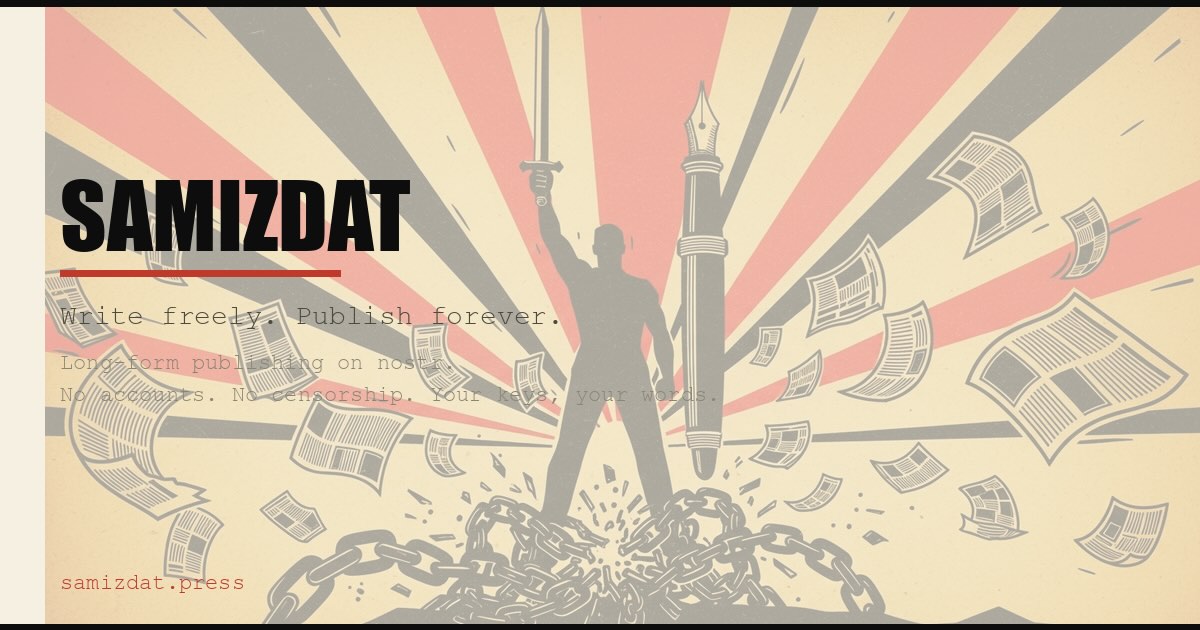
They tried this in East Germany – as well as the old Soviet Union, where there was no truth in Pravda and no news in Izvestia. What happened was the creation of an underground press – Samizdat – that published truth and heresy, which were often the same thing. The state did all it could to stamp out Samizdat, but it was effectively impossible because it was highly decentralized; anyone with the ability to write and access to paper could produce leaflets, even pamphlets.
In this way, truth and heresy spread. 
It may become necessary to go Samizdat again. Everything online is being centralized and corporatized and brought to heel by the state, often via the corporations that are becoming indistinguishable from the state. You have probably heard about proposals to mandate ID to even get online, or to be allowed to view certain conduct (this is already being done with regard to porn, which is the way they’ll get people to accept it for everything online). If they know what you’re looking at – or reading – it serves as a disincentive to look at or read it. It has a “chilling effect,” as the old saying you don’t hear much anymore goes.
Their plan is to control the online world as tightly as they once controlled the print media world – only more so, because at least in the old print media days, you did not have to show ID to buy The New York Times. They not only want to know, they want to control.
But they can’t control Samizdat.
It may prove to be the only way we can recover the freedom of speech we once had online.
. . .
If you like what you’ve found here please consider supporting EPautos.
We depend on you to keep the wheels turning!
Our donate button is here.
If you prefer not to use PayPal, our mailing address is: EPautos 721 Hummingbird Lane SE Copper Hill, VA 24079










The biggest problem with a return to print media is the cost. It costs money- a LOT of money, to print and mail print media, unless one is talking about very localized stuff intended for a specific already-cultivated audience.
For anything to reach the general public, one would be looking at some form of sponsorship- like advertising; and some sort of distribution network…which means that one would encounter the same problems one does with online media- i.e. the need to kow-tow to those who sponsor and distribute and sell.
The internet WAS a great thing in that gave virtually everyone freedom of press. We knew that couldn’t last long, and that the end game HAD to be ultimately something that effect more control and censorship…and here we are.
Thecmagazine stands are gone; the presses are largely gone. Other than leaflets and newsletters (which are really just for “the choir”), I don’t see any way to resurrect private print media. Remember, as you said, Eric, the print media was conquered before the internet even got started in earnest.
The control of information is foundational to a police state…and they’ve got that locked up tighter than a Jew’s purse.
I think it’s inevitable that print (and non-digital interface in general) will come around again.
Old school methods like leafleting will no longer work in an age of universal surveillance and AI pattern matching. Wearing a disguise to stick your samizdat leaflet on a bulletin board somewhere will be recorded and analyzed with remarkable effectiveness.
Of course it won’t be used universally, those who believe themselves chosen to rule find safety valves and controlled opposition useful. But any effective dissent and resistance can safely be snuffed out by various methods, keeping it from ever reaching critical mass.
Or so they think, the insults have been optimized until the entire populace is at a slow simmering boil, but not quite boiling over into active resistance/the troubles.
This is sort of like when the Soviets decided to slow Chernobyl way down to increase plutonium production. The universe is not predictable to any real extent, and some quantum thing will happen and the whole mess will boil over and explode.
I knew there was a reason I couldn’t stand Jordan Peterson. He may be able to debate competently, but he never actually seemed to believe what he was saying. Once he took the jab and then groveled why he had to do it I completely checked out. If one claims to be a psychologist one should have been able to see the Plandemic as the psych op that it was.
Jordan Peterson, DJ Trump, myself, and yourself all have feet of clay, human frailties and foibles.
I enjoy Jordan Peterson, I believe he would be great fun to sit and drink beer in front of a bonfire with, just like most of the patrons at EP Autos.
I found his explanation of stupidity particularly enlightening. Yes he took the shot. A tragic mistake, but if we never forgive anyone we play right into the hands of those who use our passions against us.
When he “broke out” and published his “12 Rules” book, it was a great thing for young men. If for no other reason, he’s A-OK with me.
Samizdat … or better encryption?
Samizdat is inherently local. You can hand it out, or send it first-class mail for 82 cents. It probably won’t be opened, but USPS will photograph the envelope showing the sender and addressee, thus giving Big Gov the tools to map your personal network.
Sufficiently good encryption avoids those difficulties, but introduces gnarly trust issues, as governments break into (or even sponsor) these ‘secure’ comms platforms. When you read about tech bros and ‘PTA moms’ microdosing LSD, they are acquiring it on the dark web, which seems to be too big for the authorities to fully police. Maybe that’s what AI is for.
Vanity Fair just published an explosive article about how Dutch intelligence hacked the personal iPhone of ‘Jared Kushner’ in 2017. Then they watched the screen as he logged into a $700 million slush fund disguised as an Emirati charity, over which ‘Jared’ had signature authority. These days, the true extent of official corruption is beyond comprehension.
Some have returned to old-fashioned signaling methods, straight out of the Boy Scout handbook. This week, the Houthis landed a missile on Aramco headquarters in eastern Saudi Arabia. Aramco responded publicly by sending everyone home to work remotely. Message received! 🙂